AIMING HIGHER: Results from the Commonwealth Fund Scorecard on State Health System Performance

http://www.commonwealthfund.org/interactives/2017/mar/state-scorecard/
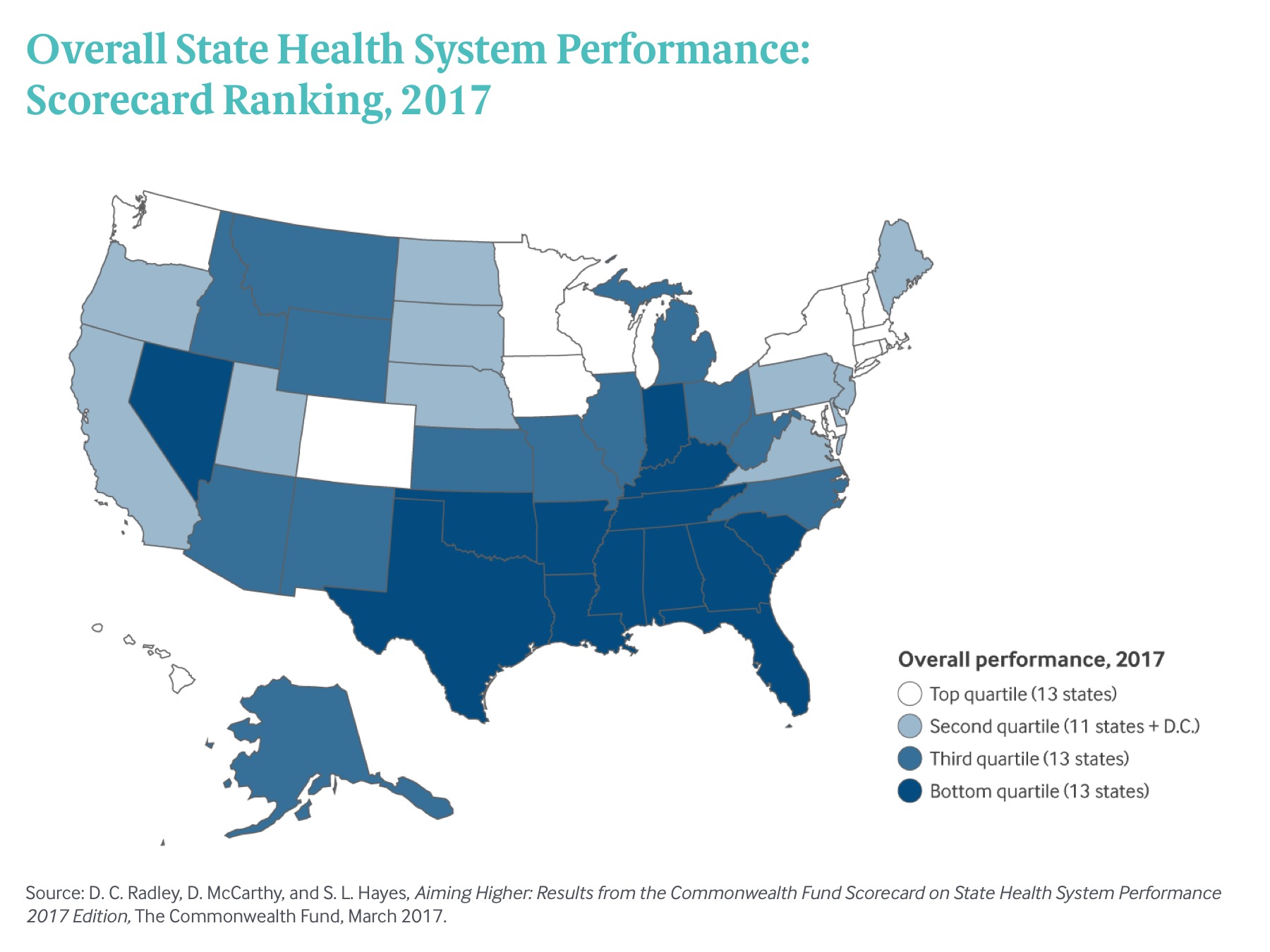
Image result for AIMING HIGHER: Results from the Commonwealth Fund Scorecard on State Health System Performance

The 2017 edition of the Commonwealth Fund Scorecard on State Health System Performance finds that nearly all state health systems improved on a broad array of health indicators between 2013 and 2015. During this period, which coincides with implementation of the Affordable Care Act’s major coverage expansions, uninsured rates dropped and more people were able to access needed care, particularly those in states that expanded their Medicaid programs. On a less positive note, between 2011–12 and 2013–14, premature death rates rose slightly following a long decline. The Scorecard points to a constant give-and-take in efforts to improve health and health care, reminding us that there is still more to be done.

Vermont was the top-ranked state overall in this year’s Scorecard, followed by Minnesota, Hawaii, Rhode Island, and Massachusetts (Exhibit 1). California, Colorado, Kentucky, New York, and Washington made the biggest jumps in ranking, with New York moving into the top-performing group for the first time. Kentucky also stood out for having improved on more measures than any other state.

Exhibit 1Exhibit 1: Overall State Health System Performance: Scorecard Ranking, 2017

Using the most recent data available, the Scorecard ranks states on more than 40 measures of health system performance in five broad areas: health care access, quality, avoidable hospital use and costs, health outcomes, and health care equity. In reviewing the data, four key themes emerged:

  • There was more improvement than decline in states’ health system performance.
  • States that expanded Medicaid saw greater gains in access to care.
  • Premature death rates crept up in almost two-thirds of states.
  • Across all measures, there was a threefold variation in performance, on average, between top- and bottom-performing states, signifying opportunities for improvement.

By 2015, fewer people in every state lacked health insurance. Across the country, more patients benefited from better quality of care in doctors’ offices and hospitals, and Medicare beneficiaries were less frequently readmitted to the hospital. The most pervasive improvements in health system performance occurred where policymakers and health system leaders created programs, incentives, or collaborations to ensure access to care and improve the quality and efficiency of care. For example, the decline in hospital readmissions accelerated after the federal government began levying financial penalties on hospitals that had high rates of readmissions and created hospital improvement innovation networks to help spread best practices. (notes)

Still, wide performance variation across states, as well as persistent disparities by race and economic status within states, are clear signals that our nation is a long way from offering everyone an equal opportunity for a long, healthy, and productive life. Looking forward, it is likely that states will be challenged to provide leadership on health policy as the federal government considers a new relationship with states in public financing of health care. To improve the health of their residents, states must find creative ways of addressing the causes of rising mortality rates while also working to strengthen primary and preventive care.


Does Health Insurance Save Lives?

http://www.medpagetoday.com/PublicHealthPolicy/HealthPolicy/66276?isalert=1&uun=g885344d5576R7095614u&xid=NL_breakingnews_2017-06-26

Data from multiple sources all point to one answer.

With multiple bills, strained markets, and CBO scores all competing for the public’s attention in the healthcare debate, some researchers are examining a presumably simple question: Does health insurance save lives? A couple of recent papers, including a review appearing Monday in Annals of Internal Medicine, prompted MedPage Today clinical reviewer F. Perry Wilson, MD, to take a look at the available data and the statistical tools used to parse them.

You may have noticed that there’s a bit of a debate going on about health insurance in this country. Reflecting the great diversity of American political life, we have those calling for a universal, single-payer healthcare system:

But in the end, there’s one question that seems to really cut through the political debate: does health insurance save lives? Multiple groups are synthesizing decades worth of data to answer that question. Last week, we saw a report co-authored by Atul Gawande and appearing in the New England Journal of Medicine that concluded:


Teaching Hospitals Cost More, but Could Save Your Life

Teaching Hospitals Cost More, but Could Save Your Life

Image result for teaching hospitals

Perhaps not evident to many patients, there are two kinds of hospitals — teaching and nonteaching — and a raging debate about which is better. Teaching hospitals, affiliated with medical schools, are the training grounds for the next generation of physicians. They cost more. The debate is over whether their increased cost is accompanied by better patient outcomes.

Teaching hospitals cost taxpayers more in part because Medicare pays them more, to compensate them for their educational mission. They also tend to command higher prices in the commercial market because the medical-school affiliation enhances their brand. Their higher prices could even cost patients more, if they are paying out of pocket.

To save money, insurers have started establishing hospital networks, and policy makers are considering ways to steer patients away from teaching hospitals. Those efforts may well save patients and taxpayers money. But how will that affect the quality of care?

One answer is provided in a new study of over 21 million hospital visits paid for by Medicare in 2012 and 2013. Teaching hospitals save lives. For every 83 elderly patients seen by a major teaching hospital, one more is alive 30 days after discharge than if those patients had been admitted to a nonteaching hospital. This is a large mortality effect.

“It’s about half the size of a breakthrough medical therapy like stenting for heart-attack patients,” said Amitabh Chandra, an economist with the Harvard Kennedy School and a longtime skeptic of the value of teaching hospitals, who wasn’t involved in this study.

“Minor” teaching hospitals — which also have educational missions but are not members of the Council of Teaching Hospitals and Health Systems — also outperformed nonteaching hospitals, but by a smaller margin.

The study, published in the Journal of the American Medical Association, adjusted for other factors that could have skewed the results, like demographics, patients’ diagnoses, hospital size and profit status. Because mortality rates differ geographically, it compared teaching with nonteaching hospitals within the same state. Even after such adjustments, it found mortality rates are lower at teaching hospitals for 11 of 15 common medical conditions and five of six major surgical conditions. The more doctors in training per bed a hospital had, the lower its mortality rate.

Given the importance of this issue, you’d think we would already know the mortality differences between teaching and nonteaching hospitals. But the seminal studies on the subject are based on data at least two decades old. Other, more recent studies focus on only a few types of patients or offer conflicting results.

“We thought the comparative performance of teaching and nonteaching hospitals was worth a fresh look because medicine has changed considerably since those older studies,” said Laura Burke, the lead author on the study and an emergency physician with the Harvard T.H. Chan School of Public Health. “And the more recent studies don’t settle the question.” (I am a co-author on the study, along with Dr. Burke and other Harvard colleagues Dhruv Khullar, E. John Orav and Ashish Jha. Dr. Khullar is also an Upshot contributor.) The study was funded by the American Association of Medical Colleges, which had no editorial control over analysis or publication.

Though the study revealed mortality differences by teaching status, it could not illuminate the cause of those differences. Perhaps teaching hospitals attract higher-quality practitioners, more closely follow best practices, or use medical technology more effectively.

Other studies suggest teaching hospitals do not offer higher quality more broadly. For example, an analysis led by Jose Figueroa, a physician with the Harvard T.H. Chan School of Public Health, found that teaching hospitals were more likely to be penalized by Medicare for low quality compared with nonteaching hospitals. Another study found teaching hospitals were more likely to be penalized for higher hospital readmission rates.

An examination of Massachusetts hospitals found comparable quality performance at teaching and nonteaching hospitals. The state has a goal — codified in a 2012 state law — of bringing health care spending growth in line with overall economic growth. The Massachusetts Health Policy Commission has highlighted the high costs of teaching hospitals as part of this effort.

The new study did not assess the cost of the benefits in mortality that teaching hospitals deliver.

“The typical teaching hospital is at least 30 percent more expensive,” Mr. Chandra said. “Is 1 percent fewer deaths worth that price?” It’s a question few like to ask, but spending more on hospital care means less for other things we value — and that are known to improve health and welfare, too — like education and nutrition programs.

About 26 percent of hospitals are teaching hospitals, accounting for just over half of all admissions. Unsure which hospitals in your area are teaching hospitals? It’s something most of them make a point of mentioning, so you can often find a hospital’s teaching status on its website. If not, an inquiry to the hospital should settle the matter. If you use one, the cost of your care will be higher, but it might save your life.

Physician Age Linked to Clinically Significant Patient Mortality Risk

http://www.healthleadersmedia.com/physician-leaders/physician-age-linked-clinically-significant-patient-mortality-risk?spMailingID=11059722&spUserID=MTY3ODg4NTg1MzQ4S0&spJobID=1161579213&spReportId=MTE2MTU3OTIxMwS2#

Image result for hospital mortality rates

The difference in mortality rates translates into one additional patient death for every 77 patients treated by physicians 60 and older, compared with those treated by doctors 40 and younger.

Patients treated by older hospitalists are somewhat more likely to die within a month of admission than patients treated by younger physicians, suggests research published this week in the BJM.

Researchers at Harvard note that the difference in mortality rates was modest yet clinically significant—10.8% among patients treated by physicians 40 and younger, compared with 12.1% among those treated by physicians 60 and older.

That translates into one additional patient death for every 77 patients treated by physicians 60 and older, compared with those treated by doctors 40 and younger.

Study lead author Anupam B. Jena, MD, a hospitalist, and associate professor of medicine at Harvard Medical School, spoke with HealthLeaders about the findings. The following is a lightly edited transcript.

South Carolina hospitals see major drop in post-surgical deaths with nation’s first proven statewide Surgical Safety Checklist program

South Carolina hospitals see major drop in post-surgical deaths with nation’s first proven statewide Surgical Safety Checklist program

Surgery

South Carolina saw a 22 percent reduction in post-surgical deaths in hospitals that completed a voluntary, statewide program to implement the World Health Organization Surgical Safety Checklist.

The findings of the five-year project between the South Carolina Hospital Association, Ariadne Labs, and Harvard T.H. Chan School of Public Health will appear in the August 2017 print issue of the Annals of Surgery and is published online. The study is the first to demonstrate large-scale population-wide impact of the checklist.

“That is a major reduction in post-surgical mortality and it demonstrates that when done right, the Surgical Safety Checklist can significantly improve patient safety at large scale,” said lead author Dr. Alex B. Haynes, associate director of the Ariadne Labs Safe Surgery Program and a surgeon at Massachusetts General Hospital.

Adoption of a safe surgery checklist has been demonstrated to reduce deaths in controlled research studies since 2009. But the ability to produce improved outcomes at large scale has remained questioned.

In the Safe Surgery South Carolina program, all hospitals in the state were invited to participate in a voluntary, statewide effort to complete a twelve-step implementation program with Ariadne Labs that included customizing the checklist for the local setting, doing small scale testing, and observing and coaching on checklist performance. Fourteen hospitals, representing nearly 40 percent of the inpatient surgery volume in the state, completed the program. Researchers compared the 30-day post-surgery mortality outcomes between these hospitals with the mortality outcomes of the rest of the hospitals in the state. Surgical procedures in the analysis represent a wide range of specialties, from neurological, thoracic and cardiac, to soft tissue and orthopedic. 

The study found that the post-surgery death rate in the 14 hospitals that completed the program was 3.38 percent in 2010 (prior to implementation) and fell to 2.84 percent in 2013 after implementation. In the other 44 hospitals in the state, mortality was 3.5 percent in 2010 and 3.71 percent in 2013. This corresponded to a 22 percent difference in mortality between the groups. 

With these results, South Carolina offers a national model of best practices in implementing a team-based, communication checklist to drive quality improvement in the operating room.

“We are honored to be a learning lab for the rest of the country,” said Thornton Kirby, President and CEO of the South Carolina Hospital Association. “The study validates what we hoped and believed from the outset if you change the operating room culture of how you communicate and coordinate your efforts, you can produce better outcomes.”

Ariadne Labs’ Executive Director Dr. Atul Gawande led the development of the WHO Surgical Safety Checklist in 2008 with a team of international experts. The 19-item checklist prompts surgical team discussion of the surgical plan, risks, and concerns. Following surgery, patients are at risk of complications and death from a variety of causes such as infection, hemorrhage, and organ failure. Collectively, the checklist items create a culture of operating room communication that improves overall surgical care and safety.

Evidence from a 2009 pilot study with selected operating teams in eight countries around the world demonstrated a 47 percent decrease in post-surgical mortality. Further studies went on to confirm the powerful effect. But translating the checklist into population-wide mortality reduction has not been proven until now.

“Safety checklists can significantly reduce death in surgery. But they won’t if surgical teams treat them as just ticking a box,” said Gawande. “With this work, South Carolina has demonstrated that surgery checklists can save lives at large scale and how hospitals can support their teams to do it.”

Funding for the study came from the Branta and Rx Foundations, AHRQ (R18:HS019631).

Patient Mortality During Unannounced Accreditation Surveys at US Hospitals

http://jamanetwork.com/journals/jamainternalmedicine/article-abstract/2610103

Image result for JCAHO Survey

Key Points

Question  What is the effect of heightened vigilance during unannounced hospital accreditation surveys on the quality and safety of inpatient care?

Findings  In an observational analysis of 1984 unannounced hospital surveys by The Joint Commission, patients admitted during the week of a survey had significantly lower 30-day mortality than did patients admitted in the 3 weeks before or after the survey. This change was particularly pronounced among major teaching hospitals; no change in secondary safety outcomes was observed.

Meaning  Changes in practice occurring during periods of surveyor observation may meaningfully improve quality of care.

Conclusions and Relevance  Patients admitted to hospitals during TJC survey weeks have significantly lower mortality than during nonsurvey weeks, particularly in major teaching hospitals. These results suggest that changes in practice occurring during periods of surveyor observation may meaningfully affect patient mortality.

Wide variation in Medicare payments to treat post-surgical complications

http://www.fiercehealthcare.com/finance/wide-variation-medicare-payments-to-treat-post-surgical-complications?utm_medium=nl&utm_source=internal&mrkid=959610&mkt_tok=eyJpIjoiWVRNelpHVmtNR1JrTmpjeiIsInQiOiIyNGJBRGJMS1pRVkRSNnFvOEhmQ2dlKzRUcmVxeWJScjVKdmpSeWVDclY3bEhRRXpobHp5Z3JvSE9ydnkycDgrNU14Y2NFeGFwRzNVWTdzRGZTRE1DUzhmZEpvZElCaVFGTVJNcnFEV0VXOD0ifQ%3D%3D

surgery

Post-operative complications are always costly. But depending on the hospital, they can cost much more than anticipated.

That’s the conclusion of researchers at the University of Michigan School of Medicine and Brigham and Women’s Hospital in Boston. The research team examined more than 576,000 Medicare patients who suffered post-surgical complications for abdominal aortic aneurysm repair, oncology-related colectomies, pulmonary resection and total hip replacements. Complication rates ranged from 4.9 percent for the hip replacements to 25.1 percent for the colectomies.

Prior research has suggested that higher-volume facilities tend to have better outcomes and associated lower costs.

The cost of delivering care for the post-surgery complications was anywhere from two to three times higher at more expensive hospitals than at lower-cost facilities, with quality of care often suffering in comparison, according to their study, which was published in JAMA Surgery.

Could It Be Sepsis? C.D.C. Wants More People to Ask

Between one million and three million Americans are given diagnoses of sepsis each year, and 15 percent to 30 percent of them will die, Dr. Frieden said. Sepsis most commonly affects people over 65, but children are also susceptible. According to one estimate, more than 42,000 children develop sepsis in the United States every year, and 4,400 die.

Sepsis develops when the body mounts an overwhelming attack against an infection that can cause inflammation in the entire body. When that happens, the body undergoes a cascade of changes, including blood clots and leaky blood vessels that impede blood flow to organs. Blood pressure drops, multiple organs can fail, the heart is affected, and death can result.

“Your body has an army to fight infections,” said Dr. Jim O’Brien, the chairman of Sepsis Alliance. “With sepsis, your body starts suffering from friendly fire.”

Sepsis appears to be rising. The rate of hospitalizations that listed sepsis as the primary illness more than doubled between 2000 and 2008, according to a 2011 C.D.C. study, which attributed the increase to factors like the aging of the population, a rise in antibiotic resistance and, to some extent, better diagnosis.

Sepsis is a contributing factor in up to half of all hospital deaths, but it’s often not listed as the cause of death because it often develops as a complication of another serious underlying disease like cancer. So although death certificates list sepsis as a cause in 146,000 to 159,000 deaths a year, a recent report estimated that it could play a role in as many as 381,000.

Yet advocacy organizations say many Americans have never heard of sepsis and don’t know the signs and symptoms.

Hospital Readmissions are Not the Enemy

http://www.healthleadersmedia.com/quality/hospital-readmissions-are-not-enemy?spMailingID=9540993&spUserID=MTMyMzQyMDQxMTkyS0&spJobID=1001565259&spReportId=MTAwMTU2NTI1OQS2

PostHospitalSyndromePostHospitalSyndromePostHospitalSyndrome

The Centers for Medicare & Medicaid Services has all but declared war on readmissions. But one researcher suggests that the relationship between readmission rates and quality is flawed.

The Life-Changing Magic of Choosing the Right Hospital

There’s an exceedingly simple way to get better health care: Choose a better hospital. A recent study shows that many patients have already done so, driving up the market shares of higher-quality hospitals.

A great deal of the decrease in deaths from heart attacks over the past two decades can be attributed to specific medical technologies like stents and drugs that break open arterial blood clots. But a study by health economists at Harvard, M.I.T., Columbia and the University of Chicago showed that heart attack survival gains from patients selecting better hospitals were significant, about half as large as those from breakthrough technologies.

That’s a big improvement for nothing more than driving a bit farther to a higher-quality hospital.