Infection Lapses Rampant In Nursing Homes But Punishment Is Rare

https://khn.org/news/infection-lapses-rampant-in-nursing-homes-but-punishment-is-rare/

Image result for Infection Lapses Rampant In Nursing Homes But Punishment Is Rare


A Kaiser Health News analysis of federal inspection records shows that nursing home inspectors labeled mistakes in infection control as serious for only 161 of the 12,056 homes they have cited since 2014.

Basic steps to prevent infections — such as washing hands, isolating contagious patients and keeping ill nurses and aides from coming to work — are routinely ignored in the nation’s nursing homes, endangering residents and spreading hazardous germs.

A Kaiser Health News analysis of four years of federal inspection records shows 74 percent of nursing homes have been cited for lapses in infection control — more than for any other type of health violation. In California, health inspectors have cited all but 133 of the state’s 1,251 homes.

Although repeat citations are common, disciplinary action such as fines is rare: Nationwide, only one of 75 homes found deficient in those four years has received a high-level citation that can result in a financial penalty, the analysis found.

“The facilities are getting the message that they don’t have to do anything,” said Michael Connors of California Advocates for Nursing Home Reform, a nonprofit in San Francisco. “They’re giving them low-level warnings year after year after year and the facilities have learned to ignore them.”

Infections, many avoidable, cause a quarter of the medical injuries Medicare beneficiaries experience in nursing homes, according to a federal report. They are among the most frequent reasons residents are sent back to the hospital. By one government estimate, health care-associated infections may result in as many as 380,000 deaths each year.

The spread of methicillin-resistant Staphylococcus aureus (MRSA) and other antibiotic-resistant germs has become a major public health issue. While Medicare has begun penalizing hospitals for high rates of certain infections, there has been no similar crackdown on nursing homes.

As average hospital stays have shortened from 7.3 days in 1980 to 4.5 days in 2012, patients who a generation ago would have fully recuperated in hospitals now frequently conclude their recoveries in nursing homes. Weaker and thus more susceptible to infections, some need ventilators to help them breathe and have surgical wounds that are still healing, two conditions in which infections are more likely.

“You’ve got this influx of vulnerable patients but the staffing models are still geared more to the traditional long-stay resident,” said Dr. Nimalie Stone, the CDC’s medical epidemiologist for long-term care. “The kind of care is so much more complicated that facilities need to consider higher staffing.”

The Centers for Medicare & Medicaid Services (CMS), which oversees inspections, has recognized that many nursing homes need to do more to combat contagious bugs. CMS last year required long-term care facilities to put in place better systems to prevent infections, detect outbreaks early on and limit unnecessary use of antibiotics through a stewardship program.

But the agency does not believe it has skimped on penalties. CMS said in a statement that most infection-control violations have not justified fines because they did not put residents in certain danger. For instance, if an inspector observed a nurse not washing his or her hands while caring for a resident, the agency said that would warrant a lower-level citation “unless there was an actual negative resident outcome, or there was likelihood of a serious resident outcome.”


Hospital floors, sinks pose deadly infection risks

http://www.fiercehealthcare.com/healthcare/studies-hospital-floors-sinks-pose-infection-risk?utm_medium=nl&utm_source=internal&mrkid=959610&mkt_tok=eyJpIjoiWkRjeU1tTTFPVEUyTjJaaCIsInQiOiJBNGU4aWlDQkpcL3l6eURqQUMyR2w3aVFtNStxVzBraUpQcTVOamQ4SVNEVUNDeXFQQ1RDWG5qdmptMjI4VWpiVTdHUDltN0ZTMG5ObWlHOWl0cXRmVEpjQ0h2bFU1NXJKM2YzaHBrcnc2VlVJVkoyTHJrQjBndGI5b3BGWmdJV1oifQ%3D%3D

hospital hallway

Hospital floors and sinks may pose infection risks, ones that could be overlooked when trying to control the spread of disease.

The floors in patient rooms may be contaminated by bacteria like methicillin-resistant Staphylococcus aureus (MRSA) or Clostridium difficile, according to a new study published in the American Journal of Infection Control. These pathogens, which can cause potentially deadly infections, can be spread when items are dropped on the floor, the researchers noted.

The research team swabbed a number of surfaces, including the floors, clothing, call-buttons and other high-touch items, in 159 rooms at five Cleveland hospitals, according to the study. The study included C. difficile-isolated rooms, and researchers found floors were often tainted by bacteria, most commonly with MRSA, C. difficile and vancomycin-resistant enterococci (VRE). The researchers also found that in 41% of these rooms, at least one high-touch object came in contact with the floor.

The study team said it hopes the results bring more attention to the infection risk posed by floors, which are not often considered in the conversation on infection control.

“Although healthcare facility floors are often heavily contaminated, limited attention has been paid to disinfection of floors because they are not frequently touched,” lead study author Abhishek Deshpande, M.D., Ph.D., an internal medicine physician for the Cleveland Clinic, said in an announcement. The results of our study suggest that floors in hospital rooms could be an underappreciated source for dissemination of pathogens and are an important area for additional research.”

Another recent study noted that hospital sinks may frequently host drug-resistant superbugs like MRSA or VRE. The research, which was published in Applied and Environmental Microbiology, set up five identical sinks in a lab that replicated sinks at the University of Virginia’s hospital in Charlottesville. The researchers then contaminated the sinks with E. coli bacteria, and though colonization began in drain pipes, it inched toward sink strainers before water spread it in the sink.

“This type of foundational research is needed to understand how these bacteria are transmitted, so that we can develop and test potential intervention strategies that can be used to prevent further spread,” Amy Mathers, M.D., an associate professor of medicine at pathology at University of Virginia, told HealthDay.

No one knows how many patients are dying from superbug infections in California hospitals

http://www.latimes.com/business/la-fi-torrance-memorial-infections-20161002-snap-story.html?utm_campaign=KHN%3A+First+Edition&utm_source=hs_email&utm_medium=email&utm_content=35220326&_hsenc=p2ANqtz–q48_nyJSgCl8xVrBEwT6GLi1L5uwbL-wFLD1CzsDaqKwJvA7Gvbnan0dOU4uApCaA6Nc4bjRnR-iXNQlJtbH0Z6T0mA&_hsmi=35220326

Sharley McMullen's death certificate says she died from respiratory failure and septic shock caused by her ulcer.

We, the community of physicians, had been watching these patients die and trundling them off to the morgue for years.— Dr. Barry Farr, former president, Society for Healthcare Epidemiology of America

‘Superbug’ scourge spreads as U.S. fails to track rising human toll

http://www.reuters.com/investigates/special-report/usa-uncounted-surveillance/

Fifteen years after the U.S. declared drug-resistant infections to be a grave threat, the crisis is only worsening, a Reuters investigation finds, as government agencies remain unwilling or unable to impose reporting requirements on a healthcare industry that often hides the problem.

http://www.healthleadersmedia.com/quality/hidden-toll-drug-resistant-superbugs-0?spMailingID=9540993&spUserID=MTMyMzQyMDQxMTkyS0&spJobID=1001565259&spReportId=MTAwMTU2NTI1OQS2#


The Ultimate Battle Against MRSA

http://www.wsj.com/articles/the-ultimate-battle-against-mrsa-1473699288

An electron micrograph image of Methicillin-resistant Staphylococcus aureus, or MRSA (the purple spheres).

Hospitals give ICU patients germ-killing baths and antibiotic nose ointment upon admission

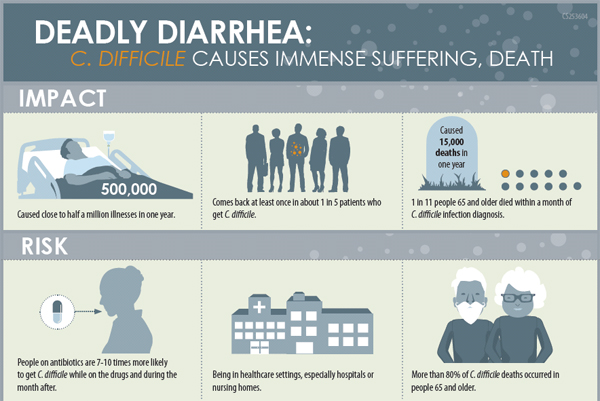
C. Diff: Deadly Infection on the Rise in U.S. Hospitals

http://www.consumerreports.org/doctors-hospitals/c-diff-deadly-infection-on-rise-us-hospitals/

C. Diff. Image: Washing hands with soap.

Drug-resistant superbugs: CDC urges three-pronged attack to fight HAIs

http://www.fiercehealthcare.com/story/drug-resistant-superbugs-cdc-urges-three-pronged-attack-fight-hais/2016-03-04?utm_medium=nl&utm_source=internal&mkt_tok=3RkMMJWWfF9wsRons6%2FOde%2FhmjTEU5z14ukkX6a2lMI%2F0ER3fOvrPUfGjI4DSsdiNK%2BTFAwTG5toziV8R7LMKM1ty9MQWxTk

Reports 1 in 7 catheter and surgery-related infections are caused by 1 of 6 bacteria resistant to antibiotics

Hospital Infection Rates Are On The Downslide (With One Troubling Exception)

Hospital Infection Rates Are On The Downslide (With One Troubling Exception)

C-Diff

Superbug threat prompts West to revisit Soviet-era virus therapy

http://www.reuters.com/article/2015/07/02/us-health-bacteriophages-insight-idUSKCN0PC1FO20150702

Two plates coated with drug-resistant bacteria with a mutation called NDM 1 and then exposed to various antibiotics are seen at the Health Protection Agency in north London, Britain in this March 9, 2011 file photo. REUTERS/Suzanne Plunkett/Files

Two plates coated with drug-resistant bacteria with a mutation called NDM 1 and then exposed to various antibiotics are seen at the Health Protection Agency in north London, Britain in this March 9, 2011 file photo.