
The Three Types of Workplace Courage

http://www.leadershipdigital.com/edition/weekly-innovation-management-2019-05-11?open-article-id=10478094&article-title=the-three-types-of-workplace-courage&blog-domain=leadershipnow.com&blog-title=leading-blog

Three Types of Workplace Courage

COURAGE IS THE FIRST VIRTUE of organizational performance. Consider, for example, all the other concepts that courage connects to in workplace settings. Leadership takes courage because it requires making bold decisions that some people won’t agree with or support. Innovation takes courage because it requires creating ideas that are ground-breaking and tradition-defying; great ideas always start out as blasphemy! And sales always take courage because it requires knocking on the doors of prospects over and over in the face of rejection. These aspects of work simply can’t exist in the absence of courage.

That’s why it’s crucial to instill courage in those you lead, both in their development and training programs, but also by leading by example. There’s a lot you can do as a leader toward this end: rewarding jumping first, creating safety nets to make trying and failing a palatable option, teaching to harness fear, and modulating comfort levels are all management tools for setting a foundation that supports and encourages courageous behavior. But while courage in the abstract is an easy thing to get behind, in practice it’s more useful to break it down into different types of courage. Having a way of categorizing courageous behavior allows you to pinpoint the exact type of courage that each individual worker may be most in need of building.

I think of courage as falling into three distinct buckets: TRY, TRUST, and TELL Courage. Let’s talk about each.

TRY Courage

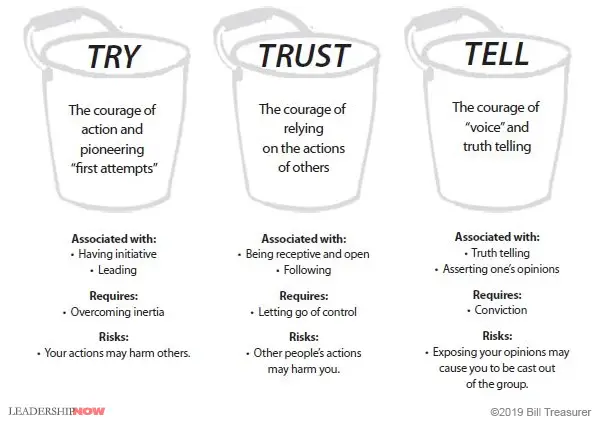
The first bucket of courage is TRY Courage. TRY Courage is the courage of action. It is the courage of initiative. TRY Courage requires you to exert energy in order to overcome inertia. Certainly, it is easier not to do something than to do it, which is one reason why many people prefer to stay in their “comfort zones.” It takes courage to TRY something, particularly when you’ve not done it before. This is the kind of courage that’s demonstrated when someone “steps up to the plate,” for example, taking on a project on which others have failed. You experience your TRY Courage whenever you must attempt something for the very first time, as when you cross over a threshold that other people may have already crossed over.

The courage of try is associated with:

  • “Stepping up to the plate,” such as volunteering for a leadership role.
  • First attempts; for example, the first time you lead an important strategic initiative for the company.
  • Pioneering efforts, such as leading an initiative that your organization has never done before.
  • Taking action.

All courage buckets come with a risk, and the risk is what causes people to avoid behaving with courage. The risk associated with TRY Courage is that your courageous actions may harm you, and, perhaps more importantly, other people. If you act on the risk and wipe out, not only are you likely to be hurt, but you could also potentially harm those around you. It is the risk of harming yourself or others that most commonly causes people to avoid exercising their TRY Courage.

TRUST Courage

TRUST Courage involves resisting the temptation to control other people. Unlike TRY Courage, TRUST Courage is not about action. Instead it often involves inaction, or “letting go” of the need to control. With TRUST Courage, you step back and follow the lead of others. A common example of TRUST Courage is delegation. TRUST Courage is very hard for people who tend to be controlling and those who have been burned by trusting people in the past. TRUST Courage, though, is a crucial element in building strong bonds between people.

The courage of trust is associated with:

  • Releasing control, such as delegating a task without hovering over the person to whom you’ve delegated.
  • Following the lead of others, such as letting a direct report facilitate your meeting.
  • Presuming positive intentions and giving team members the benefit of the doubt.

TRUST Courage, of course, comes with a risk. The risk associated with TRUST Courage isn’t that you will harm other people, but that by trusting them, they might harm you. By trusting others, you open yourself up to the possibility of your trust being misused. Thus, many people, especially those who have been betrayed in the past, find offering people trust very difficult. For them, entrusting others is an act of courage.

TELL Courage

The third bucket of courage is TELL Courage, which is the courage of voice. TELL Courage is what is needed to tell the truth, regardless of how difficult that truth may be for others to hear. It is the courage to not bite your tongue when you feel strongly about something. Brown-nosing and people pleasing are symptoms of low TELL Courage. TELL Courage requires independence of thought. We also use our TELL Courage when we take responsibility for a mistake or offer an apology. Whenever we speak up and say what’s hard to say, whether it be speaking truth to power, admitting a mistake, or saying “I’m sorry,” we are using TELL Courage.

The courage of TELL is associated with:

  • Speaking up and asserting yourself when you feel strongly about an issue.
  • Telling the truth, regardless of where the person to whom you are telling the truth resides in the organizational hierarchy, such as presenting an idea to your boss’s boss.
  • Using constructive confrontation, such as providing difficult feedback to a peer, direct report, or boss.
  • Admitting mistakes and saying, “I am sorry.”

TELL Courage can be scary and comes with risks too. We avoid using TELL Courage because we don’t want to offend others and fear being cast out of the group. The need for affiliation with those we work with is very strong, and the risk of TELL Courage is that, by speaking up and asserting ourselves, we will be cast out of the group and won’t “belong” anymore.

Courage is Contagious

Understanding (and influencing) courageous behavior requires that you be well versed in the different ways that people behave when their courage is activated. By acting in a way that demonstrates these different types of courage, and by fostering an environment that encourages them, you can make your company culture a courageous one where employees innovate and grow both personally and professionally. Here’s a handy diagram to remind you of these types of courage and what they require:
Courage is Contagious


THE SINGLE BIGGEST FACTOR IN LONG-TERM ORGANIZATIONAL SUCCESS

The Single Biggest Factor in Long-Term Organizational Success

“What ultimately constrains the performance of your organization is not its business model, nor its operating model, but its management model.” (The Future of Management, Gary Hamel)

Factors of organizational success:

Jim Collins says the key factors for success include:

  1. Getting the right people on the bus
  2. Getting the right people in the right seats.
  3. Getting the wrong people off the bus.
  4. Level 5 leadership – Humble leaders with indomitable will. (Good to Great)

Managers:

“Gallup finds that the quality of managers and team leaders is the single biggest factor in your organization’s long-term success.” (It’s the Manager)

Organizations ask, “How do managers get more out of people?”

“Ironically, the management model encapsulated in this question virtually guarantees that a company will never get the best out of its people. Vassals and conscripts may work hard, but they don’t work willingly.” Gary Hamel

Boss to coach:

The BEST managers are coaches, not bosses. Jim Clifton and Jim Harter say there are three requirements of coaching.

  1. Establish expectations.
  2. Continually coach.
  3. Create accountability.

3 tips for shifting from boss to coach:

#1. Understand the dance between freedom and intervention.

Give high performers freedom. Intervene when performance lags.

Intervention isn’t oppression or punishment. It might mean weekly one-on-ones, instead of monthly.

#2. Overcome the most difficult shift.

Solving problems for talented people devalues their talent. Over-helpfulness sucks the life out of talented people. Stop giving quick answers.

Coaches help people find their own answers. The old style of management, when people were tools, is to give them answers and expect conformity.

#3. Practice accountability that energizes people.

Accountability that energizes is self-imposed. We need to rise above the false notion that we can force people into high performance.

Noticing is healthy accountability. Walk around noticing performance as it relates to expectation.

Work that isn’t noticed goes down in value.

What factors enhance long-term organizational success?

How might managers bring out the best in people?


Take off your clothes?

https://interimcfo.wordpress.com/2018/08/30/take-off-your-clothes/

Image result for organizational culture


Abstract:  This article takes a look at the role of culture in organizational performance.

It has been a while since I have written for my blog.   I’ve been a little busy on an engagement that has taken a lot of my time.   One of the most challenging aspects of working with organizations in transition is dealing with culture.   I have written a lot about culture in my blog and it continues to be one of the most vexing aspects of leadership and Interim Executive Consulting.    The following story is true and it happened almost spontaneously.   I now use this experience to make a point that people will remember about how they allow their cultural limitations to limit their capability.

I was listening to a group of managers debating the hospital’s preparedness for a regulatory survey.   Concern was being expressed about the fact that there were multiple known deviations from standards.   The longer I listened to this, the more frustrated I became.   At the breaking point of my patience, I stood up and said, “OK, that’s enough.”  “Everyone in the room, take off your clothes.”  The shock and awe were palpable.   People sat staring at me as they tried to comprehend what they had just heard.   I said, “I’m serious.   Everyone.   Take off your clothes right now.”  My audience was dumbfounded.   I suspect some of them were wondering if the psychiatrist was in the building.

I said, “Let me ask you folks a question.   If I continue to press this point, my prediction is that at least one of you will take the position that you will not take off your clothes.   You will refuse to do this because you have modesty, morals, ethics, decency and or religious convictions upon which you will base your refusal.”  My question was, “If you have standards that prevent you from taking your clothes off when all that is involved is a simple violation of modesty, how do you rationalize having knowledge of regulatory deficiencies in your areas of responsibility and not having done enough to resolve them when patient safety may be compromised?”  Remember the movie, ‘A Few Good Men?’  Tom Cruise asked, “Can you explain this?”

And so, I had another head-on collision with entrenched dysfunctional culture.   Several years ago, I had the privilege of doing work with Northside Hospital in Atlanta.   Northside’s culture as it relates to regulatory compliance is very simple:  Every department is expected to operate 100% compliant with applicable standards 100% of the time.   As a result, a compliance survey is or should be a non-event at Northside.   This is dramatically different from the culture in other hospitals I have worked in that go through episodes of horror when they are in the survey window and word comes that surveyors have been spotted in the next town.   These hospitals have a culture that says it is OK to have a laissez-fair attitude and approach toward regulatory compliance until they think they might be surveyed.  Then there is a mad rush to get into compliance.

I told the leadership team that the Board of Trustees had decided to commit the hospital to applicable accreditation standards.   Therefore, the question as to whether or not managers are expected to follow regulations is off the table.   Anyone that does not agree with this position of the Board should ‘punch the clock and get over the hill,’ as my dad would say.   I went on to tell the group that in deciding to comply with regulatory standards, the Board had a reasonable right to expect that the standards were being followed on a continuous basis and not just when the hospital was in the survey window.

I told the group that I needed a volunteer, someone that could explain to the Board if the survey turned out as bad as they predicted, how the organization had developed a culture of tolerance of areas of non-compliance with so many standards.   To my chagrin, I did not get a volunteer.   I told the group that this depressed me so much that I was going to go to the store, buy a bottle of wine and drink the whole thing, I was then going to bring the bottle back to the next meeting and use it to play spin the bottle to determine who the spokesman from the group to the Board would be.  I then exited the room.

Over the next couple of weeks, the leadership team of the organization responded admirably.   There was no need to go back to the meeting to play spin the bottle.   Every manager of every department went to work, around the clock in some cases to bring their areas into compliance with regulations.   Sure enough, in less than two weeks, the surveyors showed up.   The hospital had one of the best if not the best surveys in its history.

Was this result due to me making a speech?  I don’t think so.   All I did was challenge the hypocrisy of a dysfunctional culture that in some cases could potentially jeopardize patient safety.   What changed was that a group of managers decided independently that they were no longer going to be associated with substandard compliance in their areas of responsibility.   There is a one-liner that states that “You don’t have to move all of the cattle to change the direction of a herd.   All you have to do is to change the direction of the lead steer.”  Peer influence in an organization is extremely powerful.   This is what led me to redefine my own  understanding of the word ‘culture.’  Webster defines culture as the beliefs, customs, arts, etc., of a particular society, group, place, or time: a particular society that has its own beliefs, ways of life, art, etc.: a way of thinking, behaving, or working that exists in a place or organization.   I define culture as the lowest level of excellence a group will accept as tolerable and normal.   Groups in my experience do a very good job of enforcing the culture of the organization on their peers for better or worse.   When a group decides to hold itself to a higher level of performance or rejects the mediocrity that has held it back, its performance improves measurably.

So, I conclude with questions for you.   To what degree are you being limited by the culture that is surrounding you in your present situation?  What are you doing to change the culture?  Do you have the support you need to get the culture from where it is to where it needs to be?

Remember my challenge to take off your clothes.   Give some thought to where you will draw the line when it comes to the level of mediocrity you will accept and tolerate.

Please feel free to contact me to discuss any questions or observations you might have about these blogs or interim executive services in general.  As the only practicing Interim Executive that has done a dissertation on Interim Executive Services in healthcare in the U.S., I might have an idea or two that might be valuable to you.  I can also help with career transitions or career planning.

The easiest way to keep abreast of this blog is to become a follower.  You will be notified of all updates as they occur.  To become a follower, just click the “Following” link or bubble that usually appears near the bottom of this web page.

There is a comment section at the bottom of each blog page.  Please provide input and feedback that will help me to improve the quality of this work.

If you would like to discuss any of this content or ask questions, I may be reached at ras2@me.com.  I look forward to engaging in productive discussion with anyone that is a practicing interim executive or a decision maker with experience engaging interim executives in healthcare.