The healthiest and unhealthiest states in America: Where did your state rank for 2018?

https://www.beckershospitalreview.com/rankings-and-ratings/the-healthiest-and-unhealthiest-states-in-america-where-did-your-state-rank-for-2018.html?origin=rcme&utm_source=rcme

Image result for state health assessment


Hawaii reclaimed its title as the healthiest state in United Health Foundation’s 29th annual America’s Health Rankings report, which placed Louisiana as the least healthy state in the nation.

The report is the longest-running annual assessment of the nation’s health on a state-by-state basis from United Health Foundation, an arm of UnitedHealth Group.

Here are seven takeaways from the latest 188-page report, which calculates state health by analyzing five categories: health outcomes, health behaviors, community and environment, policy and clinical care. (Specific information on ranking methodology can be found here.)

1. The five healthiest states in the U.S. are Hawaii (No. 1), Massachusetts, Connecticut, Vermont and Utah, in ascending order. These same states ranked among the top five in 2017.

2. The five states with the most room for improvement are Arkansas (No. 46), Oklahoma, Alabama, Mississippi and Louisiana, in ascending order. Last year, Mississippi ranked as the least healthy state.

3. Maine experienced the greatest improvement in the past year, moving up seven spots from No. 23 to No. 16. Maine saw the most improvement in the categories of health behaviors and community and environment measures, with specific progress in smoking and the rate of children in poverty.

4. California and North Dakota each climbed five spots to the No. 12 and No. 13 ranks, respectively.

5. Oklahoma saw the greatest decline in rank, falling four places from No. 43 to No. 47. The downturn was largely driven by changes in health behaviors in the past year, including an 11 percent uptick in obesity rates and a 14 percent uptick in physical inactivity.

6. The report highlights some major setbacks for health of Americans. More are dying prematurely than in prior years, and suicide, drug deaths, occupational fatalities and cardiovascular deaths all increased. Obesity increased nationally and in all 50 states since 2017. The report also finds self-reported frequent mental distress and frequent physical distress increased in the past two years.

7. At the same time, several improvements are worth noting. The number of mental health providers per 100,000 population increased 8 percent since 2017, and the percentage of children in poverty decreased 6 percent in the same time frame. Stark differences by state still exist, however.

Here are the overall health rankings for each state in 2018. The full report contains breakdowns of the determinants for each state’s rank.

  1. Hawaii
  2. Massachusetts
  3. Connecticut
  4. Vermont
  5. Utah
  6. New Hampshire
  7. Minnesota
  8. Colorado
  9. Washington
  10. New York
  11. New Jersey
  12. California
  13. North Dakota
  14. Rhode Island
  15. Nebraska
  16. Idaho
  17. Maine
  18. Iowa
  19. Maryland
  20. Virginia
  21. Montana
  22. Oregon
  23. Wisconsin
  24. Wyoming
  25. South Dakota
  26. Illinois
  27. Kansas
  28. Pennsylvania
  29. Florida
  30. Arizona
  31. Delaware
  32. Alaska
  33. North Carolina
  34. Michigan
  35. New Mexico
  36. Nevada
  37. Texas
  38. Missouri
  39. Georgia
  40. Ohio
  41. Indiana
  42. Tennessee
  43. South Carolina
  44. West Virginia
  45. Kentucky
  46. Arkansas
  47. Oklahoma
  48. Alabama
  49. Mississippi
  50. Louisiana

Click to access ahrannual-2018.pdf
 

AIMING HIGHER: Results from the Commonwealth Fund Scorecard on State Health System Performance

http://www.commonwealthfund.org/interactives/2017/mar/state-scorecard/

Image result for AIMING HIGHER: Results from the Commonwealth Fund Scorecard on State Health System Performance

The 2017 edition of the Commonwealth Fund Scorecard on State Health System Performance finds that nearly all state health systems improved on a broad array of health indicators between 2013 and 2015. During this period, which coincides with implementation of the Affordable Care Act’s major coverage expansions, uninsured rates dropped and more people were able to access needed care, particularly those in states that expanded their Medicaid programs. On a less positive note, between 2011–12 and 2013–14, premature death rates rose slightly following a long decline. The Scorecard points to a constant give-and-take in efforts to improve health and health care, reminding us that there is still more to be done.

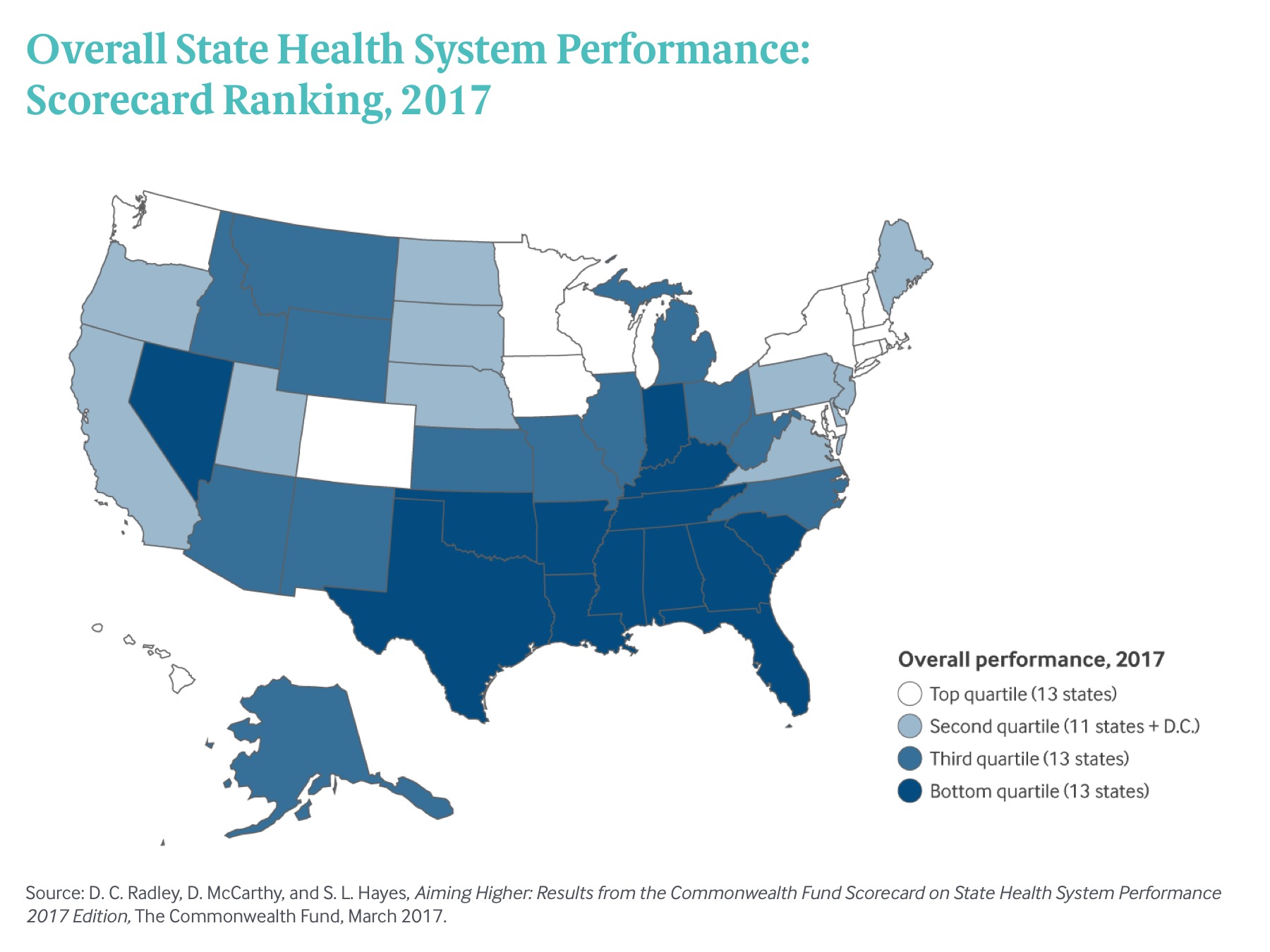
Vermont was the top-ranked state overall in this year’s Scorecard, followed by Minnesota, Hawaii, Rhode Island, and Massachusetts (Exhibit 1). California, Colorado, Kentucky, New York, and Washington made the biggest jumps in ranking, with New York moving into the top-performing group for the first time. Kentucky also stood out for having improved on more measures than any other state.

Exhibit 1Exhibit 1: Overall State Health System Performance: Scorecard Ranking, 2017

Using the most recent data available, the Scorecard ranks states on more than 40 measures of health system performance in five broad areas: health care access, quality, avoidable hospital use and costs, health outcomes, and health care equity. In reviewing the data, four key themes emerged:

  • There was more improvement than decline in states’ health system performance.
  • States that expanded Medicaid saw greater gains in access to care.
  • Premature death rates crept up in almost two-thirds of states.
  • Across all measures, there was a threefold variation in performance, on average, between top- and bottom-performing states, signifying opportunities for improvement.

By 2015, fewer people in every state lacked health insurance. Across the country, more patients benefited from better quality of care in doctors’ offices and hospitals, and Medicare beneficiaries were less frequently readmitted to the hospital. The most pervasive improvements in health system performance occurred where policymakers and health system leaders created programs, incentives, or collaborations to ensure access to care and improve the quality and efficiency of care. For example, the decline in hospital readmissions accelerated after the federal government began levying financial penalties on hospitals that had high rates of readmissions and created hospital improvement innovation networks to help spread best practices. (notes)

Still, wide performance variation across states, as well as persistent disparities by race and economic status within states, are clear signals that our nation is a long way from offering everyone an equal opportunity for a long, healthy, and productive life. Looking forward, it is likely that states will be challenged to provide leadership on health policy as the federal government considers a new relationship with states in public financing of health care. To improve the health of their residents, states must find creative ways of addressing the causes of rising mortality rates while also working to strengthen primary and preventive care.