
5-Hour Rule: If you’re not spending 5 hours per week learning, you’re being irresponsible

View at Medium.com

“In my whole life, I have known no wise people (over a broad subject matter area) who didn’t read all the time — none. Zero.”
— Charlie Munger, Self-made billionaire & Warren Buffett’s longtime business partner

Why did the busiest person in the world, former president Barack Obama, read an hour a day while in office?

Why has the best investor in history, Warren Buffett, invested 80% of his time in reading and thinking throughout his career?

Why has the world’s richest person, Bill Gates, read a book a week during his career? And why has he taken a yearly two-week reading vacation throughout his entire career?

Why do the world’s smartest and busiest people find one hour a day for deliberate learning (the 5-hour rule), while others make excuses about how busy they are?

What do they see that others don’t?

The answer is simple: Learning is the single best investment of our time that we can make. Or as Benjamin Franklin said, “An investment in knowledge pays the best interest.”

This insight is fundamental to succeeding in our knowledge economy, yet few people realize it. Luckily, once you do understand the value of knowledge, it’s simple to get more of it. Just dedicate yourself to constant learning.

Knowledge is the new money

“Intellectual capital will always trump financial capital.” — Paul Tudor Jones, self-made billionaire entrepreneur, investor, and philanthropist

We spend our lives collecting, spending, lusting after, and worrying about money — in fact, when we say we “don’t have time” to learn something new, it’s usually because we are feverishly devoting our time to earning money, but something is happening right now that’s changing the relationship between money and knowledge.

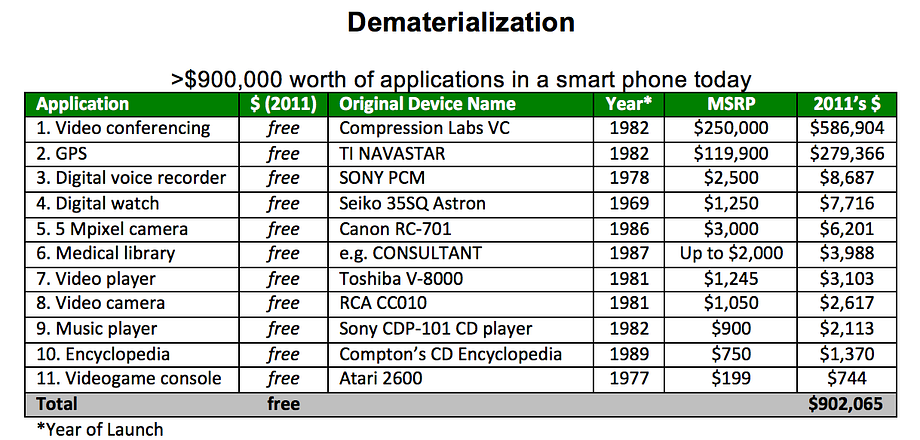
We are at the beginning of a period of what renowned futurist Peter Diamandis calls rapid demonetization, in which technology is rendering previously expensive products or services much cheaper — or even free.

This chart from Diamandis’ book Abundance shows how we’ve demonetized $900,000 worth of products and services you might have purchased between 1969 and 1989.
This demonetization will accelerate in the future. Automated vehicle fleets will eliminate one of our biggest purchases: a car. Virtual reality will make expensive experiences, such as going to a concert or playing golf, instantly available at much lower cost. While the difference between reality and virtual reality is almost incomparable at the moment, the rate of improvement of VR is exponential.

While education and health care costs have risen, innovation in these fields will likely lead to eventual demonetization as well. Many higher educational institutions, for example, have legacy costs to support multiple layers of hierarchy and to upkeep their campuses. Newer institutions are finding ways to dramatically lower costs by offering their services exclusively online, focusing only on training for in-demand, high-paying skills, or having employers who recruit students subsidize the cost of tuition.

Finally, new devices and technologies, such as CRISPR, the XPrize Tricorder, better diagnostics via artificial intelligence, and reduced cost of genomic sequencing will revolutionize the healthcare system. These technologies and other ones like them will dramatically lower the average cost of healthcare by focusing on prevention rather than cure and management.

While goods and services are becoming demonetized, knowledge is becoming increasingly valuable.

The central event of the twentieth century is the overthrow of matter. In technology, economics, and the politics of nations, wealth in the form of physical resources is steadily declining in value and significance. The powers of mind are everywhere ascendant over the brute force of things.” —George Gilder (technology thinker)

Perhaps the best example of the rising value of certain forms of knowledge is the self-driving car industry. Sebastian Thrun, founder of Google X and Google’s self-driving car team, gives the example of Uber paying $700 million for Otto, a six-month-old company with 70 employees, and of GM spending $1 billion on their acquisition of Cruise. He concludes that in this industry, “The going rate for talent these days is $10 million.”

That’s $10 million per skilled worker, and while that’s the most stunning example, it’s not just true for incredibly rare and lucrative technical skills. People who identify skills needed for future jobs — e.g., data analyst, product designer, physical therapist — and quickly learn them are poised to win.

Those who work really hard throughout their career but don’t take time out of their schedule to constantly learn will be the new “at-risk” group. They risk remaining stuck on the bottom rung of global competition, and they risk losing their jobs to automation, just as blue-collar workers did between 2000 and 2010 when robots replaced 85 percent of manufacturing jobs.

Why?
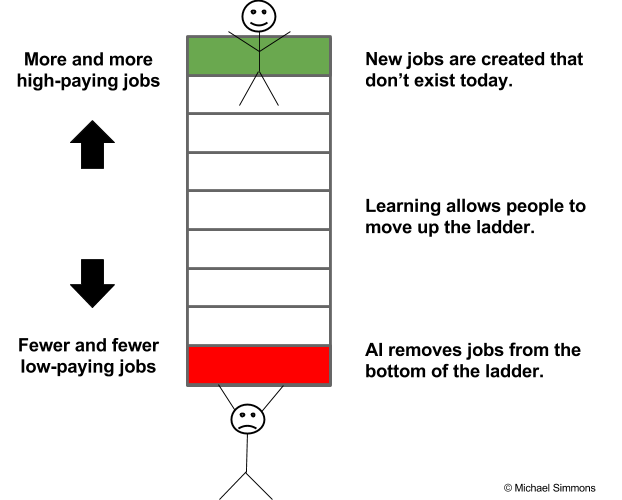
People at the bottom of the economic ladder are being squeezed more and compensated less, while those at the top have more opportunities and are paid more than ever before. The irony is that the problem isn’t a lack of jobs. Rather, it’s a lack of people with the right skills and knowledge to fill the jobs.

An Atlantic article captures the paradox: “Employers across industries and regions have complained for years about a lack of skilled workers, and their complaints are borne out in U.S. employment data. In July [2015], the number of job postings reached its highest level ever, at 5.8 million, and the unemployment rate was comfortably below the post-World War II average. But, at the same time, over 17 million Americans are either unemployed, not working but interested in finding work, or doing part-time work but aspiring to full-time work.”

In short, we can see how at a fundamental level knowledge is gradually becoming its own important and unique form of currency. In other words, knowledge is the new money. Similar to money, knowledge often serves as a medium of exchange and store of value.

But, unlike money, when you use knowledge or give it away, you don’t lose it. In fact, it’s the opposite. The more you give away knowledge, the more you:

  • Remember it
  • Understand it
  • Connect it to other ideas in your head
  • Build your identity as a role model for that knowledge

Transferring knowledge anywhere in the world is free and instant. Its value compounds over time faster than money. It can be converted into many things, including things that money can’t buy, such as authentic relationships and high levels of subjective well-being. It helps you accomplish your goals faster and better. It’s fun to acquire. It makes your brain work better. It expands your vocabulary, making you a better communicator. It helps you think bigger and beyond your circumstances. It connects you to communities of people you didn’t even know existed. It puts your life in perspective by essentially helping you live many lives in one life through other people’s experiences and wisdom.

Former President Obama perfectly explains why he was so committed to reading during his Presidency in a recent New York Times interview:

“At a time when events move so quickly and so much information is transmitted,” he said, reading gave him the ability to occasionally “slow down and get perspective” and “the ability to get in somebody else’s shoes.” These two things, he added, “have been invaluable to me. Whether they’ve made me a better president I can’t say. But what I can say is that they have allowed me to sort of maintain my balance during the course of eight years, because this is a place that comes at you hard and fast and doesn’t let up.”

6 essentials skills to master the new knowledge economy

The illiterate of the 21st century will not be those who cannot read and write, but those who cannot learn, unlearn, and relearn.” — Alvin Toffler

So, how do we learn the right knowledge and have it pay off for us? The six points below serve as a framework to help you begin to answer this question. I also created an in-depth webinar on Learning How To Learn that you can watch for free.

  1. Identify valuable knowledge at the right time. The value of knowledge isn’t static. It changes as a function of how valuable other people consider it and how rare it is. As new technologies mature and reshape industries, there is often a deficit of people with the needed skills, which creates the potential for high compensation. Because of the high compensation, more people are quickly trained, and the average compensation decreases.
  2. Learn and master that knowledge quickly. Opportunity windows are temporary in nature. Individuals must take advantage of them when they see them. This means being able to learn new skills quickly. After reading thousands of books, I’ve found that understanding and using mental models is one of the most universal skills that EVERYONE should learn. It provides a strong foundation of knowledge that applies across every field. So when you jump into a new field, you have preexisting knowledge you can use to learn faster.
  3. Communicate the value of your skills to others. People with the same skills can command wildly different salaries and fees based on how well they’re able to communicate and persuade others. This ability convinces others that the skills you have are valuable is a “multiplier skill.” Many people spend years mastering an underlying technical skill and virtually no time mastering this multiplier skill.
  4. Convert knowledge into money and results. There are many ways to transform knowledge into value in your life. A few examples include finding and getting a job that pays well, getting a raise, building a successful business, selling your knowledge as a consultant, and building your reputation by becoming a thought leader.
  5. Learn how to financially invest in learning to get the highest return. Each of us needs to find the right “portfolio” of books, online courses, and certificate/degree programs to help us achieve our goals within our budget. To get the right portfolio, we need to apply financial terms — such as return on investment, risk management, hurdle rate, hedging, and diversification — to our thinking on knowledge investment.
  6. Master the skill of learning how to learn. Doing so exponentially increases the value of every hour we devote to learning (our learning rate). Our learning rate determines how quickly our knowledge compounds over time. Consider someone who reads and retains one book a week versus someone who takes 10 days to read a book. Over the course of a year, a 30% difference compounds to one person reading 85 more books.

To shift our focus from being overly obsessed with money to a more savvy and realistic quest for knowledge, we need to stop thinking that we only acquire knowledge from 5 to 22 years old, and that then we can get a job and mentally coast through the rest of our lives if we work hard. To survive and thrive in this new era, we must constantly learn.

Working hard is the industrial era approach to getting ahead. Learning hard is the knowledge economy equivalent.

Just as we have minimum recommended dosages of vitamins, steps per day, and minutes of aerobic exercise for maintaining physical health, we need to be rigorous about the minimum dose of deliberate learning that will maintain our economic health. The long-term effects of intellectual complacency are just as insidious as the long-term effects of not exercising, eating well, or sleeping enough. Not learning at least 5 hours per week (the 5-hour rule) is the smoking of the 21st century and this article is the warning label.

Don’t be lazy. Don’t make excuses. Just get it done.

“Live as if you were to die tomorrow. Learn as if you were to live forever.” — Mahatma Gandhi

Before his daughter was born, successful entrepreneur Ben Clarke focused on deliberate learning every day from 6:45 a.m. to 8:30 a.m. for five years (2,000+ hours), but when his daughter was born, he decided to replace his learning time with daddy-daughter time. This is the point at which most people would give up on their learning ritual.

Instead of doing that, Ben decided to change his daily work schedule. He shortened the number of hours he worked on his to do list in order to make room for his learning ritual. Keep in mind that Ben oversees 200+ employees at his company, The Shipyard, and is always busy. In his words, “By working less and learning more, I might seem to get less done in a day, but I get dramatically more done in my year and in my career.” This wasn’t an easy decision by any means, but it reflects the type of difficult decisions that we all need to start making. Even if you’re just an entry-level employee, there’s no excuse. You can find mini learning periods during your downtimes (commutes, lunch breaks, slow times). Even 15 minutes per day will add up to nearly 100 hours over a year. Time and energy should not be excuses. Rather, they are difficult, but overcomable challenges. By being one of the few people who rises to this challenge, you reap that much more in reward.

We often believe we can’t afford the time it takes, but the opposite is true: None of us can afford not to learn.

Learning is no longer a luxury; it’s a necessity.

Start your learning ritual today with these three steps

The busiest, most successful people in the world find at least an hour to learn EVERY DAY. So can you!

Just three steps are needed to create your own learning ritual:

  1. Find the time for reading and learning even if you are really busy and overwhelmed.
  2. Stay consistent on using that “found” time without procrastinating or falling prey to distraction.
  3. Increase the results you receive from each hour of learning by using proven hacks that help you remember and apply what you learn.

Over the last three years, I’ve researched how top performers find the time, stay consistent, and get more results. There was too much information for one article, so I spent dozens of hours and created a free masterclass to help you master your learning ritual too!


Is the Rise of Contract Workers Killing Upward Mobility?

http://knowledge.wharton.upenn.edu/article/the-perils-of-contract-workers/

Image result for Is the Rise of Contract Workers Killing Upward Mobility?

In the employment firmament, their star is rising. They appear when you need them, go away when you don’t, and there’s always a long line of replacements ready to step in. Contract workers are in wide use today, and it’s easy to see why: The short-term financial gains are simply too alluring to pass up, says Wharton management professor Peter Cappelli.

“Investors hate ‘employment’ because it seems like a fixed cost, even though most companies have no reluctance to get rid of employees, and many keep contractors around as long as their average employee,” says Cappelli, director of Wharton’s Center for Human Resources. “Even though it is typically more expensive per hour to hire contractors, it shows up on different budgets. But it also reflects a general short-term view of strategy: Rather than getting really good at something, which requires investing in competencies, we are going instead to just find new opportunities quickly.”

There are, however, costs to contracting out, and those costs are becoming increasingly hard to ignore. Lack of institutional memory and slowed organizational momentum are obvious deficits to relationships with contract workers. More important, by not investing in the individual, companies are also simply shifting costs.

“I think more than short-termism, this is a classic example of a so-called negative externality,” says Wharton professor of management Claudine D. Gartenberg. “By that I mean, here’s a series of decisions taken by companies — and not just for-profits, but universities, hospitals and across the non-profit sector, as well — that often benefits the organizations financially, but may have serious social consequences that are not borne by the organizations but by workers and society as a whole.”

Moreover, there is reason to believe that just as contract work is not a panacea for workers, it is also not a panacea for companies. “Contract workers have a fundamentally different relationship with the companies they work for than employees do,” says Gartenberg. “Just as companies under-invest in contractors, there are ample studies that suggest that contractors likewise under-invest in the companies. This could definitely hit the bottom line in areas like innovation and customer service.”

If we are in fact in the process of solidifying two distinct classes of workers — one employee in which firms invest, and another that is in a sense more disposable — what are we as a society losing?

“A lot,” says Gartenberg. “This is what the American Dream is built on — upward mobility. Contract work and outsourcing, among other factors, appear to be disrupting that engine, and it is not clear what the best policy response, if any, should be.”

“Investors hate ‘employment’ because it seems like a fixed cost, even though most companies have no reluctance to get rid of employees, and many keep contractors around as long as their average employee.”–Peter Cappelli

A Cost Masquerading as a Savings

While contract workers look good for the bottom line, that’s not the end of it. “It’s great having these people who aren’t part of the headcount, but then you discover all of these hidden costs,” noted Wharton management professor Matthew Bidwell during a recent appearance on the Knowledge@Wharton show on SiriusXM channel 111. (Listen to the full podcast using the player at the top of the page.) “Turnover is higher; often you have to pay them more because they need some premium in order to come to work. And it’s quite disruptive. When contractors move out, you have to move somebody else in and train them up again.”

The introduction of second-class status for some employees also changes the workplace dynamic. “It’s a big deal,” says Bidwell. “Whenever you start designating different groups it creates friction. We worry that contractors can feel threatening to regular employees — there is a sense of, ‘Is my job going to be next to be contracted out?’”

Contracting also appears to have a deleterious effect on one’s career arc. “One big issue is training,” notes Bidwell. “As an employee, your employer may pay to train you and keep you up to date on new technologies. They will also give you a chance to try new kinds of work and learn that way. As a contractor, nobody is paying for you to learn. They only want to hire you to do things that you have already demonstrated you can do elsewhere. That means you have to pay for your own training. You also suffer a Catch-22 when it comes to doing new kinds of work. People won’t hire you to work on different stuff until somebody else has already hired you to do it.”

Bidwell and Wharton doctoral student Tracy Anderson are working on a study that looks at MBA alums who work as contractors, and, in analyzing career trajectories, they find that people who spent time as a contractor seemed to suffer a career penalty later on. “The contractors also said that future employers didn’t take their contracting experience seriously. I think these challenges are particularly severe for contractors in managerial work,” Bidwell said.

Still, contracting out appears to be growing. Exact numbers are elusive because job categories are often only loosely defined. But the percentage of workers engaged in alternative work arrangements of various types — temp agency workers, on-call workers, contract workers, and freelancers — rose from 10% to nearly 16% between February 2005 and late 2015, according to Lawrence F. Katz of Harvard and Alan B. Krueger of Princeton. The percentage of workers hired out through contract companies showed the sharpest increase — from 0.6% in 2005 to 3.1% in 2015.

“A striking implication of these estimates is that all of the net employment growth in the U.S. economy from 2005 to 2015 appears to have occurred in alternative work arrangements,” write Katz and Krueger in “The Rise and Nature of Alternative Work Arrangements in the United States, 1995-2015.”

“Here’s a series of decisions taken by companies … that often benefit the organizations financially, but may have serious social consequences….”–Claudine D. Gartenberg

The consequences are rippling out. Large U.S. firms have played a big role in reducing wage dispersion, therefore helping to mitigate inequality, according to Wharton management professor Adam Cobb and University of Texas at Austin sociology assistant professor Ken-Hou Lin. But that is less the case now, they argue in “Growing Apart: The Changing Firm-Size Wage Premium and Its Inequality Consequences,” published in Organization Science in May, 2017.

Using data from the Current Population Survey and the Survey of Income and Program Participation, Cobb and Lin find that in 1989, although all private-sector workers benefited from a firm-size wage premium, the premium was significantly higher for individuals at the lower end and middle of the wage distribution compared to those at the higher end. But between 1989 and 2014, the average firm-size wage premium declined markedly. Significantly, the decline was exclusive to those at the lower end and middle of the wage distribution — while there was no change for those at the higher end. They conclude that the uneven declines in the premium across the wage spectrum could account for about 20% of rising wage inequality during this period.

“While large firms still compress the wage distribution, they do so to a much lesser degree than in the past. This suggests that although large U.S. firms in our observation period lowered wage inequality, their role as an inequality-mitigating institution has diminished considerably over time,” they write.

Can the Pendulum Ever Swing Back?

In fact, the spread of alternative work arrangements has resulted in “downward pressure on earnings and the shifting of basic risks onto workers and their households,” wrote David Weil, author of The Fissured Workplacein the Huffington Post recently. Weil, who led the Wage and Hour Division of the U.S. Department of Labor during the Obama administration and is now dean and professor at the Heller School of Social Policy and Management at Brandeis University, is arguing for a number of interventions: Creating greater transparency on wages and working conditions, drastically reducing the use of non-compete and mandatory arbitration clauses by employers, creating greater access to skill enhancement, and fostering more varied methods of third-party worker representation (including, but not limited to, unions).

A few trends and forces could slow the use of contract workers, says Gartenberg. “The first is the rise in data analytics within firms. Firms have long suspected the costs of employee disengagement. Gallup estimates $500 billion in lost productivity per year from low employee engagement, and another study shows the bottom-line benefits of having employees feel a strong sense of purpose, which contractors likely do not share,” she notes. “But until a clearer case can be made firm-by-firm, it is hard to justify a change. A range of new technologies for measuring employee productivity, innovativeness, and linking those outcomes to happiness may well help companies make the case to in-source and re-invest in employees.”

“This is what the American Dream is built on — upward mobility. Contract work and outsourcing, among other factors, appear to be disrupting that engine.”–Claudine D. Gartenberg

Another possible impetus for change could come via the decline in publicly traded firms and the increase in institutional common ownership of those that remain. “There are half the number of public firms today as there were in the late 1990s, and investment capital is increasingly concentrated within a few institutional investors,” she says. “Large institutional shareholders are feeling increasing pressure to invest in socially responsible firms. These two trends in corporate ownership may converge to swing the pendulum back towards investing in workers, if enough external pressure is applied and if a sufficient business case can be made.”

Surprisingly, automation may play a role in reversing the trend. If more of the rote work becomes automated, we may be left with work where hard-to-contract softer skills matter more and correspondingly mean higher pay, “at least for a subset of workers,” says Gartenberg. “As an example, I was recently talking with the head of operations of a health care logistics start-up. She said their entire logistics operations were essentially automated, and a real source of advantage was that their call-center representatives were freed up to provide the human face to the company. They had no intentions to outsource or automate that function, as they recognized the value of engaged employees interacting with customers, rather than the mind-numbing IVRs [interactive voice response systems] that we have learned to hate over the past 20 years.”

Bidwell points out that the question of whether the use of contractors continues to grow depends at least partly on legal enforcement. “[For] the previous [presidential] administration, one of their priorities was around companies that were incorrectly classifying independent contractors as employees. Obviously once you are classified as a contractor you are outside of some of the protections — you are under a different tax code, not subject to the minimum wage, all of those sorts of things,” he says. “And contracting shouldn’t be a means for companies to stage an end-run around a bunch of laws that are there because we believe that fundamentally most employers have much more power in the bargaining relationship than employees and we want to even that up a certain amount.” Ideally, we would update the law, Bidwell adds, but “getting anything through Congress these days is not necessarily easy, and so, with a different administration, how fierce they are on who is a contractor versus an employee is going to have at least some impact on this market.”

“It’s great having these people who aren’t part of the headcount, but then you discover all of these hidden costs.”–Matthew Bidwell

As it is, the “legal situation in the U.S. is a light touch,” says Janice Bellace, Wharton professor of legal studies and business ethics. When it comes to companies contracting for workers with another company — a temp agency, for instance — the law has little to say. When a firm engages an individual as independent contractor, there are rules to be followed, and the firm that flouts them risks the government stepping in and determining that they are employees rather than contractors.

But those risks were greater under Barack Obama, when there was a more worker-friendly National Labor Relations Board. In addition, Donald Trump has drastically reduced the enforcement capacity of the Department of Labor by cutting the budget. “Consider that Trump’s first nominee for head of the labor department was a man who headed a fast food chain that had been repeatedly cited for wage/hour violations,” Bellace says.

But what should the policy response be to the increased use of contracting? Gartenberg says that it is important to take note of two factors. First, there is a difference between involuntary temp-workers or workers for contracting agencies, and freelancers/independent contractors. For the latter group, many prefer contract status to full-time employment, and “grouping these people into the overall pool of contract workers overstates the problem,” she says.

Second, alternative work arrangements enable firms to be more competitive overall by lowering costs and providing a better way to respond to market fluctuations. “If, in an alternate world with 100% full-time workers, these firms would be uncompetitive, then these arrangements may end up helping on net, even if some are worse off,” says Gartenberg. “Or, firms may be stuck in a downward spiral where workers end up net worse off, but no single firm can undo this because they cannot bear the costs and remain competitive. These two factors highlight why this isn’t necessarily a cut-and-dry problem with easy answers.”

As Healthcare Changes, So Must its CEOs, CFOs, COOs…

http://www.healthleadersmedia.com/leadership/healthcare-changes-so-must-its-ceos-cfos-coos%E2%80%A6?spMailingID=10269321&spUserID=MTY3ODg4NTg1MzQ4S0&spJobID=1081665555&spReportId=MTA4MTY2NTU1NQS2#

To keep up with big changes in how healthcare is administered, financed, and organized, top leaders are finding a need for new talents and organizational structures.

CFO roundtable: 3 finance leaders on clinical staffing, retention issues

http://www.beckershospitalreview.com/finance/cfo-roundtable-3-finance-leaders-on-clinical-staffing-retention-issues.html

Image result for CFO roundtable

The healthcare workforce represents one of hospitals’ biggest costs and affects every aspect of the organization, from the quality of patient care to the hospital’s bottom line. With such high stakes amid the transition to value-based care, leaders must ramp up recruiting and retention strategies while mitigating the effects of the nationwide staffing shortage.

At AMN Healthcare 2016 Workforce Summit in San Diego, Scott Becker, publisher of Becker’s Hospital Review, moderated a panel discussion with four health system finance executives on the top staffing challenges they are seeing in their organizations.

Panelists included Gary Raju, CFO of St. Louis-based Mercy Health System of Oklahoma; Chip Neuman, CFO of Community Regional Medical Center in Fresno, Calif.; and Brian Scott, CFO, chief administrative officer and treasurer of AMN Healthcare.

Here are three of the most interesting takeaways from the panel.