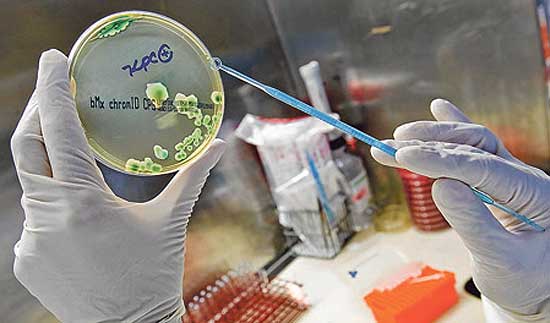
Superbug infection kills patient in Reno

http://www.healthcarefinancenews.com/news/superbug-infection-kills-patient-reno

A superbug infection resistant to all 27 available antibiotics killed a woman in Reno, Nevada, the Centers for Disease Control and Prevention reported Friday, in issuing a precaution to hospitals nationwide.

While this superbug case was rare, sepsis blood infections reportedly kill an estimated 258,000 Americans each year.

Medical experts have been warning for years of the dangers of overprescribing antibiotics because of the potential for antibiotic-resistant superbugs.

The female patient who died this September from the superbug infection was a Washoe County, Nevada resident in her 70s who arrived in the United States in early August 2016 after an extended visit to India, the CDC said.

On August 18, she was admitted to an acute care hospital with a primary diagnosis of an infection called systemic inflammatory response syndrome, which likely resulted from an infected right hip.

A week after she was admitted, the hospital notified the Washoe County Health District in Nevada that the patient had a bacterial infection of carbapenem-resistant Enterobacteriaceae, called CRE.


No one knows how many patients are dying from superbug infections in California hospitals

http://www.latimes.com/business/la-fi-torrance-memorial-infections-20161002-snap-story.html?utm_campaign=KHN%3A+First+Edition&utm_source=hs_email&utm_medium=email&utm_content=35220326&_hsenc=p2ANqtz–q48_nyJSgCl8xVrBEwT6GLi1L5uwbL-wFLD1CzsDaqKwJvA7Gvbnan0dOU4uApCaA6Nc4bjRnR-iXNQlJtbH0Z6T0mA&_hsmi=35220326

Sharley McMullen's death certificate says she died from respiratory failure and septic shock caused by her ulcer.

We, the community of physicians, had been watching these patients die and trundling them off to the morgue for years.— Dr. Barry Farr, former president, Society for Healthcare Epidemiology of America

Superbug resistant to two last-resort antibiotics found in US for first time

Superbug resistant to two last-resort antibiotics found in US for first time

A strain of E. coli resistant to two last-resort antibiotics has for the first time been reported in the United States.

The strain was found in the urine of a man treated at a New Jersey hospital two years ago. It was tested in 2016 as part of a larger analysis of bacteria from the hospital.

For hard-to-treat bacteria infections, the antibiotics colistin and carbapenem are considered the big guns — a last line of defense when nothing else is working. In recent months mcr-1, a gene which confers resistance to colistin, has been found in E. coli from over 30 countries, including bacteria isolated from pigs and people in China and a patient in New York City.

Similarly the gene blaNDM-5 renders the antibiotic carbapenem useless against its bacterial carrier. In 2012, the Centers for Disease Control and Prevention found carbapenem-resistant bacteria in about 4 percent of US hospitals.

Researchers and health officials have feared the joining of these two genes in a single bacterial strain, as it could set the stage for the rise of superbugs that can’t be treated with our current arsenal of drugs. The combination has been detected before in other countries, including Germany, Venezuela, and China, but until now, it has never been seen within the United States.


The End of Antibiotics? Drug-Resistant Superbug Reaches the US

http://www.thefiscaltimes.com/2016/05/26/End-Antibiotics-Drug-Resistant-Superbug-Reaches-US?utm_campaign=541c47950e351dbe08037e5f&utm_source=boomtrain&utm_medium=email&bt_alias=eyJ1c2VySWQiOiJjNmQ1ZmRkOC03N2RkLWFjOWUtZWQyZC0zYmZmN2E3ODZjZjcifQ%3D%3D

For the first time, researchers have found a person in the United States carrying bacteria resistant to antibiotics of last resort, an alarming development that the top U.S. public health official says could mean “the end of the road” for antibiotics.

The antibiotic-resistant strain was found last month in the urine of a 49-year-old Pennsylvania woman. Defense Department researchers determined that she carried a strain of E. coli resistant to the antibiotic colistin, according to a study published Thursday in Antimicrobial Agents and Chemotherapy, a publication of the American Society for Microbiology. The authors wrote that the discovery “heralds the emergence of a truly pan-drug resistant bacteria.”

HOW FACTORY FARMS PLAY CHICKEN WITH ANTIBIOTICS

How Factory Farms Play Chicken With Antibiotics

And the inside story of one company confronting its role in creating dangerous superbugs.

Superbug threat grows in DC hospitals

http://www.fiercehealthcare.com/story/superbug-threat-grows-dc-hospitals/2016-05-04?utm_medium=nl&utm_source=internal&mrkid=959610&mkt_tok=eyJpIjoiTWpVd1lqSTNZalZsWWpReCIsInQiOiJINE9BNitVSm1VYUR3NFVOZG1YMFFiVFQ2d2lmRGtEZ01NdjVpY0x2bmZUSmxTVFFcL2NcL3FMTmlGaXJqRFhSUHI2Tm1yK0Q1MHU1R3U2OWlGQ3NVYU9uTll2VXMxcEJSdUxlcGlYSjJEV1ZBPSJ9

New report finds prevalence of 5% drug-resistant bacteria in District.

http://www.bizjournals.com/washington/news/2016/05/03/exclusive-first-ever-study-of-superbugs-in-d-c.html


Support for the Preventing Superbugs and Protecting Patient Act

http://consumersunion.org/research/support-for-the-preventing-superbugs-and-protecting-patient-act/

Policy

Click to access CULetter.Support.PreventSuperbugsProtectPatientsAct.pdf

NDM-1 (New Delhi metallo-beta-lactamase)

http://www.medicinenet.com/ndm-1/article.htm

ndm1-superbug

NDM-1 stands for New Delhi metallo-beta-lactamase, which is an enzyme produced by certain strains of bacteria that have recently acquired the genetic ability to make this compound. The enzyme is active against other compounds that contain a chemical structure known as a beta-lactam ring. Unfortunately, many antibiotics contain this ring, including the penicillins, cephalosporins, and the carbapenems.

Emergence of Klebsiella pneumoniae Carbapenemase (KPC)-Producing Bacteria

http://www.ncbi.nlm.nih.gov/pmc/articles/PMC3075864/

KPC Bacteria

Klebsiella pneumoniae carbapenemase (KPC)-producing bacteria are a group of emerging highly drug-resistant Gram-negative bacilli causing infections associated with significant morbidity and mortality. Once confined to outbreaks in the northeastern United States (US), they have spread throughout the US and most of the world. KPCs are an important mechanism of resistance for an increasingly wide range of Gram-negative bacteria and are no longer limited to K pneumoniae.