Hospital CEOs could face new taxes 

The Republican tax overhaul bill also includes a small section that would levy a 20% excise tax on any wages of more $1 million for executives who work at tax-exempt organizations. Guess who’s not thrilled about that? Hospitals.

What they’re saying: The American Hospital Association said it was “concerned” about that provision because “there is already a rigorous process prescribed by the Internal Revenue Service for setting up executive compensation.”

Go deeper: As Axios’ Bob Herman has reported, hospital and health system CEOs command some of the highest salaries in the not-for-profit world.

The value of hospitals’ tax exemptions

http://www.aha.org/content/17/benefit-of-tax-exemption.pdf?utm_source=newsletter&utm_medium=email&utm_campaign=newsletter_axiosvitals&stream=health-care

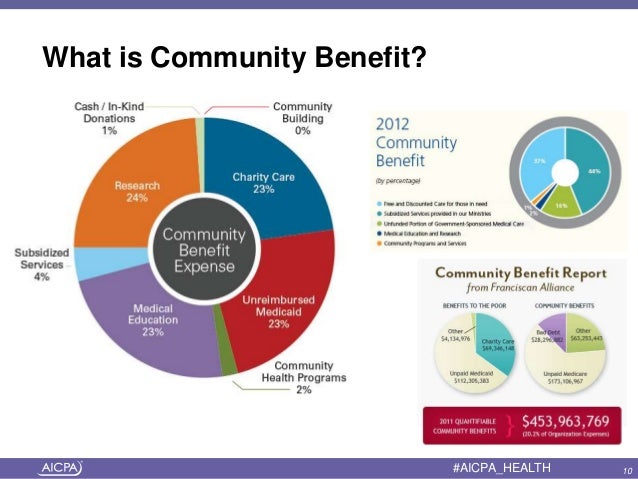
Image result for community benefit


The American Hospital Association released a report last week that said the benefits that not-for-profit hospitals provide to their local communities far outweigh foregone federal tax revenue. But Axios’ Bob Herman talked to some experts who said the AHA’s report has flaws and omissions that exaggerate hospitals’ community roles and understate the power of their tax exemptions.

  • The AHA did not account for the giant tax break hospitals get on their property, “which is just a joke,” said Craig Garthwaite, a health economist at Northwestern University.
  • “Exclusion of property taxes would be a very major problem,” added Gary Young, a health policy professor at Northeastern University who has studied tax exemptions for not-for-profit hospitals.
  • Calculating shortfalls from Medicare as a community benefit also raises a red flag. For-profit hospitals that pay taxes treat Medicare patients. The IRS doesn’t acknowledge Medicare shortfalls as a community benefit.
  • Plus, research shows hospitals often lose money from Medicare because of their high fixed costs and inefficiency, not because payments are too low. “That’s really just trying to get that (community benefits) number as high as possible,” Garthwaite said.

AHA’s response: Mindy Hatton, the AHA’s top lawyer, responded with a statement to Axios. The report did not include property tax values, she said, because the analysis only covered federal exemptions, which “Congress has jurisdiction over.”

IRS revokes hospital’s tax-exempt status for failure to comply with ACA rule

http://www.beckershospitalreview.com/finance/irs-revokes-hospital-s-tax-exempt-status-for-failure-to-comply-with-aca-rule.html

Image result for IRS

The Internal Revenue Service has revoked the tax-exempt status of an unnamed nonprofit hospital for failure conduct a community health needs assessment, adopt an implementation strategy and make it widely available to the public.

In a letter dated Feb. 14, 2017, and released earlier this month, the IRS said it revoked the hospital’s tax-exempt status for failure to comply with section 501(r) of the Internal Revenue Code.

The ACA added new requirements that hospitals must meet to qualify as a tax-exempt facility under section 501(c)(3) of the Internal Revenue Code. Specifically, the ACA added section 501(r), which imposes four new requirements, one of which requires hospitals to conduct a community health needs assessment at least once every three years and adopt an implementation strategy to address community health needs identified in the assessment.

The IRS revoked the tax-exempt status of the unnamed hospital for what the agency referred to as “egregious failures when reviewed in the context of [section] 501(r).” Although the name of the hospital is not included in the letter from the IRS, previous correspondence from the agency identified the facility as a disproportionate share hospital and a critical care access facility.

The IRS noted a revenue agent met with the hospital’s CEO, CFO and COO during the audit, and the administrators made it clear the organization “had neither the will, the financial resources, nor the staff to follow through with the CHNA process.”

IRS taking harder look at non-profit hospitals

http://www.fiercehealthcare.com/finance/irs-taking-harder-look-at-non-profit-hospitals?utm_medium=nl&utm_source=internal&mrkid=959610&mkt_tok=eyJpIjoiTWpobE5XSmlZemMyWkRjMCIsInQiOiJpQXhSN0R1K3dBWmdacXFyRjlRTXM0RlptYlJFeFo3WitQNUg4U0lOaHUrWmJMWFdnVHZiRkxndDRnVUhXUWtDc1BXQTJ3dWREUGhrYVRkd3VHTjRJYmNlMndwYkllakN3U1FmS25icFllVT0ifQ%3D%3D

money

The Internal Revenue Service (IRS) is ratcheting up surveillance of non-profit hospitals regarding their levels of community benefits and patient financial assistance.

The IRS reviewed 692 hospitals in fiscal 2016, which ended late last month, Bloomberg BNA has reported. Of those, 166 were referred for a closer “field examination.” The increased scrutiny is specific to 501(r) requirements under the Affordable Care Act, which mandate that hospitals formulate clear written financial assistance policies for patients and make reasonable efforts to determine if patients are eligible for assistance prior to taking any collection actions. The IRS is supposed to review each hospital every three years.

The U.S. Treasury Department issued regulations as to how the rules are to be enforced in 2014. Penalties for non-compliance include being subject to an excise tax or even losing a tax exemption entirely.

“We’ve entered into the enforcement phase now,” Donald B. Stuart, a partner with the law firm Waller Lansden Dortch & Davis LLP told Bloomberg BNA. “We’ve just moved into this new phase and new stage of 501(r), which is going to be a little bit of a wake-up call for a lot of people.”

The hospital sector has pushed back on enforcement, saying that some of the requirements were too burdensome.

Red flags included a hospital’s lack of a community health needs assessment or financial assistance guidelines. Hospitals that are out of compliance risk being audited, which can lead to other issues, such as scrutiny of unrelated business income.

Trinity Health Settles Church Pension Suit for $75M

http://www.bna.com/trinity-health-settles-n73014445765/

Image result for class-action lawsuits


Hospitals more likely to admit children with private insurance

http://www.fiercehealthcare.com/payer/hospitals-more-likely-to-admit-children-private-insurance?utm_medium=nl&utm_source=internal&mrkid=959610&mkt_tok=eyJpIjoiTXpNd1lqZGlNR0U1WkRJeCIsInQiOiJLOWhzWGhXZ2FrUHdBMEg5d1VNTnppNTR6TEh5XC9tQjI1bDgxcVlUUWNcL1wvSWt0SkRUck9vYm90K1VuSlZJUGFpQ3RubDhPdjFFTWZFUEF1S3RDTUlpZ0VQbmtJRmYyOVg5ZHk0T3RiUUZYRT0ifQ%3D%3D

Medicaid on paper and a stethoscope Medicaid on paper and a stethoscope

New research shows hospitals are more likely to admit children with private insurance over those with publicly funded plans, particularly during times when there are limited inpatient beds, an indication that reimbursement rates play a role in how hospitals manage pediatric patients in the emergency room.

Researchers from the National Bureau of Economic Research studied billing patterns for children in New Jersey that visited an emergency room between 2006 and 2012. The economists found that children with Medicaid or Children’s Health Insurance Program that presented to the ER with flu symptoms were 10 percent less likely to be hospitalized than those with private plans, according to the Washington Post.  During peak flu season, when there was a shortage of inpatient beds, children between 2 and 10 years old on Medicaid and CHIP were 20 percent less likely to be admitted.

Wall Street Journal combs through nonprofit hospitals’ board-business ties: 6 things to know

http://www.beckershospitalreview.com/finance/wall-street-journal-combs-through-nonprofit-hospitals-board-business-ties-6-things-to-know.html

As some of the largest nonprofits in the U.S., hospitals face a major challenge — their board members or executives often have direct ties to organizations with which the hospital does business, The Wall Street Journal reports.

Here are six things to know about nonprofit hospitals and their business associations, according toWSJ.

Profit margins at hospitals rise as charity care falls in the St. Louis region

http://www.stltoday.com/business/local/profit-margins-at-hospitals-rise-as-charity-care-falls-in/article_6f0b2ae6-46e9-5435-a40a-0334122ff8dc.html

shutterstock_4345456

Profit margins at St. Louis area hospitals rose to 4.5 percent in 2014 due to increased emergency room and outpatient visits and steep declines in charity care, according to a new report from the St. Louis Area Business Health Coalition, an organization that represents area employers.

While profits increased, hospitals were less charitable, the organization found. In 2014 area hospitals spent 2.1 percent of their operating revenue on charity care, or free or reduced care for low-income individuals. In the previous year, area hospitals spent 2.93 percent of operating revenue on charity care. That’s a nearly 28 percent decline in charity care in the region, according to Karen Roth, author of the report.

For some health care advocates, a decrease in charity care is problematic because nonprofit hospitals are tax-exempt based on an expectation that they provide free care to those in need. However, the Internal Revenue Service and the state of Missouri do not have any requirements regarding how much charity care a nonprofit hospital must provide.

Nonprofit Hospital Stops Suing So Many Poor Patients: Will Others Follow?

https://www.propublica.org/article/nonprofit-hospital-stops-suing-so-many-poor-patients-will-others-follow?utm_campaign=KHN%3A+Daily+Health+Policy+Report&utm_source=hs_email&utm_medium=email&utm_content=30188607&_hsenc=p2ANqtz-9ws8jWCL7DsmwpJ9Giqz6yPmhnYR4A6FPRG5BkfOwW4K0xZgtCQXWdvzAuVHiikTwzMJToEBXJ2vWq6SYDiwa7r6g3nw&_hsmi=30188607""

Debt Collection

// <![CDATA[
var abgp={elp:document.getElementById(‘abgcp‘),el:document.getElementById(‘abgc‘),ael:document.getElementById(‘abgs‘),iel:document.getElementById(‘abgb‘),hw:15,sw:75,hh:15,sh:15,himg:’https://tpc.googlesyndication.com’+’/pagead/images/adchoices/icon.png’,simg:’https://tpc.googlesyndication.com/pagead/images/adchoices/en.png’,alt:’AdChoices‘,t:’AdChoices‘,tw:53,t2:”,t2w:0,tbo:0,popuptext:”,att:’adchoices’,ff:”,halign:’right’,fe:false,iba:false,lttp:true,umd:false,uic:false,uit:false,ict:document.getElementById(‘cbb‘),icd:undefined,uaal:true,opi: false};
// ]]>