

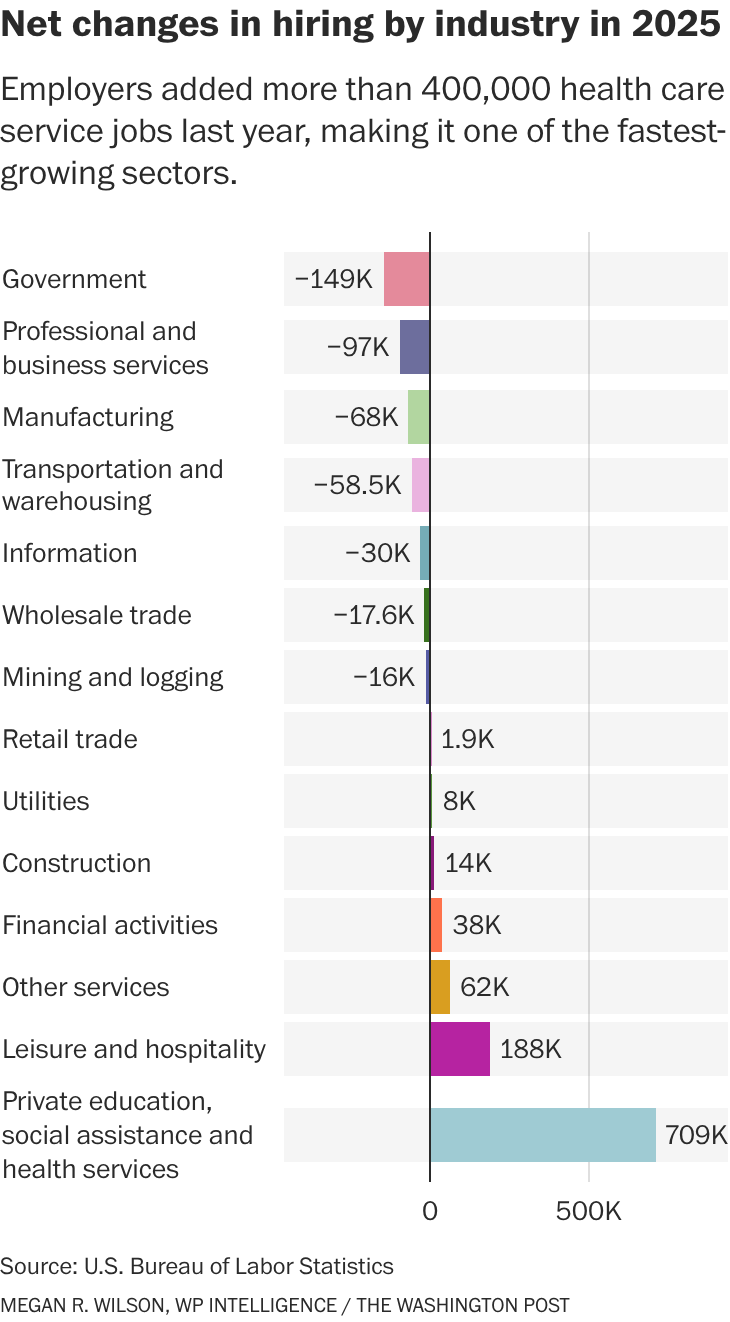
| The Lead Brief. The health services industry was once again a bright spot in the economic data in today’s jobs report, which otherwise landed with a thud and capped off the weakest year for overall hiring since the pandemic. The growth underscores how much health care employers are propping up the overall labor market — accounting for most of the gains, both in sheer numbers and percentage growth. “The fundamental reason why health care employment continues to grow so strongly is that the aging population continues to boost demand for health care services,” said Jed Kolko, a senior fellow at the Peterson Institute for International Economics. “The population will continue to age, so that fundamental driver of demand continues. ”Behind the numbers: Although economists expect the health industry to continue expanding, they note that 2025 represented a slowdown from the previous year. Although many factors are at play, multiple analysts said the Trump administration’s restrictive immigration policies may be to blame. More on that later. |
 |
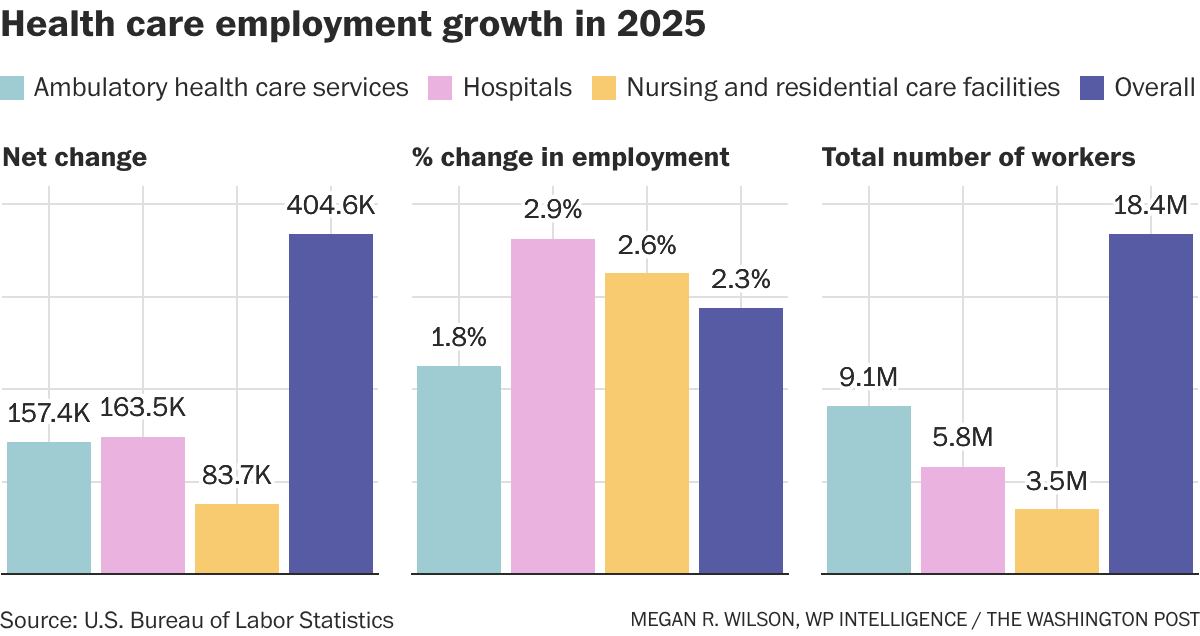 |
| Hospitals represented the highest employment growth rate — 2.9 percent — in the health services industry, followed by jobs at nursing homes and residential care facilities, at 2.5 percent. “We’re getting older and sicker. And, on top of that, we’re getting older and sicker in a way [where] we don’t have young people around to take care of the older, sicker people, right?” said Richard Frank, economic studies senior fellow at Brookings and director of its Center on Health Policy. Advertisement “So what used to be long-term care delivered by family members when we had four or five kids per household, that looks very different today,” Frank said. “You’re going to have to pay people to do that work. ”While economists anticipate health care hiring to continue to grow — in part for that very reason — there two major policy shifts loom as a dark cloud over the industry and may impact the health services workforce.— Immigration: Providers around the country have said that the Trump administration’s approach to immigration has hampered their ability to hire people. The administration has been cracking down on legal immigration as well as on people who have come to the U.S. illegally. Meanwhile, immigrants make up 28 percent of the long-term care workforce and 32 percent of home care workers, according to KFF.— Medicaid cuts: The Republicans’ tax-and-domestic-policy law enacted last July is expected to slash nearly $1 trillion from the Medicaid program for low-income Americans. Researchers estimate that this will hammer the balance sheets of many hospitals, which are likely to see an influx in patients seeking care but are unable to pay for it. Hospitals and health clinics are already shutting down or laying off workers across the country. Although the Medicaid policy changes — which won’t fully kick in for years — aren’t the only reason for the closures, it shows how vulnerable many providers already are. Other changes, including the proposed cuts to the National Institutes of Health, could trickle down to communities with research hospitals and ultimately impact the labor market, according to research from the Brookings Institution. New Medicare payment policies that aim to shift care away from expensive hospital services and toward primary care could also have an impact, although it likely won’t be large enough to show up in the data, I’m told. However: Some states are working to offset some of the administration’s immigration policy changes or health program cuts, which could make it hard to evaluate their impact in the next round of employment data. “There are a lot of … crosswinds blowing in the aggregate that might cover up” the overall impact of these policies,” said Frank. Other data: Employment in what the government calls “individual and family services” — listed under the “social assistance” category — increased by more than 289,000 people in 2025, representing a nearly 9 percent increase over 2024. These jobs include personal care aides, social workers and substance abuse counselors. |
 HENRY KOTULA