


A wave of coordinated lawsuits is transforming the No Surprises Act’s arbitration system into a battlefield where insurers seek to intimidate physicians, rewrite the law and consolidate control.
As I have written, Congress passed the No Surprises Act (NSA) to safeguard patients from unforeseen medical expenses and establish a neutral, independent dispute resolution (IDR) process for payment conflicts between insurers and out-of-network providers. That design was meant to replace brinkmanship with an independent referee. What Congress designed as a neutral arbitration system is now being challenged by Big Insurance through coordinated litigation designed to narrow, intimidate, and ultimately reshape the law.
Major insurance conglomerates — including UnitedHealthcare entities, Elevance/Anthem affiliates and Blue Cross Blue Shield plans — have launched a coordinated series of federal lawsuits against providers, hospitals, and revenue-cycle vendors who have used IDR at scale. Employing nearly identical language, legal arguments, and allegations, these lawsuits are not isolated ordinary litigation. It is lawfare.
Narratively, these suits recast lawful engagement in the NSA’s IDR process as “abuse,” but functionally they are designed to intimidate physicians from seeking NSA protection. A Pennsylvania suit from UnitedHealthcare against NorthStar Anesthesia presents the most urgent and perilous threat to independent physicians. If Unitedhealthcare prevails, insurers will be able to obtain judgments of fraud against physicians who incorrectly file NSA disputes. The effects of this will be catastrophic for independent physician practices, who cannot afford to litigate against billion dollar behemoths that have armies of lawyers on staff and retainer.
If successful in these efforts, the insurers will further weaken physician practices and make them ripe for acquisitions, continuing the dangerous path of vertically integrated insurance corporations – and the further decimation of independent physician practices.
The “Flooding” Myth
The lawsuits all start in a similar fashion. Each one claims that the defendant “abused” federal legislation “designed to protect patients from unexpected medical bills” and asserts that “the IDR process has not functioned as intended.” This wording appears verbatim in cases filed months apart, across different jurisdictions, against completely different defendants. Insurers adopt the same basic allegation: providers or billing companies “flooded,” “overwhelmed,” or unleashed an “avalanche” of IDR disputes that insurers assert were ineligible.
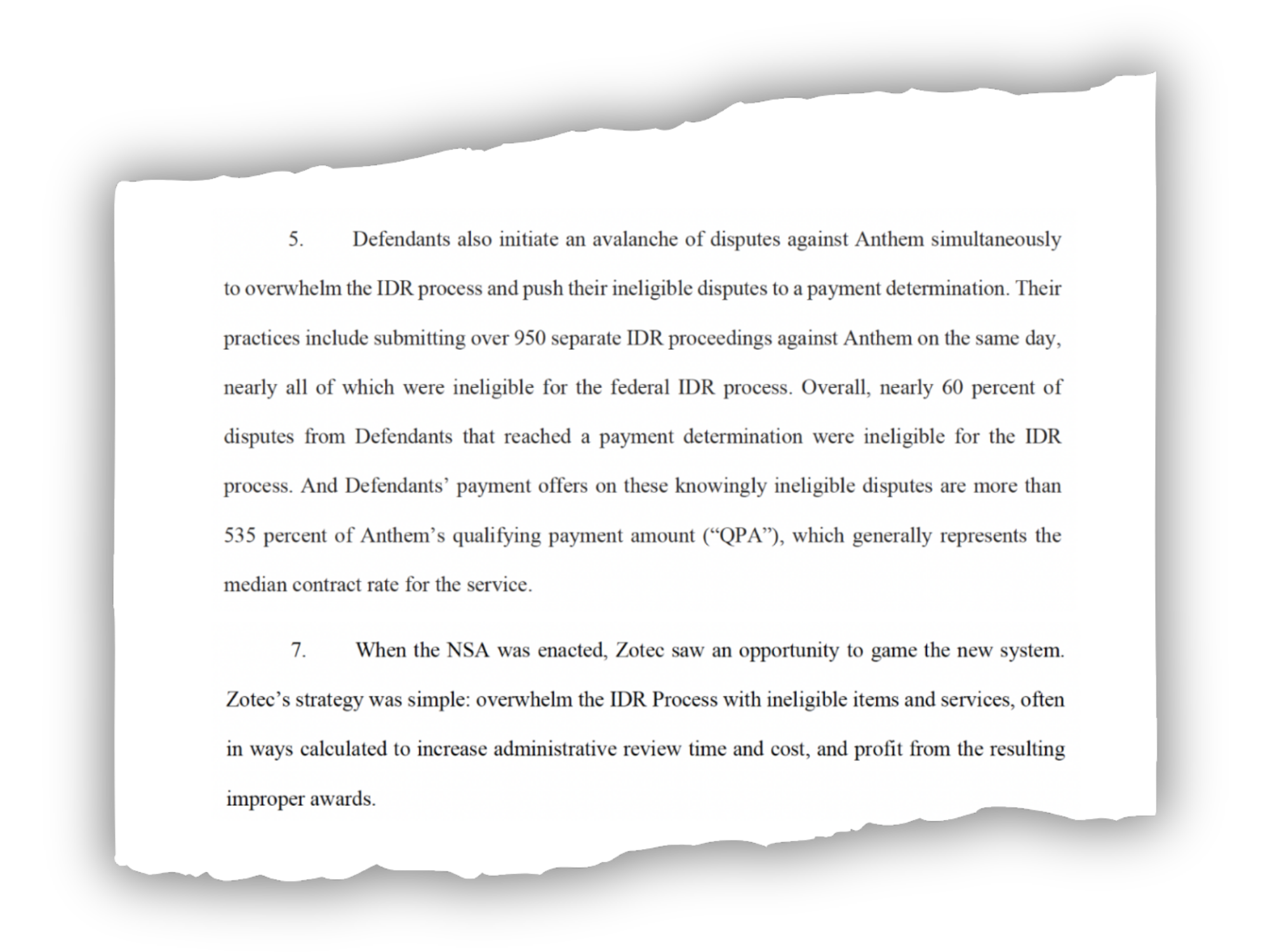
Those characterizations are based on bad data. Before the NSA went into effect, the Departments of Health and Human Services, Labor, and Treasury projected that the independent dispute resolution (IDR) process would see roughly 17,000 disputes annually. In reality, the system received nearly hundreds of thousands of disputes in its first year. That mismatch didn’t happen by accident. The departments based their projections on New York’s experience with a state arbitration system, scaling the state’s dispute numbers nationally. But New York’s law relied on an independent benchmark called FAIR Health that sharply reduced disputes. This is a structural feature the federal law does not have.
A more realistic comparison was available at the time: Texas. Unlike New York, Texas operated an arbitration system without an external benchmark making it a better comparison for the federal No Surprises Act. In its first year, the Texas system received nearly 49,000 arbitration requests for a population of just under six million people. That experience should have been a clear signal that arbitration volume would be far higher than federal projections suggested. Insurers have used this modeling error to their rhetorical advantage in their litigation.
 HENRY KOTULA