


Hospitals in just one state filed 1.15 million lawsuits — enabled by insurance plans that shift costs to patients while shielding themselves from the fallout.
“People are having to choose between going to the hospital and staying home and dying. Because at least my family won’t be burdened with a lawsuit if I die at home.”
That’s not a line from a dystopian novel. It’s what a real patient — identified only as GV0242002 in court records — told researchers after being sued by Sentara Health, Virginia’s largest hospital system and its most prolific medical debt litigant.
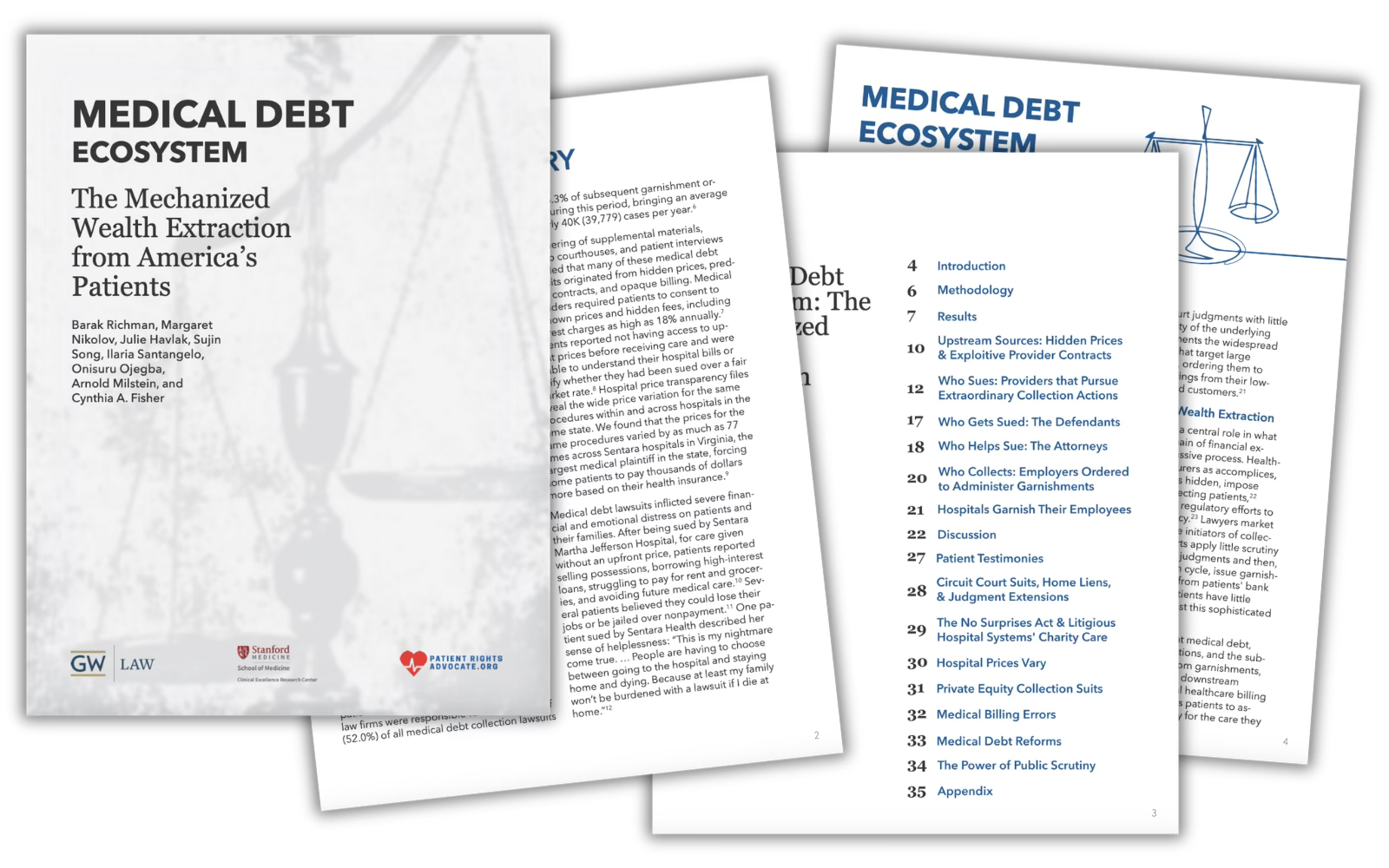
A major new report from researchers at George Washington University Law School and Stanford University’s Clinical Excellence Research Center, produced with PatientRightsAdvocate.org, documents what happens when American health care’s hidden costs finally catch up with the people least able to pay them. The findings for Virginia alone are staggering: between 2010 and 2024, hospitals and medical providers filed 1.15 million lawsuits against patients, seeking to collect $1.4 billion in medical debt. They followed those suits with more than 400,000 garnishment orders targeting wages and bank accounts. Plaintiffs’ attorneys collected $87 million in fees. Courts tacked on another $46 million in costs. And some providers charged interest as high as 18% annually — four times the prevailing commercial rate — buried in consent documents patients signed while frightened, in pain, and in no position to negotiate.
Among the top garnishee employers? Walmart, public schools, grocery stores and the hospitals themselves. Nonprofit hospitals in Virginia filed more than 4,100 garnishment orders against their own employees.
As the report notes, the hospitals’ patients have almost no way of knowing how much an inpatient stay or an outpatient service will cost or how much they will be on the hook for even if they are insured. The researchers describe health care providers operating “with insurers as accomplices” in keeping prices hidden from patients. That word — accomplices — is important and appropriate. This is not just a hospital story with an insurance footnote. It is also an insurance story. Both hospitals and insurers are complicit, although I would argue that hospitals have to operate in a system that is increasingly controlled by Big Insurance. That said, the relationship between hospitals and insurers is symbiotic, and the cost-sharing requirements imposed by insurers and the opacity of the agreements they enter into with hospitals enables both parties to increase prices and premiums in a way that ensures a rate of medical inflation that is perennially much higher than regular inflation and wage increases.
Here is the mechanism. An insurer designs a health plan with a $4,000 or $6,000 or $8,000 deductible. A patient — let’s say she works at a Kroger in Charlottesville, covered by her employer’s plan — gets sick and goes to Sentara Martha Jefferson Hospital. She signs an admissions agreement she cannot meaningfully read, consenting to pay “charges” based on a chargemaster that reflects prices no willing purchaser would ever agree to. She receives care. Weeks later, she gets a bill she cannot understand, for an amount she cannot verify, tied to prices that were never disclosed. She can’t pay. The hospital refers the account to one of the 20 law firms that brought more than half of all medical debt cases in Virginia during this period. She gets sued. The insurer that collected her premium — and her employer’s premium contribution — faces no lawsuit, no garnishment, no reputational consequence. It moves on to the next enrollment cycle.
The report covers 2010 through 2024 — the first 14 years of the Affordable Care Act. The ACA expanded coverage and has saved countless lives. But it did not stop the proliferation of high-deductible health plans that left millions of newly insured Americans technically covered and financially exposed. In fact, the ACA legitimized them. Since 2000, employer-sponsored family health insurance premiums have risen 321%, according to data cited in the report, and deductibles and other out-of-pocket costs have also skyrocketed. Wages rose 123% over the same period.
Patients are not drowning in medical debt because they are irresponsible. They are drowning because the insurance industry spent years engineering products that shift financial risk onto health plan enrollees and then collecting ever-increasing premiums for doing so.
I should note one finding with particular resonance for me personally. Ballad Health — the dominant hospital system serving the Tri-Cities of Northeast Tennessee and Southwest Virginia, the region where I grew up — filed 26,300 lawsuits against patients during this period. Ballad was created through a controversial 2018 merger that was granted antitrust immunity under a rare state certificate of public advantage, in exchange for commitments to maintain services and community benefit. The merger eliminated competition across one of the poorest stretches of Appalachia, leaving patients in communities like Scott County, Lee County, and Wise County, Virginia — some of the most economically distressed in either state — with effectively no choice in where they seek care.
Whether Ballad has honored its merger commitments has been disputed ever since. What is no longer in dispute: The system that was handed a regional monopoly turned around and sued its captive patients tens of thousands of times. Wise County, for those who don’t know, is also where Remote Area Medical for years set up a makeshift clinic at the county fairgrounds — the place that first showed me, up close, what this industry does to people when it stops pretending.
Virginia’s legislature took a meaningful step last year to give patients some relief. Former Governor Glenn Youngkin signed the Medical Debt Protection Act last May, capping interest on medical debt at 3%, eliminating interest for the first 90 days, and barring hospitals from foreclosing on homes or placing property liens. Those are real protections, and they matter. But as the researchers note, the law does almost nothing about the hidden prices and opaque billing at the point of care that generate the debt in the first place. The legislature addressed the collection machinery. It did not touch the engine driving it.
That engine — high cost-sharing, hidden prices, insurer-designed benefit structures that make patients financially liable before they walk through the door — is what I’ll be examining in depth in the coming weeks, as the major insurers report their first-quarter 2026 earnings. The Virginia data describe how this system costs patients. The earnings reports will tell you how it benefits big insurers and their shareholders.
Stay with me.
 HENRY KOTULA