Health care IPOs had a big 2019

https://www.axios.com/newsletters/axios-vitals-cd5b1e39-4d51-47d8-840c-1d446b3fccc4.html?utm_source=newsletter&utm_medium=email&utm_campaign=newsletter_axiosvitals&stream=top

Image result for Health care IPOs had a big 2019

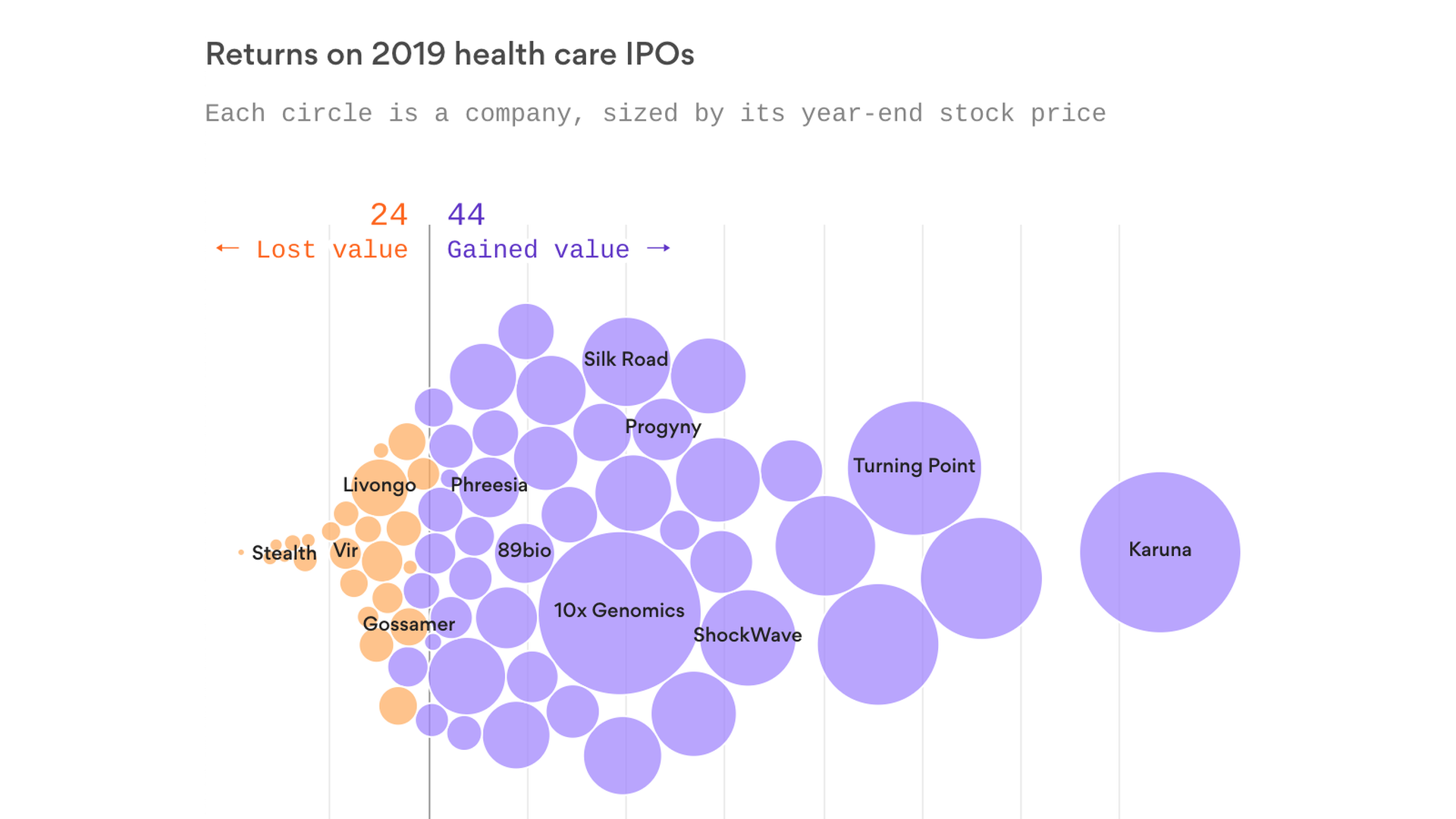
Two-thirds of the 68 health care companies that went public in 2019 traded above their IPO price by the end of year — many of which provided huge initial returns to owners and outside investors, Axios’ Bob Herman reports.

The big picture: The vast majority of health care companies that go public are biotechnology firms. Several of those biotechs in the 2019 class benefited from some promising, but extremely early, clinical trial data.

By the numbers: If you bought an equal amount of shares of every health care company that went public last year and then sold before the calendar flipped, you would have gotten a 47% return on your money.

  • Sixteen companies saw their stock prices double between their IPOs and the end of the year.

Winners: Karuna Therapeutics made the biggest leap, as the biotech company’s stock price almost quintupled by the end of the year. Early clinical trial data showed that Karuna’s schizophrenia drug relieved many symptoms, Stat reported.

  • NextCure and Turning Point Therapeutics also saw their stocks rise after releasing early-stage drug data.
  • Two medical device firms — ShockWave Medical and Silk Road Medical — and fertility benefits company Progyny were the exceptions to the biotech-heavy list.

Losers: SmileDirectClub, which mails teeth-straightening kits, and a handful of biotech startups like Stealth BioTherapeutics saw their stock prices fall by more than half from their IPOs.

The bottom line: Biotech stocks are notoriously fickle. Poor clinical trial data can derail an entire company, and some of these firms inevitably will fail, given the nature of science.

  • But the initial signals indicate investors still have plenty of money to throw at health care startups of all stripes.

Go deeper: One Medical was one of the first health care IPOs of 2020


Doctors try CRISPR gene editing for cancer, a 1st in the US

https://apnews.com/40211902a28946fe89f3f92b3c084e51

The first attempt in the United States to use a gene editing tool called CRISPR against cancer seems safe in the three patients who have had it so far, but it’s too soon to know if it will improve survival, doctors reported Wednesday.

The doctors were able to take immune system cells from the patients’ blood and alter them genetically to help them recognize and fight cancer, with minimal and manageable side effects.

The treatment deletes three genes that might have been hindering these cells’ ability to attack the disease, and adds a new, fourth feature to help them do the job.

“It’s the most complicated genetic, cellular engineering that’s been attempted so far,” said the study leader, Dr. Edward Stadtmauer of the University of Pennsylvania in Philadelphia. “This is proof that we can safely do gene editing of these cells.”

After two to three months, one patient’s cancer continued to worsen and another was stable. The third patient was treated too recently to know how she’ll fare. The plan is to treat 15 more patients and assess safety and how well it works.

“It’s very early, but I’m incredibly encouraged by this,” said one independent expert, Dr. Aaron Gerds, a Cleveland Clinic cancer specialist.

Other cell therapies for some blood cancers “have been a huge hit, taking diseases that are uncurable and curing them,” and the gene editing may give a way to improve on those, he said.

Gene editing is a way to permanently change DNA to attack the root causes of a disease. CRISPR is a tool to cut DNA at a specific spot. It’s long been used in the lab and is being tried for other diseases.

This study is not aimed at changing DNA within a person’s body. Instead it seeks to remove, alter and give back to the patient cells that are super-powered to fight their cancer — a form of immunotherapy.

Chinese scientists reportedly have tried this for cancer patients, but this is the first such study outside that country. It’s so novel that it took more than two years to get approval from U.S. government regulators to try it.

The early results were released by the American Society of Hematology; details will be given at its annual conference in December.

The study is sponsored by the University of Pennsylvania, the Parker Institute for Cancer Immunotherapy in San Francisco, and a biotech company, Tmunity Therapeutics. Several study leaders and the university have a financial stake in the company and may benefit from patents and licenses on the technology.

Two of the patients have multiple myeloma, a blood cancer, and the third has a sarcoma, cancer that forms in connective or soft tissue. All had failed multiple standard treatments and were out of good options.

Their blood was filtered to remove immune system soldiers called T cells, which were modified in the lab and then returned to the patients through an IV. It’s intended as a one-time treatment. The cells should multiply into an army within the body and act as a living drug.

So far, the cells have survived and have been multiplying as intended, Stadtmauer said.

“This is a brand new therapy” so not it’s not clear how soon any anti-cancer effects will be seen. Following these patients longer, and testing more of them, will tell, he said.


Kaiser Permanente, American Cancer Society join blood test startup’s $160M funding round

https://www.beckershospitalreview.com/healthcare-information-technology/kaiser-permanente-american-cancer-society-join-blood-test-startup-s-160m-funding-round.html?oly_enc_id=2893H2397267F7G

Image result for freenome funding

South San Francisco-based biotech company Freenome announced the close of a $160 million funding round, with participation from Kaiser Permanente Ventures, the American Cancer Society’s BrightEdge Ventures and Alphabet’s GV and Verily Life Sciences.

The Series B financing will be used to further develop Freenome’s blood test for early cancer detection. The startup uses an artificial intelligence-powered multiomics platform to analyze routine blood draws for often-missed biomarkers of early-stage cancer. Development of the platform has so far centered on use in detecting colorectal cancer.

Beyond further refinement of the platform, Freenome will also conduct a validation study to be submitted to the FDA and CMS for review and, eventually, expand the test to detect other forms of cancer and disease, according to CEO Gabe Otte.


Healthcare stocks rally after Trump administration nixes drug rebate plan

https://www.beckershospitalreview.com/finance/healthcare-stocks-rally-after-trump-administration-nixes-drug-rebate-plan.html

Shares of major health insurers and other healthcare companies surged July 11 after the Trump administration yanked a plan to curb drug rebates. The healthcare rally helped push the Dow Industrial Average to 27,088 — its highest close ever.

UnitedHealth Group led the Dow to its all-time high, according to The Wall Street Journal. UnitedHealth climbed 5.5 percent July 11 to $261.16 per share.

Shares of major pharmaceutical companies, including Merck, Pfizer and Eli Lilly, lost ground on July 11, hampering the Dow’s climb, according to TheStreet.

“Pharma is getting absolutely shellacked,” Jamie Cox, managing partner for Harris Financial Group, told TheStreet. “I think being in the crosshairs of both parties in advance of an election year is definitely not a good place to be. It’s the one area where Democrats and Republicans can agree-they can beat up on pharma and there’s no negative repercussions.”

The S&P 500 also reached a record July 11, trading 0.2 percent higher. In the S&P 500, Cigna jumped 9.2 percent to $175.34 per share, while shares of CVS Health climbed 4.7 percent to $57.97. However, pharmaceutical companies and biotechnology firms broadly declined, according to The Wall Street Journal.