


Quote of the Day – On Courage

Today marks the 63rd anniversary of Harper Lee‘s “To Kill a Mockingbird” (1960) — a novel containing truths so universal that they bear repeating in 2023.
“You never really understand a person until you consider things from his point of view … Until you climb inside of his skin and walk around in it.”
“I wanted you to see what real courage is … It’s when you know you’re licked before you begin but you begin anyway and you see it through no matter what. You rarely win, but sometimes you do.”
“People generally see what they look for, and hear what they listen for.”
“The one thing that doesn’t abide by majority rule is a person’s conscience.”
“Sometimes the Bible in the hand of one man is worse than a whisky bottle in the hand of another … There are just some kind of men who — who’re so busy worrying about the next world they’ve never learned to live in this one, and you can look down the street and see the results.”

https://mailchi.mp/d73a73774303/the-weekly-gist-may-27-2022?e=d1e747d2d8

Only 10 days after a racially motivated mass shooting that killed 10 in a Buffalo, NY grocery store, 19 children and two teachers were murdered on Tuesday at an elementary school in Uvalde, TX. The Uvalde shooting was the 27th school shooting, and one of over 212 mass shootings, that have occurred this year alone.
Firearms recently overtook car accidents as the leading cause of childhood deaths in the US, and more than 45,000 Americans die from gun violence each year.
The Gist: Gun violence is, and has long been, a serious public health crisis in this country. It is both important to remember, yet difficult for some to accept, that many mass shootings are preventable.
Health systems, as stewards of health in their communities, can play a central role in preventing gun violence at its source, both by bolstering mental health services and advocating for the needed legislative actions—supported by a strong majority of American voters—to stem this public health crisis.
As Northwell Health CEO Michael Dowling said this week, “Our job is to save lives and prevent people from illness and death. Gun violence is not an issue on the outside—it’s a central public health issue for us. Every single hospital leader in the United States should be standing up and screaming about what an abomination this is. If you were hesitant about getting involved the day before…May 24 should have changed your perspective. It’s time.”
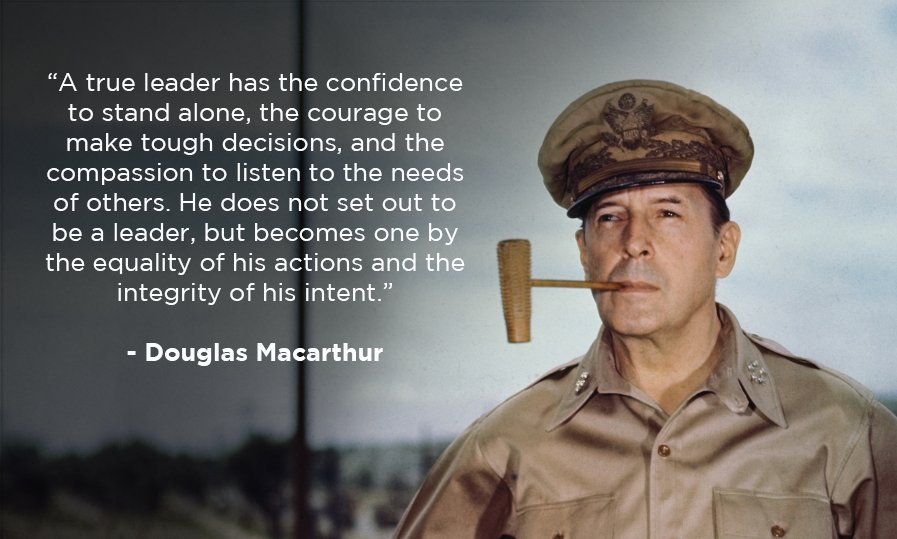
https://www.leadershipnow.com/macarthurprinciples.html

Douglas MacArthur was one of the finest military leaders the United States ever produced. John Gardner, in his book On Leadership described him as a brilliant strategist, a farsighted administrator, and flamboyant to his fingertips. MacArthur’s discipline and principled leadership transcended the military. He was an effective general, statesman, administrator and corporate leader.
William Addleman Ganoe recalled in his 1962 book, MacArthur Close-up: An Unauthorized Portrait, his service to MacArthur at West Point. During World War II, he created a list of questions with General Jacob Devers, they called The MacArthur Tenets. They reflect the people-management traits he had observed in MacArthur. Widely applicable, he wrote, “I found all those who had no troubles from their charges, from General Sun Tzu in China long ago to George Eastman of Kodak fame, followed the same pattern almost to the letter.”
Do I heckle my subordinates or strengthen and encourage them?
Do I use moral courage in getting rid of subordinates who have proven themselves beyond doubt to be unfit?
Have I done all in my power by encouragement, incentive and spur to salvage the weak and erring?
Do I know by NAME and CHARACTER a maximum number of subordinates for whom I am responsible? Do I know them intimately?
Am I thoroughly familiar with the technique, necessities, objectives and administration of my job?
Do I lose my temper at individuals?
Do I act in such a way as to make my subordinates WANT to follow me?
Do I delegate tasks that should be mine?
Do I arrogate everything to myself and delegate nothing?
Do I develop my subordinates by placing on each one as much responsibility as he can stand?
Am I interested in the personal welfare of each of my subordinates, as if he were a member of my family?
Have I the calmness of voice and manner to inspire confidence, or am I inclined to irascibility and excitability?
Am I a constant example to my subordinates in character, dress, deportment and courtesy?
Am I inclined to be nice to my superiors and mean to my subordinates?
Is my door open to my subordinates?
Do I think more of POSITION than JOB?
Do I correct a subordinate in the presence of others?
 HENRY KOTULA