Can Your Employer Require You to Get a COVID-19 Vaccine?

https://www.aarp.org/work/working-at-50-plus/info-2020/employer-require-covid-vaccine/
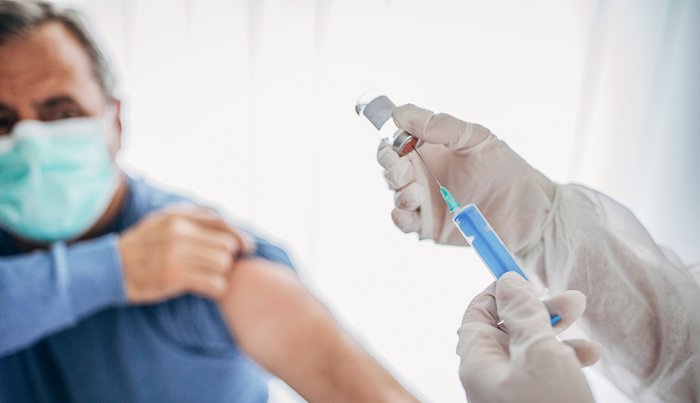
A man is about to get a vaccine

Workers have rights, but the answer is more complicated than you think.

En español | With millions of people out of work and millions of others forced to work from home, the pandemic has reshaped the nation’s labor force. And it’s not done yet. As the unemployed look ahead to getting hired and remote employees prepare for a return to the workplace, many are contemplating the same question: Could they eventually be required to get a COVID-19 vaccination if they want to keep their jobs?

The question has become more urgent since the U.S. Food and Drug Administration (FDA)  granted Pfizer and BioNTech’s coronavirus vaccine emergency use authorization on Dec. 11. The short answer: Yes. An employer can make a vaccination a requirement if you want to continue working there. But there are significant exceptions for potential concerns related to any disability you may have and for religious beliefs that prohibit vaccinations. And experts say that employers are more likely to simply encourage their workers to get immunized rather that issue a company-wide mandate.

On Dec. 16, the Equal Employment Opportunity Commission (EEOC) confirmed that a COVID-19 vaccination requirement by itself would not violate Americans with Disabilities Act (ADA). That law prohibits employers from conducting some types of medical examinations.

“If a vaccine is administered to an employee by an employer for protection against contracting COVID-19, the employer is not seeking information about an individual’s impairments or current health status and, therefore, it is not a medical examination,” the EEOC says.

But some employees may be exempted from mandatory vaccinations based on potential concerns related to any disability you may have and for religious beliefs that prohibit vaccinations. And experts say that employers are more likely to simply encourage their workers to get immunized rather that issue a company-wide mandate.

“Employment in the United States is generally ‘at will,’ which means that your employer can set working conditions,” says Dorit Reiss, a law professor at the University of California, Hastings, who specializes in legal and policy issues related to vaccines. “Certainly, employers can set health and safety work conditions, with a few limits.”

Those restrictions generally are tied to the federal Americans with Disabilities Act (ADA) and Title VII of the Civil Rights Act of 1964. If employees have medical reasons or sincerely held religious beliefs that prevent them from taking a potential coronavirus vaccine, employers could be legally required to give the workers some reasonable alternative to continue to work, Reiss says.

The EEOC guidance notes that even if an employer finds that a worker who cannot be vaccinated due to disability poses a risk to the workplace, the employer cannot exclude the employee from the job — or take any other action — unless there is no way to provide a reasonable accommodation that would reduce this risk to others.

“That might be a [wearing a] mask, a working from home, or a working separately from other people alternative. As long as it’s not too significant a barrier for the employer,” Reiss says. “If you can achieve the same level of safety as the vaccine via mask, or remote working, you can’t fire the employee. You need to give them an accommodation.”

Vaccine recommendations vs. requirements

The potential medical and religious accommodations are just two of the factors employers will have to consider when deciding whether to put a vaccination requirement in place. Experts say that given all the different concerns employers will need to balance with a potential COVID-19 vaccine, many might choose to simply recommend their workers get immunized rather than make vaccination a condition of employment.

For example, employers also need to weigh any liability issues a vaccination requirement might raise. Some federal lawmakers already have raised concerns that employers are vulnerable to lawsuits from workers and customers who might have contracted COVID-19 at the business. A mandate that all their employees get inoculated could complicate the risks for companies.

“It’s a treacherous area for employers,” says Jay Rosenlieb, an employment law attorney at the Klein DeNatale Goldner law group in California. “The reason it’s treacherous for employers is liability that arises from requiring a vaccine where the vaccine goes sideways and creates harm to the employee. That’s going to probably be a workers compensation claim against the employer. And, of course, some kind of claim against the vaccine manufacturer. There’s a lot of weighing that goes on here.”

L.J. Tan, chief strategy officer for the Immunization Action Coalition — an advocacy group that supports vaccinations — says that because potential COVID-19 vaccines are largely being developed in the same manner as earlier vaccines, researchers have the benefit of past scientific experience to better ensure that a vaccine for this coronavirus will be safe. But he noted that the speed of the development of a COVID-19 vaccine — compressed into months rather than the usual years — and the politics that have accompanied it add to the reasons employers may be unwilling to make vaccination a requirement.

“One of the challenges we’re going to be dealing with, obviously, especially now is that there is a shadow of politics over the vaccine,” Tan says. “As a result, there’s some fear about whether the vaccine can be safe, whether it can be approved appropriately. Because of that shadow, I think it’s going to be extremely difficult for an employer to make COVID-19 vaccination a condition of employment.”

Vaccine requirement more likely in health care, other high-risk jobs

The industry most likely to require COVID-19 vaccinations for workers is health care, where most employers already require workers to get a flu shot annually. In fact, interim guidance from the Centers for Disease Control and Prevention (CDC) on which groups might be among the first to have access to a coronavirus vaccine placed “healthcare personnel likely to be exposed to or treat people with COVID-19” at the top of the list.

But once enough doses of a vaccine have been produced for distribution to the broader public, some employers might start to consider a mandate.

“For example, essential workers in retail stores or in food production plants, such as a meat-packing plant, seem to be at high risk,” Reiss says. “Those employers could reasonably require [a COVID vaccination], because remember, if an employee doesn’t vaccinate, it’s not just a risk to them. It’s a risk to other employees, and — if it’s a customer-facing business — a risk to the customers. So, in high-risk places, I think it’s reasonable.”

Some companies may make inoculation voluntary but make it as easy as possible for workers to get the shot. For instance, Ford already has purchased twelve of the ultracold freezers required to store doses of Pfizer’s vaccine so it can provide the shot to employees who want it.

For those workers who might be told to get a vaccination, remember to raise any concerns you might have with your employer.

“Ask for reasonable accommodation and have a discussion with the employer as to whether there might be reasonable alternatives such as work from home or such as continued use” of personal protective equipment, Rosenlieb says.

If vaccination requirements do become more common, both workers and their employers will have to find ways to balance personal concerns with public safety.

“On one hand, [vaccine requirements] do limit the autonomy of workers that have reservations,” Reiss says. “On the other hand, they also protect workers by making the workplace safer from the disease. So, it’s not just a mandate to limit your rights. A mandate can also protect your right to a safe work environment.

As thousands of athletes get coronavirus tests, nurses wonder: What about us?

On her day off not long ago, emergency room nurse Jane Sandoval sat with her husband and watched her favorite NFL team, the San Francisco 49ers. She’s off every other Sunday, and even during the coronavirus pandemic, this is something of a ritual. Jane and Carlos watch, cheer, yell — just one couple’s method of escape.

“It makes people feel normal,” she says.

For Sandoval, though, it has become more and more difficult to enjoy as the season — and the pandemic — wears on. Early in the season, the 49ers’ Kyle Shanahan was one of five coaches fined for violating the league’s requirement that all sideline personnel wear face coverings. Jane noticed, even as coronavirus cases surged again in California and across the United States, that Levi’s Stadium was considering admitting fans to watch games.

But the hardest thing to ignore, Sandoval says, is that when it comes to coronavirus testing, this is a nation of haves and have-nots.

Among the haves are professional and college athletes, in particular those who play football. From Nov. 8 to 14, the NFL administered 43,148 tests to 7,856 players, coaches and employees. Major college football programs supply dozens of tests each day, an attempt — futile as it has been — to maintain health and prevent schedule interruptions. Major League Soccer administered nearly 5,000 tests last week, and Major League Baseball conducted some 170,000 tests during its truncated season.

Sandoval, meanwhile, is a 58-year-old front-line worker who regularly treats patients either suspected or confirmed to have been infected by the coronavirus. In eight months, she has never been tested. She says her employer, California Pacific Medical Center, refuses to provide testing for its medical staff even after possible exposure.

Watching sports, then, no longer represents an escape from reality for Sandoval. Instead, she says, it’s a signal of what the nation prioritizes.

“There’s an endless supply in the sports world,” she says of coronavirus tests. “You’re throwing your arms up. I like sports as much as the next person. But the disparity between who gets tested and who doesn’t, it doesn’t make any sense.”

This month, registered nurses gathered in Los Angeles to protest the fact that UCLA’s athletic department conducted 1,248 tests in a single week while health-care workers at UCLA hospitals were denied testing. Last week National Nurses United, the country’s largest nursing union, released the results of a survey of more than 15,000 members. About two-thirds reported they had never been tested.

Since August, when NFL training camps opened, the nation’s most popular and powerful sports league — one that generates more than $15 billion in annual revenue — has conducted roughly 645,000 coronavirus tests.

“These athletes and teams have a stockpile of covid testing, enough to test them at will,” says Michelle Gutierrez Vo, another registered nurse and sports fan in California. “And it’s painful to watch. It seemed like nobody else mattered or their lives are more important than ours.”

Months into the pandemic, and with vaccines nearing distribution, testing in the United States remains something of a luxury. Testing sites are crowded, and some patients still report waiting days for results. Sandoval said nurses who suspect they’ve been exposed are expected to seek out a testing site on their own, at their expense, and take unpaid time while they wait for results — in effect choosing between their paycheck and their health and potentially that of others.

“The current [presidential] administration did not focus on tests and instead focused on the vaccine,” says Mara Aspinall, a professor of biomedical diagnostics at Arizona State University. “We should have focused with the same kind of ‘warp speed’ on testing. Would we still have needed a vaccine? Yes, but we would’ve saved more lives in that process and given more confidence to people to go to work.”

After a four-month shutdown amid the pandemic’s opening wave, professional sports returned in July. More than just a contest on television, it was, in a most unusual year, a symbol of comfort and routine. But as the sports calendar has advanced and dramatic adjustments have been made, it has become nearly impossible to ignore how different everything looks, sounds and feels.

Stadiums are empty, or mostly empty, while some sports have bubbles and others just pretend their spheres are impermeable. Coaches stand on the sideline with fogged-up face shields; rosters and schedules are constantly reshuffled. On Saturday, the college football game between Clemson and Florida State was called off three hours before kickoff. Dodger Stadium, home of the World Series champions, is a massive testing site, with lines of cars snaking across the parking lot.

Sports, in other words, aren’t a distraction from a polarized nation and its response to a global pandemic. They have become a constant reminder of them. And when some nurses turn to sports for an attempt at escape, instead it’s just one more image of who gets priority for tests and, often, who does not.

“There is a disconnect when you watch sports now. It’s not the same. Covid changed everything,” says Gutierrez Vo, who works for Kaiser Permanente in Fremont, Calif. “I try not to think about it.”

Sandoval tries the same, telling herself that watching a game is among the few things that make it feel like February again. Back then, the coronavirus was a distant threat and the 49ers were in the Super Bowl.

That night, Sandoval had a shift in the ER, and between patients, she would duck into the break room or huddle next to a colleague checking the score on the phone. The 49ers were playing the Kansas City Chiefs, and Sandoval would recall that her favorite team blowing a double-digit lead represented the mightiest stress that day.

Now during shifts, Sandoval sometimes argues with patients who insist the virus that has infected them is a media-driven hoax. She masks up and wears a face shield even if a patient hasn’t been confirmed with the coronavirus, though she can’t help second-guessing herself.

“Did I wash my hands? Did I touch my glasses? Was I extra careful?” she says.

If Sandoval suspects she has been exposed, she says, she doesn’t bother requesting a test. She says the hospital will say there aren’t enough. So instead she self-monitors and loads up on vitamin C and zinc, hoping the tickle in her throat disappears. If symptoms persist, which she says hasn’t happened yet, she plans to locate a testing site on her own. But that would mean taking unpaid time, paying for costs out of pocket and staying home — and forfeiting a paycheck — until results arrive.

National Nurses United says some of its members are being told to report to work anyway as they wait for results that can take three to five days. Sutter Health, the hospital system that oversees California Pacific Medical Center, said in a statement to The Washington Post that it offers tests to employees whose exposure is deemed high-risk and to any employee experiencing symptoms. Symptomatic employees are placed on paid leave while awaiting test results, according to the statement.

“As long as an essential healthcare worker is asymptomatic,” Sutter’s statement read, “they can continue to work and self-monitor while awaiting the test result.”

Sandoval said employees have been told the hospital’s employee health division will contact anyone who has been exposed. Though she believes she’s exposed during every shift, Sandoval says employee health has never contacted her to offer a test or conduct contact tracing.

“If you feel like you need to get tested, you do that on your own,” she says. Sandoval suspects the imbalance is economic. In September, Forbes reported NFL team revenue was up 7 percent despite the pandemic. Last week Sutter Health reported a $607 million loss through the first nine months of 2020.

Sandoval tries to avoid thinking about that, so she keeps heading back to work and hoping for the best. Though she says her passion for sports is less intense now, she nonetheless likes to talk sports when a patient wears a team logo. She asks about a star player or a recent game. She says she is looking forward to the 49ers’ next contest and the 2021 baseball season.

Sometimes, Sandoval says, patients ask about her job and the ways she avoids contracting the coronavirus. She must be tested most every day, Sandoval says the patients always say.

And she just rolls her eyes and chuckles. That, she says, only happens if you’re an athlete.