Expanding beyond patient experience 

https://mailchi.mp/cd8b8b492027/the-weekly-gist-january-26-2024?e=d1e747d2d8

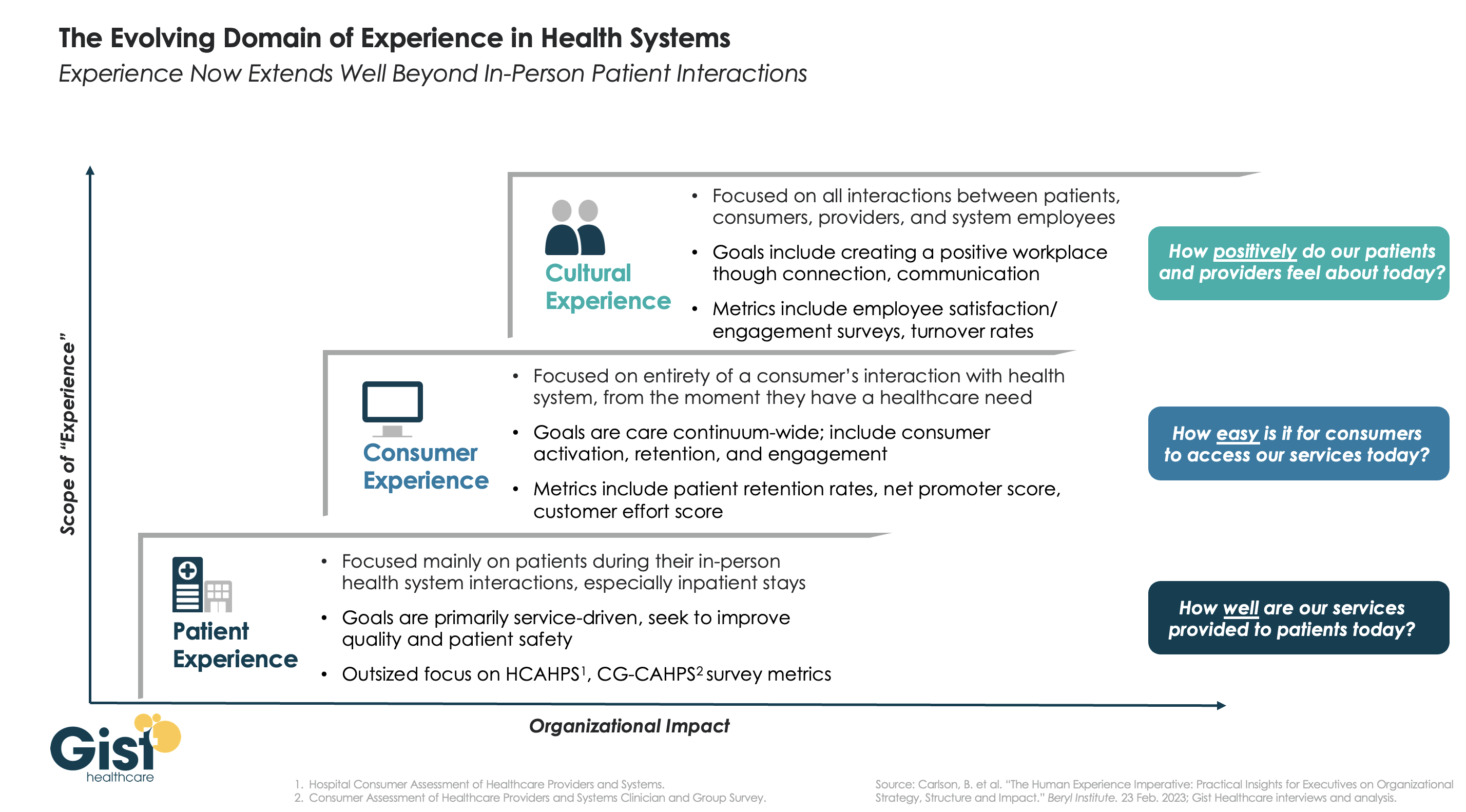
In this week’s graphic, we highlight the importance of broadening the domain of health system experience initiatives beyond patients to include consumers and even employees.

While reimbursements tied to HCAHPS (Hospital Consumer Assessment of Healthcare Providers and Systems) and CG-CAHPS (Clinician and Group Consumer Assessment of Healthcare Providers and Systems) scores have made patient experience a main focus for years, an increasingly consumer-driven healthcare industry means that health systems must consider the experience of all consumers in their markets, with the hopes of meeting their needs and eventually welcoming them as new—or retuning—patients. 

Embracing this mindset requires focusing on the entirety of a consumer’s interactions with the health system and the tracking of non-traditional metrics that measure the strength and value of their relationship to the system. Some systems are expanding their experience purview even further by also focusing on the working conditions and morale of their providers and other staff, as a healthy workplace environment serves to better both the patient and consumer experience. Easily accessible services and positive interactions with providers and other staff can determine a consumer’s view of their experience before any care is actually delivered. 

Cultural and strategic shifts that integrate experience from the top down into all operational facets of the health system will ultimately strengthen consumer loyalty, employee retention, and the financial health of the system.

72 hospital patient experience benchmarks

Patient experience measures declined nationwide in 2022, though some hospitals are showing early signs of improvement.

Below are 72 hospital patient experience benchmarks based on national HCAHPS measures from CMS. Data was collected from hospitals in calendar year 2022 and published on CMS’ Provider Data Catalog Nov. 8. Learn more about the methodology here.

Communication with hospital staff

  1. Nurses always communicated well: 79% 
  2. Nurses sometimes or never communicated well: 5%
  3. Nurses usually communicated well: 16%
  4. Nurses always treated them with courtesy and respect: 85%
  5. Nurses sometimes or never treated them with courtesy and respect: 3%
  6. Nurses usually treated them with courtesy and respect: 12%
  7. Nurses always listened carefully: 76%
  8. Nurses sometimes or never listened carefully: 5%
  9. Nurses usually listened carefully: 19%
  10. Nurses always explained things so they could understand: 75%
  11. Nurses sometimes or never explained things so they could understand: 6%
  12. Nurses usually explained things so they could understand: 19%
  13. Physicians always communicated well: 79%
  14. Physicians sometimes or never communicated well: 5%
  15. Physicians usually communicated well: 16%
  16. Physicians always treated them with courtesy and respect: 85%
  17. Physicians sometimes or never treated them with courtesy and respect: 4%
  18. Physicians usually treated them with courtesy and respect: 11%
  19. Physicians always listened carefully: 78%
  20. Physicians sometimes or never listened carefully: 6%
  21. Physicians usually listened carefully: 16%
  22. Physicians always explained things so they could understand: 74%
  23. Physicians sometimes or never explained things so they could understand: 7%
  24. Physicians usually explained things so they could understand: 19%

Responsiveness of hospital staff

  1. Patients always received help as soon as they wanted: 65%
  2. Patients sometimes or never received help as soon as they wanted: 11%
  3. Patients usually received help as soon as they wanted: 24%
  4. Patients always received call button help as soon as they wanted: 64%
  5. Patients sometimes or never received call button help as soon as they wanted: 10%
  6. Patients usually received call button help as soon as they wanted: 26%
  7. Patients always received bathroom help as soon as they wanted: 66%
  8. Patients sometimes or never received bathroom help as soon as they wanted: 11%
  9. Patients usually received bathroom help as soon as they wanted: 23%

Communication about medicines

  1. Staff always explained medicines before giving it to them: 62%
  2. Staff sometimes or never explained: 20%
  3. Staff usually explained: 18%
  4. Staff always explained what new medications were for: 75%
  5. Staff sometimes or never explained new medications: 10%
  6. Staff usually explained new medications: 15%
  7. Staff always explained possible side effects: 48%
  8. Staff sometimes or never explained possible side effects: 31%
  9. Staff usually explained possible side effects: 21%

Discharge information

  1. Yes, staff did give patients information about what to do during their recovery at home: 86%
  2. No, staff did not give patients information: 14%
  3. No, staff did not give patients information about help after discharge: 16%
  4. Yes, staff did give patients information about help after discharge: 84%
  5. No, staff did not give patients information about possible symptoms: 13%
  6. Yes, staff did give patients information about possible symptoms: 87%
  7. Patients who agree they understood their care when they left the hospital: 43%
  8. Patients who disagree or strongly disagree they understood their care when they left the hospital: 6%
  9. Patients who strongly agree they understood their care when they left the hospital: 51%

Cleanliness of hospital environment

  1. Room was always clean: 72%
  2. Room was sometimes or never clean: 10%
  3. Room was usually clean: 18%

Quietness of hospital environment

  1. Always quiet at night: 62%
  2. Sometimes or never quiet at night: 10%
  3. Usually quiet at night: 28%

Transition of care

  1. Patients who agree that staff took their preferences into account: 47%
  2. Patients who disagree or strongly disagree that staff took their preferences into account: 8%
  3. Patients who strongly agree that staff took their preferences into account: 45%
  4. Patients who agree they understood their responsibilities when they left the hospital: 43%
  5. Patients who disagree or strongly disagree they understood their responsibilities when they left the hospital: 6%
  6. Patients who strongly agree they understood their responsibilities when they left the hospital: 51%
  7. Patients who agree they understood their medications when they left the hospital: 37%
  8. Patients who disagree or strongly disagree they understood their medications when they left the hospital: 5%
  9. Patients who strongly agree they understood their medications when they left the hospital: 58%

Overall hospital rating

  1. Patients who gave a rating of six or lower: 9%
  2. Patients who gave a rating of seven or eight : 21%
  3. Patients who gave a rating of nine or 10: 70%
  4. Patients probably would not or definitely would not recommend the hospital: 6%
  5. Yes, patients would definitely recommend the hospital: 69%
  6. Yes, patients would probably recommend the hospital: 25%

Despite provider claims, hospital M&A not associated with improved care, NEJM finds

https://www.healthcaredive.com/news/despite-provider-claims-hospital-ma-not-associated-with-improved-care-ne/569671/

Dive Brief:

  • Hospital consolidation is associated with poorer patient experiences and doesn’t improve care, according to a study published Thursday in the New England Journal of Medicine, refuting a common provider justification for rampant mergers and acquisitions.
  • The study funded by HHS’ health quality research division, the Agency for Healthcare Research and Quality, found that acquired hospitals saw moderately worse patient experience, along with no change in 30-day mortality or readmission rates. ​Acquired hospitals did improve slightly in clinical process, though that can’t be directly chalked up to the results of an acquisition, researchers found.
  • It’s further evidence that bigger isn’t always better when it comes to hospitals, and adds onto a heap of previous studies showing provider mergers lead to higher prices for commercially insured patients.

Dive Insight:

Hospitals continue to turn to M&A to navigate tricky industry headwinds, including lowering reimbursement and flatlining admissions as patients increasingly turn to alternate, cheaper sites of care. Provider trade associations maintain consolidation lowers costs and improves operations, which trickles down to better care for patients.

Though volume of deals has ebbed and flowed, hospital M&A overall has steadily increased over the past decade. The hospital sector in 2018 saw 90 deals, according to consultancy Kaufman Hall, up 80% from just 50 such transactions in 2009.

Thursday’s study analyzed CMS data on hospital quality and Medicare claims from 2007 through 2016 and data on hospital M&A from 2009 to 2013 to look at hospital performance before and after acquisition, compared with a control group that didn’t see a change in ownership.

American Hospital Association General Counsel Melinda Hatton took aim at the study’s methods to refute its findings, especially its reliance on a common measure of patient experience called HCAHPS.

“Using data collected from patients to make claims about quality fails to recognize that it is often incomplete, as patients are not required to and do not always respond comprehensively,” Hatton told Healthcare Dive in a statement. “The survey does not capture information on the critical aspects of care as it is delivered today.”

The results contradict a widely decried AHA-funded study last year conducted by Charles River Associates that found consolidation improves quality and lowers revenue per admission in the first year prior to integration. The research came quickly under fire by academics and patient advocates over potential cherrypicked results.

A spate of previous studies found hospital tie-ups raise the price tag of care on payers and patients. Congressional advisory group MedPAC found both vertical and horizontal provider consolidation are correlated with higher healthcare costs, the brunt of which is often borne by consumers in the form of higher premiums and out-of-pocket costs.

A 2018 study published in the Quarterly Journal of Economics found prices rose 6% after hospitals were acquired, partially due to limiting market competition. Groups like the left-leaning Center for American Progress have called for increased scrutiny from antitrust regulators as a result, but — despite snowballing M&A — there’s been little change in antitrust regulation since the 1980s. The Federal Trade Commission won several challenges to hospital consolidation in the 2010s, but the agency only contests 2% to 3% of mergers annually, according to MedPAC analysts.

Providers, like most actors across the healthcare ecosystem, are increasingly under fire for high prices and predatory billing practices. President Donald Trump’s administration finalized a rule late last year that would force hospitals to reveal secret negotiated rates with insurers, relying on the assumption that transparency would shame both actors into lowering prices.

A cadre of provider groups led by the AHA sued HHS over the regulation, arguing it violates the First Amendment and would place undue burden on hospitals, while potentially stifling competition. The lawsuit is currently being reviewed by the U.S. District Court for the District of Columbia.