U.S. leads world in confirmed coronavirus cases for first time

https://www.axios.com/united-states-most-coronavirus-cases-52b6d1b5-bc65-4b86-a42d-712cf9e3b556.html?stream=top&utm_source=alert&utm_medium=email&utm_campaign=alerts_all

Coronavirus dashboard: Catch up fast - Axios

The United States on Thursday reported the most coronavirus cases in the world for the first time, over China and Italy with at least 82,404 infections and more than 1,000 deaths, according to data from Johns Hopkins.

Why it matters: From the beginning, the U.S. — with a population of more than 325 million — has repeatedly underestimated and reacted slowly to the coronavirus, prolonging its economic pain and multiplying its toll on Americans’ health.

First, it happened with testing — a delay that allowed the virus to spread undetected, Axios’ Caitlin Owens reports.

  • Then we were caught flat-footed by the surge in demand for medical supplies in emerging hotspots.
  • And the Trump administration declined to issue a national shelter-in-place order. The resulting patchwork across the country left enough economic hubs closed to crash the economy, but enough places up and running to allow the virus to continue to spread rampantly.

What they’re saying: At a press conference Thursday, President Trump attributed the U.S. overtaking China to ramped up testing, before casting doubt on whether the Chinese government is reporting accurate numbers.

  • It is possible that China, which was the site of the original coronavirus outbreak, has been underreporting its cases.
  • The Chinese government covered up the outbreak in its first few weeks, likely allowing the virus to spread both domestically and throughout the rest of the world.

Flashback: Exactly one month ago on Feb. 26, President Trump said at a coronavirus press briefing that the U.S. has 15 reported cases and that “the 15 within a couple of days is going to be down to close to zero.”


America’s Wuhan: New York

https://www.axios.com/new-york-battle-coronavirus-58626845-3b0f-4afb-89e7-12be2346396b.html

Image result for axios America's Wuhan: New York

New York’s fight against the novel coronavirus is also the nation’s fight, as the state — and the city in particular — emerges with “astronomical numbers” of cases, to quote Gov. Andrew Cuomo.

Why it matters: The Empire State has 5% of the world’s COVID-19 cases and about 50% of the nation’s. Its success — or failure — in fighting the virus, safeguarding citizens and treating the afflicted will tell us a lot about what can succeed in the rest of the U.S.

It’s a national travel hub, so it could be the catalyst for outbreaks elsewhere.

Cuomo is trying to shut the state down and stop the spread.

  • He is using his public mic as a blunt instrument to crush happy talk about quick ends or easy fixes.

A pivotal moment: Cuomo spoke passionately at a press conference Tuesday about the importance of devoting all resources to New York’s rapidly escalating caseload.

  • “We are the canary in the coal mine,” he said. “New York is going first. We have the highest and the fastest rate of infection.”

Later in the day, at a media briefing by the White House coronavirus task force, the White House advised people who had recently left New York City to self-quarantine for 14 days.

  • Asked if he had given Cuomo a “heads up” about this advice, Trump said, “We’re talking to them about it.”

By the numbers: New York has 25,000 cases of the novel coronavirus, vs. 2,800 in California, 2,200 in Washington state and 1,200 in Florida, Cuomo said.

  • The apex of the epidemic in New York isn’t expected for 14 to 21 days.
  • The state had 53,000 hospital beds pre-crisis and now expects to need 140,000.
  • New York City accounts for more than half the state’s cases: Nearly 16,000 people have been diagnosed and at least 125 people have died.
  • The first COVID-19 death in the state happened just under two weeks ago, in Brooklyn.

New York is throwing everything against the wall. Not only have residents been told to stay home whenever possible — and schools and most retail stores are closed — but the state is also trying experimental treatments and testing far more people for the virus than other places in the U.S.

  • Ventilator tubes are being split in half to accommodate two patients at once.
  • “We’re also trying all the new drug therapies — the hydroxychloroquine … we’re actually starting that today,” Cuomo said Tuesday.
  • In terms of protective gear and other relevant equipment, “We have acquired everything on the market that there is to acquire.”
  • The National Guard has been called in, and the U.S. Army Corps of Engineers is turning empty hotels and dormitories — and other huge facilities — into hospital rooms.

“What happens in New York, we can expect to see in other cities around the world, but maybe not at the same scale,” Denis Nash, an epidemiologist at City University of New York’s school of public health, told Axios.

Be smart: Population density, which a New York Times headline called a “trait defining New York life,” is the reason the Big Apple has become the U.S. focal point.

  • On the NYC subway — where 23 employees have tested positive — reduced service (due to budget constraints and workers calling in sick) has straphangers riding cheek-by-jowl.
  • Of the 5 boroughs, Queens — a magnet for immigrants, with lots of packed apartment buildings — has the highest number of cases.

As the densest city in the country, “New York is really a testing ground” for ways to fight the coronavirus, Tomas Hoyos, co-founder of Voro, an online social network where people share recommendations for doctors, told Axios.

  • “To the extent that you can apply elsewhere the lessons you learn from the most difficult place to contain COVID-19, you’re going to be in a good spot,” he said.
  • The flip side? New York also has more resources and commands more attention than other places that haven’t (yet) been hit as hard.

My thought bubble: As a born-and-bred New Yorker who watched from my office window as the second plane hit the Twin Towers on 9/11, I find eerie similarities between the empty streets I see this week — and the constant wail of emergency sirens — and the days after the terror attacks.

  • A key difference: Social distancing has us pulling away from one another, not coming together for comfort.


The pandemic shaping the future

https://www.axios.com/newsletters/axios-future-trends-0eb404e7-34a3-40ac-af56-8fefba59535c.html?utm_source=newsletter&utm_medium=email&utm_campaign=newsletter_axiosfuturetrends&stream=top

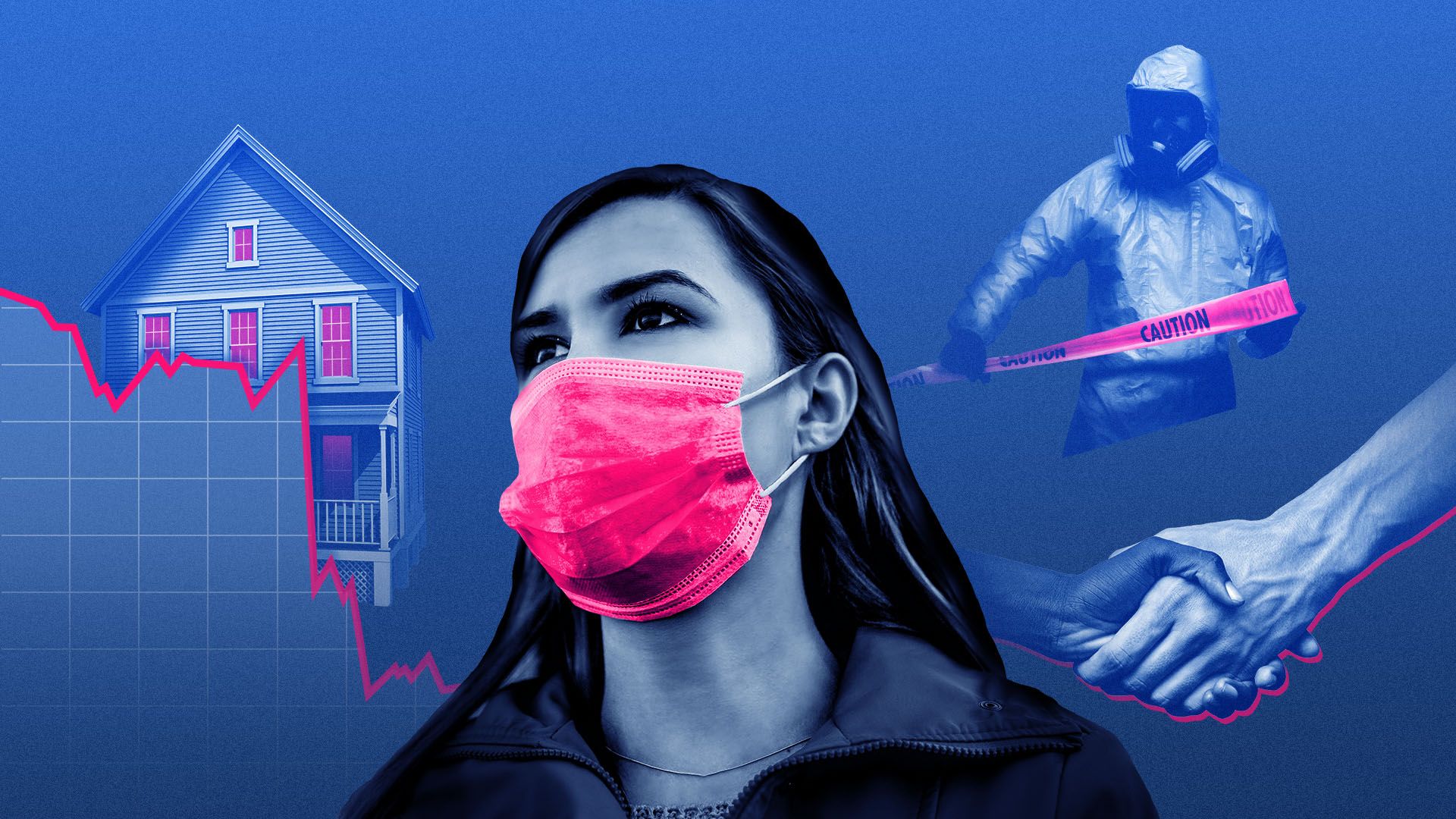
Illustration of a woman in a medical mask surrounded by a falling trend line, a house, a person in a hazmat suit with caution tape, and two hands shaking

The world that emerges from the coronavirus pandemic will be fundamentally different, Axios Future correspondent Bryan Walsh writes.

  • Why it matters: This crisis may prove to be as significant as the 2008 financial meltdown or even 9/11.
  • So the choices that businesses and governments are making now will have enormous social and economic ramifications.

The intrigue: U.S. health and government officials are facing the epidemiological equivalent of the “fog of war,” worsened by a massive American failure to act on weeks of warnings as the virus spread in China.

  • The Trump administration declared a national emergency yesterday, seven weeks after the first U.S. case was announced by the Centers for Disease Control and Prevention.
  • By failing to rapidly scale up testing, U.S. officials have added an additional — and partly unnecessary — layer of uncertainty about how to respond.
  • Harvard epidemiologist Michael Mina calls it “the most daunting virus that we’ve contended with in half a century or more.”

Flashback: As recently as the 1918 influenza pandemic, scientists lacked the ability to rapidly respond to an infectious disease outbreak.

  • Today, scientists can sequence a virus in days, develop rapid tests that can determine infection before obvious symptoms, and use complex mathematical models to predict future spread.

What we’ll find out in coming days:

  • The actual fatality rate of the virus.
  • How contagious it is, and the precise role that children — who seem outwardly unaffected by the disease — may play in transmission.
  • If the outbreak will naturally slow down when the weather warms, as tends to happen with influenza.

What’s next: For now, distance becomes the first line of defense. Schools and companies are shifting online — with potential consequences.

  • If companies are able to function relatively well with a largely remote workforce, expect lower levels of business travel.
  • After decades of emphasizing the efficiency of supply chains — which often meant complex international linkages and just-in-time inventories — businesses will look to build resilient supply chains.

The bottom line: The mobility — of people, capital and products — that we’ve taken for granted may not outlast the virus.


Great Leaders Are Thoughtful and Deliberate, Not Impulsive and Reactive

https://hbr.org/2019/04/great-leaders-are-thoughtful-and-deliberate-not-impulsive-and-reactive?utm_source=facebook&utm_medium=social&utm_campaign=hbr&fbclid=IwAR15xBzRuRJsKxkITe-z0wa1AwDMc_gwJmhM5r6ONnL7bw3s9zP8qRxYiEE

You set aside the first hour of your day to work on a strategy document that you’ve been putting off for a week. You haven’t been disciplined about getting to it, but you’ve had one crisis after another to deal with in the past week. Now, finally, you’ve carved out 90 early morning minutes to work on it.

First, however, you take a quick peek at the email that has piled up in your inbox overnight. Before you know it, you’ve used up the whole 90 minutes responding to emails, even though none of them were truly urgent.

By the time you walk into your next meeting, you’re feeling frustrated that you failed to stick by your plan. This meeting is a discussion with a direct report about the approach he’ll be taking in a negotiation with an important client. You have strong views about how best to deal with the situation, but you’ve promised yourself that you will be open and curious rather than directive and judgmental. You’re committed, after all, to becoming a more empowering manager.

Instead, you find yourself growing even more irritable as he describes an approach that doesn’t feel right to you. Impulsively, you jump in with a sharp comment. He reacts defensively. You worry for a moment — and rightly so — that you cut him off too quickly, but you tell yourself that you’ve worked with this client for years, the outcome is critical, and you don’t have time to hear your direct report’s whole explanation. He leaves your office looking hurt and defeated.

Welcome to the invisible drama that operates inside us all day long at work, mostly outside our consciousness. Most of us believe we have one self. In reality, we have two different selves, run by two separate operating systems, in different parts of our brain.

The self that we’re most aware of — the one that planned to work diligently on the strategy document and listen patiently to your direct report — is run by our pre-frontal cortex and mediated through our parasympathetic nervous system. This is the self we prefer to present to the world. It’s calm, measured, rational, and capable of making deliberate choices.

The second self is run by our amygdala, a small almond-shaped cluster of nuclei in our mid-brain and it is mediated by our sympathetic nervous system. Our second self seizes control any time we begin to perceive threat or danger. It’s reactive, impulsive, and operates largely outside our conscious control.

This second self serves us well if a lion is coming at us, but the threats we experience today are mostly to our sense of worth and value. They can feel nearly as terrifying as those to our survival, but the danger we experience isn’t truly life-threatening. Responding to them as if they are only make things worse.

It’s in these moments that we often use our highest cognitive capacities to justify our worst behaviors. When we feel we’ve fallen short, we instinctively summon up our “inner lawyer” — a term coined by author Jonathan Haidt — to defend us.

Our inner lawyer is expert at rationalizing, avoiding, deflecting, dissembling, denying, disparaging, attacking, and blaming others for our missteps and shortcomings. The inner lawyer works overtime to silence our own inner critic, and to counter criticism from others. All this inner turmoil narrows and consumes our attention and drains our energy.

The problem is that most organizations spend far more time focused on generating external value than they do attending to people’s internal sense of value. Doing so requires navigational skills that most leaders have never been taught, much less mastered. The irony is that ignoring people’s internal experience leads them to spend more energy defending their value, leaving them less energy to create value.

In our work with leaders, we’ve discovered that the antidote to reacting from the second self is to develop the capacity to observe our two selves in real time. You can’t change what you don’t notice, but noticing can be a powerful tool for shifting from defending our value to creating value.

A well-cultivated self-observer allows us to watch our dueling selves without reacting impulsively. It also makes it possible to ask our inner lawyer to stand down whenever it rises up to argue our case to our inner and outer critics. Finally, the self-observer can acknowledge, without judgment, that we are both our best and our worst selves, and then make deliberate rather than reactive choices about how to respond in challenging situations.

To improve your capacity to self-observe, begin with negative emotions such as impatience, frustration, and anger. When you feel them arising, it’s a strong signal that you’re sliding into the second self. Simply naming these emotions as they arise is a way to gain some distance from them.

Also, watch out for times when you feel you’re digging in your heels. The absolute conviction that you’re right and the compulsion to take action are both strong indicators that you‘re feeling a sense of threat and danger.

In our work, we provide leaders with small daily doses of support — reminders to pay attention to what they’re feeling and thinking.  We’ve also found it helpful to build small groups that meet at regular intervals so leaders can share their experiences. A blend of support, community, connection and accountability helps offset our shared impulse to stop noticing, push away discomfort, and revert to survival behaviors in the face of perceived threats to our value. A good starting place is to find a colleague you trust to be your accountability partner, and to seek regular feedback from one another.

Finally, it’s important to ask yourself two key questions in challenging moments: “What else could be true here?” and “What is my responsibility in this?” By regularly questioning your conclusions, you’re offsetting your confirmation bias — the instinct to look for evidence that supports what you already believe. By always looking for your own responsibility, you’re resisting the instinct to blame others and play victim and focusing instead on what you have the greatest ability to influence — your own behavior.

A deceptively simple premise lies at the heart of this deliberate set of practices: see more to be more. Rather than simply getting better at what they already do, transformational leaders balance courage and humility in order to grow and develop every day.