Health officials say omicron variant likely to cause record-high coronavirus cases, hospitalizations in U.S.

Top government health officials on Sunday warned that the United States will probably see record numbers of coronavirus cases and hospitalizations as the omicron variant spreads rapidly and forces Americans to again grapple with the dangers of a pandemic that has upended life around the globe.

“Unfortunately, I think that that is going to happen. We are going to see a significant stress in some regions of the country on the hospital system, particularly in those areas where you have a low level of vaccination,” Anthony S. Fauci, the nation’s leading infectious-disease specialist, said on CNN’s “State of the Union” when asked whether the United States could see record numbers of cases, hospitalizations and deaths.

Fauci described the variant as “extraordinary” in its transmissibility, with a doubling time of two to three days. It accounts for 50 percent of coronavirus cases in parts of the country, which meant it would almost certainly take over as the dominant variant in the United States, he added.

“It is going to be a tough few weeks, months, as we get deeper into the winter,” Fauci said.

On CBS News’s “Face the Nation,” Francis Collins, director of the National Institutes of Health, said that cases will rise steeply over the next couple of weeks and that the country could soon see 1 million new cases a day tied to the omicron variant, dramatically exceeding the record of about 250,000 new cases per day set in January.

“The big question is, are those million cases going to be sick enough to need health care and especially hospitalization?” Collins said. “We’re just holding our breath to see how severe this will be.”

Fauci and Collins painted a stark but realistic picture of the winter ahead, on the heels of a week of coronavirus-related setbacks. Coronavirus cases, hospitalizations and deaths rose across much of the country last week, with officials warning of a surge just as millions of Americans — already weary after nearly two years of the pandemic — are expected to travel for Christmas and New Year’s. On Friday, Pfizer and BioNTech announced that coronavirus vaccines for children younger than 5 would be pushed back further into 2022, as the companies modified their trials to include a third dose. On Sunday, New York, one of the country’s early epicenters in the pandemic, reported 22,478 cases.

Health officials have continued to urge the unvaccinated to get their shots and those who have received only two doses of either the Pfizer or Moderna mRNA vaccines to get booster doses. Vaccines cannot be the only layer of protection against the omicron variant, Fauci said, but defeating the pandemic would not be possible without them.

There are still safe ways for vaccinated people to get together for the holidays, including wearing a mask while traveling, testing beforehand and knowing the vaccination status of everyone present at indoor celebrations, Fauci said on “Face the Nation.”

“If you do these things, I do believe that you can feel quite comfortable with a family setting,” he said. “Nothing is 100 percent risk-free, but I think if you do the things that I just mentioned, you’d actually mitigate that risk enough to feel comfortable about being able to enjoy the holiday.”

Collins stopped short of urging people to cancel holiday plans but said travel will be risky even for vaccinated people.

“This virus is going to be all around us,” he said. “I’m not going to say you shouldn’t travel, but you should do so very carefully. … People are going, ‘I’m so sick of hearing this,’ and I am, too. But the virus is not sick of us, and it is still out there looking for us, and we’ve got to double down on these things if we’re going to get through the next few months.”

Doctors, nurses and others are warning that the nation’s health system continues to be strained by an unending stream of coronavirus cases. Confirmed U.S. coronavirus infections have surpassed more than 128,000 per day and confirmed virus deaths are near 1,300 per day, according to The Washington Post’s rolling seven-day average.

“For people trained to save lives, this moment is frustrating, exhausting and heartbreaking,” the American Hospital Association, the American Medical Association and the American Nurses Association said in a joint statement on Friday, urging more Americans to get booster shots.

Public health experts are bracing for a winter surge of cases driven by the omicron variant, which can evade some protection conferred by vaccinations and prior infections, as well as cases linked to the delta variant. Officials caution that they are still relying on preliminary data about the omicron variant’s severity compared with earlier forms of the virus.

President Biden plans to address the nation Tuesday on the status of the country’s fight against the virus, the White House said Saturday.

“We are prepared for the rising case levels,” White House press secretary Jen Psaki wrote on Twitter, adding that Biden “will detail how we will respond to this challenge. He will remind Americans that they can protect themselves from severe illness from COVID-19 by getting vaccinated and getting their booster shot when they are eligible.”

The speech, coming just before Christmas and New Year’s Day, underlines Biden’s struggle to contain the pandemic nearly a year into office. On top of the emergence of new variants and attendant challenges, the administration has at times faced criticism for what some have described as mixed signals.

Biden won high marks from the public during the first half of the year as cases declined, the country opened up from shutdowns and vaccines became widely available. But the past few months have been more difficult. After he gave a speech on July 4 saying the country was “closer than ever to declaring our independence from a deadly virus,” the situation started changing. Case rates increased as the delta variant gained a foothold and many Americans refused to get vaccinated.

And despite Biden’s promise that at-home rapid tests would become a widely available tool to fight the coronavirus, the tests remain hard to find in many parts of the country and are more expensive than in some other places across the globe.

Fauci conceded Sunday that the administration needed to do better on increasing the availability of at-home coronavirus rapid tests, though he emphasized that the country was in a much better place than it was a year ago, with 200 million to 500 million tests available per month, many of them free.

“We’re going in the right direction,” he said on CNN. “We really need to flood the system with testing. We need to have tests available for anyone who wants them, particularly when we’re in a situation right now where people are going to be gathering.”

The omicron variant also has challenged the nation’s coronavirus medicine cabinet, with evidence that mutations will wipe out or weaken the effectiveness of treatments that can reduce the virus’s severity and keep people out of hospitals. As a result, the Biden administration around Thanksgiving paused distribution of sotrovimab, the one monoclonal antibody that remains effective against the omicron variant, with senior officials such as David Kessler calculating that the drug should be maximally deployed when the variant becomes more prevalent.

By Thursday, administration officials decided to resume shipments of the drug, amid indicators that the omicron variant was spreading faster in states such as New York and Washington than data published by the Centers for Disease Control and Preventionearlier in the week indicated, said two officials with knowledge of the deliberations.

“Shipment of product will begin soon, and jurisdictions will see product arrive as early as Tuesday, December 21, 2021,” the federal health agency said in a statement on Friday, announcing that about 55,000 doses of sotrovimab would soon go out.

Doctors said they were desperate for treatments like sotrovimab as emergency rooms begin to crowd and case numbers soar.

“Too slow! We are already seeing widespread omicron,” texted one infectious-disease doctor at a large New York City hospital, who estimated that at least 50 percent of patients had contracted the variant and requested confidentiality to discuss patient care. “It’s a lot of hospitalizations that could have potentially [been] averted because of slow response.”

Fauci said Sunday that he expected it to be months before antiviral drugs can be mass-produced and available to anyone who needs them. While he did not foresee the kind of shutdowns that were put in place in the early days of the pandemic, Fauci also noted that it would be difficult to keep the virus under control when there remained “about 50 million people in the country who are eligible to be vaccinated who are not vaccinated.”

Similarly, several governors on Sunday shied away from the possibility of implementing more shutdowns to fight the spread of the new variant. Maryland Gov. Larry Hogan (R) said on “Fox News Sunday” that his state, which has seen a 150 percent increase in hospitalizations over the past two weeks, was not considering shutdowns and instead was putting more resources into testing and encouraging vaccinations and boosters. New Jersey Gov. Phil Murphy (D) said on the same show that shutdowns remained “on the table” but that he didn’t think such a move was likely because a high percentage of the state’s population was vaccinated.

Colorado Gov. Jared Polis (D) emphasized that people in his state should keep themselves safe with “individual freedom and local control.” He also said Colorado officials were looking to change the definition of “fully vaccinated” to include three shots, as health officials in the country and around the world have signaled in recent days they are also considering.

“That’s certainly where it’s headed,” Polis said on NBC News’s “Meet the Press.” “I wish they’d stop talking about [the third shot] as a booster. It really is a three-dose vaccine.”

CDC: Omicron accounted for 73% of recent COVID-19 cases

COVID testing in NYC

The Omicron variant accounted for more than 73% of recent COVID-19 cases in the U.S., according to Centers for Disease Control and Prevention’s updated data released on Monday.

The big picture: The data showed nearly a six-fold increase in Omicron’s share of COVID-19 infections in just one week.

What they’re saying: “These numbers are stark, but they’re not surprising,” said Rochelle Walensky, the CDC’s director, adding that the growing infections reflect what has been seen in other countries.

  • While the Delta variant still drives up a lot of new infections, Walensky told AP she anticipates “that over time that Delta will be crowded out by Omicron.”

What’s next: President Biden on Tuesday will deliver a speech outlining new steps the administration will take to address the rapid spread of the new variant.

What should you take if you get Covid-19? 

https://link.vox.com/view/608adc4e91954c3cef03e60dfi7ya.jor/68bd1086

Hey readers, 

Last week, Florida Surgeon General Joseph Ladapo released a public service announcement talking about protecting your health from Covid-19. The PSA stood out for a couple of reasons:

1. While “vaccination” briefly appeared onscreen in a list of options, it didn’t merit a mention in the video.

2. The surgeon general listed guidance on “emerging” treatments that was … remarkably on point.

The absence of focus on vaccines in the video is unfortunate, if entirely in keeping with the GOP’s willingness to play to its anti-vax base. That’s bad, but not surprising.

What was surprising was No. 2. The information Ladapo shared about treatments was fairly accurate. In the video, he told Floridians to ask their doctor about monoclonal antibodies, fluvoxamine, and inhaled budesonide should they come down with Covid-19. 

I’ve been reporting on the Covid-19 treatment beat for much of this year, and I’ve uncovered a massively confusing pile of contradictory information. But those are the top three treatments I’d recommend sick loved ones talk to doctors about, and while there’s much we still don’t know, solid science suggests they have real promise.

That said, the fact that such important (and accurate) information stood out in a government PSA indicates just how dismal the state of public communications on treatments is — and just how much misinformation and distrust are hampering the fight against Covid-19. 

What should you take if you get Covid-19? 

There’s been little public health communication about which treatments to pursue if you get Covid-19, perhaps because for much of the pandemic, it’s been unclear what options are better for mild Covid than just resting at home. While in 2021 the best treatment recommendations have gotten clearer, public health messaging over the last year has rightly been focused on vaccination.

The official CDC page on what to do if you get sick with Covid-19 advises you to wear a mask, wash your hands, and clean high-touch surfaces to avoid infecting those around you. If your breathing deteriorates or you show signs of severe illness like confusion or an inability to stay awake, the CDC advises you to go to the hospital. 

All sound guidance — but what it doesn’t offer is advice on a question that patients who aren’t sick enough for hospitalization might desperately need to know: What medication should I take if I come down with Covid-19? 


That’s not because there’s a lack of options. For instance, the FDA has approved monoclonal antibodies as a treatment for Covid-19 patients at risk of progressing to severe disease. They recently expanded this approval to include monoclonal antibodies for children as well. The treatment has to be administered in a clinic, as an IV infusion or as four shots, but it is highly effective, with some high-quality studies finding an 85 percent reduction in the risk of hospitalization or death.

Meanwhile, large, high-quality, peer-reviewed, and published randomized controlled trials (RCTs) have found promise for cheap therapies that are already FDA approved for other purposes and have an established safety profile. 

One medication, fluvoxamine, is an antidepressant that appears to reduce hospitalizations from Covid-19 by about 30 percent. Another, budesonide asthma inhalers, was found in one large RCT to speed at-home recovery considerably and in another to reduce risk of hospitalization. In the US, there’s been no formal guidance on when to consider budesonide, but in the UK, health agencies have advised doctors they can consider prescribing it off-label to help older and at-risk patients recover at home, while in Canada doctors are encouraged to consider budesonide on a case-by-case basis.

Research underway will help provide a better understanding of both of these therapies, but there’s enough evidence that some doctors are already prescribing them to patients. If you have the opportunity to enroll in an ongoing clinical trial of these medications, you can get access to a potentially promising treatment and help contribute to our scientific understanding of whether these treatments really work.

Another exciting treatment in the pipeline is Paxlovid, an antiviral developed by Pfizer that showed impressive 90 percent efficacy in preventing hospitalization — so effective that in November, the clinical trial stopped enrolling new participants because investigators concluded it’d be unethical to put them in the control group. It has not yet been approved by the FDA, but it might be a game changer if, as is expected, it’s approved in January.

The FDA is also in the process of considering molnupiravir, another repurposed drug that looks to be moderately effective, though there are some concerns it could spur new viral variants.

Why is it so hard to find good guidance about treatments?

The US government has communicated little about Covid-19 treatment options. NIH guidelines about treatments like fluvoxamine haven’t been updated since this past spring, meaning results from recent high-quality studies haven’t been incorporated into that guidance. Without it, physicians considering whether to prescribe these medications can’t turn to official public health resources for help. 


From a certain perspective, that reticence is understandable. Learning which Covid-19 treatments work is very hard. While large-scale RCTs found promising evidence for fluvoxamine and inhaled budesonide, “promising” is still the most we can say — it could absolutely turn out that the real-world effects are much smaller than hoped for, or even fail to materialize altogether.

But it’s precisely because this area is so difficult to navigate for doctors and patients that the CDC, FDA, and NIH could play an important role in pointing out good treatments — yet it’s a role they have been puzzlingly reluctant to play.

Perhaps because of the dearth of formal federal government guidance on treatments — and because of politically driven crazes over drugs like hydroxychloroquine and ivermectin, which evidence thus far suggests do little to fight Covid-19 — Florida media has been critical of Ladapo’s PSA and its recommendations.

Politicians who pander to anti-vax sentiment are harming their constituents, and it’s very reasonable to be frustrated with their conduct. Ladapo is a DeSantis appointee who has forcefully opposed Covid-19 restrictions — and has refused to wear a mask in meetings with immunocompromised legislators — and lots of people are reasonably reading his PSA in that light. 

But that justified irritation shouldn’t get in the way of a needed conversation about the possible benefits and drawbacks of monoclonal antibodies, fluvoxamine, and budesonide. As the US braces for an omicron surge that is likely to hit even vaccinated people, effective treatment is going to be essential for saving lives. Yes, promoting vaccines is a must, but tens of thousands of Americans are getting sick each day, which makes clear, accurate communication about which treatments to ask your doctor about extremely important. 

The more society and public health get aligned on what works, the better off we’ll be in confronting omicron and other future variants.

Michigan this week counted more people hospitalized with COVID-19 than at any other time during the pandemic

https://www.cnn.com/2021/12/09/us/hospital-covid-19-deaths-michigan/index.html

Coronavirus: Michigan's highest-in-the-U.S. case count exceeds California,  Texas combined | CTV News

Nurse Katie Sefton never thought Covid-19 could get this bad — and certainly not this late in the pandemic. “I was really hoping that we’d (all) get vaccinated and things would be back to normal,” said Sefton, an assistant manager at Sparrow Hospital in Lansing, Michigan. But this week Michigan had more patients hospitalized for Covid-19 than ever before. Covid-19 hospitalizations jumped 88% in the past month, according to the Michigan Health & Hospital Association.

“We have more patients than we’ve ever had at any point, and we’re seeing more people die at a rate we’ve never seen die before,” said Jim Dover, president and CEO of Sparrow Health System.

“Since January, we’ve had about 289 deaths; 75% are unvaccinated people,” Dover said. “And the very few (vaccinated people) who passed away all were more than 6 months out from their shot. So we’ve not had a single person who has had a booster shot die from Covid.”

Among the new Covid-19 victims, Sefton said she’s noticed a disturbing trend.

We’re seeing a lot of younger people. And I think that is a bit challenging,” said Sefton, a 20-year nursing veteran.She recalls helping the family of a young adult say goodbye to their loved one. “It was an awful night,” she said. “That was one of the days I went home and just cried.”

‘We haven’t peaked yet’

It’s not just Michigan that’s facing an arduous winter with Covid-19. Nationwide, Covid-19 hospitalizations have increased 40% compared to a month ago, according to data from the US Department of Health and Human Services. This is the first holiday season with the relentless spread of the Delta variant — a strain far more contagious than those Americans faced last winter.

“We keep talking about how we haven’t peaked yet,” Sefton said.Health experts say the best protection against Delta is to get vaccinated and boosted. But as of Thursday, only about 64.3% of eligible Americans had been fully vaccinated, and less than a third of those eligible for boosters have gotten one.

Sparrow Hospital nurse Danielle Williams said the vast majority of her Covid-19 patients are not vaccinated — and had no idea they could get pummeled so hard by Covid-19.“Before they walked in the door, they had a normal life. They were healthy people. They were out celebrating Thanksgiving,” Williams said. “And now they’re here, with a mask on their face, teary eyed, staring at me, asking me if they’re going to live or not.”

‘The next few weeks look hard’

Dover said he’s saddened but not surprised that his state is getting walloped with Covid-19.“Michigan is not one of the highest vaccination states in the nation. So it continues to have variant after variant grow and expand across the state,” he said.

“The next few weeks look hard. We’re over 100% capacity right now,” Dover said.”Most hospitals and health systems in the state of Michigan have gone to code-red triage, which means they won’t accept transfers. And as we go into the holidays, if the current growth rate that we’re at today, we would expect to see 200 in-patient Covid patients by the end of the month — on a daily basis.”And that would mean “absolutely stretching us to the breaking point,” Dover said.”We’ve already discontinued in-patient elective surgeries,” he said. “In order to create capacity, we took our post-anesthesia recovery care unit and converted it into another critical care unit.”

‘There’s a lot of frustration’

Nurse Leah Rasch is exhausted. She’s worked with Covid-19 patients since the beginning of the pandemic and was stunned to see so many people still unvaccinated enter the Covid unit.

“I did not think we’d be here. I truly thought that people would be vaccinated,” the Sparrow Hospital nurse said.”I don’t remember the last time we did not have a full Covid floor.”The relentless onslaught of Covid-19 patients has impacted Rasch’s own health. “There’s a lot of frustration,” she said. “The other day, I had my first panic attack … I drove to work and I couldn’t get out of the car.”

‘We need everybody to get vaccinated’

Dover said many people have asked how they can support health care workers.”If you really want to support your staff, and you really want to support health care heroes, get vaccinated,” he said. “It’s not political. We need everybody to get vaccinated.”

He’s also urging those who previously had Covid-19 to get vaccinated, as some people can get reinfected.”My daughter’s a good example. She had Covid twice before she was eligible for a vaccine,” Dover said. “She still got a vaccine because we know that if you don’t get the vaccine, just merely having contracted Covid is not enough to protect you from getting it again. And I know that from personal experience. “And those who are unvaccinated shouldn’t underestimate the pandemic right now, Dover said.

“The problem is, it’s not over yet. I don’t know if people realize just how critical it still is,” he said.”But they do realize it when they come into the ER, and they have to wait three days for a bed. And at that point, they realize it.”

Americans Are Already Over Omicron

https://view.newsletters.time.com/?qs=5b1b0210a9c0c6052e991fca0f304c50728dc4fa7e9bd80a730492ab7976421ba3ed7c38d7503d4b37e904c3ff5e8bfe48500d64b3838149189f24c10f3605bc9f361596380fa0c3fa7c7f3217d03d57

Most Americans have heard of the Omicron variant, few are very familiar |  Ipsos

Americans seem to be greeting the Omicron variant with a collective “eh,” according to new polling data from Axios/Ipsos.

Compared to other COVID-19 strains, Omicron seems to be extra transmissible and possibly more likely to cause breakthrough infections, at least based on preliminary data. As of Dec. 8, 22 U.S. states had reported at least one case related to the variant. But despite the early panic about the variant, most people surveyed by Axios/Ipsos in early December said they weren’t going to make big changes to their behavior. Specifically, the poll found that just:

  • 33% of surveyed U.S. adults are likely to stop dining inside restaurants
  • 28% are likely to stop gathering with people outside their households
  • 23% are likely to cancel holiday travel plans
  • 13% are likely to stop going to work in person

It’s hard to blame people. At this point in the pandemic, it’s safe to say everyone is tired and ready to be done with COVID-19. Plus, 60% of the U.S. population is now fully vaccinated, and thus, based on what we’ve seen so far, largely protected from the worst the virus can do. People who have received a booster dose are in an even better position, given early reports that boosters hold up well against Omicron.

Americans are also, to some degree, doing what public figures told them to do. President Joe Biden called Omicron “a cause for concern—but not a cause for panic.” And many health officials have jumped to assure the public that we are not going back to square one, thanks to the protection offered by vaccines.

The caveat, however, is that we’re still learning about Omicron. Early indications suggest the variant does not cause more severe disease than other variants, but it’s too soon to say that definitively. If it does turn out to be highly contagious, good at outsmarting vaccines and capable of causing serious disease, we may have to return to some precautions, for the sake of individuals and our overburdened health care system. The variant is already taking root in Europe, which may be a harbinger of what’s to come here.

The good news? The Axios/Ipsos poll did find that most Americans are still willing to step up and take protective measures when necessary. More than 60% said they were likely to go back to (or continue) always masking in public, and almost 70% said they’d support businesses requiring customers to wear masks.

A tale of two New Yorks: COVID-19 hospitalization rate surging upstate

https://www.yahoo.com/gma/tale-two-yorks-covid-19-100301204.html

COVID-19-related hospitalizations have been on an upward trend in New York state since last month, but there appears to be a drastic divide between the Big Apple and some of the state’s more rural areas, health data shows.

In New York City, the seven-day average of new COVID-19 hospitalizations per 100,000 people rose from 0.5 on Nov. 10 to 1.1 on Dec. 7, the New York State Department of Health said.

The story is different in several counties hundreds of miles north, where new COVID-19 hospitalizations are rising at a higher rate. In the Finger Lakes region, officials in several counties declared a state of emergency after the seven-day average of new COVID-19 hospitalizations per 100,000 people went from 2.9 on Nov. 10 to 4.9 on Dec. 7.

David Larsen, an associate professor of public health at Syracuse University, told ABC News that there are several factors behind this divide, but the most important one is the lower vaccination rates in certain counties upstate.

“At the end of the day, you’re more likely to get severe COVID-19 symptoms and go to the hospital if you’re not vaccinated,” Larsen said.

Health experts and state officials predict the situation upstate is only going to get worse during the holidays and colder months, but the tide can be turned if more people get their shots and heed health warnings.

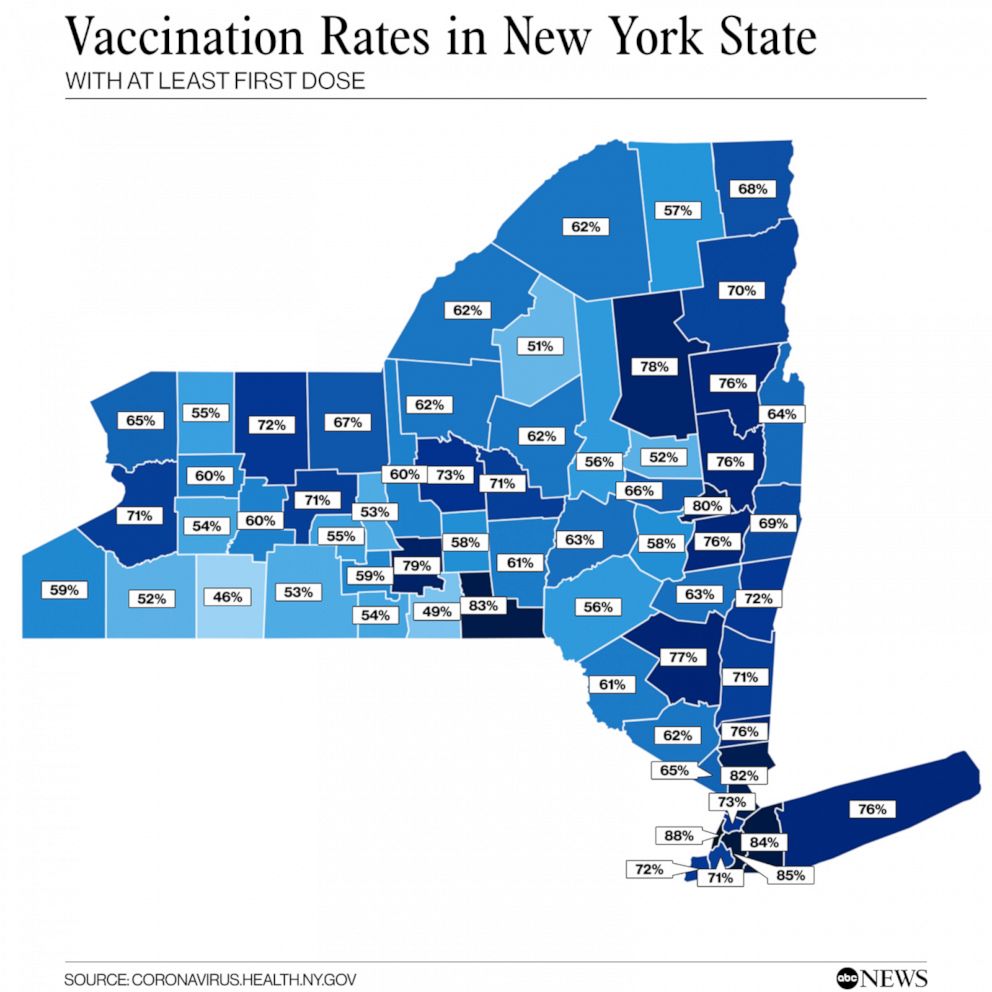
As of Dec. 8, 74.9% of all New York state residents have at least one COVID-19 vaccine dose, but those numbers vary by region, according to state health data.

New York City and Long Island had over 78% of their populations with at least one shot, the state data showed. Further north, the rates for at least one dose in the Mohawk Valley, the Finger Lakes and North Country sections were 60.6%, 68.5%, and 63% respectively.

There is even more division within the regions when it comes to vaccination, the data shows; for example, counties that are along the Interstate 87 corridor, such as Hamilton, Schenectady and Saratoga, all have rate of at least one dose above 75% of their populations.

Counties directly west of those locations, Schoharie, Fulton and Montgomery, have one-dose vaccination rates under 65%, the state data showed.

New York Gov. Kathy Hochul has repeatedly highlighted that the unvaccinated are the ones suffering and being hospitalized.

“It is a conscious decision not to be vaccinated. And the direct result is a higher rate of individuals in those regions upstate as well as it has a direct correlation to the number of hospitalizations,” she said during a Dec. 2 news conference.

Dr. Isaac Weisfuse, an adjunct professor of public health at Cornell University, told ABC News that there are fewer options for upstate residents to turn to for medical help and fewer hospitals in the area are handling patients from more locations.

Weisfuse, a former deputy health commissioner for New York City’s Health Department, noted that New York City residents have much closer access to amenities like free testing sites and medical clinics than their upstate counterparts.

“If you live in a rural county in New York state and it takes a while to get to a doctor, you may put it off. So when you do eventually go get care, you may be sicker versus someone who lives closer and gets a quicker diagnosis,” he said.

Larsen added that there has been pandemic fatigue across the country, and many Americans have scaled back on mitigation measures, especially mask-wearing indoors.

While New York City requires proof of vaccination for indoor activities, such as movie theaters and restaurants, there are no such rules in many upstate counties. As a result, some upstate residents have less of an incentive to get their shots, and are less cautious in indoor group settings, according to Larsen.

PHOTO: A sign asks for proof of COVID-19 vaccination in Manhattan at the entrance to a museum on Nov. 29, 2021, in New York City. (Spencer Platt/Getty Images)

“We’re doing less mask wearing. What that does is it increases transmission, which is fine for the vaccinated people but it does go to the unvaccinated people and they are higher risk,” he said.

Weisfuse said the hospitalizations are likely to grow upstate and have ripple effects for those regions. The governor has ordered elective surgeries to be postponed at 32 hospitals upstate that have seen their available beds decrease.

PHOTO: Tse Cowan, 8, winces as he is administered the Pfizer COVID-19 vaccine at a pop-up vaccine site at P.S. 19 on Nov. 08, 2021 in the Lower East Side of New York City. (Michael M. Santiago/Getty Images)

State officials said they are beefing up their marketing efforts to encourage eligible New Yorkers to get their shots.

Weisfuse said this outreach needs to be done meticulously if upstate officials want to avoid more overcrowded emergency rooms this winter.

“The state needs to take a good look at the pockets of non-vaccination,” he said. “They need to make some targeted intervention in those neighborhoods.”

Anyone who needs help scheduling a free vaccine appointment can log onto vaccines.gov.

First known U.S. case of the Omicron variant identified in California

First confirmed US case of Omicron coronavirus variant detected in  California | Coronavirus | kwwl.com

The first known U.S. case of the Omicron variant was detected in California, the Centers for Disease Control and Prevention confirmed Wednesday.

Driving the news: The confirmed case was detected in a traveler returning from South Africa who was fully vaccinated and has mild symptoms, according to the CDC.

  • Anthony Fauci, the director of the National Institute of Allergy and Infectious Diseases, had previously cautioned that the Omicron would “inevitably” be found in the U.S.

What they’re saying: “The recent emergence of the Omicron variant … further emphasizes the importance of vaccination, boosters and general prevention strategies,” the CDC said in a statement.

  • “We know what we need to do to protect people,” Fauci said following the announcement. “Get vaccinated if you’re not already vaccinated.”

The big picture: Since the variant was first identified by scientists in South Africa earlier last month, Omicron cases have been confirmed across Europe, Canada, Israel, Hong Kong and Australia, among other countries.

Covid Natural Immunity vs Vaccine Immunity

Covid Natural Immunity vs Vaccine Immunity | The Incidental Economist

There’s a lot of talk about “natural immunity” to Covid-19, and some people are refusing vaccination on the grounds that they’ve got this natural immunity thanks to a previous Covid-19 infection. In this episode we take a look at how infection and vaccination compare in terms of immunity, reinfection, and overall health risks and benefits.

Gottlieb: ‘A pretty good degree of confidence’ people with three doses are protected from omicron

https://thehill.com/policy/healthcare/583280-gottlieb-a-pretty-good-degree-of-confidence-that-people-with-three

Sunday shows - Spotlight shifts to omicron variant | TheHill

Former Food and Drug Administration (FDA) Commissioner Scott Gottlieb on Sunday said vaccine developers have “a pretty good degree of confidence” that fully vaccinated individuals who have received a COVID-19 booster are protected against the omicron variant.

Appearing on CBS’s “Face the Nation,” Gottlieb said that there is no indication that the omicron variant first detected in South Africa makes individuals more ill than other previously detected variants, and that there have been anecdotal accounts of people experiencing mild cases of COVID-19, though he pointed out that initial cases appear to have been clustered among young people.

“The question here is going to be whether or not a fully boosted individual someone who’s had three doses of vaccine has good protection against this variant right now,” said Gottlieb, who now sits on Pfizer’s board of directors.

“If you talk to people in vaccine circles, people who are working on a vaccine, they have a pretty good degree of confidence that a boosted vaccine, so three full doses of vaccine, is going to be fairly protective against this new variant,” said Gottlieb.

However, Gottlieb stressed that data on the omicron data is sparse, with no clinical studies or test tube studies having been completed. He estimated that studies testing the blood of vaccinated people against the omicron variant could be out by the end of this week or some time next week.

“Now, I would expect that those studies are going to show that the neutralization against this virus declined substantially. But that doesn’t mean that the vaccines won’t be effective,” he said.

How to Talk about Vaccines at Thanksgiving

May be an image of 6 people and text that says 'How to talk about vaccines at Thanksgiving The big thing to know when talking to family and friends about vaccine falsehoods during the holidays: It's better to respond with facts than to offer corrections.'

“Please pass the green beans.” “What kind of pie is that?”“What about spike proteins!?”These are some of the phrases that may be uttered during your Thanksgiving and holiday dinners this season. But! We have prepared a glossary for you. Swipe through a quick guide to some of the most misused terms around vaccines that PolitiFact has noticed in our fact-checking. And because we know that shouts of “that’s wrong!” don’t go over smooth like gravy, we’re including an expert’s advice on how to talk about vaccine falsehoods with family and friends.The big thing to know: It’s better to respond with facts than to offer corrections.”If they said something like ‘the vaccine is dangerous,’ include a statistic about how 75% of the people in their state have gotten vaccinated and none have died, or how severe and dangerous COVID-19 is,” said Rupali Limaye, an associate scientist at Johns Hopkins School of Public Health. “And, ultimately, make sure you’re saying it all with empathy.”

May be an image of text that says '"Spike protein" The human body and other organisms are made up of a variety of proteins, and SARS-COV-2, the virus that causes COVID-19, has its own. The virus' spike protein, which allows the virus to penetrate cells and cause infection, has sharp bumps that protrude from the surface of the virus' outer envelopes. COVID-19 vaccines introduce a piece of the protein- but not the harmful part of the virus which the immune system quickly identifies, attacks and destroys as a foreign invader.'
May be an image of text that says '"mRNA" The Pfizer and Moderna COVID-19 vaccines use messenger RNA to deliver an instruction manual to cells for making the coronavirus' spike protein. They're different from conventiona vaccines that use part of a bacterium or virus to induce protein production. The mRNA is fragile and quickly broken down in the body once the cells learn the blueprint, which is usually within three days of receiving the vaccine. The molecule does not we repeat, does not enter the nucleus of cells and alter a person's DNA.'
May be an image of text that says '"VAERS" VAERS stands for the Vaccine Adverse Effects Reporting System, a critical reporting tool for the federal government to collect and analyze data on after-effects from all vaccines, not just COVID-19. Unlike other government data sources, VAERS is designed so that anyone- parents, patients and health care professionals can report health effects that occur after a vaccination, whether or not those effects were caused by the vaccine. The reports aren't verified before they're entered, and anyone with a computer can access the data.'
May be an image of text that says '"Syncytin-1" Syncytin-1, a protein found in humans and some animals, is most known for helping develop the placenta, the temporary organ that helps nourish a fetus during pregnancy. Syncytin-1 and the coronavirus spike protein have almost nothing in common, making the vaccine highly unlikely to trigger a reaction. "If someone says they heard the vaccine causes infertility, would just respond with something direct- like that there are no studies that show a link between the vaccines and infertility Zero," an expert said.'
May be an image of text that says '"Ivermectin" vermectir is an anti-parasitic medication that has been widely touted as a COVID-19 treatment despite health authorities warning against COVID-19 patients self-medicating with the drug. When people started to believe it could treat COVID- 19, some of them ingested forms of the drug made for animals, causing a dramatic uptick in calls to poison control. Officials warn that more research is still needed on ivermectin's effectiveness as a COVID-19 treatment.'
May be an image of text that says 'A final word about words The best way to talk through different views on vaccines with loved ones is by making your point in a personal context that takes the focus off them. "Think of family member they want to protect, so it's not all about them," said Rupali Limaye, an associate scientist at Johns Hopkins School of Public Health." "Like 'Hey, I'm really concerned about grandma and just want to make sure we are doing all we can to protect her. It leaves the pressure off them but they still have some skin in the game."'