
The Press Is Beginning to Take Notice of How Health Insurers Are Raiding The Medicare Trust Fund

Sometimes a health policy story comes along that should be shouted from the rafters — well at least reported by media that cover the subject. Brett Arends’ story for Dow Jones’ MarketWatch is one of those stories. 

In “Medicare Advantage is overbilling Medicare by 22%,” Arends introduces readers to a government agency that in its latest report exposed Medicare Advantage plans to light.

The revelations about overpayments come from the Medicare Payment Advisory Commission, MedPAC for short, some of whose recommendations over the years have resulted in high rate increases for Advantage plan sellers that helped make it possible for them to offer groceries, bits of dental care, and other goodies seniors have snapped up. The media’s role in revealing and dissecting those overpayments is long overdue.

The last several months news outlets have been paying more attention to the downsides of Medicare Advantage plans.

Arends’ story focused on one thread in the story: MedPAC’s latest report to Congress that revealed something health policy wonks — but not the public — have known for a long time. Medicare Advantage plans are taking advantage of the federal gravy train.

“The private insurers who now run more than half of all Medicare plans are overcharging the taxpayers by a staggering $83 billion a year,” Arends wrote. “They are charging us taxpayers 22% more than it would cost us to provide the same health insurance to seniors directly if we just cut out the private insurance companies as middlemen.”

MedPAC was set up by the Balanced Budget Act of 1997, “back when people in Washington were actually doing their jobs,” Arends points out. The commission’s job is to advise Congress on issues involving Medicare. MedPAC reports discuss the financial situation of the Medicare trust funds, and over the years those reports often revealed that the private health plans have been overpaid. Until recently, there has been little to no pushback from the government or most of the media, in effect leaving the insurance industry a clear path to sell Medicare Advantage plans to more than half of the Medicare market. The media have recently begun to ask why. 

Arends calls the Medicare Advantage arrangement “a rip-off, pure and simple,” noting that what sellers of the plan are paid “is more than twice as much as it would cost simply to provide free dental, hearing and vision care to all traditional Medicare beneficiaries, not just those in private ‘Medicare Advantage’ plans.”

I have covered Medicare for decades now and have often asked the experts why there couldn’t be a level playing field that would allow beneficiaries in the traditional program to receive vision and dental benefits. The answer was always, “We can’t afford that.” 

Arends debunks that thinking by directly quoting the MedPAC report:

“It reads: ‘We estimate that Medicare spends approximately 22 percent more for MA enrollees than it would spend if those beneficiaries were enrolled in FFS (fee for service or traditional) Medicare, a difference that translates into a projected $83 billion in 2024.’ MedPAC reported that its review of private plan payments suggests that over the 39-year history with private plans, they “have never yielded aggregate savings for the Medicare program. Throughout the history of Medicare managed care, the program (Medicare Advantage) has paid more than it would have paid if beneficiaries had been in FFS (fee for service) Medicare.”

I checked in with Fred Schulte, who now writes for KFF Health News, and who over his career has written many prize-winning stories documenting the shenanigans insurers have used to enhance their reimbursements from Medicare, such as upcoding. That’s the practice of billing Medicare for ailments that are more serious than what patients actually have. “For example, instead of reporting a patient has diabetes, the insurers would say diabetes with neuropathy or eye problems and receive higher reimbursement,” he explained.

“It took a very long time for the government and the Justice Department to understand what was going on here with this coding,” Schulte said. “The codes just kept getting higher and higher, and profits kept going up and up.”

A year ago, Paul Ginsburg, a senior fellow at the University of Southern California’s Schaffer Center, said, “The current Medicare Advantage structure results in overpayments, markedly higher than previously understood.” 

Even Michael Chernow, who heads the Medicare Payment Advisory Commission authorized by Congress in 1997, recently admitted on Twitter that Medicare Advantage “has never saved Medicare money.” But he added, “that doesn’t mean Medicare Advantage isn’t a key pillar of Medicare sustainability. At its best it can provide better care at lower cost.” 

Arends’ story doesn’t sound hopeful about the direction of Medicare. He concludes, “Medicare Advantage isn’t making the rest of Medicare better. It is putting the rest of Medicare out of business. And not by being more efficient, but by being less efficient. It is driving up the overall cost of Medicare by 22%. And not by being more efficient but by being less efficient. 

The logical outcome is that traditional Medicare ceases to exist and that Medicare dollars pass through the hands of private insurance companies at 122 cents on the dollar.”

Arends’ prediction may well come true, but perhaps not without a fight. David Lipschutz, associate director at the Center for Medicare Advocacy, says a “confluence of factors have come together to make it harder to ignore the problems of Medicare Advantage by the press and policymakers.”
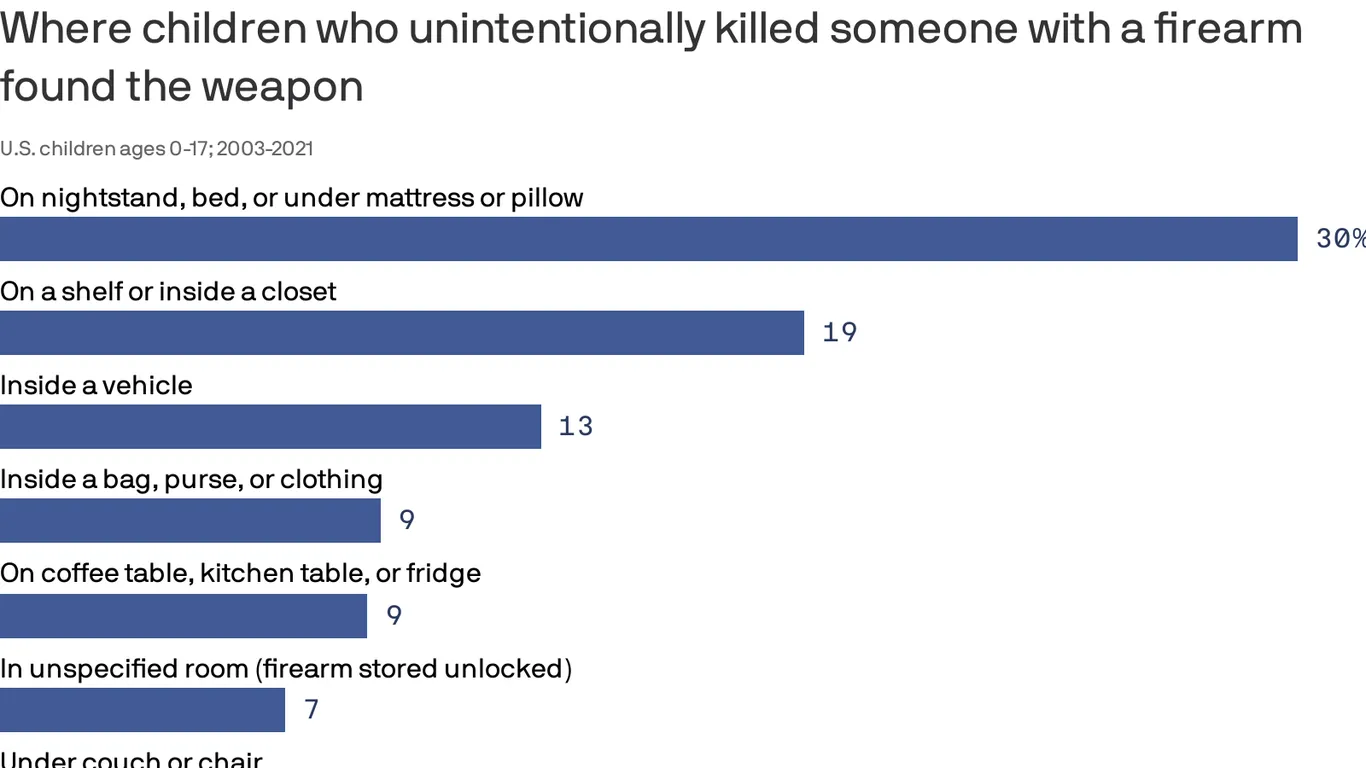

Kids killed in gun accidents most often found weapon in the bedroom: CDC

Children and teens involved in unintentional fatal shootings most commonly found the gun inside or on top of a nightstand, under a mattress or pillow, or on top of a bed, according to a new federal study.

Why it matters: 

The data from the Centers for Disease Control and Prevention, which covers nearly 20 years of deadly firearm accidents among America’s youth, demonstrates why putting a gun out of sight or out of reach is not “safe storage,” federal researchers said.

  • It underscores the need for policymakers, health experts and parents to promote safe gun storage, they said.

The big picture: 

Previous research has shown guns are the leading cause of death among kids in the U.S., reaching a record high in 2021.

By the numbers: 

Using data recorded between 2003 and 2021 by the National Violent Death Reporting System, researchers identified more than 1,250 unintentional gun deaths among kids.

  • The vast majority involved guns that were unlocked (76%), and most of those unlocked firearms were also loaded (91%).
  • Two-thirds (67%) of unintentional gun injury deaths among kids occurred when the shooter was playing with the gun or showing it to others.
  • In 30% of deaths, guns were found around nightstands and other sleeping areas.
  • Guns were also most commonly found on top of a shelf or inside a closet (18.6%) or inside a vehicle (12.5%).

The Conundrum facing Not-for-Profit Hospital Systems

Does hospital ownership matter? According to a study published last week in Health Affairs Scholar, NOT MUCH. That’s a problem for not-for-profit hospitals who claim otherwise.

58% of U.S. hospitals are not-for-profit hospitals; the rest are public (19%) or investor-owned (24%). In recent months, not-for-profit systems have faced growing antagonism from regulators and critics who challenge the worthwhileness of their tax exemptions and reasonableness of the compensation paid their top executives.

The lion’s share of this negative attention is directed at large, not-for-profit hospital system operators. Case in point: last week, Banner Health (AZ) joined the ranks of high-profile operators taken to task in the Arizona Republic for their CEO’s compensation contrasting it to not-for-profit sectors in which compensation is considerably lower.

Unflattering attention to NFP hospitals, especially the big-name systems, is unlikely to subside in the near-term. U.S. healthcare has become a winner-take-all battleground increasingly dominated by large-scale, investor-owned interests in hospitals, medical groups, insurance, retail health in pursuit of a piece of the $4.6 trillion pie. 

The moral high ground once the domain of not-for-profit hospitals is shaky.

The NYU study examined whether hospital ownership influenced decisions made by consumers: they found “Fewer than one-third of respondents (29.5%) indicated that hospital status had ever been relevant to them in making decisions about where to seek care…significantly more important to respondents who indicated the lowest health literacy—74.7% of whom answered the key question affirmatively—than it was for people who indicated high health literacy, of whom only 18.3% found hospital ownership status to be relevant…also considerably more relevant for people working in health care than for those who did not work in health care (61.0% vs 24.5%)…

We found little evidence that hospital nonprofit status influenced Americans’ decisions about where to seek care. Ownership status was relevant for fewer than 30% of respondents and preference was greatest overall for public hospitals. Only 30–45% of respondents could correctly identify the ownership status of nationally recognized hospitals, and fewer than 30% could identify their local hospitals.

These findings suggest that contract failure does not currently provide a justification of nonprofit hospitals’ value; further scrutiny of tax exemption for nonprofit hospitals is warranted.”

Are NFP hospitals concerned? YES. It’s reality as systems address near term operational challenges and long-term questions about their strategies.

Last weekend, I facilitated the 4th Annual Chief Strategy Officers Roundtable in Austin TX sponsored by Lumeris. The group consisted of senior-level strategists from 11 not-for-profit systems and one for-profit. In one session, each reacted to 50 future state scenarios in terms of “likelihood” and “disruptive impact” in the NEAR term (3-5 years) and LONG TERM (8-10 years) using a 1 to 10 scale with 10 HI.

From these data and the discussion that followed, there’s consensus that the U.S. healthcare market is unlikely to change dramatically long-term, their short-term conditions will be tougher and their challenges unique.

  • Near-term cost containment is a priority. Hospitals are here-to-stay, but operating them will be harder.’
  • ‘Increased scale and growth are necessary imperatives for their systems.’
  • ‘Hospital systems will compete in a market wherein private capital and investor ownership will play a growing role, insurers will be hostile and value will the primary focus of cost-reduction by purchasers and policymakers.’
  • Distinctions between not-for-profit and for-profit hospitals are significant.’
  • ‘Conditions for hospitals will be tougher as insurers play a stronger hand in shaping the future.’

Given the NYU study findings (above) concluding NFP ownership has marginal impact on hospital choices made by consumers, it’s understandable NFPs are anxious.

My take:

The issues facing not-for-profit hospitals in the U.S. are unique and complex. Per the commentary of the CSOs, their market conditions are daunting and major changes in their structure, funding and regulation unlikely.

That means lack of public understanding of their unique role is a conundrum. 

Paul

PS: Issues about CEO compensation in healthcare are touchy and often unfair.

In every major NFP system, comp is set by the Independent Board Compensation Committee with outside consultative counsel. The vast majority of these CEOs aren’t in the job for the money joining their workforce in pursuit of the unique higher calling afforded service leaders in NFP healthcare.