Prime Healthcare Services unlawfully stopped nurses’ anniversary raises, court rules

https://www.beckershospitalreview.com/legal-regulatory-issues/prime-healthcare-unlawfully-stopped-nurses-anniversary-raises-court-rules.html

Image result for national labor relations board


A federal appeals court ruled that Ontario, Calif.-based Prime Healthcare Services violated the National Labor Relations Act when it canceled anniversary raises for unionized nurses, according to a Reuters report.

Here are six things to know about the issue.

1. The U.S. Court of Appeals for the D.C. Circuit made the ruling May 18, affirming a previous ruling by the National Labor Relations Board.

2. The NLRB found Prime “violated both the unilateral change doctrine and the duty to provide relevant information during negotiations with its employees’ bargaining representatives, Service Employees International Union Local 121RN and SEIU United Healthcare Workers-West,” according to the May 18 ruling. The NLRB specifically found Prime canceled anniversary step increases for nurses after the expiration of its labor deals with the two SEIU bargaining units, and determined the private for-profit hospital operator failed to provide information about employee healthcare programs as requested by the units. The NLRB ordered Prime to resume the raises, take care of any owed back pay due to the discontinuation of the raises and provide the requested information.

3. Both sides reached a settlement regarding complaints related to UHW’ unfair labor practice charges in the matter, and the unfair labor practice charges filed by 121RN remained at issue, according to the ruling. Prime’s agreements with 121RN, as well as UHW, were effective from Jan. 1, 2007, through March 31, 2011. The 121RN bargaining unit represents registered nurses at Prime’s Encino (Calif.) Hospital Medical Center, while UHW represents service and technical employees at Encino and Prime’s Garden Grove (Calif.) Hospital Medical Center.

4. Prime argued, among other things, that the anniversary step increases were terminated when the labor deal with 121RN expired in 2011 because they were tied to annual pay increases in the expired contract, according to the ruling.

5. The appeals court found “no merit in these challenges, however. Accordingly, we deny the petition for review and grant the [NLRB] board’s cross-application for enforcement of its order.”

6. In response to the ruling, Jamie Konn, outside counsel for Prime, told Becker’s Hospital Review: “This is an old matter that is now behind us. Encino and 121RN entered into a collective bargaining agreement in November 2014. The parties will continue to work together, and this matter should be resolved soon.”


Aetna whistle-blower put on leave after accusing CVS Caremark of $1B billing scheme

https://www.beckershospitalreview.com/legal-regulatory-issues/aetna-whistle-blower-put-on-leave-after-accusing-cvs-caremark-of-1b-billing-scheme.html

Image result for whistleblower lawsuit


Aenta’s former chief Medicare actuary was placed on administrative leave after filing a whistle-blower lawsuit alleging pharmacy benefits manager CVS Caremark overbilled Medicaid and Medicare for prescription drugs, according to The Columbus Dispatch.

Here are four things to know about the lawsuit.

1. Sarah Behnke, Aetna’s former chief Medicare actuary, filed the pending whistle-blower suit after her internal investigation found CVS Caremark has been allegedly overbilling the federal government for prescriptions since 2007, according to the lawsuit. Ms. Behnke accused CVS Caremark of inappropriately billing the government $1 billion-plus in fraudulent charges.

2. Aetna placed Ms. Behnke on administrative leave after the whistle-blower suit was unsealed in federal court in early April. The unsealing comes as CVS Health, the parent company of CVS Caremark, is attempting to buy Aetna for $69 billion.

3. Ms. Behnke’s lawyer told The Columbus Dispatch Aetna’s decision to place its then-Medicare actuary on administrative leave was “retaliatory and inappropriate.”

4. CVS Caremark rejected the allegations and said it will hand documents over to the court by June 1. The company said it was unaware who filed the lawsuit until after its parent put out an offer to Aetna. CVS Health spokesperson Michael DeAngelis told the publication, “We believe this complaint is without merit, and we intend to vigorously defend ourselves against these allegations.” Aetna officials declined The Columbus Dispatch‘s request for comment.


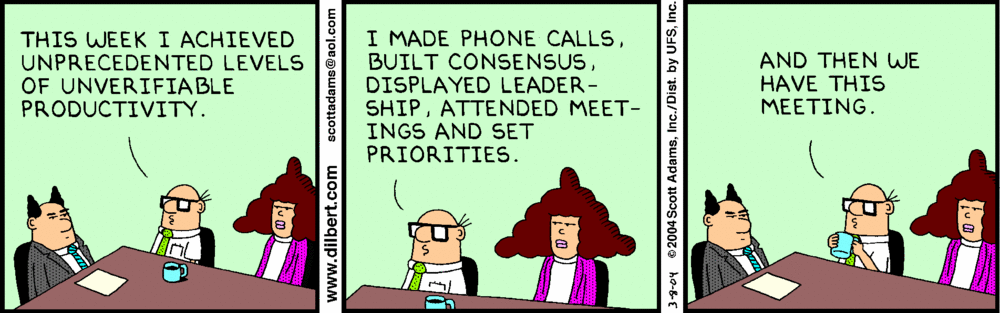
Cartoon – Unprecedented Levels of Unverifiable Productivity

Related image

Beth Israel Deaconess Medical Center will file certificate of need on new $534 million inpatient building

http://www.healthcarefinancenews.com/news/beth-israel-deaconess-medical-center-will-file-certificate-need-new-534-million-inpatient?mkt_tok=eyJpIjoiTURSaU5UWXhOV1EzTlRNeiIsInQiOiJvU3NYQXBoQkwzMXBteUNzVVNpXC9abldIM3RMZXkrc05LNUNXdXd1TzUrUmJwTFZYTDBFZmRYNmFvVnloTEE2K0dtZXhEbWYyRjFWTmpRT29Zb3I0ZFdLRW92bGFrQUJnYyt2N0JyV1dVSE5IR1RJRmczYnZJUlo1d1pYZzR1UkIifQ%3D%3D

Credit: Beth Israel Deaconess Medical Center


The new building, which will house 345,000 square feet of space, is their first new building in 20 years, the system says.

Beth Israel Deaconess Medical Center will spend $534 million to build a new inpatient tower at their Longwood Medical Center Campus, the system announced.

The new 10-story, 345,000 square foot building will be BIDMC’s first in 20 years and will be located on their West Campus.

It will house single-bedd, family-friendly patient rooms, including up to 128 medical-surgical patient rooms, some of which will replace double-bedded rooms elsewhere on BIDMC’s West Campus. It will also hold 30 intensive care unit rooms ideal for privacy and complex medical care.

Large surgical suites and diagnostic and procedural suites to handle acute care patients as well as a medical helicopter landing pad to support the level 1 trauma center will also be part of the new building.

To benefit patients, caregivers and families and continue environmental stewardship efforts, an accessible rooftop green space and healing garden will be available as well.

The announcement that the system will file a certificate of need this month comes as BIDMC’s parent company CareGroup moves ahead with a major merger that will yield a new system that also includes Lahey Health facilities and a stand-alone hospital in Newburyport. The system would be the second largest in the region following Partners Healthcare.

Last month, the Massachusetts Department of Health officially greenlighted the proposed merger, with the Public Health Council voting unanimously in favor of the deal. The Health Policy Commission and leaders in the proposed new system are working on a cost and market impact report, which would gauge the impact of the merger. That report is expected in mid-June.


CMS Administrator Seema Verma promotes cuts to 340B drug payments

http://www.healthcarefinancenews.com/news/cms-administrator-seema-verma-promotes-cuts-340b-drug-payments?mkt_tok=eyJpIjoiTURSaU5UWXhOV1EzTlRNeiIsInQiOiJvU3NYQXBoQkwzMXBteUNzVVNpXC9abldIM3RMZXkrc05LNUNXdXd1TzUrUmJwTFZYTDBFZmRYNmFvVnloTEE2K0dtZXhEbWYyRjFWTmpRT29Zb3I0ZFdLRW92bGFrQUJnYyt2N0JyV1dVSE5IR1RJRmczYnZJUlo1d1pYZzR1UkIifQ%3D%3D

Image result for 340b drug discount program

Senate committee is taking a closer look at the drug discount program.

The Centers for Medicare and Medicaid Services’ focus on lowering drug prices now includes the contentious 340B drug pricing program.

On Wednesday, CMS Administrator Seema Verma told the Pharmacy Quality Alliance that the agency’s change in the 340B payment rate to qualifying hospitals would save Medicare beneficiaries $320 million this year.

Under 340B, hospitals that serve a large number of vulnerable patients are able to buy drugs from manufacturers at discounted prices. However, Verma said Wednesday, “these discounts were not being passed on to our beneficiaries. So, CMS reduced the amount that beneficiaries and the federal government will pay hospitals for drugs that they acquire through this program.”

Medicare beneficiaries will save a total of $320 million in drug spending this year from the change, Verma said.

Last November, several hospital groups including the American Hospital Association, sued CMS for the $1.6 billion in cuts, representing a 28 percent decrease.

On Tuesday, a Senate health committee got involved when members questioned why a rule that would set ceiling prices on drugs in the program has been delayed five times.

The final rule would impose monetary penalties for manufacturers that charge more than the ceiling price for an outpatient drug and imposes other restrictions.

340B hospitals want to see the rule enforced.

The Government Accountability Office will be looking into the issue and the work of the Health Resource and Services Administration, the agency which manages the program and is responsible for the latest delay in implementation of the final rule until July 2019.

The problem is that states and providers do not know the ceiling prices. Confidentiality rules prevent the HRSA from sharing ceiling prices with states or 340B providers.

Because of this, 340B hospitals don’t know what they ought to be paying for discounted drugs, according to Ann Maxwell, assistant inspector general for evaluation and inspections for the Office of the Inspector General, speaking before the Senate Committee on Health, Education, Labor and Pensions.

This lack of transparency prevents ensuring that 340B providers are not overpaying pharmaceutical manufacturers and that state Medicaid programs are not overpaying 340B providers, Maxwell said.

The 340B drug pricing program debate pits the hospitals that benefit from the discounted prices of the program against organizations that contend these providers are taking advantage of the financial incentive.

The 340B program, established in 1992, generates savings for certain safety-net providers by allowing them to purchase outpatient drugs at discounted prices.

Opponents of 340B say seniors get none of the benefit and pay full price and that the disproportionate share hospitals that get the discount take advantage of the financial incentive by buying larger quantities of drugs and more expensive drugs.

HRSA reported that total 340B sales in 2016 amounted to approximately $16 billion, or about 3.6 percent of the U.S. drug market.

The Alliance for Integrity and Reform of 340B, or AIR340B released a new report with analytics by the Berkeley Research Group on Medicare Part B hospital outpatient reimbursements that found in 2016, 340B hospitals accounted for nearly two-thirds of Medicare Part B reimbursements – while only representing slightly more than half of all Medicare hospital outpatient revenue.

“Medicare patients treated in 340B hospitals have disproportionately high outpatient drug spend as compared to patients treated at non-340B hospitals,” AIR340B said

PhRMA said it was encouraged to see the Senate HELP Committee continuing to take a closer look at issues within the 340B program.

The New England Journal of Medicine concluded that financial gains for 340B hospitals have not been associated with clear evidence of expanded care or lower mortality among low-income patients, PhRMA said.

340B also drives a shift of treatment to more expensive hospital settings for physician-administered medicines, PhRMA said.

Hospitals and proponents say the 340B drug pricing program is one of the few federal programs to curb drug costs that is working.

“Sadly, the administration’s policy proposals would erode that progress and just put more money into the pockets of pharmaceutical companies,” 340B Heath said. “The administration’s proposals are based on a faulty understanding of the 340B program and the pharmaceutical market. The notion that 340B discounts are raising drug prices is simply false. Drug companies set the prices for their products and they, alone, decide how high those prices go.”

Hospitals participating in the 340B program account for 60 percent of all uncompensated care in the U.S. and serve a high proportion of low-income patients on Medicaid, 340B Health said.

“There is a clear history of manufacturers overcharging 340B providers. Delaying enforcement of this rule will have a tremendous adverse impact on hospitals, clinics and health systems caring for low-income and rural patients,” said Maureen Testoni, interim president and CEO of 340B Health.

America’s Essential Hospitals said federal scrutiny of manufacturer pricing practices has found overcharges in the 340B drug pricing program.

“These overcharges undermine the program’s ability to make drugs affordable for vulnerable patients and increase costs for their hospitals, which already operate with thin margins,” the group said.