Five Key Standard Terms And Conditions Of The Washington 1115 Medicaid Waiver

Five Key Standard Terms and Conditions of the Washington 1115 Medicaid Waiver

On January 9, 2017 the Washington Healthcare Authority (HCA) reached a pivotal milestone in their partnership with the Centers for Medicare and Medicaid (CMS) to transform the delivery and quality of care served to their Medicaid population. The two parties finalized the Standard Terms and Conditions (STCs) of the 1115 Medicaid waiver, making the waiver officially approved, which up until that point had only been agreed-in-principle at the federal level. The STCs are an essential document as they outline the fundamental rules and regulations that HCA, the regional Accountable Communities of Health (ACHs) and providers throughout the state will have to follow as they begin to implement the transformation elements outlined in the waiver.

Over the coming months, HCA will develop the remaining governing documents of the waiver known as the protocols (or attachments to the STCs) and work to gain approval of these from CMS. These documents are critical as they will further define items such as:

  • Project valuation and the funds flow formula that will allocate the maximum dollars each ACH can earn through demonstrated performance
  • The semi-annual reporting requirements needed to demonstrate performance
  • Expectations around the collection and reporting of clinical quality outcomes
  • A number of other key governing regulations.

While the STCs are not complete until all of the protocols are developed and approved, this Health Insights piece will focus on five key terms outlined in the STCs related to the DSRIP program and offer suggestions as to things ACHs and community providers should begin to consider as they prepare for the implementation requirements of waiver participation. This piece is not intended to prescribe waiver next steps or compare other waiver programs; COPE Health Solutions has developed other thought leadership pieces that explain these elements of the Washington waiver and those articles are linked at the bottom of this piece.
 

Trump Group’s Ads Bolstering GOP Obamacare Repeal Drive

https://www.nytimes.com/aponline/2017/04/17/us/politics/ap-us-health-overhaul-ads.html?_r=0

Related image

A pro-Trump group is airing ads in a dozen Republican-held House districts aimed at drumming up support for the White House’s wounded drive to repeal President Barack Obama’s health care law.

The $3 million campaign comes during a two-week congressional recess in which GOP lawmakers’ town hall meetings have been rocked by liberal supporters of Obama’s 2010 statute. Underscoring the challenges Republicans face, one poll showed Monday that the public trusts Democrats over the GOP on health care by their biggest margin in nearly a decade.

Leaders averted a planned House vote last month on a bill replacing much of Obama’s law with a GOP alternative because Republican divisions would have ensured its defeat. White House officials complained at the time that while conservative outside groups opposing the bill had pressured lawmakers, there was insufficient lobbying and advertising by supportive organizations.

Talks among White House officials and GOP lawmakers have continued during the break, but there have been no tangible signs that they’ve found a way to reverse what has been a damaging defeat for President Donald Trump and congressional leaders.

The TV and internet ads by America First Policies are running in districts from Arizona to Pennsylvania, the group said Monday. Some are represented by lawmakers who backed the GOP legislation, others opposed it and others hadn’t taken clear public positions.

One ad aimed at Rep. Gary Palmer, R-Ala., urges people to thank him “for standing with President Trump to repeal Obamacare now.” Palmer said after the House vote was canceled that he backed the decision to pull the bill so work on the legislation could continue.

America First Policies is run by former Trump White House and campaign staffers including Katie Walsh, who left her job as White House deputy chief of staff shortly after the leaders’ retreat from the House vote.

A poll by the nonpartisan Pew Research Center showed that by 54 percent to 35 percent, more people think Democrats do a better job than Republicans handling health care. Though the public has usually given Democrats an advantage on the issue in Pew polls, the two parties were ranked about evenly as recently as 2013.

Obamacare’s Insurers Struggle for Stability Amid Trump Threats

https://www.bloomberg.com/politics/articles/2017-04-17/obamacare-s-insurers-struggle-for-stability-amid-trump-threats

Image result for Obamacare's Insurers Struggle for Stability Amid Trump Threats

Obamacare is stuck in limbo, and insurers and state regulators are struggling to set their plans for what’s increasingly shaping up as a chaotic year for the health-care program.

After the failure of Republicans’ first attempt to repeal and replace the Affordable Care Act and President Donald Trump’s subsequent threats to let the program “explode,” more health insurers are threatening to pull out next year, while others may sharply raise the premiums they charge. They’ll start to declare in the next few weeks whether they’re in or out.

Marguerite Salazar, Colorado’s insurance regulator, said that her state’s carriers, which include Anthem Inc. and Cigna Corp., haven’t said they’re leaving, though they don’t want to commit either.

“That’s my biggest fear, is that we would lose carriers in the individual market,” Salazar said. “We don’t want to set up an environment that would tell them, well, maybe we don’t need to be here.”

In Washington, Insurance Commissioner Mike Kreidler pushed back by a month the date when insurers have to say what they’ll offer. He’s urging them to stay and thinks most will, but “they’re not making commitments right now.”

“They’ve got those cards and they’re holding them close,” said Kreidler, a Democrat. “Right now, there’s so much uncertainty.” The fear is that they’ll follow the lead of Aetna Inc. and Wellmark Inc., which pulled out of Iowa’s Obamacare markets this month.

Trump’s Uncertainty

Much of the uncertainty is thanks to the Trump administration, which will play a key role in deciding whether the health law’s markets collapse or survive. Industry representatives — including company executives and insurance lobby CEO Marilyn Tavenner — are scheduled to meet Tuesday with Seema Verma, the head of the Centers for Medicare and Medicaid Services, the U.S. agency that oversees the law.

Trump’s latest threat has been to stop payments that subsidize co-pays and other upfront costs for lower-income people. Without them, insurers would likely boost their premiums or drop out entirely. The administration has refused to commit to keeping the payments going.

Health insurers see April 30 as a key deadline for a decision on the cost-sharing payments. They’ll start filing with some state regulators in May to say whether or not they’ll stay in the markets.

“Everybody is still in a wait-and-see mode,” said Kristine Grow, a spokeswoman for the industry group America’s Health Insurance Plans. AHIP and other industry groups are pushing the administration to commit to making the cost-sharing payments that Trump has threatened to halt. “Plans really need certainty,” she said.


Medicare-for-All is the next step to improving health care

http://www.cincinnati.com/story/opinion/contributors/2017/04/17/medicare–all-next-step-improving-health-care/100482226/

Image result for medicare for all sign

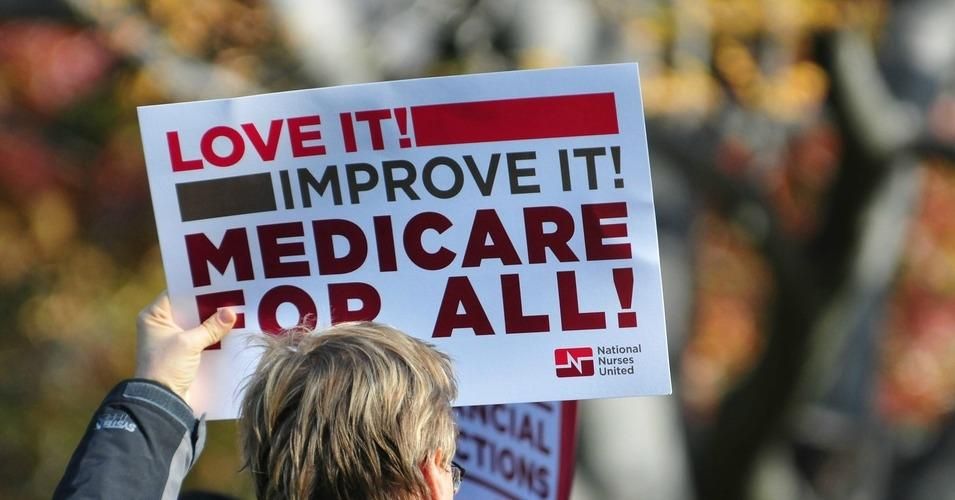
It’s time to educate ourselves about Medicare-for-All, which has passionate and growing support in our country. Most Americans, 64 percent in a recent Kaiser poll,  like the general idea. Energetic and caring citizen groups promote it, such as SPAN Ohio (Single Payer Action Network). In the middle of our health care debates, we should pause to look closely at Medicare-for-All. We need more clarity for smart decisions.

I’ve been reading Medicare-for-All explanations by legislators, doctors, public interest groups and journalists. I’m no expert, but the fundamental concepts are coming clear to me. Here is some central information for those who wonder how Medicare-for-All would work in America.

Who would be covered? For what kinds of health care?

Everyone would be covered. The current Senate proposal, “The American Health Security Act” (S. 1782, soon to be updated), promotes “universal entitlement” and outlines plans to register everyone in this country, starting at birth.

Both House and Senate full-text proposals specify complete coverage for all health-care categories (except cosmetic procedures). They include care typically left out of general health insurance. Dental, vision and prescription coverage are named early in the House proposal, “Expanded and Improved Medicare for All Act” (H. R. 676). Both proposals offer complete maternity and child care, which could remedy Ohio’s “near the bottom” rates of infant mortality.

Vital screenings for cancer and STD/HIV belong with the promised diagnostic tests in these proposals. There is pressing need. In Ohio, 80,000 men and women are tested yearly by Planned Parenthood. Addiction and substance abuse treatment, mental health care, home and hospice care, and prosthetics are among an abundance of named services.

People would choose their own providers. Doctors and hospitals would remain independent. There would be no premiums, deductibles, or co-pays.

Who would pay for all this coverage?

The Senate and House proposals, state government bills, and Physicians for a National Health Program – all envision a Medicare-for-All that is affordable.

To reach real affordability, we need to exclude profit-making health insurance companies. Cut the cord of their power over costs. In ACA exchanges now, health insurers increase costs.  Even with this handicap, the ACA has taught us for years what affordability feels like. That’s why so many cling to the ACA. One in four Ohio hospitals believes that without the ACA, they would close.

Medicare-for-All, the next step from the ACA, offers complete affordability. It would appropriate funds from Medicare, Medicaid, CHIP, ACA, and other federal health programs. It would leave health insurance giants behind, saving another $350 billion to $500 billion yearly. Medicare-for-All would have negotiating clout with Big Pharma.

Without premiums and deductibles and co-pays, people could afford a few modest taxes to help with funding. Maybe a health income tax, small for most, larger for the top 5 percent of incomes. A limited, progressive excise payroll tax would help, as well as a tax on securities transactions – a few hundredths of a percent of fair market value.

If we adopt Medicare-for-All, what risks are we taking? Might health care be rationed? Would we have long waits? Ballooning costs?

The GOP’s problem on health reform is they’ve spent years hiding their real position

http://www.vox.com/policy-and-politics/2017/4/17/15325366/gop-problem-on-health-reform

The most interesting policy argument in America right now is the debate between conservatives’ real position on health care and their fake position.

The fake, but popular, position goes something like this: Conservatives think everyone deserves affordable health insurance, but they disagree with Democrats about how to get everyone covered at the best price. This was the language that surrounded Paul Ryan and Donald Trump’s Obamacare alternative — an alternative that crashed and burned when it came clear that it would lead to more people with worse (or no) health insurance and higher medical bills.

Conservatives’ real, but unpopular, position on health care is quite different, and it explains their behavior much better. Their real position is that universal coverage is a philosophically unsound goal, and that blocking Democrats from creating a universal health care system is of overriding importance. To many conservatives, it is not the government’s role to make sure everyone who wants health insurance can get it, and it would be a massive step toward socialism if that changed.

This view provided the actual justification for Ryan and Trump’s Obamacare alternative — it’s why they designed a bill that led to more people with worse (or no) health insurance and higher medical bills, but that cut taxes for the rich and shrank the government’s role in providing health care.

There was, for decades, a logic to the GOP’s dual positions: the fake but popular position was used to pursue the ends of the real but unpopular position. But in the post-Obamacare world, the chasm that has opened between conservatives’ fake and real positions has become unmanageable, and how — or whether — conservatives resolve it has become perhaps the most interesting public policy question going today.

A real conservative health care debate worth hearing

On the latest episode of Peter Robinson’s Uncommon Knowledge, Avik Roy and John Podhoretz have perhaps the most honest and bracing discussion of this I’ve heard. Podhoretz, a columnist and editor with a deep pedigree in conservative politics, begins by arguing that the passage of Obamacare, and the debate over the American Health Care Act, shows a “Rubicon” has been crossed in American politics — there is now an “almost unspoken acceptance of the idea that there should be universal coverage for health care in the United States.”


Long-term care insurance facing major pricing shift

https://www.washingtonpost.com/news/get-there/wp/2017/04/17/long-term-care-insurance-facing-major-pricing-shift/?utm_term=.44bd32bcb04a

One of the biggest fears people have about retirement is getting sick and running out of money to cover their health issues.

So in comes long-term care insurance, which can cover the cost of nursing homes, assisted-living facilities and in-home care. Medicare — except in very limited situations — does not cover long-term care. Medicaid covers long-term care, but to qualify for the benefit, you have to be pretty poor.

If you need help with life’s basic activities — eating, dressing and bathing — it can be expensive and the cost of that care can decimate your savings.

The problem is that there have been some steep premium increases for long-term care insurance, and it has many people wondering if the insurance is worth it. Insurance companies have had trouble pricing the insurance. Initial premiums charged haven’t been enough to cover claims.

But how the insurance is priced may be changing significantly. Rather than keeping premiums steady for several years and then having to impose huge double-digit rate hikes, Genworth, one of the largest providers of long-term care insurance, wants to be have the ability to change premiums annually, reports Forbes contributor Howard Gleckman.

“In this design, unfortunately called the Annual Rate Sufficiency Model, buyers of new policies would likely see modest, single-digit rate hikes each year or two,” Gleckman writes. “If Genworth thinks it is likely to pay fewer claims than expected or if investment income is higher than projected, consumers might even see small rate reductions in some years.”

He goes on: “For years, some brokers told buyers that their premiums would never increase. But in reality, while carriers could not raise rates on individual policies, they could boost prices for an entire class of buyers. They often delayed those rate hikes — or were blocked by state insurance commissioners — for five years or more, until policyholders got hammered with increases of 40 percent and up.”


Needle vending machines are the future of helping drug users, Las Vegas bets

http://www.miamiherald.com/news/nation-world/national/article145112354.html

Needle exchange programs help drug users prevent disease.

Most vending machines are full of things — like soda and candy — that can contribute to health problems. But Las Vegas is hoping its new vending machines can help its drug using-population avoid additional ones.

By the end of May, Las Vegas will have debuted three new vending machines that dispense clean needles. They hope to keep drug users who get their fix via syringe from contracting diseases by reusing needles that could carry bloodborne infections. HIV, hepatitis C and other diseases can be transmitted when needles are used repeatedly.

The machines resemble an average vending machine but will instead dispense kits of clean needles and disposal containers for used ones. There will also be wound cleaning and safe sex kits. The machines will be available in three separate organizations that all work with drug users.

“Having access to clean syringes is a harm-reduction approach that’s going to allow people to protect themselves against getting communicable diseases such as HIV and hepatitis C,” Chelsi Cheatom, program manager for Trac-B Exchange, told the Las Vegas Review-Journal. Trac-B Exchange provides community consulting focused on preventing infectious diseases and safer alternatives to syringe use and disposal.

To gain access to the needle vending machines, users will register to receive a card that will allow them two kits each week.

According to the Harm Reduction Coalition, needle exchange programs lower health care costs. A sterile syringe costs as little as 97 cents and could save between $3,000 and $5,000 per HIV infection prevented. Intravenous drug users have also seen a decrease in hepatitis C infection following the spread of needle exchanges. Treatment for that disease can cost $25,000 to $30,000 per person. Programs that provide sterile needles can also provide other healthcare services and counseling to a population that can be uninsured.

Last year, Congress partially lifted the federal ban on funds for syringe exchange programs. It had orginally been repealed in 2009 after being in place for more than 20 years, but the Republican House put it back in place in 2011. Currently, federal funds can’t be used for needles themselves but can be used for other aspects of needle exchange programs, like staff salaries and counseling services.