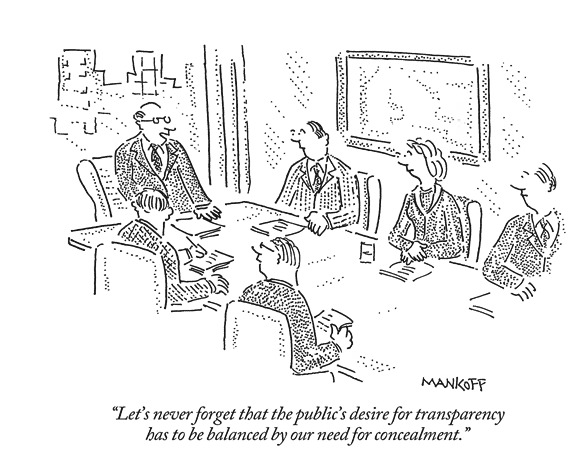
Cartoon – The Company with a Heart


Dr. Thomas Malone on Thursday announced his resignation as president and CEO of Summa Health, 21 days after more than 240 physicians signed a no-confidence letter calling for his departure.
Malone, 60, a Northeast Ohio native who began leading the health system two years ago, will continue to serve as CEO for up to 60 days while Summa’s board of directors conducts a search for his successor, the board said.
In a statement released Thursday, Malone said he had detracted from the health system’s mission.
“I care deeply about the future of Summa Health and am incredibly proud of all that we have accomplished together over the past two years,” Malone wrote. “However, as I thought about what would be best for our organization moving forward, it became clear to me that my presence may be a distraction from our goals. And that is unacceptable to me.”
http://www.bizjournals.com/kansascity/news/2017/01/26/prime-healthcare-aco.html

A Kansas City-area health network may benefit from its new designation through a pilot program created under the Affordable Care Act — if it isn’t repealed. As an accountable care organization (ACO), physicians affiliated with the Prime Healthcare ACO in Kansas and Missouri could benefit from cost-sharing incentives for Medicare patients.
Specifically, providers and the Centers for Medicare and Medicaid Services would split the savings from reducing costs for a patient through coordinated care, such as not ordering duplicate tests. Of course, ACO providers still must meet key quality metrics.
“It’s looking back at those procedures that have already occurred,” said Paula Ellis, chief nursing officer at Saint John Hospital, a Prime Healthcare affiliate in Leavenworth. “It’s really being a lot more mindful, and looking at all of the information that’s out there. It’s seeing where (the patient) is getting care that their primary care provider doesn’t know about.”
Prime Healthcare also owns Providence Medical Center in Kansas City, Kan., St. Joseph Medical Center in Kansas City, Mo., and St. Mary’s Medical Center in Blue Springs
While savings between different ACO providers have been mixed, Ellis said other markets under Prime Healthcare have found success. The California-based for-profit hospital operator launched its first ACO in California last year.
Its application for the Kansas City ACO model was granted on Jan. 1. It is serving about 10,000 Medicare patients who use Prime Healthcare physicians as their primary care provider.
“The model’s been out there for a few years,” Ellis said. “It has a track record.”
It’s worth noting that the future of ACOs, for the most part, is unknown. The model is part of the Medicare Shared Saving Program, established under the Affordable Care Act, to reduce costs and improve care. A substantial number of providers have adopted it; CMS reported 480 ACOs served a total of 9 million assigned beneficiaries as of January.

Stop doing things that haven’t worked. More of the same will yield more disappointment and frustration.
I’m not sure “Irrational’s” behavior is irrational to him. He’s behaving in ways that make sense to him.
The fact that his first year went well indicates he knows how to perform within your culture.
Identify wants:
Clarify what your team member wants for himself, colleagues, and your organization. You may believe you know what he wants, but it’s worth a conversation or two.
How do behaviors reflect and align with wants?

There’s a difference between being liked and being respected. I like ice cream, but I don’t respect it. You like many people that you wouldn’t respect as leaders. Here are some ideas on meeting deadlines and gaining respect at the same time.
You gain respect when you deal with tough issues firmly, compassionately, and collaboratively.
#1. Apologize for falling short as a leader.
“I’ve let you down as a leader. Worse yet, I let myself down when I allow us to habitually perform below our competencies.”
Express discomfort openly. “I feel uncomfortable bringing this up. But, I owe it to you to let you know how I’ve failed our team.”
Be candid. “This issue is driving me crazy. I need your help.”
Teams respect authentic leaders who face their fears with forward-facing resolve. “I’m working to resolve this issue. I believe we can live up to our capacity. I need your help.”

Leaders monitor environments:
Congratulations for being aware of your environment. Leaders pay attention to the way people feel while they work together. You can’t control feelings. You can influence them.
David Foster Wallace writes, “There are these two young fish swimming along and they happen to meet an older fish swimming the other way, who nods at them and says “Morning, boys. How’s the water?” And the two young fish swim on for a bit, and then eventually one of them looks over at the other and goes “What the hell is water?
Leaders create environments:
It’s far too easy to notice what’s wrong than it is to do something about it. Taking responsibility for the way it feels to work together seems like trying to feel the water we swim in.
Paint a picture of what you want, after noticing what you don’t want. Move from generalities to specific behaviors.
Focus on simple behaviors. We smile and stand when team members enter our office, for example.