
Life sciences and diagnostic equipment maker Aspect Imaging, a division of Singapore-based Aspect International, and design and strategy firm frog, have collaborated to produce a new category of magnetic resonance imaging (MRI) machines.
The Embrace Neonatal MRI System preps and scans newborn babies in under one hour within a hospital’s neonatal intensive care unit (NICU). Unlike most MRIs, the system doesn’t require other medical equipment, cooling systems or a dedicated, shielded MRI facility.
Frog Creative Director James Luther said the design firm employed human-centered design process to perform field-work in neonatal intensive care units (NICUs) throughout the United States and Europe. The goal was to understand “the context, roles, work flow and pain points” in NICUs, eliciting the advice of NICU physicians and nurses and replicating a NICU that included incubators and mock silicone newborns.

Dignity Health has answered a federal discrimination lawsuit filed by a transgender nurse by arguing that civil rights law does not require its self-insured employer health plan to cover gender reassignment-related care. It says Title VII of the Civil Rights Act does not cover transgender status as a protected classification.
The San Francisco-based hospital chain also argued last month in response to the closely watched suit—one of the first of its kind in the country—that HHS’ May rule barring categorical exclusion of coverage for gender transition services does not take effect until Jan. 1, 2017. Prior to that, it argues, federal law does not require an employer to provide health coverage for “sex transformation” treatment.
In addition, the new federal anti-bias rule does not bar self-insured employer health plans from excluding benefits for services that are not medically necessary, according to Dignity’s motion for dismissal. It said “the medical efficacy of sex transformation surgery remains the subject of debate.”
But lawyers for the American Civil Liberties Union who are representing nurse Josef Robinson say both Title VII and the new HHS rule interpreting Section 1557of the Affordable Care Act clearly require employers and health plans to cover treatment related to gender dysphoria. That’s the name for the condition where people feel they are not the gender they were assigned at birth.
Legal experts expect more such lawsuits following HHS’ issuance of the anti-bias rule in May.

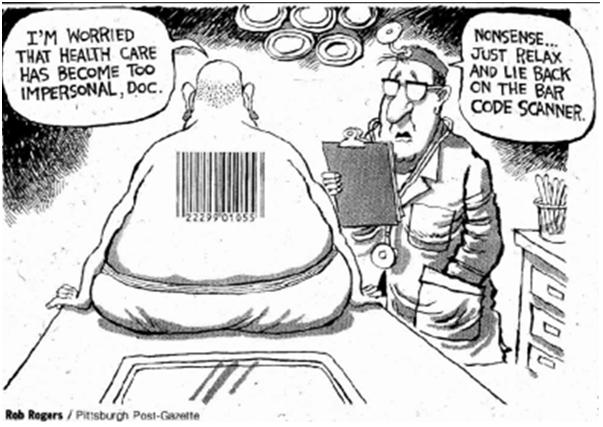
She’s one of a growing number of doctors who have cut loose from what she calls the “assembly-line, volume approach” and is now using a health care delivery model called direct primary care. She has scaled back the number of patients she sees and takes longer with the ones she does. She doesn’t take insurance and deals mostly in cash; she charges each time she sees a patient, but most direct primary care doctors charge a monthly fee for unlimited visits. In her previous practice, (Lorraine) Page says, the pressure to see more patients in less time wore her down, as did the need for an army of support staff to process the copious paperwork required by insurance companies.
Should Big Insurance Become Like Walmart To Lower Health Costs?

Retail titan Walmart uses its market dominance to inflict “ruthless,” “brutal” and “relentless” pressure on prices charged by suppliers, business writers frequently report.
What if huge health insurance companies could push down prices charged by hospitals and doctors in the same way?
The idea is getting new attention as already painful health costs accelerate and major medical insurers seek to merge into three enormous firms.
Now that hospitals have themselves combined, in many cases, into companies that dominate their communities, insurance executives argue the only way to fight bigness is bigness.

For at least 20 years, Leslie Love relied on the UC Davis Medical Center’s hospital and clinics for her health care. Her children and grandchildren went to the same doctors there.
“They cared about me,” said Love, a 57-year-old teacher’s assistant who lives near the academic medical center, which is located in Sacramento. “There’s people there that I can trust.”
But that trust was recently broken: Love has been fighting for follow-up care since her knee surgery at UC Davis in 2014. Love’s current Medi-Cal managed care plan, Health Net, ended its contract with the UC Davis Health System in January 2015. As a result, Love could no longer see the physicians there who had treated her knee.
The pullout, which affected an estimated 3,700 patients at the time, means that Health Net’s now nearly 123,000 Medi-Cal managed care enrollees in Sacramento County can no longer seek primary care at UC Davis.
Ever since, tension has been building over what some critics say is limited access for Medi-Cal patients at UC Davis’ health clinics.
Because it is financed partly by state taxpayers, the UC Davis Health System — like all University of California hospitals and clinics — is considered a public institution with a mandate to care for the poor.
That’s why some patients and their advocates are frustrated. They say UC Davis is not fulfilling its mission as a public hospital because the health system generally no longer accepts primary care patients covered by Medi-Cal managed care contracts. Medi-Cal patients still can receive specialized and emergency room care, as well as in-hospital stays.