Four predictions for the future of healthcare

http://managedhealthcareexecutive.modernmedicine.com/managed-healthcare-executive/news/four-predictions-future-healthcare?cfcache=true&ampGUID=A13E56ED-9529-4BD1-98E9-318F5373C18F&rememberme=1&ts=12082016

Healthcare policy has long been a moving target, but it’s hard to remember a time when more change was cycling through the industry. Now, more than half a decade since the passing of the Affordable Care Act (ACA), the focus has shifted from expanding access to health insurance to reforming the delivery of healthcare.

In particular, policymakers have embarked on a series of experiments and initiatives to transition from the traditional fee-for-service (FFS) system to a payment-for-value delivery system, with key attention to cost containment and quality improvement.

We are in the first generation of pursuing approaches better than FFS, and expect the industry’s shift toward value-based care (VBC) to accelerate and continue to impact providers, patients, vendors, and payers in different ways.

Now a little more than halfway through 2016, we thought it would be a good time to look at trends in the industry and how they will shape the relationships among stakeholders for the years to come.

What are Interim Executive Services anyway?

About Interim Executive Services

Interim EXECUTIVE SERVICES is temporary consulting service provided in or to the executive suite of an organization.  Executive Services is differentiated from other interim services based on the reporting relationship of the Interim Executive.  If the Interim Executive is reporting to the Board of Directors or CEO, they are engaged in Executive Services as opposed to other interims or temps that are working at lower levels in the organization.  The differentiating factor about Executive Services is that the work is more strategic and cognitive in focus as opposed to task orientated, supervised activities carried out by most of the interims an organization will typically engage.  There is a lot more at risk with an Interim Executive providing Executive Services.  Typically, billing rates are higher and the potential of the Interim Executive to have a profound effect on the organization is much higher.  An organization engaging Executive Services has the right to expect a lot more from an sophisticated Executive Services Interim than they would from someone picked to just fill a slot temporarily.

This is why we need RCTs, total-body CT edition

This is why we need RCTs, total-body CT edition

A number of observational studies have shown that total-body CT scans are beneficial when working up a trauma victim. So we do them. We know observational studies aren’t what we need, but we do them.

Enter this RCT from four hospitals in the Netherlands and Switzerland. Adults who had undergone trauma were randomized on a 1:1 basis to get either immediate total-body CT scans or a standard workup with conventional imagine and CT scanning when individually needed. Clearly doctors weren’t blinded, and neither were patients. The outcome of interest were in-hospital mortality.

Your Health Insurance Will Cost More Next Year: Here’s What’s Driving Prices Higher

http://www.thefiscaltimes.com/2016/08/10/Your-Health-Insurance-Will-Cost-More-Next-Year-Here-s-What-s-Driving-Prices-Higher

The cost of getting your health insurance through work will go up an average of 5 percent next year, according to a new survey of large employers by the National Business Group on Health.

The cost for employers will go up 6 percent. This is the third consecutive year that employers’ health costs have risen by 6 percent. While that’s still more six times the current rate of inflation, it’s likely a smaller increase than will be experienced by consumers who purchase insurance through the public exchanges.

While those plans vary widely by state, the average plan is expected to cost 10 percent more in 2017, according to Kaiser. Last year, the price of the average silver level plan on public exchanges increased 12 percent.

For employers, the biggest driver of the cost increases is the price of specialty drugs. Other factors included high-cost claims and long-term conditions, according to the NGBH survey.

Where Lead Lurks And Why Even Small Amounts Matter

http://www.npr.org/sections/health-shots/2016/08/12/483079525/where-lead-lurks-and-why-even-small-amounts-matter?utm_campaign=KHN%3A+Daily+Health+Policy+Report&utm_source=hs_email&utm_medium=email&utm_content=32858954&_hsenc=p2ANqtz-8kDCnnjDbfp4JvZ95fZBYFg0rvQnr0k1mC0p1B7O4jguEVJHjhzW0BsVUUUTFVZ8CkCycZO56aYhcnG_R04U8iDQ-JsA&_hsmi=32858954

Katherine Du for NPR

When There’s Lead Underground

When there is a problem with lead in drinking water, service lines are the most likely culprit. Service lines are like tiny straws that carry water from a utility’s water main, usually running below the street, to each building.

In older cities, many of them in the Midwest and Northeast, these service lines can be made of pure lead.

Wherever lead service lines are in place, there is a risk of water contamination. The toxic metal can leach into the water whenever something jostles the pipes, like nearby construction, a heavy truck coming down the road or when the water just sits still for too long.

Civil engineer Marc Edwards, the Virginia Tech professor who helped document the lead problems with water in Flint, calls lead service lines “ticking time bombs.”

WHY IT MATTERS: Health Care

http://bigstory.ap.org/article/a6c6a83bd9f7435ca6f79423f1240c4d/why-it-matters-health-care

About 9 in 10 Americans now have health insurance, more than at any time in history. But progress is incomplete, and the future far from certain. Millions remain uninsured. Quality is still uneven. Costs are high and trending up again. Medicare’s insolvency is two years closer, now projected in 2028. Every family has a stake.

Patients from all over the world come to America for treatment. U.S. research keeps expanding humanity’s ability to confront disease. But the U.S. still spends far more than any advanced country, and its people are not much healthier.

Obama’s progress reducing the number of uninsured may be reaching its limits. Premiums are expected to rise sharply in many communities for people covered by his namesake law, raising concerns about the future.

The health care overhaul did not solve the nation’s longstanding problem with costs. Total health spending is picking up again, underscoring that the system is financially unsustainable over the long run. Employers keep shifting costs to workers and their families.

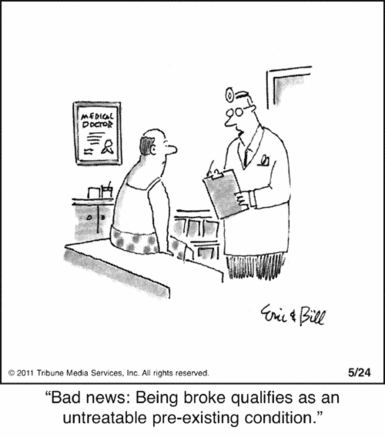
No one can be denied coverage anymore because of a pre-existing condition, but high costs are still a barrier to access for many, including insured people facing high deductibles and copayments. Prescription drug prices — even for some generics — are another major worry.

The election offers a choice between a candidate of continuity — Clinton — and a Republican who seems to have some core beliefs about health care, but lacks a coherent plan.

If the presidential candidates do not engage the nation in debating the future of health care, it still matters.

In Battle Of Health Care Titans, Should Insurers Act Like Wal-Mart?

http://www.npr.org/sections/health-shots/2016/08/11/488891554/should-big-insurance-become-like-walmart-to-lower-health-costs

Who has the upper hand in health care prices?

In late July, the Justice Department sued to block both insurance mergers, arguing that competition is important to keep premiums down and that the deals “would leave much of the multitrillion-dollar health insurance industry in the hands of three mammoth insurance companies.”

They also rejected the Wal-Mart argument, which is related to what economists call “monopsony,” a concentration of buying power.

Monopsony is the opposite of monopoly: Instead of using market dominance to raise prices for consumers, huge buyers force down prices from suppliers. Wal-Mart is often described as holding monopsony-like power.

But critics of the insurance deals say monopsony can go too far. If the buyer pushes prices too low, suppliers stop producing, making needed goods and services unavailable.

“As a result of the merger, Anthem likely would reduce the rates that … providers earn by providing medical care to their patients,” the Justice Department argued. “This reduction in reimbursement rates likely would lead to a reduction in consumers’ access to medical care.”

This Nurse Leader Cut LOS by 40% in the Emergency Department

http://www.healthleadersmedia.com/nurse-leaders/nurse-leader-cut-los-40-emergency-department-0?spMailingID=9348186&spUserID=MTMyMzQyMDQxMTkyS0&spJobID=980998666&spReportId=OTgwOTk4NjY2S0#

Around 2012, Ajimol Lukose, DNP, RN-BC, nursing director at Swedish Covenant Hospital in Chicago, noticed a trend—more patients with behavioral health issues were seeking treatment in the emergency department. This development came on the heels of the state cutting $113.7 million in general funds from its mental health budget, and Chicago closing of six of its 12 city-run mental health clinics.

“There was a reduction in mental health clinics, so the follow-up or outpatient programs were limited. That resulted in patients showing up in the emergency department,” Lukose told me.

On any given day, there could be as many as six or seven behavioral health patients in the ED.

“Our emergency department was struggling with patients with mental health issues staying there for three and four days and waiting for state transfer, especially unfunded patients,” she said.

At the same time, Lukose needed to implement a project for the doctorate of nursing practice degree she was working toward. She has a background in psychiatric nursing and thought she could help address some of the issues around caring for this patient population by developing a safe care delivery model to improve care quality and reduce length of stay in the ED.

Her results were even better than expected.