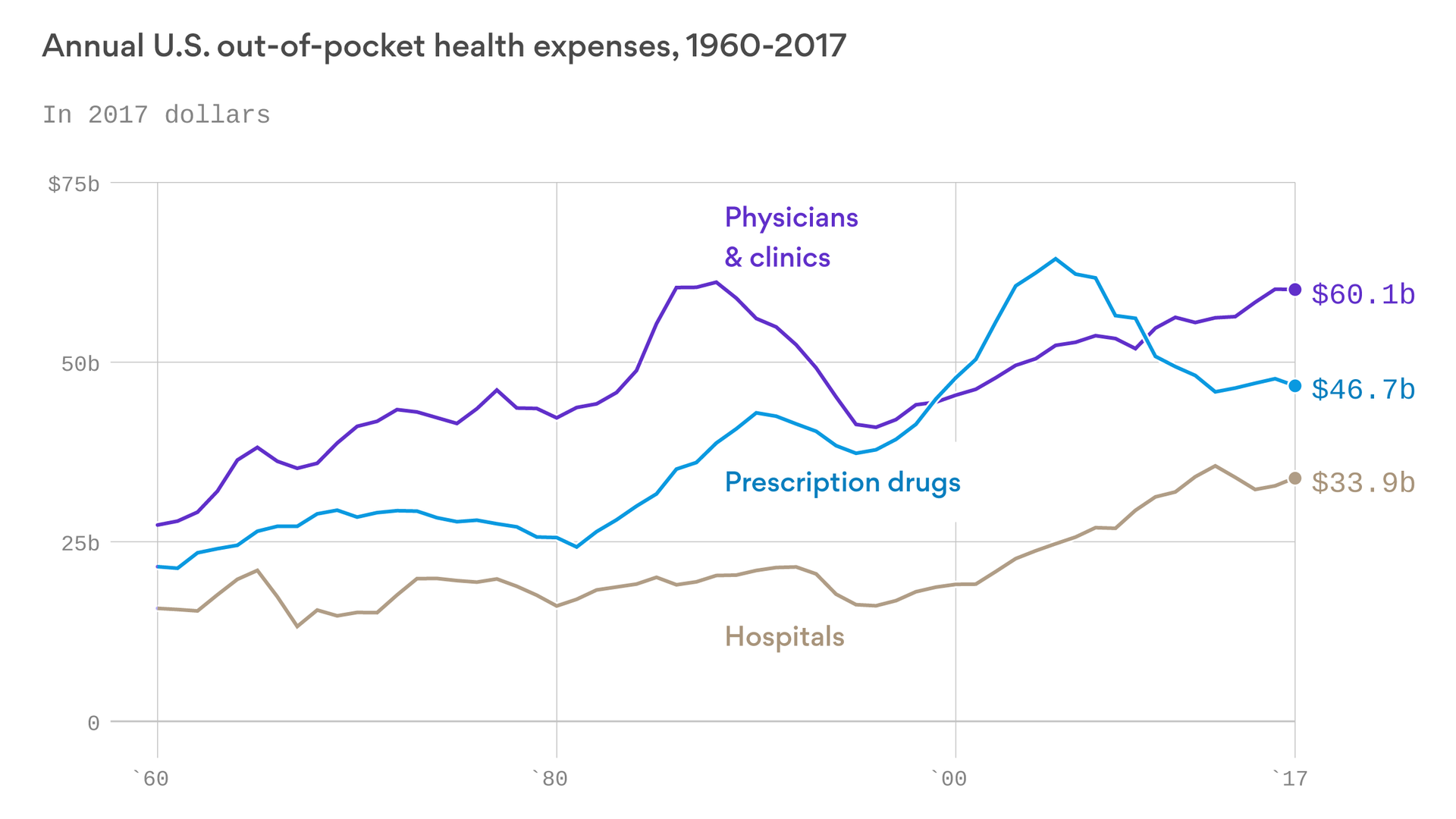
Hospitals smallest part of out-of-pocket costs

https://www.healthsystemtracker.org/interactive/?utm_campaign=KFF-2018-Peterson&utm_source=hs_email&utm_medium=email&utm_content=68267802&_hsenc=p2ANqtz–ktue7Wpa6NlVV1m5K05fMVx7jZNGoCLlk_ATmPS8Y6TgyNwDww1IGCz7sUIjYm69FTQmPft_pPBXXoE4h62JNKY1rEA&_hsmi=68267802&display=U.S.%2520%2524%2520Billions&service=Hospitals%252CPhysicians%2520%2526%2520Clinics%252CPrescription%2520Drug&source=Out%2520of%2520Pocket&tab=0

Image result for Hospitals smallest part of out-of-pocket costs


We spend more on hospital care than any other type of health care service, but hospitals make up the smallest amount of out-of-pocket spending.

  • That means insurers are passing on a smaller percentage of hospital costs to enrollees, although they indirectly pay for hospital care through premiums.

Between the lines:

  • “A big role of patient cost-sharing is to discourage use of inappropriate or unnecessary services. So much of hospital care is non-discretionary from the perspective of patients,” Kaiser Family Foundation’s Larry Levitt says.
  • Levitt adds that insurance tends to pay a bigger part of hospital bills versus other services because hospital bills tend to be large, causing patients to blow through their deductible or hit their out-of-pocket maximum.


Congress could get rid of ACA lawsuit, but won’t

https://www.axios.com/congress-could-get-rid-of-aca-lawsuit-ba906df5-57fd-492a-b365-baab06421ac1.html

 Illustration of hand with gavel breaking a red cross symbol

Congress could kill the lawsuit that threatens to wipe out the Affordable Care Act, legal experts say, but the politics of the issue will almost certainly keep it from doing so.

Why it matters: While these same legal experts think it’s very likely that this case gets thrown out on appeal, that doesn’t mean it definitely will — and a failure to overturn it would wreak havoc on the entire health care system.

The big picture: A federal judge ruled that since Congress repealed the ACA’s fine for not having health insurance, the still-existing-yet-toothless mandate that people have insurance is now unconstitutional, as is the rest of the law.

  • That’s because the requirement for having insurance is no longer bringing in any revenue. Its status as a revenue-generating tax is why the ACA survived its first major legal challenge.
  • The judge wrote in his decision that “both [the 2010 and 2017] Congresses manifested the same intent: The Individual Mandate is inseverable from the entire ACA.” That means the rest of the law is, by association with the mandate, unconstitutional as well.

What they’re saying: Each of the three legal experts I spoke to offered a different idea as to how Congress could make the entire lawsuit moot, if it wanted to.

  • Law professor Nicholas Bagley said that Congress could pass a law, signed by the president, stating that it believes the individual mandate is separable from the ACA – making its intent clear.
  • Legal expert and ACA supporter Tim Jost said that Congress could pass a $1 penalty for not having health insurance, essentially recreating its status as a (constitutional) tax.
  • Legal expert and ACA critic Jonathan Adler told me that Congress could just repeal the health insurance requirement entirely. “The surest way you make that go away is by officially getting rid of the part of the law that is allegedly unconstitutional,” he said.

Yes, but: Doing any of these things would require Republicans to vote to protect the ACA — giving up yet another chance to get rid of it — and Democrats to admit that the lawsuit is reasonable, as well as potentially to vote to repeal the individual mandate.

  • “We shouldn’t be jumping through hoops to try to respond to a judge who just broke decades of legal precedent on severability,” Sen. Chris Murphy said. “Maybe there’s creative things we could do if it got upheld on appeal, but I don’t think it’s going to be upheld on appeal.”
  • “This is an interesting case and we’re going to have to see how it ultimately plays out,” Finance Chairman Orrin Hatch said in a statement.

Incoming House Speaker Nancy Pelosi and Senate Minority Leader Chuck Schumer have said that they want to intervene in the case.

  • While only Pelosi has the power or the votes to make that happen without Republican assistance, it would have little practical effect, the experts said.
  • Courts care what Congress does, not what Congress says,” Adler said. “And intervening to defend the law in court is really more Congress talking than Congress doing.”

Ironicallythe precedent for the House filing a lawsuit or becoming party to a case is when the House sued the Obama administration over the ACA’s cost-sharing reduction payments.

  • “Just like [former Speaker John] Boehner’s intervention was a political stunt, I also think Pelosi’s intervention would be a political stunt,” Bagley said.


The GOP’s health problem: They like big chunks of the Affordable Care Act

https://www.axios.com/aca-ruling-republicans-politics-changed-f54f7a3f-53f4-47f2-9deb-2c4c424534b6.html

A protester in New York holds a sign saying, "ACA saves lives"

Now that a Texas judge has ruled that the entire Affordable Care Act is unconstitutional — all because of its individual mandate — Republicans may find themselves wishing for a different outcome.

The big picture: There is little hope of a deal with Democrats on health reform in a divided Congress if the decision is upheld. Democrats will now use the 2020 campaign to paint Republicans as threatening a host of popular provisions in the ACA. And here’s the kicker: protections for pre-existing conditions, the provision that played such a big role in the midterms, is not even the most popular one.

Here are just some of the more popular provisions that would be eliminated — in order of their popularity, according to the Kaiser Family Foundation’s November tracking poll:

  • Young adults can remain on their parents’ health insurance policies until age 26: 82% of the public supports this, including 66% of Republicans.
  • Subsidies for lower and moderate income people: 81% support this, including 63% of Republicans.
  • Closing the “donut hole” so there’s no gap in Medicare prescription drug coverage: 81% like this, as do 80% of Republicans.
  • Eliminating costs for many preventive services: 79% support this, as do 68% of Republicans.
  • Medicaid expansion: 77% like it, as do 55% of Republicans.

The list goes on, but notably, further down but still very popular: 65% of the public supports protecting people with pre-existing conditions, as do 70% of Democrats, 66% of independents and 58% of Republicans. The fact the pre-existing conditions does not top the list shows how popular all of the other provisions are.

The Republican attorneys general brought their lawsuit in a different political environment, when Republicans held the House, Senate and the White House. If that had continued, they could have had reason to hope that a ruling in their favor, if upheld by higher courts, could have helped them achieve their goal of repeal and replace legislation.

The bottom line: Their world has changed politically, with Democrats preparing to take control of the House next year, and Republicans may have been better off settling for the repeal of the mandate penalty that Congress already passed. The mandate was by far the least popular part of the law and gave them something to crow about. Now, they may have bought more than they bargained for.


HEALTHLEADERS TOP 10 FINANCE STORIES OF 2018

https://www.healthleadersmedia.com/finance/healthleaders-top-10-finance-stories-2018

Here’s a roundup of our most popular finance stories of the year.


KEY TAKEAWAYS

M&A activity among health systems and payers were a dominant narrative throughout 2018.

Policy changes affecting payment models also drew widespread attention from health leaders across the country.

The entrance of corporate disruptors stirred discussion and speculation among traditional healthcare industry players.

This year was marked by changing dynamics relating to healthcare finance, most notably from outside corporate disruptors like Amazon eyeing entry into the industry and widespread M&A activity across most sectors.

HealthLeaders has been on the front line covering the news and policy changes coming out of Washington, D.C., Wall Street, Nashville, and how it is going impact healthcare organizations as they shape their business strategies.

Below are the top 10 healthcare finance stories of 2018:

10. 4 TAKEAWAYS AS ATHENAHEALTH SELLS FOR LESS, BOARD INVESTIGATED

“Months of public negotiations and tribulations have resulted in a $5.7 billion acquisition of athenahealth set to close in Q1 2019, but it’s not a done deal yet.”

9. CMS DELAYS E/M PAYMENT CHANGES TO 2021 IN PHYSICIAN FEE SCHEDULE FINAL RULE

“A plan to simplify the way physicians bill Medicare for evaluation and management (E/M) visits has been finalized and will begin to take effect next year, but the controversial payment component of the plan will be delayed until 2021, giving stakeholders more time to influence policymaking, the Centers for Medicare & Medicaid Services announced.”

8. FIDELIS-CENTENE DEAL CLOSES, CATHOLIC CHURCH CREATES $3.2B HEALTH FOUNDATION

“The sale of the nonprofit health plan came after months of review from state regulators and final approval from interim Attorney General Barbara Underwood. ‘We are pleased to have completed our transaction with Fidelis Care on schedule and to enter the New York market by joining with a company with which we are closely aligned on many levels,’ Michael F. Neidorff, CEO of Centene, said in a statement.”

7. MEMORIAL HERMANN CFO BRIAN DEAN TALKS INNOVATION AND GROWTH

“Since joining Memorial Hermann Health System in 2013, Brian Dean served as both CFO and CEO of Memorial Hermann-Texas Medical Center, before his promotion last month to CFO of the entire system effective this August. Dean spoke to HealthLeaders about ascending to the new role, the lessons he’s learned in his years at the system, and the strategies he’s pursuing to further strengthen the organization’s finances.”

6. NATIONAL PENSION CRISIS COMING STORM FOR HOSPITALS

“Healthcare organizations are feeling the effects of the national shortfall of $645 billion in pension liabilities and are pursuing the ‘least bad option’ for handling the problem. The nationwide pension crisis has organizations scrambling to properly fund employee’ retirement packages and represents a self-inflicted dilemma that will have a dramatic impact on the healthcare industry without a clear solution.”

5. ‘SITE-NEUTRAL’ PAYMENTS? HOSPITALS UNHAPPY WITH OPPS 2019

“One observer praised CMS for ‘picking a fight with powerful hospitals’ in the agency’s annual update to payment proposals for outpatient services. Under OPPS 2019, reimbursement for clinic visits in outpatient hospital settings would be capped at the rate paid for clinic visits in physician offices.”

4. HOW DATA WILL DRIVE THE CVS-AETNA MERGER

“Through a vertical integration without significant precedence in healthcare, CVS and Aetna have the opportunity to use their increased scale to pursue several innovative business strategies going forward. Many industry players are interested in what the newly merged company could accomplish to further assist consumers at multiple points along the healthcare experience.”

3. WALMART-HUMANA ‘SIGNIFIES THE BEGINNING OF THE AVALANCHE’ IN HEALTHCARE

“PBMs, retailers, and providers are getting together to integrate health plans, with Walmart-Humana taking mergers to another level of complexity and transformation, says one healthcare consultant. The Walmart merger with Humana is another strong sign that the healthcare industry is rapidly merging with disparate parts of the retail world, intermingling so much and so quickly that some traditional parts of healthcare may be absorbed and cease to exist as we now know them.”

2. HEALTHCARE RIDESHARING MAKES INROADS IN LOST REVENUE

“Health systems are recouping lost patient revenues by removing barriers to access treatment, and reducing operational costs by coordinating with ridesharing services.Nearly 4 million patients per year miss out on care due to lack of available transportation options related to cost or geographic barriers, according to the 2017 American Hospital Association study, ‘Transportation and the Role of Hospitals.'”

1. TRUMP ADMINISTRATION RELEASES FINAL ACA RULE FOR 2019

“After attempts to repeal the Obama administration’s signature healthcare law faltered, the Trump administration set an agenda for the Affordable Care Act’s implementation next year.In signing a major tax reform bill into law late last year, President Donald Trump claimed to have “essentially repealed Obamacare” by neutralizing the legislation’s individual mandate penalty.”


FastMed, NextCare announce merger

https://www.healthcaredive.com/news/fastmed-nextcare-announce-merger/544538/

Dive Brief:

  • Phoenix-based FastMed Urgent Care has signed a definitive agreement to acquire NextCare Holdings of America, a Mesa, Arizona-based provider of urgent care and occupational medical services.
  • The combined company will have 251 clinics in 10 states — merging FastMed’s 110 clinics in Arizona, Texas and North Carolina with NextCare’s 141 in Arizona, Colorado, Kansas, Missouri, New Mexico, North Carolina, Oklahoma, Texas, Virginia and Wyoming.
  • The deal, which is subject to regulatory approvals, is expected to close within 60 days.

Dive Insight:

The shift to value-based care and greater use of alternative care sites is one factor fueling growth in urgent care centers. Meanwhile, the million of Americans newly insured under the Affordable Care Act and a growing aging population has driven up emergency room volumes.

In a 2015 survey, 75% of emergency department physicians said visits had increased over the past year. The result is an overtaxed emergency staff and long wait times for patients. By contrast, urgent care offers medical care when and where patients need it and at a lower price point.

According to MarketsandMarkets, the global urgent care market will reach $26 billion by 2023, growing at a compound annual growth rate of 5.3%. Driving growth are lower costs and shorter wait times, growing investment in the sector, aging of populations and strategic partnerships between urgent care providers and hospitals.

In July, Morristown, New Jersey-based Atlantic Health System and MedExpress partnered to improve urgent care access and care coordination between the companies. The collaboration will allow MedExpress’ urgent care patients to get care at an Atlantic Health facility if more advanced care is needed.

And in October, Walgreens announced a strategic collaboration with Michigan-based McLaren Health Care aimed at improving health and pharmacy services. The vertical pact came as CVS Health and Aetna were wrapping up their megamerger.