How will the Graham-Cassidy proposal affect the number of people with health insurance coverage?

https://www.brookings.edu/research/how-will-the-graham-cassidy-proposal-affect-the-number-of-people-with-health-insurance-coverage/?utm_campaign=Brookings%20Brief&utm_source=hs_email&utm_medium=email&utm_content=56637974

ES_20170922_GrahamCassidyTable1

On September 13, Senators Graham and Cassidy, together with two other Republican colleagues, introduced legislation that would repeal major portions of the Affordable Care Act (ACA). Press reports indicate that the legislation has gained considerable support among Senate Republicans, and Senate Majority Leader McConnell’s office announced on Wednesday that the Senate would hold a vote on this legislation sometime during the week of September 25.

This legislation has not yet been analyzed by the Congressional Budget Office (CBO), and CBO has indicated that it will not be able to provide a complete analysis of the legislation before the Senate vote. Notably, CBO stated that its analysis would not include “point estimates of [the Graham-Cassidy legislation’s] effects on the deficit, health insurance coverage, or premiums.” To help fill the gap left by the Senate’s decision to hold a vote in the absence of a complete CBO analysis, this analysis draws upon CBO’s estimates for prior legislation to evaluate how the Graham-Cassidy legislation might affect the number of people with health insurance coverage.

Starting in 2020, the Graham-Cassidy proposal would eliminate the ACA’s Medicaid expansion and Marketplace subsidies. Also in that year, the legislation would begin providing block grant funding to states, as well as allowing states to seek waivers from ACA regulations that bar insurers from varying premiums based on health status and require insurers to cover certain health care services.For years prior to 2020, this new legislation broadly tracks prior Republican bills, most importantly by immediately repealing the individual mandate. CBO’s analyses of these prior bills imply that the Graham-Cassidy legislation would reduce insurance coverage by around 15 million in 2018 and 2019. The reduction would be larger if uncertainty about the effects of the more radical changes implemented by the legislation in 2020 caused some insurers to pre-emptively withdraw from the individual market.

To estimate the effects on insurance coverage during these years, we consider the various ways in which states might respond to the options provided by the legislation, using prior CBO analyses to evaluate the likely coverage outcomes for each of four broad categories of states. We then make assumptions about how many states will take each broad policy approach.

Based on this analysis, we estimate that the Graham-Cassidy legislation would reduce the number of people with insurance coverage by around 21 million each year during the 2020 through 2026 period. This estimate likely understates the reductions in insurance coverage that would actually occur under the Graham-Cassidy legislation, particularly toward the beginning and end of the seven-year period, because it does not account for the challenges states will face in setting up new programs on the bill’s proposed timeline, the possibility that uncertainty about the program’s future will cause market turmoil toward the end of the seven-year period, or the bill’s Medicaid per capita cap and other non-expansion-related Medicaid provisions. These estimates are, of course, subject to considerable uncertainty, most importantly because predicting how states would respond to the dramatic changes in the policy environment under the Graham-Cassidy proposal is very challenging. What is clear, however, is that the legislation would result in very large reductions in insurance coverage.

Based on this analysis, we estimate that the Graham-Cassidy legislation would reduce the number of people with insurance coverage by around 21 million each year during the 2020 through 2026 period.

The Graham-Cassidy legislation’s adverse effects on insurance coverage are likely to increase after its block grant funding expires at the end of 2026. After that time, the legislation is similar to the “repeal and delay” proposal that the Senate considered in July, which CBO estimated would reduce the number of people with insurance coverage by 32 million people in the long run. Reductions in insurance coverage would likely be somewhat larger under the Graham-Cassidy proposal because of the legislation’s non-expansion related Medicaid provisions, which would further reduce insurance coverage


Healthcare Triage News: Let’s Talk Cassidy-Graham

Healthcare Triage News: Let’s Talk Cassidy-Graham

Image result for Healthcare Triage News: Let’s Talk Cassidy-Graham

We had a whole other video planned for today but we have to talk about the Cassidy-Graham bill, which is getting closer to passing despite our predictions last week.

The only option left to the Senate is to make health care reform someone else’s problem

The only option left to the Senate is to make health care reform someone else’s problem

Image result for pass the buck dilbert

I wish I had more time to blog. I really do. But I’m consumed with grant submissions, mentoring researchers, and writing columns about health policy because it’s clear that someone’s got to do it.

That said, I’m taking ten minutes out of my day here to rant. Read it or don’t.

If it hasn’t become abundantly clear, the only thing left for Republican Senators to try is to kick the can down the road. Again. They’re going to try and pass a bill which gives less money overall to states, a lot less money to some states, and then tells them to “figure it out”. Later, they can claim that they gave the states all the tools they needed to fix the health care system, so now it’s THEIR fault things don’t work.

This is ridiculous.

There is no magic. There is no innovation. If there was a way to make the health care system broader, cheaper, and better, we would do it right now. We would have done it years ago. No matter what you may think of Democrats in 2009, they didn’t choose the ACA because they wanted to keep states from fixing the health care system. The ACA was the best they could get.

There are no governors, of red or blue states, who have a magic plan for health care innovation. There are no state legislators (who likely work part-time) who have a secret plan to unleash the power of federalism. The Republicans in Congress have had seven years, all the money in the world, the phone numbers of every conservative wonk in the country, the CBO, experts eager to offer their help… If they couldn’t figure this out, do they think that Montana will? Oklahoma? Indiana? In less than two years?

THERE IS NO WAY TO SPEND LESS, COVER MORE, AND MAKE IT BETTER.

Pretty much every health care organization is against this bill. The organization of Medicaid directors is against this bill. Most governors are against this bill. Nearly every wonk I can think of is against this bill.

There are legitimate ways to reform the health care system according to conservative principles. They all involve tradeoffs. The people defending this bill refuse to acknowledge that. Many are – at this point – seemingly just making stuff up and promising the moon. And – I’ll bet all the money in my pocket on this – when they can’t deliver, it’s going to be someone else’s fault.

GOP health bill all but dead; McCain again deals the blow

https://www.yahoo.com/news/trump-lashes-gop-opponents-health-care-bill-110647029–politics.html

FILE - In this July 27, 2017, file photo, Sen. John McCain, R-Ariz., speaks to reporters on Capitol Hill in Washington.  McCain says he won't vote for the Republican bill repealing the Obama health care law. His statement likely deals a fatal blow to the last-gasp GOP measure in a Senate showdown expected next week.   (AP Photo/Cliff Owen, file)

Sen. John McCain declared his opposition Friday to the GOP’s last-ditch effort to repeal and replace “Obamacare,” dealing a likely death blow to the legislation and, perhaps, to the Republican Party’s years of vows to kill the program.

“I cannot in good conscience vote for the Graham-Cassidy proposal,” McCain said in a statement, referring to the bill by Sens. Lindsey Graham of South Carolina and Bill Cassidy of Louisiana.

“I believe we could do better working together, Republicans and Democrats, and have not yet really tried,” he said. “Nor could I support it without knowing how much it will cost, how it will affect insurance premiums, and how many people will be helped or hurt by it.”

McCain was the decisive vote against the GOP’s last repeal effort, in July. Once again, the 81-year-old senator, battling brain cancer in the twilight of a remarkable career, emerged as the destroyer of his own party’s signature promise to voters.

President Donald Trump and Senate Majority Leader Mitch McConnell had both been pushing hard for the bill in recent days, and McCain’s best friend in the Senate, Graham, was an author. Trump declared during the presidential campaign that he would quickly demolish Obamacare and “it will be easy.”

McCain’s announcement likely leaves GOP leaders at least one vote short for the bill, which they had hoped to bring to the floor next week. They face a Sept. 30 deadline for action on the legislation, at which point special rules that prevent a Democratic filibuster will expire.

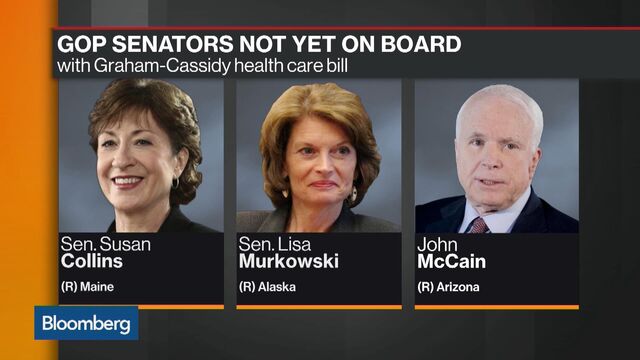
Democrats are unanimously opposed. GOP Sen. Rand Paul of Kentucky has announced his opposition and GOP Sen. Susan Collins of Maine said Friday she, too, was leaning against supporting the bill.

Along with McCain, that would leave Republicans with only 49 votes for the bill; they would need 50, plus Vice President Mike Pence to break a tie, in order to prevail.

The Graham-Cassidy bill would repeal major pillars of former President Barack Obama’s law, replacing them with block grants to states to design their own programs. Major medical groups are opposed, saying millions would lose insurance coverage and protections.

Docs, Hospitals, Insurers Blast Last-Ditch ACA Repeal

http://www.healthleadersmedia.com/leadership/docs-hospitals-insurers-blast-last-ditch-aca-repeal?spMailingID=11982714&spUserID=MTY3ODg4NTg1MzQ4S0&spJobID=1241926561&spReportId=MTI0MTkyNjU2MQS2#

Image result for Last-Ditch ACA Repeal

With one exception, most physician groups stating a position viewed the bill as dangerous.

As momentum builds for the GOP’s latest Obamacare repeal effort, most major physician and hospital groups skewered the proposal.

But some held their tongues or even welcomed certain new “freedoms” the bill could afford.

Last week senators Lindsey Graham (R-S.C.), Bill Cassidy (R-La.), Dean Heller (R-Nev.), and Ron Johnson (R-Wis.) introduced a healthcare bill to pool money that would have been funnelled into premium and cost-sharing subsidies and Medicaid expansion and direct it instead to states in the form of block grants.

The proposal would also repeal the Affordable Care Act’s individual and employer mandates, the medical device tax, and “strengthen the ability for states to waive Obamacare regulations,” according to a Sept. 13 press release posted on Cassidy’s website. It appears the bill will have no committee hearings or markups before coming to the Senate floor for a vote.

With one exception, most physician groups stating a position viewed the bill as dangerous.

Physicians: ‘Do No Harm’

The new bill “violates the precept of ‘first do no harm,'” said James Madara, MD, CEO and executive vice president of the American Medical Association, in a letter to Senate Majority Leader Mitch McConnell (R-Ky,) and Minority Leader Chuck Schumer (D-N.Y.).

“Similar to proposals that were considered in the Senate in July, we believe the Graham-Cassidy Amendment would result in millions of Americans losing their health insurance coverage, destabilize health insurance markets, and decrease access to affordable coverage and care,” he wrote.

The AMA is especially concerned about repealing the premium subsidies, cost-sharing reductions, small business tax credits, and Medicaid expansion, and described the Medicaid block grants, which would run through 2026 as “inadequate and temporary.”

“Per-capita caps (a form of block grant) fail to take into account unanticipated costs of new medical innovations or the fiscal impact of public health epidemics, such as the crisis of opioid abuse currently ravaging our nation,” he wrote.

Rebecca Parker, MD, president of the American College of Emergency Physicians, also penned a letter to Senate leadership highlighting the dangers her members see in the bill.

“ACEP cannot support any legislation that does not include emergency medical care as a covered benefit in health insurance,” she wrote. “Yet, [the Cassidy-Graham bill] allows states to easily forego requiring insurers to adhere to important consumer protections, including the requirement to cover the ten essential health benefits, and protections for those with pre-existing conditions.”

Ninety-five percent of Americans believe health plans should cover emergency medical care, Parker noted, which is currently one of the ACA’s essential benefits.

“[E]mergency physicians agree with them. Patients can’t choose when and where they will need emergency care, and they shouldn’t be punished financially for having emergencies,” she continued.

And a joint letter from six specialty organizations representing more than 500,000 physicians — the American Academy of Family Physicians, the American Academy of Pediatrics, the American Congress of Obstetricians and Gynecologists, the American Osteopathic Association, the American College of Physicians, and the American Psychiatric Association — described the bill as “disruptive” and “harmful” to patients.

In addition to failing to preserve the coverage and consumer protections enacted by the ACA, the groups said the new bill “would create a health care system built on state-by-state variability that would exacerbate inequities in coverage and most likely place millions of vulnerable individuals at risk of losing their health care coverage.”

The groups continued to urge Congress to pursue “regular order” including hearings, debates, and committee markups and not to rush a vote.

Hospitals Disappointed

Because the new bill’s approach is similar to previous repeal proposal’s, Bruce Siegel, MD, MPH, the president and CEO of America’s Essential Hospitals, said he anticipates a similar result: “millions of Americans losing coverage. ”

“Unlike those previous proposals, the Graham-Cassidy bill provides no meaningful relief from looming cuts to Medicaid disproportionate share hospital (DSH) payments,” he noted, while stressing that the new bill would also limit “how states raise support for the safety net.”

“Rather than providing flexibility, this would limit states’ coverage and financing choices,” he said.

Similarly, “This proposal would erode key protections for patients and consumers and does nothing to stabilize the insurance market now or in the long term,” said Rick Pollack, CEO of the American Hospital Association, in a press statement.

On Board, On the Fence

Not all physicans want to see the bill shredded.

Despite her “mixed feelings,” Jane Orient, MD, executive director of the Association of American Physicians and Surgeons, said on the whole, “I think that it may in the long-term make things a tiny bit better by permitting a wedge of freedom.”

Examples of this freedom include giving block grants to states and rolling back federal regulation so that states can experiment and make their Medicaid programs more efficient.

“The idea that we can just infinitely expand the money that we’re pouring into Medicaid is going to come to a halt. It has to. How can you keep spending money that you don’t have?” Orient asked.

Half of all Medicaid funding is money coming from creditors, because the government has to borrow 50 cents of every dollar it spends, she said.

The American Association of Neurological Surgeons/Congress of Neurological Surgeons indicated that members like giving states more control over how healthcare dollars are spent, and repeal of the medical device tax. But the group is concerned about “backsliding” on other insurance reforms, such as those involving pre-existing conditions, a press representative told MedPage Today in a phone call.

“Without a [Congressional Budget Office] score, it’s impossible to predict what the states are going to do at this point,” the representative said. No CBO analysis of the bill other than its effect on the federal budget is expected.

Other specialty groups have remained silent on the bill.

Insurers Skeptical

Another important set of stakeholders also stated opposition to Graham-Cassidy: the health insurance industry, whose chief trade group declared it “cannot support this proposal.”

Marilyn Tavenner, CEO of America’s Health Insurance Plans, outlined six “guiding principles” in a letter to McConnell and Schumer on Wednesday. They included: stabilizing the individual insurance market, a strong Medicaid program, guaranteed coverage for all, sufficient lead time to implement reforms smoothly, improved affordability, and reliance on the private market.

“The Graham-Cassidy-Heller-Johnson proposal fails to meet these guiding principles,” the letter said, “and would have real consequences on consumers and patients by further destabilizing the individual market; cutting Medicaid; pulling back on protections for pre-existing conditions; not ending taxes on health insurance premiums and benefits; and potentially allowing government-controlled, single payer health care to grow.”

Senate leadership aims to bring the bill to the floor for a vote next week. The body faces a Sept. 30 deadline to pass legislation with budgetary implications without needing 60 votes to overcome a filibuster.

What Are the Potential Effects of the Graham-Cassidy ACA Repeal-and-Replace Bill? Past Estimates Provide Some Clues

http://www.commonwealthfund.org/publications/blog/2017/sep/potential-effects-of-graham-cassidy

Graham Cassidy

Last week, Sens. Lindsey Graham (R–S.C.) and Bill Cassidy (R–La.) unveiled congressional Republicans’ latest bill to repeal and replace the Affordable Care Act (ACA). The Congressional Budget Office (CBO) has indicated that it will not release a score of the bill that includes its effects on insurance coverage for several weeks, but Senate leaders have indicated they will hold a vote without a score. The bill, however, is similar to prior ACA repeal-and-replace bills for which we do have CBO scores. Based on those estimates, it is likely that the bill, if enacted, would lead to a loss of health insurance for at least 32 million people after 2026.

The bill can be boiled down to five key provisions:

  • Repeals the ACA marketplace subsidies and federal funding for the Medicaid expansion in 2020.
  • Creates temporary block grants for states that end in 2026. States can use the funds for a wide range of purposes.
  • Repeals the individual and employer mandates.
  • Creates a waiver program for states that would allow insurers to charge people more based on their health and cut benefits like maternity care.
  • Places per capita spending limits on funding for the traditional Medicaid program.

Repeal with Temporary Block Grants. The bill repeals the ACA’s marketplace subsidies and Medicaid expansion, which currently cover about 30 million people. The Center on Budget and Policy Priorities (CBPP) estimates Graham-Cassidy would cut $239 billion from current spending levels, and then divide the remaining funding among states according to a complicated block-grant scheme that results in gains for some states at the expense of deep losses in other states. CBPP projects that the states that would lose the most funding are those that expanded Medicaid, including highly populated states like California and New York.

But all of that grant funding vanishes after 2026. CBO estimated the effects of a repeal of the ACA’s subsidies and Medicaid expansion in January. The bottom line: elimination of those provisions in combination with a repeal of the law’s individual mandate could lead to a loss of health insurance coverage for at least 32 million people. Compounding the coverage losses, Leighton Ku and colleagues at George Washington University have estimated that a repeal of the coverage expansions would have severe nationwide economic effects, leading to a loss of 2.6 million jobs.

Ingredients for Individual Market Instability. While supporters of the Graham-Cassidy bill claim it is market-based, it contains the ingredients for market instability, including the immediate repeal of the penalties for the individual mandate requiring health insurance. CBO’s prior analyses of the elimination of the individual mandate found that 15 million to 18 million people would become uninsured in the first full plan year after enactment (in this case 2019), as people dropped their coverage from all sources and insurers left the marketplaces. CBO also projected that premiums in the individual market would climb by 15 percent to 20 percent in the first plan year. The majority of that increase would come from the repeal of the mandate penalties: insurers would expect that those who remained in the pool would be the least healthy. And as the CBPP has pointed out, uncertainty over how states would use their block-grant funding would likely lead to even greater instability in the individual market.

Graham and Cassidy try to stem these potential market imbalances in two ways. The bill would bring back the temporary premium stabilization funds for insurers featured in both the Senate and House bills, but only for two years. Then it would allow states to apply for waivers that would let insurers charge people with health problems higher premiums, and change other ACA consumer protections such as bans on lifetime benefit limits and comprehensive coverage requirements. CBO’s analyses of a similar waiver in the House-passed American Health Care Act estimated that half the U.S. population could live in states that would likely take up such waivers, shutting out millions of older adults and people with health problems from the individual market, as in the pre-ACA days.

Reaching Beyond the ACA into Medicaid. The Graham-Cassidy bill, like the earlier Senate and House bills, reaches well beyond the ACA and makes the deepest cuts in the Medicaid program since its inception in 1965. Like those prior bills, it places a per-enrollee cap on what the federal government provides to states for their programs. This cap would threaten the health care of an additional 65 million people who depend on the program, including the elderly, disabled, children, pregnant women, and very poor adults. Cindy Mann and colleagues at Manatt Health Solutions estimated that the spending caps in a version of the Senate repeal-and-replace bill earlier this summer would result in federal  spending cuts of $172 billion over 2020 to 2026. And Al Dobson and colleagues found that, under the House-passed bill, the per-capita caps in that bill would result in a loss of $3.6 billion in revenues for safety-net hospitals alone over 10 years. The Graham-Cassidy bill imposes tighter annual limits in later years than both these bills, so losses may exceed these earlier estimates.

A Need for Public Discussion and Bipartisanship on Health Care

By repealing the ACA’s coverage expansions and cutting deeply into the Medicaid program, the Graham-Cassidy bill threatens the health care of as many as 100 million people, from newborns to the elderly. The fundamental purpose of insurance coverage — that it is essential to enabling people in the United States to get timely access to health care — has been sorely missing from this year’s debate over the future of our nation’s health insurance system. This is partly because of the lack of Congressional hearings on the Graham-Cassidy bill and its House and Senate repeal-and-replace predecessors. In stark contrast, the hearings held this month by Sens. Lamar Alexander (R–Tenn.) and Patty Murray (D–Wash.) to inform their search for a bipartisan solution to the ACA’s marketplaces have allowed for a vetting of options and their potential effects. Public discussion and deliberation may not guarantee sound, bipartisan policy solutions, but they at least enable their possibility.

Graham-Cassidy: Radical Change in the Federal–State Health Relationship

http://www.commonwealthfund.org/publications/blog/2017/sep/graham-cassidy-and-the-states?omnicid=EALERT1276210&mid=henrykotula@yahoo.com

The Graham-Cassidy legislation contains many provisions that are consistent with previous Affordable Care Act (ACA) repeal-and-replace bills. But in its treatment of states and their envisioned role, it departs dramatically from those efforts.

Federal laws often create a flow of federal tax revenue to states to manage programs and services at a local level. Inevitably, some states gain more than others in the process. But Graham-Cassidy does something rare, if not unprecedented: moving funds from one group of states (those that expanded Medicaid) to another (those that did not) (See New York Times graphic). Under any circumstances, this transfer would raise significant questions of fairness. But in this case, there is a special twist. Most of the losers are blue states, most of the winners red. Whether or not the bill’s authors intended this, it creates a precedent that could result in tit-for-tat responses from blue-state legislators in the future. When political winners pillage losers, the savagery of political conflict is bound to increase, and that does not bode well for stable governance of these united states.

Graham-Cassidy’s second departure from past repeal bills is the extensive new authorities it gives states to manage the additional funds made available for health coverage under the Affordable Care Act (ACA). At least through 2026, when ACA-related funding would disappear, the federal dollars associated with Medicaid expansion and subsidies for purchase of individual private insurance would be reduced by an estimated $239 billion, and then be pooled at the federal level and allocated as block grants to each state.

States would have to apply for the use of these funds, but would have much more flexibility than exists under the Affordable Care Act. The bill doesn’t lay out clear federal goals for how the block grants are to be used, and therefore dilutes states’ responsibilities to expand the numbers of insured through stable private health insurance markets. States also can apply for waivers under the grant program to allow participating insurers to vary premiums based on health status, or to offer less comprehensive benefits. Many other requirements of the ACA would disappear — such as the individual and employer mandates. Together, these actions could lead to a loss of coverage for at least 32 million people.

Moreover, state applications for block grants would be due by March 31, 2019, a very short amount of time for states to develop the administrative structure for a state-based coverage expansion program. States that neither ran their marketplaces nor expanded Medicaid under the ACA may not apply at all.

The assertion of states’ prerogatives to control federal funds is a bedrock conservative principle, but there are also strong rationales for federal involvement in the use of such federal outlays. The federal government has a responsibility to ensure that federal taxpayers’ funds are properly used and that services are of acceptable quality and distributed equally among all eligible citizens. For these reasons, joint federal–state control has long been typical of the Medicaid program, and performance requirements accompany many other health grants to states.

There are other rationales for a federal role in health care affairs at the state level. The Commerce Clause of the U.S. Constitution has traditionally recognized the need for federal involvement in economic transactions that affect citizens in multiple states and are important to the national economy. Private health insurance markets often extend beyond state boundaries, as do the networks of providers who care for individuals insured in some states. Thus, intrastate health insurance activities may be subject to the Commerce Clause. Indeed, the strong support by Republicans of the sale of insurance across state lines suggests their desire to increase even further the participation of insurers in interstate commerce.

Virtually all uninsured citizens in the U.S. eventually become Medicare beneficiaries. Research has shown that previously uninsured individuals are much more expensive for Medicare than are the previously insured. Thus, states that choose to use their authority under Graham-Cassidy in ways that increase the numbers of uninsured will be affecting taxpayers in other states.

The correct balance between federal and state prerogatives in extending and regulating health insurance coverage is not straightforward. Graham-Cassidy takes a radical position that departs from precedent. As such, it raises important issues that deserve debate. However, when the bill is brought to the floor next week (as Senate Majority Leader Mitch McConnell has promised), there will be literally no time left under Senate rules for floor debate of the reconciliation legislation to which it will be attached. Nor has there been an opportunity to consider these issues in the extended hearings they deserve.

The proper role of states in ensuring health coverage for their residents has emerged as a core issue in the consideration of this most recent repeal effort. This is a critical issue that will almost certainly not get the attention it deserves.

Graham and Cassidy go into overdrive to win Murkowski vote

Graham and Cassidy go into overdrive to win Murkowski vote

Image result for Deal or No Deal

Sens. Lindsey Graham (R-S.C.) and Bill Cassidy (R-La.) are going into overdrive to win over Alaska Sen. Lisa Murkowski (R), a pivotal vote for their bill to dismantle ObamaCare and give states more authority over healthcare.

The two have seen Murkowski, one of three Republicans to sink the GOP’s last repeal bill, as a critical vote for some time.

Graham told a meeting of conservative activists last week that special accommodations would have to be made in the bill for Alaska to win over Murkowski. The senator asked the groups to understand, and to not make a stink if concessions were made.

The Graham-Cassidy proposal would convert ObamaCare’s subsidies and funds for Medicaid expansion into block grants that would be given to states to design their own programs.

Right now it looks like an uphill battle to change Murkowski’s mind.

“I’d say the chances are less than 30 percent. Alaska doesn’t do very well in this bill. Her governor is lukewarm on it and her insurance commissioner is not for it,” one Senate GOP aide added.

Graham and Cassidy met with Murkowski on Wednesday in the office of fellow Alaska Sen. Dan Sullivan (R).

The face-to-face negotiations took a break Thursday as Graham traveled back to South Carolina and Murkowski flew back to Alaska, according to their offices.

Karina Petersen, a spokeswoman for Murkowski, said her boss is still vetting the bill and studying data from the Centers on Medicare and Medicaid Services and Department of Health and Human Services.

Alaska has higher health-care costs than other states because of its vast size and isolated geography.

Lori Wing-Heier, the director of Alaska’s Division of Insurance, testified before the Senate earlier this month that the state has some of the highest health-care costs in the nation because of its low population.

Under Graham-Cassidy, Alaska would see a $1 billion reduction in funding compared to current law for years 2020 through 2026, or about $1,350 per resident, according to a new study by Avalere, an independent consulting firm.

A study by the Center on Budget and Policy Priorities, a left-leaning think tank, projected a $255 million reduction in federal funding for Alaska in 2026 alone, a number made more daunting by the state’s small population of 742,000.

The Independent Journal Review reported Thursday that a new draft of Graham-Cassidy would allow Alaska as well as Hawaii to keep ObamaCare’s premium tax credits in addition to receiving block grants.

But Murkowski’s spokeswoman said she was not aware of any revised bill language being shared with her office.

Graham on Wednesday downplayed the notion that Alaska would fare better than other states in the bill but nevertheless acknowledged that something would have to be done to accommodate the state’s high costs.

“What we’re going to do is not deny Alaska the uniqueness of Alaska, but that’s it,” he said, according to The Washington Post.

The strategy could prove risky, however, as conservatives may balk at any language that might be seen as a special giveaway to Alaska.

One conservative Republican aide said extra funding for the state “possibly” could be a problem.

Graham’s office did to respond Thursday to a question about special aid for Alaska.

With Sen. Rand Paul (R-Ky.) opposed to the bill and Sen. Susan Collins (R-Maine) seen as a likely no, Republicans can’t afford to lose another GOP vote.

Yet winning Murkowski won’t guarantee passage either.

Cassidy’s office is also working with Sen. Mike Lee (R-Utah), another conservative who has raised concern about waivers for states.

Lee was encouraged earlier this week by the progress of the talks.

Other Republicans have raised concerns or said they need more time to study the bill.

Sen. John McCain (R-Ariz.) has repeatedly told reporters that legislation as complicated as healthcare reform should go through the regular order of committee hearings and markups.

The Senate Finance Committee is scheduled to hold a last-minute hearing of the legislation on Monday, but it’s doing so on a rushed schedule as lawmakers are racing to vote before Sept. 30, when special budgetary rules that will allow it to pass with a simple majority instead of 60 votes expire.

Conservative Sen. Ted Cruz (R-Texas) has raised concerns over whether the bill goes far enough to exempt states from ObamaCare’s insurance market regulations, which he believes have sent premiums soaring.

Asked this week if the bill’s insurance waivers go far enough, Cruz responded, “Not at the moment.”

Cruz, however, added that he is working with colleagues to “expand the regulatory freedom and lower premiums so that families who are struggling will be able to afford health insurance.”

Other Republicans say they need more time to make up their minds.

Sullivan, who shares some of Murkowski’s concerns about the potential impact on Alaska’s pricey insurance market, and Sen. Shelley Moore Capito (R), whose home state of West Virginia has benefited ObamaCare’s Medicaid expansion, say they are still reviewing the bill.

Senate Republican aides say McConnell has gotten fully behind Graham-Cassidy over the past week.

He told Republican senators at a lunch meeting Tuesday that this is their last chance to repeal ObamaCare in the current Congress as the legislative vehicle they need to circumvent a Democratic filibuster expires on Sept. 30.

But while McConnell and his leadership team are engaged, they are not as fully in control of the negotiations as in July, when McConnell worked with Senate Finance Committee Chairman Orrin Hatch (R-Utah), Senate Budget Committee Chairman Mike Enzi (R-Wyo.) and Senate Health Committee Chairman Lamar Alexander (R-Tenn.) to draft the healthcare bill Senate Republicans were pushing at the time.

In July McConnell’s office was in control of almost every decision and he handled much of the negotiation with wavering senators.

Now, Graham, Cassidy and their partner, former Pennsylvania Sen. Rick Santorum (R) are taking the point.

“It’s their bill, they’re the best ones to sell it,” said a senior GOP aide.

McConnell met with Murkowski and McCain on Monday to feel them out.

The GOP leader also met with Graham and Cassidy prior to their meeting with Murkowski on Wednesday.

Graham and Cassidy are after Murkowski’s vote

https://www.axios.com/graham-and-cassidy-are-after-murkowskis-vote-2488018309.html

Image result for Graham and Cassidy are after Murkowski's vote

Sens. Lindsey Graham and Bill Cassidy are considering three new Alaska-specific changes to their health care proposal to gain the backing of Sen. Lisa Murkowski, according to the Independent Journal Review.

What they’re offering: 

  • Alaska and Hawaii would “continue to receive Obamacare’s premium tax credits” despite them getting repealed in the rest of the country.
  • Medicaid per capita caps are delayed for both Alaska and Hawaii.
  • Both states get “an increased federal Medicaid matching rate”
Why it matters: Murkowski was one 3 GOP no-votes on health care earlier this year.