The Same Agency That Runs Obamacare Is Using Taxpayer Money to Undermine It

Image result for The Same Agency That Runs Obamacare Is Using Taxpayer Money to Undermine It

The Trump administration said on Thursday that it would slash spending on advertising and promotion for the Affordable Care Act, but it has already been waging a multipronged campaign against it.

Despite several failed efforts by Republican lawmakers to repeal it, the Affordable Care Act remains the law of the land. But the Department of Health and Human Services — an agency with a legal responsibility to administer the law — has used taxpayer dollars to oppose it.

Legal experts say that while it is common for a new administration to reinterpret an existing law, it is unusual to take steps to undermine it. Here are three ways the health department has campaigned against Obamacare.

1. REDIRECTING PROMOTIONAL FUNDING

Instead of using its outreach budget to promote the Affordable Care Act, the department made videos critical of the law.

In June, the health department posted 23 video testimonialson YouTube from people who said they had been “burdened by Obamacare,” including families, health care professionals and small business owners.

While it’s not certain where the money for the videos came from, several former health officials who worked in the Obama administration said that they suspect it came from the budget meant to promote the Affordable Care Act.

“There’s no other budget that makes sense,” said Lori Lodes, who oversaw outreach efforts under Mr. Obama.

The Trump administration defended the videos, saying that they were produced to inform Americans about the need for change so that people would have access to affordable health care.

“As evidenced by these important and educational testimonials, the status quo has made that impossible for millions of Americans,” a department spokeswoman, Alleigh Marré, said in July. “The administration is committed to reforming the current health care system to bring down the cost of coverage, expand health care choices, and strengthen the safety net for generations to come.”

The Daily Beast reported in July that one of the participants in the videos said he felt he was being pushed “for a harder line against Obamacare.”

While the health department refers to these testimonials as “educational videos” produced to inform Americans on the need to overhaul health care, some experts question whether they fit that definition.

“The lines between what is partisan, what is propaganda, and what is educational are nightmarish and subjective,” said Michael Eric Herz, a professor at the Cardozo School of Law in New York who has written about social media and the government.

2. ATTACKING THE LAW

The department targeted the Affordable Care Act with a marketing campaign as Republicans in Congress tried to repeal the legislation.

In addition to the YouTube videos, the department has used Twitter and news releases to try to discredit the health law. Since being sworn in as health secretary on February 10, Tom Price has posted on Twitter 48 infographics advocating against Obamacare, all of which bear the health department’s logo.

“Here, it’s an agency trying to destroy its own program because it opposes it,” said Kathleen Clark, a law professor at Washington University who is an expert on government ethics. “It is inconsistent with the constitutional duty to take care that the law is faithfully executed.”

The bulk of Mr. Price’s Twitter posts were from late June to mid-July, when Senate Republicans were trying to pass a bill to repeal and replace the Affordable Care Act. Once, Mr. Price tweeted five infographics in a single day.

Around the same time, the Trump administration ended $23 million worth of contracts with companies that help people sign up for coverage.

In August, five congressional Democrats wrote a letter to Mr. Price demanding detailed information about his plans for marketing and outreach. “Rather than encouraging enrollment in the marketplaces, the administration appears intent on depressing it,” the letter said.

3. DELETING INFORMATION ONLINE

The department removed useful guidance for consumers about the Affordable Care Act from its website.

Under the Obama administration, the health department’s website contained information to help consumers learn about the Affordable Care Act and how to obtain coverage through the health insurance marketplaces. Much of that information is now gone. Some was removed within hours of President Trump’s inauguration.

A link to a page about the Affordable Care Act disappeared from the health department’s home page the evening of the inauguration, according to a comparison of the sites, shown below.

The department also changed other areas of the website, removing overviews of the law and links to information on summaries of benefitsemergency services and doctor choice, making it more difficult for consumers to learn about the law.

It also appears to have erased positive references to the Affordable Care Act, including personal stories about individuals who benefited from the law.

For example, a video about a Florida man with diabetes who said he was able to enroll in coverage without worrying about his health status was removed from a page about pre-existing conditions. A link to a page about the number of young adults who gained coverage after the law took effect is also gone.


Even before President Trump took office, health insurance markets had serious problems in some states. But Sarah Lueck, a senior policy analyst at the Center on Budget and Policy Priorities, a liberal think tank, said the law would not be dying on its own.

“It’s these kinds of actions — pulling back on outreach and enrollment, disseminating negative propaganda about an existing law — those are the things that make the market implode,” she said.


Obstacles await as Congress resumes health care fight

https://apnews.com/fda562f69ceb44b48e7a492c11800c9e/Obstacles-await-as-Congress-resumes-health-care-fight

Image result for senate parliamentarian


Republican hopes for repealing and replacing former President Barack Obama’s health care law are still twitching in Congress, though barely.

Leaders lack the votes to pass something and face a fresh obstacle — the Senate parliamentarian ruled Friday that Republicans only have the ability to dismantle the law with 51 votes until the end of the month.

It’s among several health issues lawmakers face when they return from summer recess, even as fights over the budget and helping Texas recover from Hurricane Harvey grab center stage.

WHEN WE LEFT OFF IN LATE JULY

Senate Majority Leader Mitch McConnell, R-Ky., tried to push three plans through his chamber erasing the 2010 law called Obamacare. Republican defections denied him the 50 votes needed, with Vice President Mike Pence ready to seal victory with a tie-breaking vote.

The excruciating last roll call failed 51-49. Three Republicans voted “no,” one more than McConnell could afford to lose. President Donald Trump used August to insult McConnell for that flop, even suggesting he might need to relinquish his leadership post, inflaming tensions between the White House and congressional Republicans and lacerating party unity.

_____

OBAMACARE REPEAL MEETS THE PARLIAMENTARIAN

Republicans have used a procedure that’s prevented Democrats from killing the health bill by filibuster. It takes 60 votes to defeat a filibuster. Without that special step, Republicans controlling the Senate 52-48 would need support from eight Democrats to repeal Obamacare, impossible given unanimous Democratic opposition.

The safeguard against filibusters was included in a budget for the government’s 2017 fiscal year that Republicans pushed through Congress in January.

That protection expires at the end of September, the Senate’s nonpartisan parliamentarian, Elizabeth MacDonough, has ruled. That’s when the fiscal year ends.

Sen. Bernie Sanders, I-Vt., the ranking member of the Budget Committee, said in light of the ruling, “we need to work together to expand, not cut, health care for millions of Americans who desperately need it.”

That leaves Republicans with only September to nurture their slim repeal hopes unless the GOP-run chamber votes to overrule her.

___

A LAST REPEAL PUSH

This repeal push comes from GOP Sens. Lindsey Graham of South Carolina, Louisiana’s Bill Cassidy and Nevada’s Dean Heller.

They’ve proposed funneling Obamacare’s federal dollars directly to states and erasing its requirements that people buy coverage and companies offer it to employees. They’d cut and reshape Medicaid, halt Obama subsidies that reduce consumers’ out-of-pocket costs and repeal the tax on some medical devices.

GOP aides say the proposal is evolving.

There’s no sign sponsors have enough Republicans to prevail and McConnell hasn’t been publicly encouraging. Further reducing its chances, lawmakers need September to prevent a damaging federal default and a government shutdown, help Texas recover from Harvey and craft a GOP tax overhaul.

“If people can show me 50 votes for anything that would make progress on that, I’ll turn back to it,” McConnell said in early August of repealing Obamacare.

___

A BIPARTISAN TRY

The brightest hope comes from Senate health committee chairman Lamar Alexander, R-Tenn., and Washington state Sen. Patty Murray, that panel’s top Democrat. They’re seeking a deal on continuing federal payments to insurance companies who reduce costs for lower-earning customers.

Even this will be uphill.

Obama’s law requires the cost reductions and government subsidies to insurers, but a court has ruled Congress hasn’t legally authorized the payments. Obama and Trump have continued them, but Trump keeps threatening to stop, calling them an insurance company bailout. Many conservatives agree.

Yet those payments are a priority for Democrats and many Republicans. They and the nonpartisan Congressional Budget Office say halting the subsidies will force insurers to boost premiums for millions.

In exchange, Republicans want to revise parts of Obama’s law. They’ve suggested making it easier for insurers to avoid some Obama coverage requirements or steps like curbing lawsuits against health care providers.

Alexander wants to extend the insurers’ subsidies for one year while Democrats want two years or more. Another hurdle: Democrats have little interest in relaxing Obama’s law.

“Nobody is going to put their fingerprints on sustaining Obamacare without some sort of reform element,” Rep. Tom Cole, R-Okla., said of Republicans.

___

CHILDREN’S HEALTH

Funding for the popular Children’s Health Insurance Program expires Sept. 30. It provided health care to more than 8 million low-income children in 2015.

Democrats and most Republicans want to extend the program and success seems likely. First they must compromise on details like how many years to finance it and at what levels.

Washington pays for most of the federal-state program, and in recent years the federal share was bumped up by 23 percent for each state. Many Republicans want to phase out that boost, but Democrats are resisting.

Some Republicans say Congress needn’t act by Sept. 30 because states have enough money to continue coverage. Democrats and program advocates say without fresh funds by September’s end, some states would be forced to make cuts to wind down services.

Medicaid fueling opioid epidemic? New theory is challenged

http://abcnews.go.com/Health/wireStory/medicaid-fueling-opioid-epidemic-theory-challenged-49540513

Image result for assigning blame

An intriguing new theory is gaining traction among conservative foes of the Obama-era health law: Its Medicaid expansion to low-income adults may be fueling the opioid epidemic.

If true, that would represent a shocking outcome for the Affordable Care Act. But there’s no evidence to suggest that’s happening, say university researchers who study the drug problem and are puzzled by such claims. Some even say Medicaid may be helping mitigate the consequences of the epidemic.

Circulating in conservative media, the Medicaid theory is bolstered by a private analysis produced by the Health and Human Services Department for Sen. Ron Johnson, R-Wis. The analysis says the overdose death rate rose nearly twice as much in states that expanded Medicaid compared with states that didn’t.

Independent experts say the analysis misses some crucial facts and skips standard steps that researchers use to rule out coincidences.

Johnson has asked the agency’s internal watchdog to investigate, suggesting that unscrupulous individuals may be using their new Medicaid cards to obtain large quantities of prescription painkillers and diverting the pills to street sales for profit. Diversion of pharmacy drugs has been a long-standing concern of law enforcement.

“These data appear to point to a larger problem,” Johnson wrote. “Medicaid expansion may be fueling the opioid epidemic in communities across the country.” He stopped just short of fingering Medicaid, saying more research is needed.

But if anything, university researchers say Medicaid seems to be doing the opposite of what conservatives allege.

“Medicaid is doing its job” by increasing treatment for opioid addiction, said Temple University economist Catherine Maclean, who recently published a paper on Medicaid expansion and drug treatment. “As more time passes, we may see a decline in overdoses in expansion states relative to nonexpansion states.”

Johnson is a conservative opponent of “Obamacare” who backed GOP efforts to curtail the Medicaid expansion. Wisconsin officials have urged him to push for changes in the health law to ensure the state wouldn’t be penalized for rejecting federal dollars to expand Medicaid.

Trump administration officials, including Health Secretary Tom Price and Seema Verma, head of the Centers for Medicare and Medicaid Services, have strongly criticized Medicaid, saying the program doesn’t deliver acceptable results.

Price’s agency would not answer questions about the analysis for Johnson, and released a statement instead.

“Correlation does not necessarily prove causation, and additional research is required before any conclusions can be made,” the statement said.

Translation: Just because something happens around the same time as something else, you can’t assume cause and effect. The statement said the administration is committed to fighting the opioid crisis.

Medicaid is a federal-state program that covers more than 70 million low-income people, from newborns to elderly nursing home residents and the disabled. Thirty-one states have expanded Medicaid to serve able-bodied adults, while 19 have not. The expansion went into effect in January, 2014, and the most recent national overdose death numbers are for 2015.

That leaves researchers with just a small slice of data. Both sides agree more research is needed.

Still, some patterns are emerging.

Prescriptions for medications used to treat opioid addiction in outpatient settings increased by 43 percent in Medicaid expansion states compared with states that didn’t expand, according to Maclean’s research with Brendan Saloner of Johns Hopkins Bloomberg School of Public Health. That indicates Medicaid is paying for treatment.

Maclean and Saloner also found another piece of the puzzle: Overdose death rates were higher to begin with in states that expanded Medicaid.

That’s important because it suggests that drug problems may have contributed to state decisions to expand Medicaid. States such as Ohio with high overdose rates might have wanted to leverage more federal money to help fight addiction

Maclean and Saloner looked at deaths from overdoses and fatal alcohol poisoning from 2010-2015, starting well before the Medicaid expansion. The HHS analysis for Sen. Johnson missed that underlying trend because it started with 2013 data.

When Gov. John Kasich, R-Ohio, talks about why he expanded Medicaid, “it has a lot to do with mental health and substance use disorders,” said Republican labor economist Craig Garthwaite of Northwestern University’s Kellogg School of Management.

Garthwaite finds the claim that Medicaid expansion fueled drug deaths “fundamentally flawed.”

Still another problem with the Medicaid theory is that it lumps all drug overdoses together. But illicit drugs — heroin and fentanyl — have been driving surges in deaths since 2010. A Medicaid card doesn’t provide access to illegal drugs.

“It’s worrisome because this is the type of numerical evidence that’s used to propose bad policy,” Garthwaite said.

Maclean, who reviewed the HHS analysis, said it seemed to rely on raw numbers without controlling for a range of differences among states, a standard technique.

Some researchers see hints that Medicaid expansion may be helping to mitigate the overdose epidemic.

Vanderbilt University economist Andrew Goodman-Bacon and Harvard’s Emma Sandoe drilled down to the county level in an informal analysis. From 2010 through 2015, counties with the largest insurance coverage gains experienced smaller increases in drug-related deaths than counties with smaller coverage gains.

More research is needed to provide conclusive evidence.

Relying on faulty research is “dangerous,” said Maclean. “It can lead to bad policies and people’s lives are at stake here.”


Governors urge keeping US health law’s individual mandate

http://abcnews.go.com/Health/wireStory/apnewsbreak-governors-health-care-plan-retains-mandate-49537497

Image result for individual mandate


A bipartisan governor duo is urging Congress to retain the federal health care law’s unpopular individual mandate while seeking to stabilize individual insurance markets as lawmakers work on a long-term replacement.

The recommendation is part of a compromise plan that’s designed to be palatable to both parties. It was endorsed by six other governors.

Ohio Gov. John Kasich, a Republican, and Colorado Gov. John Hickenlooper, a Democrat, shared their plan in a letter to congressional leaders Thursday. They acknowledge that retaining the mandate may be a difficult sell for Congress, which has failed so far to pass a replacement health care bill.

“The current mandate is unpopular, but for the time being it is perhaps the most important incentive for healthy people to enroll in coverage,” they wrote to House and Senate leaders of both parties.

Experts concur that keeping younger, healthier people in the insurance pool protects against costs ballooning out of control.

The penalty and coverage requirement, or individual mandates, were intended to nudge healthy people into the insurance market. They have consistently polled negatively with Americans. In an Associated Press-NORC Center for Public Affairs Research poll conducted in July, 48 percent of those surveyed favored repealing the mandate, while 35 percent opposed repeal.

Kasich and Hickenlooper’s letter was signed by Republican Gov. Brian Sandoval of Nevada; Democratic Govs. Tom Wolf of Pennsylvania, John Bel Edwards of Louisiana, Steve Bullock of Montana and Terry McAuliffe of Virginia; and Alaska Gov. Bill Walker, a one-time Republican no longer affiliated with a political party.

After Republicans’ failure to pass a replacement of President Barack Obama’s health care law, Kasich and Hickenlooper teamed up to push for health care exchanges that would stabilize the market and assure affordability. Both took pains to quash speculation that their collaboration and public appearances suggested a bipartisan presidential ticket was in the making for 2020.

Hickenlooper emphasized Thursday that steadying individual markets is a top — and time-driven — priority. Addressing Medicaid expansion costs and other health care elements can follow, he told reporters in Denver.

“Is this going to fix all that is broken with our health care system? No,” he said. “If we can demonstrate success at stabilizing the individual markets, then we can move to the other parts of health care as well.”

Kasich and Hickenlooper also recommended that President Donald Trump commit to cost-sharing reduction payments to insurers and that Congress fund those offsets at least through 2019. Those payments reimburse insurers for providing low-income people with legally required reductions on copays and deductibles. If Trump follows through on threats to pull the plug, premiums would jump about 20 percent.

Kasich said the proposal satisfies the concerns of all parties studying the health care law.

“If you want to keep what you have, you can,” the Ohio governor said Thursday. “We’ve stabilized everything up front, but then over time, we open up the doors to innovation and individual plans, within guardrails.”

The governors support creating a temporary stability fund that states could tap to reduce premiums and limit losses; continuing to fund educational outreach and enrollment efforts under the Affordable Care Act; exempting insurers that agree to cover underserved counties from the federal health insurance tax; and supporting states’ efforts to find creative solutions for covering the uninsured.

The governors said states can pursue lots of options without federal assistance, but in some cases they are “constrained by federal law and regulation from being truly innovative.”

Kasich and Hickenlooper are expected to be in Washington next week to testify on their proposal. But congressional action on even a modest compromise is expected to be difficult following years of harsh partisan battling over the Republican drive to dismantle the health care law.

Advertising cutbacks reduce Marketplace information-seeking behavior: Lessons from Kentucky for 2018

Advertising cutbacks reduce Marketplace information-seeking behavior: Lessons from Kentucky for 2018

Image result for aca advertising

The Trump administration announced Thursday that it was cutting spending on advertisingfor the 2018 Marketplace open enrollment period from $100 to $10 million. Empirical work can inform our expectations for its impact, assuming these cuts are implemented. We already know that higher exposure to advertising has been associated with perceptions of feeling more informed about the ACA and counties with more television advertising saw larger decreases in the uninsured rate during the 2014 open enrollment period.

Kentucky— an early success story under the ACA—sponsored a robust multimedia campaign to create awareness about its state-based marketplace, known as kynect, to educate its residents about the opportunity to gain coverage. However, after the 2015 gubernatorial election, the Bevin administration declined to renew the advertising contract for kynect and directed all pending advertisements to be canceled with approximately six weeks remaining in the 2016 open enrollment period. The reduction in advertising during open enrollment gives us precisely the rare leverage needed to assess the influence of advertising using real-world data.

We obtained advertising and Marketplace data in Kentucky to identify whether a dose-response relationship exists between weekly advertising volume and information-seeking behavior. Television advertising data for Kentucky were obtained from Kantar Media/CMAG through the Wesleyan Media Project. These data provide tracking of individual ad airings, including date, time, sponsor, station, and media market. We used a population-weighted average to create a state-level count of kynect ads shown per week. Our outcome measures were related to information-seeking behavior—phone calls to the marketplace and metrics related to engagement on the kynect website—and came from the Office of the Kentucky Health Benefit Exchange via public records request. We used multivariable linear regression models to identify variation in each outcome attributable to kynect advertising and estimated marginal effects to identify the influence of advertising during open enrollment.

State-sponsored advertising for kynect fell from an average of 58.8 and 52.3 ads per week during the 2014 and 2015 open enrollment periods to 19.4 during the first nine weeks of the 2016 open enrollment period and none during the final four weeks. We found that advertising volume was strongly associated with information-seeking behavior through the kynect web site (see Figure 1). Each additional kynect ad per week during open enrollment was associated with an additional 7,973 page views (P=.001), 390 visits (P=.003), and 388 unique visitors (P<.001) to the kynect web site per week. Based on the average number of ads per week during the first two open enrollment periods, our estimates imply that there would have been more than 450,000 fewer page views, 20,000 fewer visits, and 20,000 fewer unique visitors per week during open enrollment without the television campaign. Advertising volume during open enrollment was not associated with calls to the kynect call center.

Our analysis tells us that state-sponsored television advertising was a substantial driver of information-seeking behavior in Kentucky during open enrollment––a critical step to getting consumers to shop for plans, understand their eligibility for premium tax credits or Medicaid, and enroll in coverage. Extrapolating to the national landscape, our data suggest that lower expenditures on outreach and advertising would reduce consumers’ information seeking. The announced 90% reduction will be paired with a nearly 40% cut to in-person enrollment assistance through navigator programs. This is particularly problematic after a tumultuous summer of legislative threats to the ACA, possibly leaving consumers confused about whether Obamacare is still the law of the land. Lower outreach could lead to a failure to engage so-called healthy procrastinators, resulting in weaker enrollment and a worsening risk pool for insurers. With an already shortened open enrollment period, this cascade of cuts is likely to further jeopardize the stability of the Marketplace.

Bipartisan group of governors calls on Congress to shore up elements of Affordable Care Act

https://www.washingtonpost.com/national/health-science/bipartisan-group-of-governors-calls-on-congress-to-shore-up-elements-of-affordable-care-act/2017/08/31/7853b978-8e71-11e7-84c0-02cc069f2c37_story.html?utm_term=.3975c59ec12b

Image result for bipartisanship

A bipartisan group of governors is trying to jump-start efforts to strengthen private insurance under the Affordable Care Act, urging Congress to take prompt steps to stabilize marketplaces created by law while giving states more freedom from its rules.

In a blueprint issued Thursday, the eight governors ask House and Senate leaders of both parties to take several steps to reverse the rising rates and dwindling choices facing many of the 10 million Americans who buy health plans on their own through ACA marketplaces.

Specifically, the state leaders say Congress should devote money for at least two years toward “cost-sharing subsidies” that the 2010 health-care law promises to pay ACA insurers to offset deductibles and other out-of-pocket expenses for lower-income customers. The House sued the Obama administration over the subsidies’ legality, and President Trump has repeatedly suggested that he might halt the payments — sending tremors through insurance companies in the marketplaces.

Five days before the House and Senate return to Washington, the governors also recommend preserving “for now” the ACA’s requirement that most Americans carry health insurance. Though this rule is unpopular, they concluded that it is “for the time being … perhaps the most important incentive for healthy people to enroll in coverage.”

The proposal also calls for a federal fund, to be available for two years, to buffer insurers from high-cost customers, and for the government to foster competition in ACA marketplaces by encouraging insurers to move into counties with only one company. Those that do would have the law’s insurer taxes waived on health plans sold in those locations.

Led by Ohio Gov. John Kasich (R) and Colorado Gov. John Hickenlooper (D), the blueprint essentially fleshes out the contours of four principals that many of the same governors recommended to Senate leaders in June. It focuses on the insurance market for individuals and families that buy coverage on their own — a fraction of the country’s consumers with private insurance but a perennially shaky part of the industry that the ACA was designed to strengthen.

Greg Moody, a longtime health-care aide to Kasich, said the blueprint is also an acknowledgment of the failure this year of Republicans who control Congress to deliver on their years-long goal of replacing the ACA. “We’ve recently seen how difficult that is,” Moody said.

The blueprint envisions a quick federal boost to shore up the marketplace for the coming year, while deferring to states longer term to experiment with potential changes in insurance subsidies, for instance, or different forms of penalties for consumers who drop coverage.

The proposal was released Thursday so that it would attract attention before two days of hearings scheduled next week by the Senate’s health committee, which will explore bipartisan ideas for improving the law and its marketplaces.

The other governors who signed on are Brian Sandoval (R-Nev.), Tom Wolf (D-Pa.), Bill Walker (I-Alaska), Terry McAuliffe (D-Va.), John Bel Edwards (D-La.) and Steve Bullock (D-Mont.).

Despite jitters, some health insurers start to prosper

http://www.tampabay.com/news/business/1-inch-1-inch-of-body-type-1-inch-1-inch-of/2335280

Image result for health insurance company profits


It has not been a market for the faint of heart.

Supporters of the Affordable Care Act achieved a major victory this past week when, thanks to cajoling and arm-twisting by state regulators, the last “bare” county in the United States — in rural Ohio — found an insurer willing to sell health coverage through the law’s marketplace there. So despite earlier indications that insurance companies would stop offering coverage under the law in large parts of the country, insurers have now agreed to sell policies everywhere.

But a moment of truth still looms for the industry in the coming weeks under the law known as Obamacare. Companies must set their final plans and premiums by late September, even as the Trump administration continues to threaten to cut off billions of dollars in government subsidies promised by the legislation. Insurers are also awaiting Senate hearings set to start Sept. 6 for a hint of what steps, if any, lawmakers may take to stabilize the market.

With congressional Republicans’ yearslong quest to dismantle the Affordable Care Act dead for now, the fate of the landmark law depends in large part on the health of the insurance marketplaces and the ability of insurers to make a viable business out of selling coverage to individuals. When the law passed seven years ago, insurers saw a potential bonanza: tens of millions of brand-new paying customers, many backed by generous government subsidies and required by the new law to have health coverage. Now, about four years after the law’s marketplaces opened for business, most of the industry’s biggest players have pulled out.

Yet the continuing churn among insurers and the anxiety pervading the industry have obscured an encouraging fact: Many of the remaining companies have sharply narrowed their losses, analysts say, and some are even beginning to prosper.

“Outside of the noise,” the surviving companies “are seeing a path forward in this marketplace,” said Deep Banerjee, an analyst with Standard & Poor’s who has examined the financial results of more than two dozen Blue Cross insurers.

“It is still a new market,” he added, “and everyone is adjusting to it.”

The healthier business outlook has been achieved at a big cost to consumers. To stanch their losses, many companies raised their prices substantially for this year while narrowing their networks of providers to hold down costs.

In some cases, companies will seek even higher rates for 2018; the lone insurer left in Iowa is asking for a nearly 60 percent increase, on average.

Among the insurers now making money in the individual market and expanding is Centene, a for-profit company. Some of the Blue Cross insurers, including Health Care Service Corp., which operates plans in multiple states, including Texas and Illinois, and Independence Blue Cross, which has 300,000 customers in Pennsylvania and New Jersey, began to turn a profit in the market this year.

Oscar Health, a venture capital-backed insurance startup, lost roughly $200 million last year but, sensing a more promising future, plans to enter three more states and expand in California and Texas.

Centene made use of its experience, including setting up networks of hospitals and doctors that care for Medicaid patients, to sell coverage. The company now insures about 1.1 million people in the individual market.

“For 2018, we intend to grow this profitable segment of our business,” Michael Neidorff, the company’s chief executive, told investors last month.

HHS cuts ACA advertising budget by 90%

https://www.axios.com/hhs-cuts-aca-advertising-budget-by-90-percent-2480029656.html?stream=health-care&utm_source=alert&utm_medium=email&utm_term=alerts_healthcare

Image result for HHS cuts ACA advertising budget by 90%


The Department of Health and Human Services announced today it’s slashing the advertising and promotional budget for the Affordable Care Act for next year. It’s planning to spend $10 million to promote the law in the open enrollment period that starts in November — compared to the $100 million the Obama administration spent last year.

Why they’re doing it: On a conference call with reporters, HHS officials argued that last year’s promotional spending — which was doubled from the year before — was ineffective because signups for new customers actually went down. They also said the $10 million budget is more in line with what Medicare Advantage and Medicare Part D spend to promote their open enrollments.

Why it matters: The Trump administration is making cost-effectiveness a major theme this year, but it’s sure to be accused of undermining ACA enrollment, given all of the Trump administration’s battles to repeal the law — and given that it also cancelled advertising for the final days of last year’s open enrollment.

One more thing: HHS is also planning to cut spending on “navigators,” who are supposed to help people enroll, by tying their funding to their effectiveness in reaching their enrollment goals last year.

After repeal scare, Obamacare has never been more popular

https://www.cbsnews.com/news/obamacare-repeal-has-never-been-more-popular/

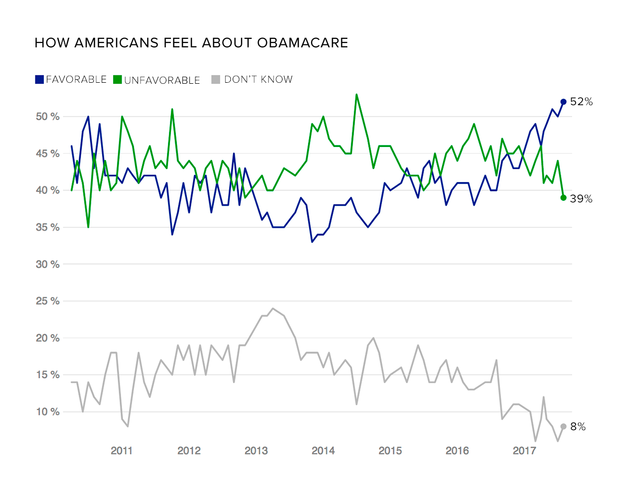
obamacare-sentiment.png

Underscoring the adage that you don’t know what you’ve got until it’s (almost) gone, the popularity of Obamacare is surging.

Only weeks after Republicans in Congress failed to repeal the landmark health reform law, 52 percent of respondents hold a favorable view of the Affordable Care Act (ACA), according to a recent Kaiser Family Foundation August poll. That’s up 10 percentage points since June of last year and nearly 20 points since November 2013, when public support for the ACA was at its nadir.

A July poll by CBS News after the repeal effort collapsed found that a plurality of Americans favor a bipartisan push in Congress to improve Obamacare.

The shift in sentiment coincides with other positive developments for Obamacare following its close call in Washington. With several large, and some smaller, insurers pulling out of the program over the past year or so, until recently it looked as if more than 92,000 participants spread out over 82 counties would have no insurer in their local health care exchanges, Cynthia Cox, associate director of Kaiser Family Foundation, said. But state insurance commissioners and other officials in states in jeopardy of losing Obamacare coverage have worked closely with insurers to negotiate continued coverage.

In Ohio, for instance, there were 20 counties without insurers, but officials ultimately convinced five health plans to cover all but one. Then, on August 24, the Ohio Department of Insurance announced that Paulding County, the last “bare county” in the country, would be covered by insurer CareSource.

In addition, the exchange marketplace overall has shown signs of stabilizing. After big financial losses in 2014 and 2015, individual market insurers saw improved performance in 2016, a trend that has continued this year, according to a different Kaiser Family Foundation study.

If Obamacare’s popularity is up, the program’s shortcomings remain clear. At last count, more than 2.6 million enrollees across 1,300 counties were expected to have only one insurer in their exchanges. More insurers also could pull out or move to sharply increase their premiums. The deadline for insurance companies to commit to participate in an exchange is September 27.

Until then, many insurers are watching closely to see if the Trump Administration will continue funding the federal cost-sharing subsidies that help low-income members pay for deductibles, co-pays and other out-of-pocket costs. Industry players are also waiting or Senate hearings to start after Labor Day in which which insurance commissioners, lawmakers and state governors are expected to testify about what can be done to stabilize the individual marketplace.

Meanwhile, some states are beginning to take matters into their own hands, moving to rewrite the ACA rules by applying for what’s known as a “Section 1332” waiver. Oklahoma is asking for a waiver to establish its own reinsurance program using some federal funds, which would cover the highest-cost individual marketplace cases. Alaska recently received approval for a similar reinsurance waiver. Oklahoma, however, is also looking ahead to more major structural changes that may spur debate.

Iowa, which is undergoing huge premium increases in its individual marketplace, has submitted a waiver that would overhaul the state’s insurance marketplace by redistributing federal tax credit money. The plan would create a single standard health plan and offer a flat tax credit based on age and income.

Critics argue this would increase health care costs significantly for Iowa’s low-income population, putting coverage out of reach for many. Proponents argue that increasing Iowa’s pool of healthy insured people is the best way to stabilize Iowa’s individual market and lower premiums for everyone.

How to keep ACA stabilization narrow

https://www.axios.com/aca-markets-narrow-problem-2479649219.html

When Congress returns next week, the health debate will shift from trying to pass sweeping legislation to stabilizing the non-group insurance market. This will be a different debate about a thorny but smaller problem. The weaknesses that need to be fixed are fairly specific, and they don’t affect the majority of Americans.

Data: Kaiser Family Foundation; Chart: Andrew Witherspoon / Axios

The bottom line: If Congress can keep the focus on market stabilization and doesn’t get mired in another divisive debate about health reform, and the news media can keep this relatively manageable problem in perspective for the public, there is at least a decent chance for bipartisan cooperation and a successful outcome.

The problem: Premiums in the Affordable Care Act marketplaces have been rising sharply, with the average increase for the benchmark “silver plan” up 21% this year. Proposed rates for next year will range from a 49% increase in Wilmington, Delaware to a 5% decrease in Providence, Rhode Island.

But the non-group market is actually fairly small, covering about 18 million people, with about 10 million of them in the ACA marketplaces which have received so much attention.

The perception: Kaiser Family Foundation poll this month found that when people read headlines or hear about “premiums soaring” in the ACA marketplaces, most Americans — 76% — they think they are hearing about their own premiums, even though the vast majority of Americans are not in the individual insurance market and are not affected. (A smaller but sizeable percentage believe they are affected when they hear about counties with no or limited insurance options in the ACA marketplaces.)

There are several reasons for this, and the media bears some of the responsibility. Health journalists have generally done an outstanding job covering the issue, but sloppy cable headlines, commentary from pundits, and spin from politicians have too often implied that everyone in America is affected when they are not.

For context: In fact, the rest of the health system where most Americans get their coverage looks very different from the non-group market. As the chart shows:

  • Average premiums in the employer insurance market, where 151 million Americans get their health coverage, rose by an average of just 3% last year. And we’re expecting continued moderation this year.
  • Likewise, per capita spending for Medicaid is projected to grow a modest 3% in 2017, with per capita Medicare spending growing by just 2 percent.

The back story: Insurers and regulators have been struggling with a unique set of issues in the non-group market, most especially a sicker than expected risk pool and the uncertainty surrounding Trump administration policies. The most important areas of uncertainty have been whether the administration will continue to pay out the $7 billion in cost sharing subsidies and enforce the individual mandate.

But even before the ACA, the non-group market was also the weak link of the insurance system, with sick people priced out or excluded from coverage altogether.

What to watch: Some think a deal on stabilizing the non-group market could be as narrow as an agreement to appropriate the $7 billion in federal cost sharing subsidies in exchange for greater flexibility for states under the ACA. That might not be a slam dunk if that flexibility trips over third rail issues, such as endangering coverage for people with pre-existing conditions.

But whether the formula for a bipartisan deal is that one or another one, policymakers will have a better chance of addressing the problems in the marketplaces if they forge a narrow agreement. And the debate stands a better chance of not spinning out of control if the news media works overtime to help the public understand who is affected and who is not.