Taking A U-Turn On Benefits, Big Employers Vow To Continue Offering Health Insurance

http://khn.org/news/big-employers-embrace-health-plan-status-quo/

The shrinking unemployment rate has been a healthy turn for people with job-based benefits.

Eager to attract help in a tight labor market and unsure of Obamacare’s future, large employers are newly committed to maintaining coverage for workers and often their families, according to new research and interviews with analysts.

Two surveys of large employers — one released Aug. 2 by consultancy Willis Towers Watson and the other out Tuesday from the National Business Group on Health, show companies continue to try to control costs while backing away from shrinking or dropping health benefits. NBGH is a coalition of large employers.

“The extent of uncertainty in Washington has made people reluctant to make changes to their benefit programs without knowing what’s happening,” said Julie Stone, a senior benefits consultant with Willis Towers Watson. “They’re taking a wait-and-see attitude.”

That’s a marked change from three years ago, when many big employers — those with 1,000 employees or more — contemplated ending medical benefits and shifting workers to the Affordable Care Act’s marketplaces.

In 2014, only 25 percent of big companies were “very confident” they would have a job-based health plan for employees in 10 years, according to the Willis Towers Watson survey.

This year, 65 percent expected to offer health benefits in a decade. And 92 percent said they were very confident a company-based health plan would exist in five years.

Many managers once eyed Obamacare marketplaces as workable coverage alternatives despite the law’s requirement that employers offer health insurance, analysts said.

But problems with marketplace plans, including fewer offerings, rising premiums and shrinking medical networks, have made employers think twice, they said.

Another big reason to maintain rich coverage is “the strength of the economy,” said Paul Fronstin, director of health research at the Employee Benefit Research Institute, an industry group. “Employers are doing what they have to do to get the right workers.”

Unemployment has fallen from 9.9 percent when Obamacare became law in 2010 to 4.3 percent last month, which equaled a 16-year low reached in May.

With such a steep decline, he added, “employers are thinking, ‘We need to offer this benefit for recruitment and retention.’”

Second Thoughts On High-Deductible Plans

Companies are even rethinking the long-standing expedient of shifting a portion of rising medical costs to employees through high-deductible plans and a greater share of the premium bill, other research shows.

“Employers are beginning to recognize that cost sharing has its limits,” said a June report from PwC, a multinational professional services network. Low unemployment and competition for workers mean “employers have less appetite for scaling back benefits and continuing with a plan design that has proven largely unpopular.”

At Fidelity Investments, a Boston-based financial firm with more than 45,000 employees, worker contributions have grown to about 30 percent of total health costs.

Jennifer Hanson, the company’s benefits chief who sits on NBGH’s board, doesn’t see that continuing.

As costs grow, “if you continue to shift more of a bigger number to employees, health care becomes unaffordable,” she said in an interview. “As employers, we really do need to pay attention less to who’s paying for what and more to how much everything costs.”

More than half of Americans with job-based insurance face deductibles — out-of-pocket costs for most care before insurance kicks in — of more than $1,000 for single-person coverage. Family deductibles can be much higher.

High On The To-Do List: Controlling Drug Costs

Big employers’ planned changes for next year focus on controlling drug costs and improving health results through telemedicine and steering patients to efficient, high-quality hospitals, noted the Willis Towers Watson report and the NBGH survey.

Employer health costs continue to rise, but not at the double-digit clip seen for many plans sold to individuals and families through the ACA marketplaces.

Employers expect health costs to increase 5.5 percent next year, up from 4.6 percent in 2017, according to the Willis Towers Watson report.

Companies in the NBGH survey predicted health costs will rise 5 percent next year, up from an average 4.1 percent increase for 2016.

That’s still far faster than inflation, which is less than 3 percent, and overall wage growth.

By many accounts, soaring costs for specialty pharmaceuticals used to treat cancer, rheumatoid arthritis, hemophilia and other complex conditions are the biggest factor.

“These are very expensive drugs,” said Brian Marcotte, NBGH’s CEO. “They cost thousands or tens of thousands per treatment.”

Often these drugs require infusion into the blood in a clinical setting, which can drive up their price tag.

For instance, hospital-based infusions have been found to cost as much as seven times more than those performed in, say, a doctor’s office.

Employers are working hard to steer patients to the least expensive, appropriate site, Marcotte said.

Big employers are also offering more on-site nurses and doctors; setting up accountable care organizations with incentives for doctors and hospitals to control costs; and striking deals with particular hospitals for high-cost operations such as transplants and joint replacements, the NBGH survey found.

Job-based insurance covers some 160 million people younger than 65, according to Census and Labor Department data, far more than the 10 million or so insured by plans sold through Obamacare marketplaces.

Government employers and companies with at least 500 workers, which historically have been more likely to offer health benefits than smaller employers, cover more than 90 million employees and dependents.

Willis Towers surveyed 555 large employers with about 12 million workers and dependents. NBGH surveyed 148 large companies with more than 15 million employees and dependents.

Healthcare Triage News: The Trump Administration Has Many Options to Undermine Obamacare

Healthcare Triage News: The Trump Administration Has Many Options to Undermine Obamacare

Image result for Healthcare Triage News: The Trump Administration Has Many Options to Undermine Obamacare


While the Senate and the House haven’t been very effective in passing a repeal of Obamacare, the ACA’s provisions are still at risk. There’s a lot that Donald Trump’s administration can do (or not do) to undermine Obamacare’s provisions and marketplaces.

Kaiser Health Tracking Poll – August 2017: The Politics of ACA Repeal and Replace Efforts

Kaiser Health Tracking Poll – August 2017: The Politics of ACA Repeal and Replace Efforts


KEY FINDINGS:
  • The August Kaiser Health Tracking Poll finds that the majority of the public (60 percent) say it is a “good thing” that the Senate did not pass the bill that would have repealed and replaced the ACA. Since then, President Trump has suggested Congress not take on other issues, like tax reform, until it passes a replacement plan for the ACA, but six in ten Americans (62 percent) disagree with this approach, while one-third (34 percent) agree with it.
  • A majority of the public (57 percent) want to see Republicans in Congress work with Democrats to make improvements to the 2010 health care law, while smaller shares say they want to see Republicans in Congress continue working on their own plan to repeal and replace the ACA (21 percent) or move on from health care to work on other priorities (21 percent). However, about half of Republicans and Trump supporters would like to see Republicans in Congress keep working on a plan to repeal the ACA.
  • A large share of Americans (78 percent) think President Trump and his administration should do what they can to make the current health care law work while few (17 percent) say they should do what they can to make the law fail so they can replace it later. About half of Republicans and supporters of President Trump say the Trump administration should do what they can to make the law work (52 percent and 51 percent, respectively) while about four in ten say they should do what they can to make the law fail (40 percent and 39 percent, respectively). Moving forward, a majority of the public (60 percent) says President Trump and Republicans in Congress are responsible for any problems with the ACA.
  • Since Congress began debating repeal and replace legislation, there has been news about instability in the ACA marketplaces. The majority of the public are unaware that health insurance companies choosing not to sell insurance plans in certain marketplaces or health insurance companies charging higher premiums in certain marketplaces only affect those who purchase their own insurance on these marketplaces (67 percent and 80 percent, respectively). In fact, the majority of Americans think that health insurance companies charging higher premiums in certain marketplaces will have a negative impact on them and their family, while fewer (31 percent) say it will have no impact.
  • A majority of the public disapprove of stopping outreach efforts for the ACA marketplaces so fewer people sign up for insurance (80 percent) and disapprove of the Trump administration no longer enforcing the individual mandate (65 percent). While most Republicans and Trump supporters disapprove of stopping outreach efforts, a majority of Republicans (66 percent) and Trump supporters (65 percent) approve of the Trump administration no longer enforcing the individual mandate.
  • The majority of Americans (63 percent) do not think President Trump should use negotiating tactics that could disrupt insurance markets and cause people who buy their own insurance to lose health coverage, while three in ten (31 percent) support using whatever tactics necessary to encourage Democrats to start negotiating on a replacement plan. The majority of Republicans (58 percent) and President Trump supporters (59 percent) support these negotiating tactics while most Democrats, independents, and those who disapprove of President Trump do not (81 percent, 65 percent, 81 percent).
  • This month’s survey continues to find that more of the public holds a favorable view of the ACA than an unfavorable one (52 percent vs. 39 percent). This marks an overall increase in favorability of nine percentage points since the 2016 presidential election as well as an increase of favorability among Democrats, independents, and Republicans.

Trump to GOP: Get Obamacare repeal bill done

http://www.politico.com/story/2017/08/10/trump-obamacare-repeal-senate-republicans-241494?utm_campaign=KHN%3A%20First%20Edition&utm_source=hs_email&utm_medium=email&utm_content=55194059&_hsenc=p2ANqtz-8_YOjdjRTjA-xM50_ZT5aTfcjL6fylg2px13PHXBu5kUC3p0UiYmzhnVD8O5O7HqNErxB3FYB_-rCA7s1w-oHuLGYjjA&_hsmi=55194059

Image result for beating a dead horse

President Donald Trump renewed his call for Senate Republicans to take another crack at dismantling Obamacare, saying Thursday it’s a “disgrace” that they failed to pass a repeal bill.

“They lost by one vote,” Trump said from his Bedminster, New Jersey, golf course. “For a thing like that to happen is a disgrace.”

The president has hectored Senate Republicans for days over their collapsed health care effort, most recently singling out Majority Leader Mitch McConnell for criticism.

“I just want him to get repeal and replace done,” Trump told reporters, when asked about his multi-day string of tweets attacking the Kentucky Republican over health care. “It’s almost two years, and all I hear is repeal and replace. And I get there, and I said where’s the bill? I want to sign it.”

McConnell has suggested that the GOP should move on from health care after falling just short of the 50 votes he needed to pass a “skinny” repeal bill, and instead focus on tax reform. And earlier this week, McConnell said Trump has “excessive expectations” about how quickly Congress can pass legislation.

But Trump demanded that Republicans follow through on their agenda, suggesting further failure could cost McConnell his job atop the Senate GOP.

“If he doesn’t get repeal and replace done, and if he doesn’t get taxes done, meaning cuts and reform, and if he doesn’t get a very easy one to get done, infrastructure, he doesn’t get them done, then you can ask me that question,” Trump said.


Taxpayers Will Pay the Price for Uncertainty Over Obamacare in 2018

https://www.thefiscaltimes.com/2017/08/10/Taxpayers-Will-Pay-Price-Uncertainty-Over-Obamacare-2018

The health insurance industry remains in the throes of a largely unnecessary crisis of confidence, according to an analysis released by the Kaiser Family Foundation on Thursday.

With the open enrollment period approaching for Obamacare insurance plans sold through state exchanges, Kaiser Foundation experts were able to analyze the proposals for 2018 submitted by insurance companies to 20 states and the District of Columbia — the only places where enough information is made public to allow an assessment of what health care costs would look like for an average policyholder under the insurers’ requested rate structures.

“Insurers attempting to price their plans and determine which states and counties they will service next year face a great deal of uncertainty,” the authors wrote. “They must soon sign contracts locking in their premiums for the entire year of 2018, yet Congress or the Administration could make significant changes in the coming months to the law – or its implementation – that could lead to significant losses if companies have not appropriately priced for these changes. Insurers vary in the assumptions they make regarding the individual mandate and cost-sharing subsidies and the degree to which they are factoring this uncertainty into their rate requests.”

What that means for consumers is a bit of a mixed bag. Almost all insurers are seeking rate increases, with some approaching a 50 percent jump. But the actual impact on consumers varies depending on where they buy their insurance and how much money they earn. One thing is for sure, though: The federal government, and therefore taxpayers, will be on the hook for larger subsidy payments.

Because the majority of Americans obtain health insurance through an employer-sponsored plan or from federal programs like Medicare and Medicaid, the impact of the premium increases of exchange-based policies will mean little to a large element of the population.

Of those who buy insurance on the exchanges, the overwhelming majority receive tax credits meant to keep their premium payments to a specific fraction of their annual income. The remaining 16 percent, depending on their income, receive either a smaller subsidy or no subsidy at all. It is these people who, if they live in some of the regions facing large premium increases, who will be hurt the most.

The Kaiser study gathered information from the largest city in each of the 20 states plus the District of Columbia. (Benchmark levels for tax credits are based on the second-cheapest Silver Level plan available in the largest city in a state.) They estimated the change in costs for a 40-year-old non-smoker earning $30,000 a year.

In only one state was the annual premium expected to fall in 2018: Rhode Island, which anticipates a 5 percent drop. Vermont’s premiums will remain static in 2018 if the data holds. The other 19 states can all expect increases, from a modest 3 percent in Michigan to a whopping 49 percent in Delaware.

The average increase in the data collected by Kaiser is 17 percent.

However, none of those costs would be passed on to the consumer making $30,000 a year. In fact, because of adjustments to the tax credit, he could expect to see monthly costs fall by 3 percent, to $201, next year, regardless of what premium levels do where he lives.

But somebody has to pay when premiums go up, and if it isn’t the consumer, it’s the Treasury and by extension, the taxpayer.

The change in premium payments required to keep that 40-year-old’s health insurance premium at $201 per month will increase very sharply in many states, depending greatly on how far from the premium cap a silver plan was in 2017.

In Washington State, according to Kaiser, the premium tax credit would increase 239 percent, from $31 per month to $105. In New Mexico, it would jump 183 percent, from $51 to $144. In Rhode Island it would fall 13 percent, while in Vermont it would rise a modest 2 percent. On average, though, the amount of premium payment picked up by the federal government will increase by about 63 percent in the states reviewed by Kaiser.

Perversely, as Kaiser points out, that fiscal wound is largely self-inflicted. While it is impossible to gauge just how much of this year’s rate increases are attributable to insurers being nervous about whether the federal government would slash support payments in the middle of the 2018 policy year, the answer is surely non-trivial, and the dollars are coming out of the pockets of taxpayers.

Carper cast as governors’ lobbyist in health care debate

http://www.delawareonline.com/story/news/politics/2017/08/08/carper-cast-governors-lobbyist-health-care-debate/546377001/

Image result for Carper cast as governors' lobbyist in health care debate

When Sen. Tom Carper was shopping for votes to block GOP health care bills, he didn’t just turn to his fellow senators. He turned to their governors.

A self-described “recovering governor,” himself, the Delaware Democrat carried out a communications blitz – calling, texting, emailing – and made contact with up to half of them. He skipped out on a Democratic campaign retreat to make a case at the National Governors Association summer meeting in Rhode Island.

His message: The legislation will hurt your states. Put your opposition in writing so the Senate can pause, work together to stabilize the insurance exchanges, and return to “regular order,” with hearings, bipartisan amendments — and input from governors, he said.

Delaware’s senators are bullish that debate over health care will turn to fixing the Affordable Care Act after the Senate early Friday morning defeated a proposal to repeal parts of the landmark law. 7/28/17 Damian Giletto/The News Journal

“He came up and spent a morning discussing the ins and outs, the details of health care changes,” Colorado Gov. John Hickenlooper, a Democrat, said on CBS’s “Face the Nation” Sunday.

Ohio Gov. John Kasich, a Republican, speaking on the same show, said, “Tom Carper from Delaware has been unbelievable in terms of his looking at trying to solve this problem.”

Carper believed that governors’ objections would be key to blocking the GOP effort to repeal and replace Obamacare, and it turned out they were. Even Sen. John McCain of Arizona, one of three Republicans who helped sink the GOP’s last-ditch effort, repeatedly highlighted his governor’s concerns.

Senate Minority Leader Charles Schumer of New York tapped Carper to lead outreach efforts to governors in early July when Carper complained that their voices weren’t being heard. In the health care drama, where there were many players, Democrats’ casting of Carper as the lead governors’ lobbyist made sense. He’s a former NGA chairman who loves the organization (and is prone to gushing about it).

“Tom Carper was really our point person with the governors, he kind of managed it,” said Sen. Tim Kaine, a former Democratic governor of Virginia. “He played a very important role in all of this. And the governors themselves, their voices were very important.”

Several days before the NGA summer meeting, Carper learned administration officials would discuss GOP health care proposals with the governors and was alarmed to discover that no one was scheduled to present the opposing view. He wangled an invitation to speak on a closed-door panel on July 15 alongside Seema Verma, administrator of the Centers for Medicare and Medicaid Services, and Secretary of Health and Human Services Tom Price.

“(Carper) was spreading this word that we should do this together, that people shouldn’t be hurt who are not in a position of being able to help themselves,” Kasich, an opponent of the GOP health care bills, said in an interview with USA TODAY. “And it was a message of slow down and let’s get this right. At no time did he ever say we should do nothing.After that, Carper kept contact information for every governor by his side, calling them during free moments between hearings and meetings. They discussed how the legislation would impact states’ Medicaid expansions, for example, or how a straight repeal of Obamacare would impact the states.

When he couldn’t reach Arizona Gov. Doug Ducey, a Republican, he said he talked several times to his Medicaid director and to his chief of staff. He said he spoke with Kasich “a dozen times or more.”

“One night he called me and it was like 10:30 at night,” Kasich said. “He was relentless in terms of what he did. And do I think he made a difference? I have no doubt that he did. Did he switch anybody? You don’t know. Did he have some people that would have not voted for this had McCain not voted ‘no,’ I just can’t tell you. But he deserves a lot of credit for being a really good public servant, keeping in mind the people that he serves.”

Carper said his outreach efforts helped him develop trust with governors “and just to let them know if they are interested in finding a path forward, they have a number of Democratic senators… who want to find common ground.”

Three days after Carper’s pitch at the NGA meeting, Kasich, Hickenlooper and nine other bipartisan governors who had been vocal about their concerns issued a statement opposing efforts to repeal the current system and replace it later. The statement, which Kasich said had been in the works for a while, called for governors to be included in the next steps.

“The best next step is for both parties to come together and do what we can all agree on: fix our unstable insurance markets,” they wrote.

They may be getting their wish, and so may Carper.

After the GOP’s three legislative failures, the Senate Health, Education, Labor and Pensions Committee announced it would begin hearings in September on ways to stabilize the individual health insurance market. The committee will hear from a wide range of stakeholders, including governors.

Moving forward, Carper said “the stage has been set” for better, more affordable health care coverage. Though he isn’t on the HELP Committee, he believes he can play a role in bipartisan discussions on health care.

“The key now is for the Senate to do its job,” Carper said.

The different ways your health care costs are going up

https://www.axios.com/the-different-ways-your-health-care-costs-are-going-up-2471186113.html

Image result for The different ways your health care costs are going up


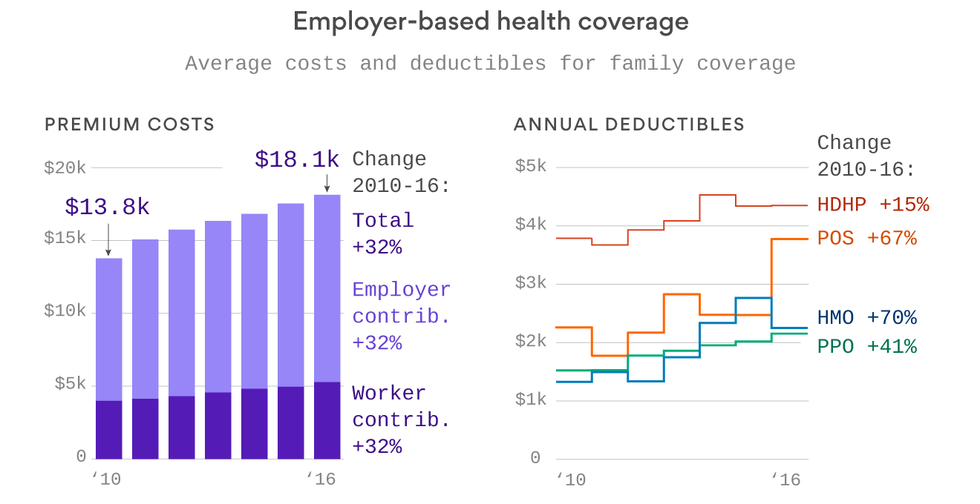
We’ve spent so much time talking about Affordable Care Act costs this year that it’s easy to forget what most people are actually paying for health care — the 156 million Americans who get their health coverage through the workplace. Turns out, most of us aren’t seeing sky-high premium increases. But it’s also worth remembering that deductibles matter too — because that’s what we pay out of pocket before insurance kicks in.

Take a look at these two graphics from Axios datavisuals genius Chris Canipe. The premium increases between 2010 and 2016 weren’t that bad — they’re single digits each year, and just add up over time. But you can see some big increases in deductibles, especially in point-of-service plans and HMOs.

Why it matters: That’s a big reason why people feel their health care costs going up, because it means they’re paying more out of pocket. And when prescription drug prices rise, they’re more likely to feel it directly.

Sen. Johnson walks back remarks on McCain’s brain cancer

http://www.cnn.com/2017/08/09/politics/kfile-ron-johnson-john-mccain/index.html

Image result for Sen. Johnson

Sen. Ron Johnson on Thursday walked back controversial remarks he made about Sen. John McCain earlier in the week when he suggested the Arizona Republican’s dissenting vote on health care might have been influenced by his recent brain cancer surgery.

Speaking on CNN’s “New Day,” Johnson, R-Wisconsin, explained that he was “just expressing sympathy,” and that McCain was “not impaired in any way, shape or form” when he cast his crucial “no” vote on health care reform late last month.
On Tuesday, Johnson had suggested in a radio interview that McCain’s brain tumor and the early morning hours may have affected his vote on the Senate bill to repeal Obamacare.
“Again, I’m not going to speak for John McCain — he has a brain tumor right now — that vote occurred at 1:30 in the morning, some of that might have factored in,” Johnson said on AM560 “Chicago’s Morning Answer.”
Seemingly shocked, a radio host responded “really?” to Johnson’s comments and asked if he really believed McCain’s brain tumor might have factored into his judgment.
“Again, I-I-I don’t know exactly what — we really thought — and again I don’t want speak for any senator,” Johnson responded. “I really thought John was going to vote yes to send that to conference at 10:30 at night. By about 1, 1:30, he voted no. So you have talk to John in terms what was on his mind.”
In response, McCain spokeswoman Julie Tarallo said in a statement to CNN that Johnson’s comments were “bizarre and deeply unfortunate.”
“It is bizarre and deeply unfortunate that Senator Johnson would question the judgment of a colleague and friend. Senator McCain has been very open and clear about the reasons for his vote,” she said.
Johnson began distancing himself from the comments on Wednesday, saying he was “disappointed I didn’t more eloquently express my sympathy for what Sen. McCain is going through.”
He added to those thoughts on CNN Thursday morning.
“A lot of us had a real problem with that skinny repeal, and we weren’t going to vote for it until we got that assurance from (House Speaker Paul Ryan). Listen, I was trying to defend his position and truthfully express my sympathy for his health condition. Again, I reached out to John, I’m hoping to talk to him today. I have the greatest respect for John McCain,” Johnson said on “New Day.”
Johnson was also asked by anchor Chris Cuomo whether he thought McCain’s cancer should be an issue.
“No, absolutely,” Johnson said. “I was just expressing sympathy for his condition. Again, I’ve got the greatest respect for John McCain. He’s not impaired in any way, shape or form.”
McCain voted no on the so-called skinny repeal, explaining in a radio interview last week that he disagreed with the process leading up to the vote and saying he supported repealing Obamacare but with an immediate replacement. McCain returned to the Senate to vote on health care-related legislation after a surgery to remove a blood clot revealed he had brain cancer.

JAMA Forum: Has Obamacare Become Trumpcare?

https://newsatjama.jama.com/2017/08/08/jama-forum-has-obamacare-become-trumpcare/?utm_campaign=KFF-2017-The-Latest&utm_source=hs_email&utm_medium=email&utm_content=55126983&_hsenc=p2ANqtz-8vj_o8hQsSTd-X9YaMl68R-qSign5oJJXs7kws6IQmZfKrthFZsdW-cMXbvwUyTxd2LsnB1OGj2fS4da5pKiDsoJnTHQ

Image result for medicaid

With the failure of several bills in the Senate to repeal or replace the Affordable Care Act (ACA), the effort to significantly remake the 2010 health law is apparently on hold, if not dead. This is a dramatic turn of events that few anticipated when Republicans took control of the White House and Congress after 7 years of vowing to repeal the ACA.

So, now what?

For the foreseeable future, all the ACA’s benefits and requirements stand—expanded Medicaid coverage for 11 million people, low-income adults; premium tax credits for about 9 million low- or middle-income people buying their own insurance; guaranteed insurance for people with preexisting conditions, and requirement that people buy insurance or pay a penalty.

The biggest question at this point is whether the Trump administration will pivot towards trying to make the law work, after the president said he might just “let Obamacare fail” to gain negotiating leverage in the repeal and replace debate.

This is without a doubt an awkward situation for President Trump and Secretary of Health and Human Services Tom Price. They have bitterly criticized the ACA, and that was at some level understandable during the high-stakes Congressional debate. But now that the debate is over for the time being, the Trump administration is left running a government responsible for implementing the law.

What would it look like for the administration to run the ACA effectively?

Most immediately, open enrollment for the ACA’s marketplaces begins November 1, and insurers have to decide by late September whether they will participate. There are a host of actions the administration could take to make it successful.

Provide Clarity Around the Rules: There is still uncertainty as to whether the administration will enforce the individual mandate and continue to make $7 billion in cost-sharing subsidy payments to insurers—which have been in limbo because of threats from the administration to cut them off and a lawsuit brought by the House of Representatives challenging the authority to make them. This uncertainty is leading insurers to propose bigger premium increases than necessary to cover the anticipated growth in medical care expenses or, in some cases, to pull out of the market entirely. If the cost-sharing payments are stopped, the Kaiser Family Foundation (KFF) estimates that insurers would have to raise premiums by an additional 19% to offset the losses.

Maintaining Outreach and Consumer Assistance: There is enormous churn in the individual insurance market as people get or lose jobs with health benefits and see their incomes rise or fall. Millions of new people need to sign up for insurance each year just to maintain steady enrollment. Importantly, any decrease in enrollment is likely to be disproportionately among healthy people. So far, the administration has mostly taken steps to pare back outreach activities, cancelling ads at the conclusion of open enrollment for this year, and recently ending contracts for consumer assistance activities. It seems unlikely that President Trump will promote ACA enrollment on an online video show like “Between Two Ferns,” as President Obama did. However, a basic level of outreach is key to making the market function.

Encouraging Insurers to Participate: The ACA represents a market-based approach to health coverage, and insurers need to participate to make it work. The number of insurers selling in the marketplaces has dropped somewhat, as some carriers found they couldn’t compete and others were concerned that not enough healthy people were signing up to maintain a balanced risk pool. However, a recent KFF analysis suggests that insurers are doing much better financially this year in the individual market, following substantial premium increases. Still, there are currently 17 counties at risk of having no insurers participating in the marketplace for 2018 (out of a total of 3143), and that number could grow if uncertainty about cost-sharing payments and individual mandate enforcement persists. If there are no marketplace insurers in a county, there is no way for enrollees to access premium tax credits, and many would likely end up uninsured. The Trump administration has generally characterized insurer exits as a sign that the ACA is failing, rather than encouraging carriers to expand their service areas to fill in bare counties.

There are also ways the Trump administration can tweak the ACA through its executive powers, while still making a good faith effort to implement the law effectively.

In particular, the administration can give states flexibility to experiment through Medicaid waivers and ACA waivers under section 1332 of the law. These waivers have certain restrictions. For example, section 1332 waivers must be budget neutral for the federal government and provide coverage that is at least as comprehensive and affordable. And, certain provisions cannot be changed through waivers, such as guaranteed insurance for people with preexisting conditions and community rating (offering insurance at the same price regardless of a person’s health status). However, these waivers provide an opportunity to create a more state-based approach, which was a key goal for Republicans in the recent health care debate.

Congress could be pivotal, as well. Appropriation of funding for the cost-sharing payments to insurers could remove any ambiguity that they will be paid. Also, even if uncertainty about the cost-sharing payments and individual mandate is resolved, there are still pockets of the country, particularly in rural areas, where the individual insurance market is fragile. An infusion of federal funding to help cover the medical expenses of high-cost patients could lower premiums and bring stability to those markets. Sen Lamar Alexander (R, Tennessee), chair of the Senate Health, Education, Labor, and Pensions Committee, has announced plans to hold bipartisan hearings in early September with a goal to quickly pass legislation.

There are also potential political consequences to just allowing—or, in fact, pushing—the ACA to fail at this point. According to KFF polling, 59% of the public believes that the president and Republicans in Congress are now responsible for any ACA-related problems moving forward. So in much of the public’s view, particularly now that the Congressional debate has stalled, Obamacare may have become Trumpcare.

Fitch: States will take the lead on Medicaid reform despite ACA repeal and replace failure

http://www.healthcarefinancenews.com/news/fitch-states-will-take-lead-medicaid-reform-despite-aca-repeal-and-replace-failure?mkt_tok=eyJpIjoiWVdGallqTTBZVGRoTVdKaSIsInQiOiI4UXRNZDB6VUZ2MEtTbGhNbm9zZ3dnQys3Z2dkS2VYWDQyZlwvbkxtNEIxRlwvT085a056VlwvbjhweFlxOEFWUktZOGVMeWRTMm5BbCtCaE44T0VlOUNDdkRIQ1ZCRFpBd2NhK1NjZTJOaGFteHJjWEZDOTN5R2pDK3oxb2w4d0xvZSJ9

Some states had already begun negotiations with the Centers for Medicare and Medicaid Services on securing Medicaid waivers, Fitch said.

Despite the Senate’s failure to pass an ACA repeal and replace bill, state governments are moving ahead with their own efforts to revamp Medicaid, especially through waivers, according to a Fitch Ratings report.

Some states had already begun negotiations with the Centers for Medicare and Medicaid Services on securing Medicaid waivers granting them more flexibility. State waiver proposals could affect both Medicaid expansion beneficiaries and the traditional enrollees, the report said.

Arkansas, Indiana and Kentucky have submitted proposals to CMS asking to add work requirements to their Medicaid expansions. Other states including Arizona, Maine, Pennsylvania and Wisconsin are considering work requirements for at least some traditional Medicaid enrollees as well, Fitch said.

Fitch ratings agency said the Trump administration has indicated they are in favor of such measures.

Overall, Fitch said states have indicated their proposed Medicaid changes could reduce costs and also “support key policy goals.”

The states proposing these measures suggested they support “key policy goals” and could yield cost savings. “However, the actual amount of cost savings could be low as some health policy experts have raised questions about the efficacy of such work requirements given characteristics of the current Medicaid population. Adding work requirements could also add to state administrative burdens for oversight of the Medicaid program,” the agency said.

Fitch also projects states will continue to focus on controlling Medicaid spending as they look at their budgets. CMS predicted long-term rises in Medicaid spending due to growth in higher-cost traditional Medicaid-eligible populations, especially the elderly and disabled, and their most recent 10-year forecast for National Health Expenditures showed state and local government Medicaid spending will rise an average of 6.1 percent annually between 2017 and 2025.

“This is far ahead of Fitch’s expectations for national economic growth and state tax revenue growth, signaling continued pressure on states to manage their budgets accordingly,” Fitch said.