Bipartisan Legislation to Lower Premiums and Stabilize Insurance Markets

https://www.americanprogress.org/issues/healthcare/news/2017/06/29/435208/bipartisan-legislation-lower-premiums-stabilize-insurance-markets/

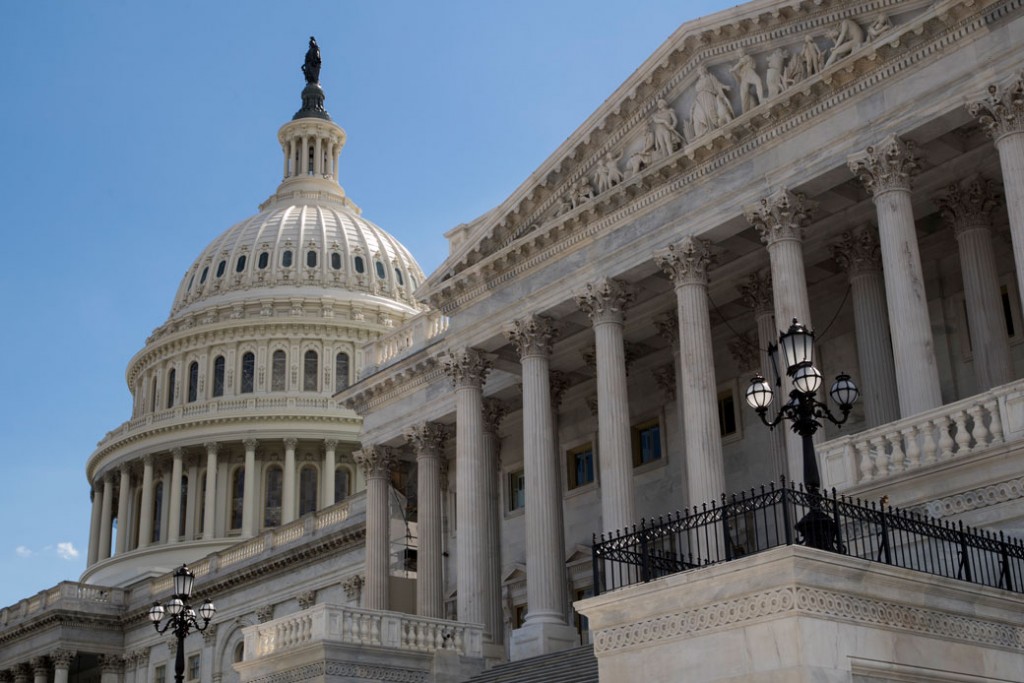
The Senate and Capitol Dome are seen on Capitol Hill in Washington, Monday, June 26, 2017.

In the wake of Senate Republicans’ decision to delay consideration of their health care repeal bill, the “Better Care Reconciliation Act (BCRA), it is clear that their partisan approach has little support and would inflict widespread harm on the American people. This moment is an inflection point where Senate Republicans can choose one of two paths: They can continue to pursue repeal, or they can work with Senate Democrats on a bipartisan basis to stabilize insurance markets.

In its letter of opposition to the BCRA, the American Medical Association (AMA) said that the bill violates the principle of “first, do no harm” on “many levels.” A bill that primarily guts Medicaid to finance tax cuts for the rich is not one designed to fix any problem with the insurance markets. In fact, the nonpartisan Congressional Budget Office (CBO) assessed that the BCRA will do just the opposite; the elimination of the individual mandate will cause premium rate shock in 2018 and insurance markets will collapse in some areas after 2019.

Bipartisan legislation would be simple and easy to put together—it would consist of four pages of legislative text that Senate Republicans have already written as part of the BCRA. It would easily command supermajorities because many Democrats and Republicans would support a bill that fixes the ACA, not destroys it—proving that the majority party can govern and restoring some faith in the Senate as an institution. Most importantly, it would work; the legislation would implement evidence-based policies that have been proven to work in Alaska and Maine.

In this brief, the Center for American Progress is proposing specific legislation, the Market Stability and Premium Reduction Act, included in the Appendix of this column. The Center for American Progress urges senators to chart a new course and work together on a bipartisan basis to first, do no harm, and second, resolve uncertainty in insurance markets.

Voters want Bipartisanship on Health Care

https://morningconsult.com/2017/07/05/voters-critical-gops-partisan-approach-health-care-overhaul/

Fewer than one in three voters approve of the partisan approach taken by congressional Republicans in their effort to repeal and replace the Affordable Care Act, according to a new Morning Consult/POLITICO poll.

Thirty-two percent of registered voters said GOP lawmakers should work only with fellow Republicans on health care legislation, while 59 percent said Republicans should work with Democrats on a compromise measure. Nine percent said they didn’t know or had no opinion.

The national survey, conducted as lawmakers returned home for the July Fourth recess, also shows that a majority of the GOP’s base disapproves of the Republican approach to remaking the nation’s health care system. Thirty-nine percent of Republican voters said GOP lawmakers should work on a partisan basis, while 53 percent said there should be an effort to reach across the aisle.

GOP leaders have brushed off criticism about not working with their Democratic counterparts, who have vowed not to cooperate on health care legislation unless Republicans drop their push to repeal Obamacare.

Despite the partisanship in Congress on health care, 28 percent of voters said passing a health care overhaul bill should be the top priority on Capitol Hill. That was followed by 21 percent of voters who said the top priority should be investigating some of President Donald Trump’s campaign officials for alleged connections or contacts with the Russian government during the 2016 race for the White House. Of the GOP’s other legislative items, 13 percent said passing tax reform should be the top priority for lawmakers, with the same percentage pointing to the importance of overhauling entitlement programs such as Medicare and Social Security.

The electorate appeared split on whether Republicans should continue their push to repeal Obamacare. Forty-four percent of respondents said the GOP should give up its efforts to undo the Affordable Care Act, while 42 percent said Republicans should press on. But responses were divided along party lines, with 67 percent of Democrats saying Republicans should throw in the towel, and 68 percent of GOP voters saying Republicans should stick with it. Independents were split, with 41 percent favoring repeal and 40 percent saying Republicans should move on to other issues.

Amid pushback from both GOP moderates and conservatives, Senate Majority Leader Mitch McConnell (R-Ky.) last week postponed a vote on legislation that would replace Obamacare. Senate GOP leaders now aim to revamp the legislation and take up a revised version later this month.

Voters are skeptical of the GOP’s legislative efforts. Without specifying differences between the House and Senate measures, 41 percent said they approved of the legislation, while 45 percent disapproved. Fifty-two percent said they believe the legislation would increase the number of uninsured Americans.

The nonpartisan Congressional Budget Office estimates that 22 million more people would lose health insurance over the next decade under the Senate bill, and 23 million under the House-passed measure, compared with current law.

While GOP lawmakers say their legislation would reduce health care costs, 45 percent of voters said it would increase the amount their family would spend on health services. Twenty-one percent said it would lower costs, and 19 percent said they dodn’t know or have no opinion.

Both the House and Senate bills would roll back Obamacare’s expansion of Medicaid, a popular component of the 2010 law, and would impose budget constraints on state Medicaid programs.

The online survey was conducted June 29 and June 30 among a national sample of 1,989 registered voters and has a margin of error of plus or minus 2 percentage points.

GOP promises lower health premiums but ignores all that’s driving them

http://www.politico.com/story/2017/07/06/health-care-premiums-republicans-obamacare-240242

Image result for underinsured

Republicans promise to bring down the cost of health insurance for millions of Americans by repealing Obamacare.

But in the race to make insurance premiums cheaper, they ignore a more ominous number — the $3.2 trillion-plus the U.S. spends annually on health care overall.

Republicans are betting it’s smart politics to zoom in on the pocketbook issues affecting individual consumers and families. But by ignoring the mounting expenses of prescription drugs, doctor visits and hospital stays, they allow the health care system to continue on its dangerous upward trajectory.

That means that even if they fulfill their seven-year vow to repeal Obamacare and rein in premiums for some people,the nation’s mounting costs are almost sure to pop out in other places — includingfresh efforts by insurers and employers to push more expenses onto consumers through bigger out-of-pocket costs and narrower benefits.

As a presidential candidate, Donald Trump didn’t talk much about health care in 2016 — not compared to the border wall, jobs, or Hillary Clinton’s emails. But the final days of the campaign coincided with the start of the Obamacare sign-up season — and Trump leapt to attack what he called “60, 70, 80, 90 percent” premium increases. Big spikes did occur in some places, but they weren’t the rule, and most Obamacare customers got subsidies to defray the cost.

But the skyrocketing premium made a good closing message for Trump — and Republicans have stuck with it.

“The Republicans decoded: What is the single, 10-second thing that says why you are running against the Affordable Care Act?” said Bob Blendon, an expert on health politics at the Harvard T.H. Chan School of Public Health. “Premiums became the face of what’s wrong.”

The GOP approach differs from the tack Democrats took when they pushed for the Affordable Care Act back in 2009-10. That debate was about covering more Americans — and about “bending the curve” of national health care spending, which eats up an unhealthy portion of the economy.

Conservatives like Sen. Ted Cruz of Texas argue that Obamacare failed to achieve its promise to bring down costs.

“The biggest reason that millions of people are unhappy with Obamacare is it’s made premiums skyrocket,” said Cruz, who is leading a small band of conservatives trying to pull the Senate repeal bill to the right as leaders seek to cobble together 50 votes. “We’ve got to fix that problem that was created by the failing policies of Obamacare.”

The answer, he says, is getting government out of the way. Conservatives want to free insurers from many of the coverage requirements and consumer protections in Obamacare. That means they could sell plans that wouldn’t cover as comprehensive a set of benefits — but they’d be cheaper.

Even some prominent critics of the Affordable Care Act think that’s not getting at the heart of the U.S. health care problem, even if it sounds good to voters.

“Too many in the GOP confuse adjustments in how insurance premiums are regulated with bringing competitive pressures to bear on the costs of medical services,” the American Enterprise Institute’s James Capretta wrote in a recent commentary for Real Clear Health. “They say they want lower premiums for consumers, but their supposed solution would simply shift premium payments from one set of consumers to another.”

The Congressional Budget Office has not yet evaluated how the House repeal bill, which narrowly passed, or the Senate companion legislation, which is still being negotiated, would affect overall health spending in coming years. It is already a sixth of the U.S. economy — more than 17 cents out of every dollar — and spending is still growing, partly because of an aging population.

The nonpartisan budget office projected the federal government would spend about $800 billion less on Medicaid over a decade, as the GOP legislation upends how Washington traditionally paid its share. But CBO hasn’t yet reported on how that would affect the health sector overall.

Many Republicans predict that limiting federal payments to states would force Medicaid to be more efficient. Democrats says the GOP bill would basically thrust those costs onto the states and onto Medicaid beneficiaries themselves, who are too poor, by definition, to get their care — often including nursing homes — without government assistance.

The CBO gave a mixed assessment of what would happen to premiums under the GOP proposals. They’d rise before they’d fall — and they wouldn’t fall for everyone. Older and sicker people could well end up paying more, and government subsidies would be smaller, meaning that even if the sticker price of insurance comes down, many people at the lower end of the income scale wouldn’t be able to afford it.

“Despite being eligible for premium tax credits, few low-income people would purchase any plan,” the CBO said.

Shrinking insurance benefits may work out fine for someone who never gets injured or sick. But there are no guarantees of perpetual good health; that’s why insurance exists. If someone needs medical treatment not covered in their slimmed-down health plan, the costs could be astronomical and the treatment unobtainable.

Couple that with skimpier benefits, bigger deductibles, smaller subsidies and weaker patient protections, and “Trumpcare” — or whatever an Obamacare successor ends up being called — could spell voter backlash in the not-too-distant future, particularly as poll after poll shows the legislation is already deeply unpopular.

“Premiums are one of the important ways in which consumers experience cost. But it’s not the only way,” said David Blumenthal, president of the Commonwealth Fund, a liberal-leaning think tank, and a former Obama administration official. But deductibles running into the thousands of dollars and steep out-of-pocket costs, he added, “are a source of discontent for Trump and non-Trump voters alike.”

Even the 2009 health debate early in the Obama presidency, which looked at staggering national health spending and what it meant for the U.S. economy, didn’t translate into a bottom line for many American families, said Drew Altman, president and CEO of the Kaiser Family Foundation, which has extensively polled public attitudes on health care.

And the bottom line — the cost of care — is what ordinary people focus on, Kaiser has found. Not just on premiums, but on what it costs to see a doctor, to fill a prescription, or to get treated for a serious disease.

“That’s what all of our polling shows,” Altman said. “The big concern is health care costs.”

Democrats have a long list of things they detest about the Republican repeal-and-replace legislation — and the lack of attention to overall health spending for the country and for individuals and families is right up there.

Sen. Ron Wyden (D-Ore.), the top Democrat on the Finance Committee, would like a bill that tackles cost — starting with rising drug prices. But this bill, he said, does nothing about health care costs.

“This really isn’t a health bill. This is a tax-cut bill,” he said. The repeal bills would kill hundreds of billions of dollars of taxes — many on the health care industry or wealthy people — that were included in Obamacare to finance coverage expansion, though the Senate is now considering keeping some of them to provide more generous subsidies.

Conservative policy experts acknowledge that premiums aren’t the whole story.

The overall cost and spending trajectory “is something we have to get to,” said Stanford University’s Lanhee Chen, who has advised Mitt Romney and other top Republicans. But for now, he said, premiums are a good first step.

GOP tensions rise over Cruz proposal

GOP tensions rise over Cruz proposal

Image result for aca

Tensions between Senate Majority Leader Mitch McConnell (R-Ky.) and his old antagonist, Sen. Ted Cruz (R-Texas), have reappeared in the high-stakes negotiation over healthcare reform.

Cruz is insisting on a reform to the Senate GOP bill that senior GOP aides say is a nonstarter with much — if not most — of the Republican conference.

While Cruz sought out Health Committee Chairman Lamar Alexander (R-Tenn.) to play what he promised would be a constructive role in the debate, senior GOP aides say Cruz is no longer being agreeable.

Instead, he is again being a thorn in McConnell’s side, much like he was in 2013, when he insisted on blocking a government spending bill unless it included language halting the implementation of ObamaCare, the staffers argue. Two years ago, Cruz famously called McConnell a liar on the Senate floor amid a debate on the Export-Import Bank.GOP aides say the proposal that Cruz and his allies are framing as the potential key to passing the stalled healthcare bill is a nonstarter with most Republicans in the upper chamber.

The proposal would allow insurance companies the freedom to sell any kinds of health plans they want as long as they also sell at least one plan that qualifies under the regulatory requirements of the Affordable Care Act (ACA).

“I would say that if we voted on the Cruz proposal, it would be in the neighborhood of 37 to 15 against, 37 no votes and 15 yeses, and that’s probably generous,” said a GOP aide familiar with the Senate negotiations.

“Nobody wants to go home and say to a 45-year-old steelworker with diabetes that you should have to pay a lot more for your health insurance,” the aide added.

Frustrations are mounting with Cruz among Senate negotiators because leaders have felt blindsided by his demand that the legislation essentially eliminate the protection for people with pre-existing conditions.

When McConnell told GOP colleagues at a presentation this spring that the bill would not touch pre-existing conditions, Cruz did not specifically object.

“What he would say is we need to go after all insurance rules, as many as we can,” said a Republican source familiar with the meeting.

A conservative Republican aide acknowledged that Sen. Mike Lee (R-Utah) was more outspoken in his objection to the refusal by leaders to touch pre-existing conditions, while Cruz’s position was left murky.

GOP leaders thought Cruz would be on board if the legislation tackled other regulations, such as rules for what services insurers must provide as essential health benefits, which the public Senate bill addresses. Cruz’s insistence, according to GOP aides, in recent weeks that the Senate bill scrap the regulations governing pre-existing conditions is a shift that has made their job more difficult.

These claims are getting strong pushback from Cruz defenders.

Aides siding with the Texas Republican say he made it clear to leaders from the start that the Senate bill should give people the freedom to buy cheaper health plans that are exempt from federal regulation.

“From day one of the Senate discussions, in a working group that Sen. Cruz started with Chairman Alexander, consumer freedom has been one of Cruz’s major points. The idea that this is sprouting at the last minute is inaccurate,” said a senior conservative Republican aide.

The Hill reported Monday that Senate GOP leaders have sent two versions of a revised healthcare bill to the Congressional Budget Office (CBO), one with the Cruz amendment and one without it.

Republican aides who say Cruz’s amendment is politically untenable acknowledge that the CBO could report some good news, like that the proposal would send down premiums without significantly affecting coverage.

But they think it’s more likely that the CBO analysis will be damning.

“Or CBO will come back and say the market will be destroyed and 45 million people will be left without insurance,” said one staffer.

Conservatives close to Cruz admit the CBO score will be better for the revised bill that does not include Cruz’s amendment because that version includes a market stabilization fund without including any of the regulatory reforms that would destabilize — at least temporarily — the market.

“It’s getting all the money without needing the money,” said one source familiar with the talks who is sympathetic to Cruz’s proposal.

Various policy experts are siding with McConnell in the debate.

American Action Network, a nonpartisan, nonprofit policy research group led by former CBO Director Douglas Holtz-Eakin, warned that a proposal like Cruz’s would send premiums soaring for people who are older and sicker than the general population.

It would have the effect of gutting ObamaCare’s popular requirement that insurance companies sell affordable plans to people regardless of pre-existing medical conditions, the group warned.

“If one modified the statute and treated the setting of premiums by pricing two separate risk pools (or if it was determined that these are in fact different plans and can be priced differently), premiums for [qualified healthcare plans] would skyrocket,” Tara O’Neill Hayes, the deputy director of healthcare policy at American Action Forum, wrote in a June 29 analysis.

Other experts agree.

“It sounds like a recipe for segmenting the market in a way that would destabilize it. You would end up back in the scary dysfunctional world we were in before the ACA where healthy people could get coverage although that coverage might not protect them if they got sick and sick people would have to pay an unaffordable amount for coverage,” said Jason Levitis, a senior fellow at the Solomon Center for Health Law and Policy at Yale Law School.

“The coverage that sick people need would still have to be offered but offered at any price, so probably unaffordable,” he added.

Levitis led the implementation of the law at the Treasury Department under President Obama.

This makes Cruz’s proposed reform, which is backed by other conservatives such as Lee, dead on arrival with the Republican caucus, senior Senate GOP aides warn.

One aide said that while a “room full of actuaries” would favor getting rid of regulations protecting pre-existing conditions, “the political real-world consequences are too devastating to take on and not of the interests of people we are trying to help.”

More than three-quarters of voters across the nation, 77 percent, say it is “very important” that people with pre-existing conditions pay the same price for health insurance as others, according to a USA Today/Suffolk University survey of 1,000 voters conducted from June 24 to June 27.

Many Republican senators have either called for protecting people with pre-existing conditions or praised the Senate bill unveiled on June 22 for keeping the current protection intact.

“The draft healthcare legislation preserves access to care for people with pre-existing conditions, strengthens Medicaid and does not change Medicare, gives people more health insurance choices, and allows people to stay on their family health insurance plan until they are 26,” Sen. Roy Blunt (R-Mo.), a member of McConnell’s leadership team, said in a statement the day the bill was made public.

Sen. Richard Burr (R-N.C.), another McConnell ally, emphasized in a statement, “The Senate bill keeps current-law protections for individuals with pre-existing conditions, prohibiting the denial of health insurance coverage for this reason.”

Cruz disputes claims that his proposal would destroy protections for people with pre-existing conditions.

He said that even if healthy people were to flock to plans free of federal regulations, sick people would still receive government subsidies to help them afford insurance coverage.

“You would likely see some market segmentation,” Cruz told Vox last week. “But the exchanges have very significant federal subsidies, whether under the tax credits or under the stabilization funds.”

He and his allies show no signs of backing down.

“If they don’t want to include that amendment, they can get to 50 elsewhere,” said a conservative Senate Republican aide.

They are backed up by conservative groups such as FreedomWorks and the Club for Growth, which panned the legislation made public last month.

Club for Growth on Wednesday praised the Cruz-Lee proposal as a “significant step in the right direction.”

“At a bare minimum, Congress should not stand in the way of allowing Americans who want to opt out of ObamaCare to do so,” said Club for Growth President David McIntosh.

Cruz and Lee also have the support of members of the conservative House Freedom Caucus, such as Rep. Mark Meadows (R-N.C.), who tweeted Wednesday that he could support the Senate bill with Cruz’s amendment.

This puts McConnell and his leadership team in a very tough spot after the July Fourth recess, when the Senate is supposed to take up the bill.

Sen. Susan Collins (R-Maine), who is considering a run for governor in 2018, is seen as a certain no because she has made clear to GOP leaders that she will not vote for legislation that includes language defunding Planned Parenthood, according to a Republican source familiar with the talks.

Sen. Rand Paul (R-Ky.) has made repeated statements that he will likely vote against the bill if it includes refundable tax credits to help low-income Americans buy health insurance — a pillar of the current Senate bill.

Republicans control 52 seats and can afford only two defections and still pass the legislation. Vice President Pence would cast the tie-breaking vote.

Cruz plan could be key to unlocking healthcare votes

Cruz plan could be key to unlocking healthcare votes

The fate of ObamaCare repeal-and-replace could hinge on an amendment from Sen. Ted Cruz.
The Texas senator is pushing for a provision that would allow insurers to sell plans that do not comply with ObamaCare insurance regulations, so long as they also sell plans that comply with those rules. Cruz says giving insurers a path around the regulations should allow them to offer some plans at a lower cost.
It’s unclear whether the amendment will be added to the Senate bill, or even whether it will pass muster under budgetary rules.
But the amendment could be the key to ensuring that the legislation passes both the House and the Senate.

House Freedom Caucus Chairman Mark Meadows (R-N.C.) indicated he could support the Senate bill if the Cruz amendment is included. That’s different than a little over a week ago, when Meadows said the Senate’s legislation lacked enough conservative support to pass the House.
“If the Cruz Consumer Choice amendment gets there, yes I can support it without the MacArthur amendment in there because I think it gives everybody some options,” Meadows told reporters late last week.

Leaders have sent two version of a revised Senate healthcare bill to the Congressional Budget Office — one with the Cruz amendment and one without it, a GOP aide confirmed to The Hill.

The text of Cruz’s amendment hasn’t been publicly released, but the goal is for the plans that don’t adhere to ObamaCare’s insurance regulations to be cheaper than those that do.

For many conservatives, lowering insurance premiums is key.

It wasn’t easy to net conservatives’ support in the House for the healthcare bill, as it took weeks for the ultra-conservative Freedom Caucus to come on board.
Leadership couldn’t pass the bill without Freedom Caucus votes, and eventually won their support after the addition of a controversial amendment from Rep. Tom MacArthur (R-N.J.). That amendment would let states apply for waivers to opt out of certain core ObamaCare insurance requirements, such as a ban from charging sick people more and the requirement that they cover a list of “essential” services, such as maternity and mental health care.

Meadows suggested the Cruz amendment would be an acceptable substitute for the House’s MacArthur amendment.
“Right now I’m looking at the Cruz consumer Choice amendment as the primary vehicle that makes the most sense to me,” Meadows said, “and I applaud him for stepping out.”

The Cruz amendment could also help get the vote of Sen. Mike Lee (R-Utah), who quickly came out in opposition to the Senate bill in its current form, in part because it doesn’t lower the cost of consumers’ healthcare enough.

In an analysis of the Senate bill, the nonpartisan Congressional Budget Office estimated premiums would be 20 percent higher in 2018 and 10 percent higher in 2019. Then, in 2020, premiums would drop 30 percent lower than under ObamaCare.

In a June 23 Medium post, Lee wrote that “for all my frustrations about the process and my disagreements with the substance of [the Better Care Reconciliation Act], I would still be willing to vote for it if it allowed states and/or individuals to opt-out of the Obamacare system free-and-clear to experiment with different forms of insurance, benefits packages, and care provision options.”

But the Cruz amendment risks alienating Senate moderates, who want to keep the protections for pre-existing conditions in place.

GOP health care bill would make rural America’s distress much worse

http://theconversation.com/gop-health-care-bill-would-make-rural-americas-distress-much-worse-78018?utm_medium=email&utm_campaign=Latest%20from%20The%20Conversation%20for%20July%201%202017%20-%2077496134&utm_content=Latest%20from%20The%20Conversation%20for%20July%201%202017%20-%2077496134+CID_7e419ab4ae6962d1afd6f9273e9cc417&utm_source=campaign_monitor_us&utm_term=GOP%20health%20care%20bill%20would%20make%20rural%20Americas%20distress%20much%20worse

Image result for rural hospitals

What rural areas need from health care reform

Previous efforts at health care reform show us that rural areas are uniquely vulnerable. Efforts need to take account not only of coverage and access – as has been the focus of the current debate – but also how reform affects rural health care institutions and the larger social factors shaping overall health.

The particular economic factors affecting rural health care institutions make rural areas particularly vulnerable to political shifts that disrupt services for existing patients and for those newly insured, creating immense challenges for rural providers. Steps that fail to account for the impact of financial hardship on these institutions not only hurt their bottom line but contribute to poor morale and workforce turnover and larger-scale decisions to reduce services, which decrease their ability to address patient needs.

At the same time, commitment to improving the health of rural Americans requires attention to the so-called upstream factors shaping rural health. That means preserving the safety net programs so vital in rural areas with underemployment and low-paying jobs, strengthening rural economies and investing in high-quality education.

If our leaders are serious about reform that will lessen the rural-urban mortality gap, they should recognize the unique needs of rural America and ensure health care policy reflects how vital access to quality care is to their financial success – not to mention their well-being.

What happens when the federal government eliminates health coverage? Lessons from the past

http://theconversation.com/what-happens-when-the-federal-government-eliminates-health-coverage-lessons-from-the-past-79989?utm_medium=email&utm_campaign=Latest%20from%20The%20Conversation%20for%20July%201%202017%20-%2077496134&utm_content=Latest%20from%20The%20Conversation%20for%20July%201%202017%20-%2077496134+CID_7e419ab4ae6962d1afd6f9273e9cc417&utm_source=campaign_monitor_us&utm_term=What%20happens%20when%20the%20federal%20government%20eliminates%20health%20coverage%20Lessons%20from%20the%20past

Image result for aca

After much secrecy and no public deliberation, Senate Republicans finalized release their “draft” repeal and replace bill for the Affordable Care Act on June 22. Unquestionably, the released “draft” will not be the final version.

Amendments and a potential, albeit not necessary, conference committee are likely to make some adjustments. However, both the House version – American Health Care Act (AHCA) – and the Senate’s Better Care Reconciliation Act (BCRA) will significantly reduce coverage for millions of Americans and reshape insurance for virtually everyone. The Congressional Budget Office (CBO) is expected to provide final numbers early the week of June 26.

If successful, the repeal and replacement of the Affordable Care Act would be in rare company. Even though the U.S. has been slower than any other Western country to develop a safety net, the U.S. has rarely taken back benefits once they have been bestowed on its citizenry. Indeed, only a small number of significant cases come to mind.

My academic work has analyzed the evolution of the American health care system including those rare instances. I believe historical precedents can provide insights for the current debate.

Providing help to mothers and infants

The first major federal grant program for health purposes was also the first one to quickly be eliminated. The program was authorized under the Sheppard-Towner Maternity and Infancy Protection Act of 1921. It provided the equivalent of US$20 million a year in today’s dollars to states in order to pay for the needs of women and young children.

Sheppard-Towner, which provided funding to improve health care services for mothers and infants, was enacted after a long debate in Congress amid accusations of socialism and promiscuity. Interestingly enough, the act may have passed only due to pressure from newly voting-eligible women.

Jeanette Rankin, the original sponsor of the Shepard-Towner Act and the first woman elected to Congress, pictured in 1970. John Duricka/AP

Overall, the program was responsible for more than 3 million home visits, close to 200,000 child health conferences and more than 22 million pieces of health education literature distributed. It also helped to establish 3,000 permanent health clinics serving 700,000 expectant mothers and more than 4 million babies.

The program continued until 1929, when Congress, under pressure from the American Medical Association, the Catholic Church and the Daughters of the American Revolution, terminated the program. Without federal support, a majority of states either eliminated the programs or only provided nominal funding. Fortunately for America’s children and mothers, the Social Security Amendment of 1935 reestablished much of the original funding and expanded it over time.

Helping America’s farmers during the New Deal

America’s next major program confronted a similar fate. To address the challenges of rural America during the Great Depression, the federal government developed a variety of insurance and health care programs that offered extensive and comprehensive services to millions of farm workers, migrants and farmers.

Grandmother and sick baby of a migratory family in Arizona. These types of families were targeted for help by the Farm Security Administration. NARA/ Dorothea Lange

Some of these programs provided subsidies to farmers to form more than 1,200 insurance cooperatives nationwide. At times, the federal government’s Farm Security Administaton (FSA) provided extensive services directly to migrant farm workers through medical assistance on agricultural trains, mobile and roving clinics, migratory labor camps that included health centers staffed with qualified providers, full-service hospitals and Agricultural Workers Health Associations (AWHA).

In all cases, services were generally comprehensive and included ordinary medical care, emergency surgery and hospitalization, maternal and infant care, prescription drugs and dental care.

Although these services were accepted during wartime, the American Medical Association and the Farm Bureau opposed them, which ultimately led to their demise shortly after World War II. Millions of farmers lost their insurance.

Medicaid in the 1980s

Perhaps the most indicative expectations on what will happen in case congressional Republicans are able to pass their proposal hails from the Medicaid program itself.

In the early 1980s, Medicaid underwent a series of cuts and reductions leading to the first contracting in the program’s history. These involved both a reduction in federal funding and in eligibility, and an increase in state flexibility to run the program, as do the Republican proposals in Congress.

The cuts pale in comparison to those currently proposed by both the Senate and House. Nonetheless, the results was the first slowing of the Medicaid growth rate. However, this came at a steep cost for many Americans in the form of a significant reduction in enrollment, benefits and access even during a recessionary period.

Protecting America’s seniors

The 1980s also saw the creation and quick demise of another health care program. The Medicare Catastrophic Coverage Act of 1988 sought to fill in the gaps of the original Medicare program for America’s seniors. Specifically, it sought to provide them with protection from major medical costs and offer them a prescription drug benefit for the first time.

Similarly to the Affordable Care Act, the law had a redistributive foundation by requiring richer seniors to contribute more than poorer individuals. Also, similarly to the Affordable Care Act, it phased in benefits over a period of time.

Congress, confronted by affluent seniors who would have shouldered much of the financial burden of the program, quickly repealed much of the law before its provisions came into effect.

A Republican President, George W. Bush, was responsible for extending prescription drug benefits to seniors under Medicare Part D.Jason Reed/Reuters

It took more than a decade to provide America’s seniors with a prescription drug benefit through Medicare Part D, while only limited steps have been taken to protect seniors from major medical losses.

A serious setback looming?

While a latecomer, the United States has inched closer to the development of a comprehensive welfare state when it comes to health care. While the development has been incomplete, health benefits, once granted, have rarely been revoked except in those few cases described above.

The consequences of those rare cases are nonetheless instructive. States were unable to continue the program without federal support or offer a valid replacement. Indeed, the programs quickly faded away. With them, millions of Americans lost access to health care.

In all three previous cases, the federal government eventually renewed its financial support. However, at times it took time for a replacement program to emerge.

The current changes proposed by congressional Republicans, particularly to the Medicaid program, are tremendously more consequential than anything we have previously experienced.

Indeed, in scale and extent, the proposed changes are unprecedented and would significantly roll back, likely for the foreseeable future, America’s safety net.

Who’s driving health care law – a free market or insurance companies?

http://theconversation.com/republican-health-care-bills-defy-the-partys-own-ideology-80175?utm_medium=email&utm_campaign=Latest%20from%20The%20Conversation%20for%20July%201%202017%20-%2077496134&utm_content=Latest%20from%20The%20Conversation%20for%20July%201%202017%20-%2077496134+CID_7e419ab4ae6962d1afd6f9273e9cc417&utm_source=campaign_monitor_us&utm_term=Republican%20health%20care%20bills%20defy%20the%20partys%20own%20ideology

Image result for insurance company lobbyists health care reform

Does this make economic sense?

Republicans may be too timid or lack the votes to advance structural reform. And they may feel it necessary to prop up insurance companies struggling with the costs of insuring high-risk patients. That’s a fair calculation.

But are they ready to create a health care system that aids every group except the working poor? The wealthy will have their health care and their tax cuts. The middle classes will continue to enjoy expensive, generous insurance that’s indirectly funded through the tax code. And insurance companies will accept whatever assistance the government provides – from tax cuts to coverage penalty periods – to continue increasing their authority over the medical system.

That’s an arrangement that leaves out the very groups that are most desperate for health care reform: lower-income families and the working poor.

Men Wrote The Senate Health Care Bill. This Woman Could Stop It.

http://khn.org/news/this-woman-can-make-or-break-mcconnells-health-bill/?utm_campaign=KFF-2017-The-Latest&utm_source=hs_email&utm_medium=email&utm_content=53790455&_hsenc=p2ANqtz-_JWCY7-Rs6iQa1IlXLvHfrruid_xBSSJj2FTGvqDRXtgdQ6xwSAaXci6idB0gn24t3CnJta099uqqsJvfzqvkN0tgSpA

As Majority Leader Mitch McConnell (R-Ky.) tries to negotiate his way to a health bill that can win at least 50 Republican votes, there is one woman in the Senate who could stop the bill cold.

She isn’t even a senator.

Elizabeth MacDonough is the Senate’s parliamentarian, the first woman to hold that post, which involves advising senators on the chamber’s byzantine rules and procedures. She alone can decide what pieces of the emerging Senate overhaul of the Affordable Care Act can be included under the budget reconciliation process senators are using. That process allows them to pass the measure with a simple majority vote rather than needing the usual 60.

In theory at least, she could reject the very deals McConnell is trying to cut.

By all accounts, MacDonough, who has spent almost her entire career working for the Senate and was appointed to her position in 2012, is scrupulously fair and trusted by both major parties.

“Elizabeth is great,” said Rodney Whitlock, a former Republican staffer on the Senate Finance Committee who has argued tricky legislative points before her numerous times. Democrats agree. “She’s a straight shooter and an honest broker,” said Bill Dauster, a longtime Democratic staff director for the Budget Committee.

It’s good that both sides like her, because if the Senate bill comes to the floor, MacDonough may have to make some tough decisions that will make one side or the other very unhappy.

MacDonough, along with her assistant parliamentarians, are charged with deciding which pieces of the bill violate the rules of budget reconciliation, in particular the “Byrd Rule,” named for its author, the late Sen. Robert Byrd (D-W.Va.). That rule requires that everything in the bill pertain directly to the federal budget. The idea is to prevent senators from loading up the budget bill, which gets fast-track consideration, with unrelated items that belong in the regular, slower Senate process.

The judgments mostly involve parts of the bill that opponents argue don’t add to or subtract from federal spending, or whose budget impact is “merely incidental” to the purpose of the policy. Outside observers say the parts of the Senate measure that are vulnerable under this rule include provisions that would defund Planned Parenthood and those affecting the rules for private insurance plans.

Generally, the “Byrd bath,” as it’s called on Capitol Hill, involves a string of meetings between Senate committee staff and the parliamentarian.

(Photo courtesy of the U.S. Senate)

“The Democrats go in, the Republicans go in, then both of them go in together,” said Dauster. Each side argues whether certain language should or should not be allowed in the bill.

The parliamentarian’s office in the Capitol “is actually a small room,” said Whitlock. “And when they are ready to have you in, you’re standing around and all the assembled in the room have at it.”

MacDonough does not make her rulings immediately after the arguments. “She has, of late, gotten back to people by email” with her decisions, said Dauster.

That has not always been the case. In the past, said Bill Hoagland, a longtime GOP staff director for the Senate Budget Committee, after making their arguments “we would wait until we went to the floor and [a senator] would raise a point of order” against some specific language, and senators and staff would learn the parliamentarian’s decision only then.

MacDonough’s ruling may prompt the bill’s authors to delete language before the bill comes to the Senate floor. Or they may opt to let the drama may play out in front of the C-SPAN cameras. Any senator can raise a point of order against a specific provision claiming it violates the Byrd Rule. It takes 60 votes to overcome such a point of order.

But what if Senate leaders opt not to accept MacDonough’s decision?

“That’s what scares the heck out of me,” said Hoagland. Under the Senate’s rules, the senator who is acting as the presiding officer during the debate does not have to take the parliamentarian’s advice. But if he or she rules against what the parliamentarian has advised, “I would argue that you have basically destroyed the Byrd Rule and you’ve destroyed the purpose of reconciliation at that point,” he said.

That’s because it would allow the majority party, which controls the Senate, to effectively include any provisions it wants in the fast-track budget bill with only a simple majority.

“It’s another way to go nuclear,” said Dauster, referring to efforts to end the Senate filibuster, which requires 60 votes to break.

Will that happen? It depends how MacDonough rules. And how badly the Republicans want their health bill to pass.

McConnell Has About $200B In ‘Candy’ To Make Deals On Obamacare Repeal

http://khn.org/news/mcconnell-has-about-200b-in-candy-to-make-deals-on-obamacare-repeal/

Image result for healthcare dollars

The path to 50 votes for an Obamacare replacement bill seemed to narrow dramatically Thursday as efforts to craft a quick compromise foundered — but Senate Majority Leader Mitch McConnell has $200 billion to build a bridge to victory. His dealmaking may be just beginning.

While many policy experts, lobbyists and senators Kaiser Health News spoke to this week seemed skeptical that the Better Care Reconciliation Act could be saved, they said they could envision a way for McConnell (R-Ky.) to succeed in crafting a bill that would partially replace the Affordable Care Act.

McConnell has significant wiggle room in his repeal bill. Under the budget rules he is using to move the legislation, he needs to reach $133 billion in deficit reduction over 10 years. The Congressional Budget Office estimated that the BCRA would save $321 billion.

That leaves about $200 billion in deficit savings that McConnell can afford to give back and use to make deals with as many as a dozen senators who oppose his draft bill.

“There’s clearly a path to do this,” said Matt Salo, the executive director of the National Association of Medicaid Directors. “McConnell has enough candy to do it, and enough time. It’s still a very real possibility.”

Figuring out exactly how to spread the confectionery around, though, is no simple matter.