iFHP cost report highlights cause for concern over lack of provider competition

http://www.healthcaredive.com/news/ifhp-cost-report-highlights-cause-for-concern-over-lack-of-provider-competi/422860/

The International Federation of Health Plans (iFHP) today released its2015 Comparative Price Report, detailing its annual survey of medical prices per unit. Designed to showcase the variation in healthcare prices around the world, the report examines the price of medical procedures, tests, scans and treatments in seven countries.

The report undercuts the idea of what’s being played out in the recent Sutter Health case which alleges the health system is overcharging insurers causing medical costs to be pushed downstream to patients. Last Friday, the suit was allowed to seek class-action status. Matthew Cantor, partner and attorney at Constantine Cannon and lead lawyer for the plaintiffs, told Healthcare Dive the plaintiffs allege to have contracts which require health plans to purchase all the hospital services that Sutter provides in Northern California.

Sutter is “leveraging its larger power in those markets to say to these health plans that they have to also purchase Sutter Health hospital services elsewhere and not only do they have to purchase them but they have to purchase those Sutter services at higher, super competitive prices,” Cantor said, adding that this, in turn, raises the costs of medical services to health plans. These higher costs, Cantor said, are then sent downstream to insurance policyholders.

“Competition is not working,” Sackville told Healthcare Dive. “The market’s not working because if it was, no one would get away with charging $17,000 [for a day of hospital care].”

The report put a focus on the lack of provider competition and consolidation. There’s been a fair amount of consolidation in various states and more systems are pursuing the idea of mergers or partnerships. Such activity, in theory, could bring down competition in an area and tick up costs for consumers as hospitals’ market power grows. “Powerful hospital systems have the ability to raise the prices of medical care. Health plans have no alternative but to take these forced, higher costs upon them because [if they refused] then no one would buy their insurance,” Cantor told Healthcare Dive.

13 recent healthcare industry lawsuits, settlements

http://www.beckershospitalreview.com/legal-regulatory-issues/13-recent-healthcare-industry-lawsuits-settlements-july8.html

Money and Scale

Feds drop challenge to West Virginia hospital takeover

http://www.newsobserver.com/news/article88050667.html

Size Matters

“This case presents another example of healthcare providers attempting to use state legislation to shield potentially anticompetitive combinations from antitrust enforcement,” the FTC said in a statement Wednesday. “Our decision to dismiss this complaint without prejudice does not necessarily mean that we will do the same in other cases in which a cooperative agreement is sought or approved.”

St. Mary’s has 393 beds and Cabell Huntington has 303 beds. They are 3 miles apart and are the top two private employers in Cabell County, with nearly 5,000 total employees. The combined operation would represent the second-largest hospital chain in the state behind Charleston Area Medical Center.

Health Affairs Study On Hospital Profitability Gives Us Some Important Factors To Watch Going Forward

http://healthaffairs.org/blog/2016/06/21/health-affairs-study-on-hospital-profitability-gives-us-some-important-factors-to-watch-going-forward/

Blog_faded surgeon hallway

Bai and Anderson report two profitability-related factors that reflect the effect of hospital consolidation trends: regional power and system affiliation. Regional power refers to hospitals that face less competition in their local markets, while system affiliation indicates hospitals that are part of multi-hospital systems. Both are associated with higher profitability in their study.

More and more hospitals across the country are joining systems that operate outside their local markets. This is due, in part, to the fact that antitrust regulators have limited local market mergers but have not, in general, adapted their models of hospital market competition and antitrust to address non-local mergers. As a result, hospitals in some instances are able to join systems, gain market power, and raise their prices without necessarily improving quality or service. My own research in this area (forthcoming inINQUIRY) shows that hospitals that are part of the largest multi-hospital systems in California were able to negotiate price increases that are consistently well above all other hospitals in that state.

Democratic Senators Ask Justice Department to Block Insurance Megamergers

http://www.nytimes.com/reuters/2016/06/22/us/politics/22reuters-usa-congress-insurance.html?utm_campaign=KHN%3A+Daily+Health+Policy+Report&utm_source=hs_email&utm_medium=email&utm_content=30930741&_hsenc=p2ANqtz-8v2_Vwj9YHKv6ikVvPVR3IjX0h53Ob9kFNoU_axW-6tBflSgUelzmdB9-b3Mwe8kW1RU0v85qamUHIL7MsBMqe0U_sYQ&_hsmi=30930741&_r=0

Health Insurance Mega Mergers

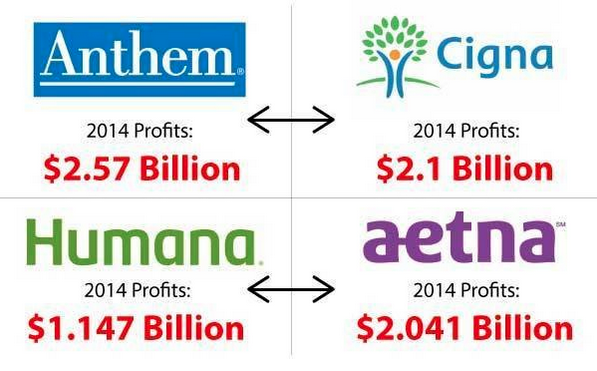
Seven Democratic senators urged the U.S. Justice Department on Wednesday to block two mergers of major health insurance companies, saying that the proposed deals would mean higher premiums and lower-quality healthcare for consumers.

The department is reviewing Aetna Inc’s $33 billion plan to buy Humana Inc and Anthem Inc’s $48 billion proposal to buy Cigna Corp. If approved, the deals, both of which were announced last July, would reduce the number of national health insurance carriers from five to three.

A warning on hospital mergers: After California allowed big chains to grow, prices

http://www.latimes.com/business/hiltzik/la-fi-hiltzik-california-hospitals-20160613-snap-story.html?utm_campaign=CHL%3A+Daily+Edition&utm_source=hs_email&utm_medium=email&utm_content=30727033&_hsenc=p2ANqtz-_lSFFriq5yA5SisvjbMwODLDPAQmVwWrr_t6XuMvz-oA2lMa5974U7UAJiXhUp_HB_zXoS9iYPUKey6BSklKM–HtzoA&_hsmi=30727033

Big California hospital chains not only raised prices faster than inflation, but gave competitors room to raise their own prices.

Hospital prices … increased substantially in California during a period of low overall price inflation, low economic growth, and declining demand.— Melnick and Fonkych, USC

As Hospital Chains Grow, So Do Their Prices For Care

http://www.healthleadersmedia.com/finance/hospital-chains-grow-so-do-their-prices-care?spMailingID=9073752&spUserID=MTMyMzQyMDQxMTkyS0&spJobID=941690582&spReportId=OTQxNjkwNTgyS0#

Dollars

As health care consolidation accelerates nationwide, a new study shows that hospital prices in two of California’s largest health systems were 25 percent higher than at other hospitals around the state.

Healthcare mergers and acquisitions in 2015: Running list

http://www.healthcarefinancenews.com/slideshow/healthcare-mergers-and-acquisitions-2015-running-list

Lazy Image


Healthcare mergers and acquisitions in 2016: Running list

http://www.healthcarefinancenews.com/slideshow/healthcare-mergers-and-acquisitions-2016-running-list

Lazy Image


Impact of antitrust suit against CHS could ripple nationwide

http://www.charlotteobserver.com/news/local/article83142307.html

Carolinas Medical Center is the flagship hospital of Charlotte-based Carolinas HealthCare System

A win for the U.S. Justice Department could establish an important legal precedent. Hospitals nationwide might have to remove contract provisions that limit competition. That could result in lower prices for patients.