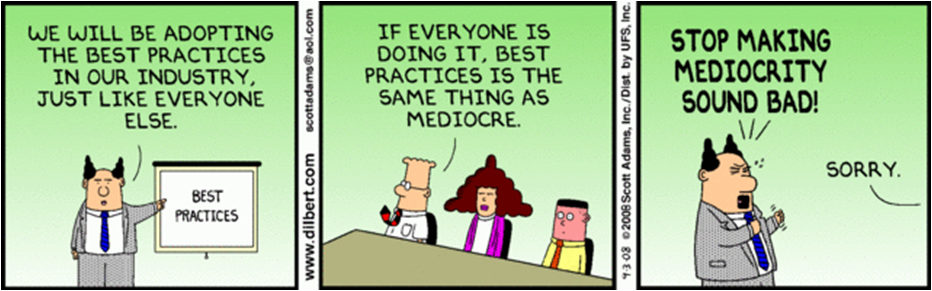
Moving beyond the “best practice” mindset

https://gisthealthcare.com/weekly-gist/

Image result for best practice

Here’s a question we get all the time, and one that I heard again this week from one of our partner health systems: “We’re working on [initiative X]. What have other health systems like us done about that?” We hear it in any number of situations, from hospitals developing clinical protocols to strategic planners putting together business plans for service line growth. Sometimes the question comes in different forms: “Do you have a white paper on [topic X]?”; or “What research do you have on [issue X]?”; or our favorite, “What’s the best practice for [activity X]?”

It’s not surprising, given our past history, that we’d frequently be asked to provide research or best practice information. But as we’ve grown our own business at Gist Healthcare and developed our own independent perspective on where our industry needs to go, we’ve become less and less impressed by “best practice” as a concept. In fact, I’d go so far as to say that “best practice” has become at best a crutch, and in many cases a hindrance, to real progress in healthcare. As we sometimes tell our clients now, healthcare has outgrown “best practice”, at least as we used to understand it.

Don’t get me wrong. Medicine should absolutely be evidence-driven, and clinical care should always be firmly grounded in proven practice. If anything, the actual clinical practice of medicine is one area where our industry must become more, not less, best-practice based.

But as to system strategy, payment innovation, service improvement, and a host of other business and operational issues, simply imitating what other “successful” organizations are doing leads inevitably to reversion to the mean, groupthink, and (most troubling) fad-driven “bubbles” of activity. It’s no surprise, given the pervasive culture of “best practice”, when suddenly every health system’s top priority turns to creating a patient portal, or hiring a chief experience officer, or starting a proton beam center, or opening freestanding EDs.

Healthcare delivery is a highly fragmented, insular business, with little visibility across markets and across institutions. That makes it very susceptible to white paper-driven trend chasing, which tends to outsource innovation to the “wisdom of the crowd”.

It’s pretty rare to find mavericks, following their own innovation instincts without getting caught up in trying to mimic what other “leaders” are doing. That’s why when a delivery organization takes a risk on a truly new strategic innovationGeisinger’s money-back guarantee, Cleveland Clinic’s promise of same-day access, Presbyterian’s direct contract to manage Intel employees’ health—it immediately sends shock waves across the industry.

Those ideas didn’t come from a white paper. We’re often asked whether we’re building a “best-practice research” capability in our new company. While we’re not quite ready to talk about our upcoming service offerings, the answer to that question is a definitive “no”.


Big-name hospitals often fail to prevent C. diff infections

http://www.fiercehealthcare.com/hospitals/report-c-diff-infections-continue-to-be-a-struggle-for-big-name-medical-centers?utm_medium=nl&utm_source=internal&mrkid=959610&mkt_tok=eyJpIjoiTVdZNE9UbGtZemxtTXpBMCIsInQiOiJVS01rMXhPNVNhS1c0V2JKaE53TSthTHg0dWFnaXVtcUtXeEZlK0VqQTk3SFBNTG01aEJpVVN0aFhqRDZ5cmFGYitGUmtrZHV0K0JGMHBcL2twN2RBeUpSSk5MaW5vS0NcL25JQTk3T2FFTUhrPSJ9

MicroscopeMicroscope

Some of the most well-known hospitals in the nation rank among the worst in preventing deadly Clostridium difficile infections, according to a new Consumer Reports analysis.

The publication analyzed C. diff infections at hospitals across the country, based on data reported to the Centers for Disease Control and Prevention between 2014 and 2015. It found well-known teaching hospitals like the Cleveland Clinic, Baylor University Medical Center in Dallas, Brigham and Women’s Hospital in Boston and Cedars-Sinai Medical Center in Los Angeles had the lowest or second-lowest ranking, indicators that these hospitals fall short against the national benchmark to control such infections.

“Teaching hospitals are supposed to be places where we identify the best practices and put them to work,” Lisa McGiffert, director of Consumer Reports‘ Safe Patient Project, said in an announcement of the findings. “But even they seem to be struggling against this infection.”

The report analyzed data from more than 3,100 U.S. hospitals and found that more than a third received a low score for C. diff infection control.

Only two large teaching hospitals, Mount Sinai Medical Center in Miami Beach, Florida and Maimonides Medical Center in Brooklyn, New York, earned top marks from Consumer Reportson controlling C. diff.

The Ultimate Battle Against MRSA

http://www.wsj.com/articles/the-ultimate-battle-against-mrsa-1473699288

An electron micrograph image of Methicillin-resistant Staphylococcus aureus, or MRSA (the purple spheres).

Hospitals give ICU patients germ-killing baths and antibiotic nose ointment upon admission

As Healthcare Changes, So Must its CEOs, CFOs, COOs…

http://www.healthleadersmedia.com/leadership/healthcare-changes-so-must-its-ceos-cfos-coos%E2%80%A6

Image result for CEO, COO, CFO

To keep up with big changes in how healthcare is administered, financed, and organized, top leaders are finding a need for new talents and organizational structures.

Four Best Practices for Strategic Planning

https://www.bcgperspectives.com/content/articles/strategic-planning-business-unit-strategy-four-best-practices-strategic-planning/?utm_source=201607Q2TOP&utm_medium=Email&utm_campaign=otr

Article imageArticle imageArticle image

Strategic planning is one of the least-loved organizational processes. Executives at most companies criticize it as overly bureaucratic, insufficiently insightful, and ill suited for today’s rapidly changing markets. Some even argue that strategic planning is a relic that should be relegated to the past and that organizations seeking to prosper in turbulent times should instead invest in market intelligence and agility.

In short, the problem isn’t strategic planning. It’s that most companies lack an effective strategic-planning process.

Although there is no one-size-fits-all approach to strategic planning, we have found that the companies that get the most benefit from their strategic-planning activities have four things in common:

  • They explore strategy at distinct time horizons.
  • They constantly reinvent and stimulate the strategic dialogue.
  • They engage the broad organization.
  • They invest in execution and monitoring.

Most hospitals fall short in following best practices for antibiotics use, study finds

http://www.healthcarefinancenews.com/news/most-hospitals-fall-short-following-best-practices-antibiotics-use-study-finds

Of the hospitals studied, only 39 percent had an action plan in place.