Insurance official to Congress: ObamaCare not collapsing

Insurance official to Congress: ObamaCare not collapsing

Insurance official to Congress: ObamaCare not collapsing

A Pennsylvania insurance official told Congress Wednesday that ObamaCare is not collapsing, as some Republicans have argued.

Speaking at a Senate Health Committee hearing on efforts to stabilize Affordable Care Act (ACA) markets, Teresa Miller, Pennsylvania’s acting Human Services secretary and former insurance commissioner, said that the notion is “just false.”

“I’m not going to sit here this morning and tell you that the ACA is perfect,” she said. “I think we all know that it’s not, but the narrative that the ACA is failing and imploding is just false.”

Miller, who works in the administration of Democratic Gov. Tom Wolf, noted that insurers in the state filed average premium increases of just 8.8 percent for next year, and that most enrollees receive government subsidies to help them afford premium costs.

While there have been “difficulties” in the market, she said, “our individual market is not collapsing.”

Other states have encountered more problems with their markets, but every state is on track to have at least one insurer offering ObamaCare coverage in every county next year, after some worries that there would be empty counties.

The insurance commissioners testifying largely called for efforts to further stabilize ObamaCare markets, for example by funding key payments known as cost-sharing reductions, which President Trump has threatened to cancel.

Multiple commissioners also called for a program called reinsurance that provides government funding to bring down premiums by paying for part of especially sick enrollees’ claims.

The Senate Health Committee is trying to reach a deal on a bipartisan stabilization bill by the end of next week, a tough task on such a polarizing issue.

A Glimmer of Bipartisanship on the ACA

http://www.commonwealthfund.org/publications/blog/2017/sep/bipartisanship-on-the-aca?omnicid=EALERT1267321&mid=henrykotula@yahoo.com

Image result for bipartisanship


With the eclipse of Republican efforts to repeal and replace the Affordable Care Act (ACA), bipartisan approaches to improving the law are having a moment in the sun. This week, Senators Lamar Alexander (R-Tenn.) and Patti Murray (D-Wash.) are cosponsoring hearings before the Senate Health, Education, Labor and Pensions (HELP) committee on bipartisan solutions to stabilizing private health insurance markets. The Problem-Solvers — a new caucus of House Democrats and Republicans — are similarly at work on a cross-party package of reforms. Eight governors have released a bipartisan plan, as has a group of health policy experts with mixed party affiliations.

The value of bipartisanship is indisputable. The alternative — on excruciating display over the last seven months — is ongoing partisan warfare that destabilizes our health care system. Health care providers and insurers cannot function effectively when changes in party control at the federal level threaten to upend the health care system every two to four years. And the fear of health coverage loss is unquestionably stressful for the millions of Americans who depend upon the ACA.

But the growing apparent consensus on key elements for a short-term, cross-party package is encouraging. These proposals focus on strengthening individual insurance marketplaces by legislating cost-sharing reduction payments; helping private insurers manage the risk of very high-cost patients using reinsurance and other means; creating a source of backup coverage for “bare markets” that lack private insurers; and offering states greater flexibility in implementing federal regulations governing private insurance markets.

Different groups propose additional bells and whistles, and there is much room for disagreement on how to design and implement specific provisions. But at least both parties are at the table. Where there’s a will, there may be a way.

Still, important practical questions remain. One is whether the will really exists. Republican supporters of repeal and replace continue to divide the Senate Republican caucus. Conservatives in the House — including the Freedom Caucus — will likely oppose anything that threatens their hope that the ACA will collapse of its own weight. And it is possible that President Trump, still grumbling about the failure of repeal and replace, will veto any narrow package that he believes pours salt in his health care wound.

Ironically, the failure of ACA markets to self-destruct may also sap the will for bipartisan reforms. Deadlines and crisis drive congressional action and, until recently, the threat that some individual markets — admittedly, small in number and population — would lack any insurer was an important spur for Congress to act. Now, that threat has receded as the last of the bare markets has found a carrier.  Bipartisanship is the legislative equivalent of nuclear fusion; it needs major external pressure to push those mutually repelling atoms together.

Even if there were a will, there might not be a way to get an ACA package into the queue. The fall congressional calendar is packed with other high-profile, high-stakes, deadline- and crisis- driven legislation. By September 30, Congress must reauthorize the Children’s Health Insurance Program (CHIP), which has traditionally enjoyed bipartisan support and is vital to the health care of more than 9 million American children. To respond to Hurricane Harvey, Congress also needs to rapidly enact emergency aid for Texas and Louisiana, which will require the extension of previously controversial flood relief legislation.

And these measures are just the beginning. Congress has to fund the federal government by September 30 — with or without support for the border wall — or face a government shutdown. There is the need to pass a controversial increase in the federal debt ceiling by the same date. And to have any hope of enacting major tax reform before the 2018 election, work must accelerate right after Labor Day. Putting the tax project off until after January is dangerous for proponents, because passing controversial tax legislation is infinitely more difficult in an election year.

Bipartisanship on health care action could lay vital groundwork in the short term for bolstering the individual health insurance market. Longer term, bipartisanship is essential for the kind of fundamental change that is necessary to increase coverage and contain costs in our health care system. We should not, however, underestimate the huge political and procedural obstacles that lie in the way of current admirable efforts to bring the two parties together on health care. It will take all the skill of committed Senate and House leaders from both parties to make progress on health care this year — or thereafter.

Governors urge keeping US health law’s individual mandate

http://abcnews.go.com/Health/wireStory/apnewsbreak-governors-health-care-plan-retains-mandate-49537497

Image result for individual mandate


A bipartisan governor duo is urging Congress to retain the federal health care law’s unpopular individual mandate while seeking to stabilize individual insurance markets as lawmakers work on a long-term replacement.

The recommendation is part of a compromise plan that’s designed to be palatable to both parties. It was endorsed by six other governors.

Ohio Gov. John Kasich, a Republican, and Colorado Gov. John Hickenlooper, a Democrat, shared their plan in a letter to congressional leaders Thursday. They acknowledge that retaining the mandate may be a difficult sell for Congress, which has failed so far to pass a replacement health care bill.

“The current mandate is unpopular, but for the time being it is perhaps the most important incentive for healthy people to enroll in coverage,” they wrote to House and Senate leaders of both parties.

Experts concur that keeping younger, healthier people in the insurance pool protects against costs ballooning out of control.

The penalty and coverage requirement, or individual mandates, were intended to nudge healthy people into the insurance market. They have consistently polled negatively with Americans. In an Associated Press-NORC Center for Public Affairs Research poll conducted in July, 48 percent of those surveyed favored repealing the mandate, while 35 percent opposed repeal.

Kasich and Hickenlooper’s letter was signed by Republican Gov. Brian Sandoval of Nevada; Democratic Govs. Tom Wolf of Pennsylvania, John Bel Edwards of Louisiana, Steve Bullock of Montana and Terry McAuliffe of Virginia; and Alaska Gov. Bill Walker, a one-time Republican no longer affiliated with a political party.

After Republicans’ failure to pass a replacement of President Barack Obama’s health care law, Kasich and Hickenlooper teamed up to push for health care exchanges that would stabilize the market and assure affordability. Both took pains to quash speculation that their collaboration and public appearances suggested a bipartisan presidential ticket was in the making for 2020.

Hickenlooper emphasized Thursday that steadying individual markets is a top — and time-driven — priority. Addressing Medicaid expansion costs and other health care elements can follow, he told reporters in Denver.

“Is this going to fix all that is broken with our health care system? No,” he said. “If we can demonstrate success at stabilizing the individual markets, then we can move to the other parts of health care as well.”

Kasich and Hickenlooper also recommended that President Donald Trump commit to cost-sharing reduction payments to insurers and that Congress fund those offsets at least through 2019. Those payments reimburse insurers for providing low-income people with legally required reductions on copays and deductibles. If Trump follows through on threats to pull the plug, premiums would jump about 20 percent.

Kasich said the proposal satisfies the concerns of all parties studying the health care law.

“If you want to keep what you have, you can,” the Ohio governor said Thursday. “We’ve stabilized everything up front, but then over time, we open up the doors to innovation and individual plans, within guardrails.”

The governors support creating a temporary stability fund that states could tap to reduce premiums and limit losses; continuing to fund educational outreach and enrollment efforts under the Affordable Care Act; exempting insurers that agree to cover underserved counties from the federal health insurance tax; and supporting states’ efforts to find creative solutions for covering the uninsured.

The governors said states can pursue lots of options without federal assistance, but in some cases they are “constrained by federal law and regulation from being truly innovative.”

Kasich and Hickenlooper are expected to be in Washington next week to testify on their proposal. But congressional action on even a modest compromise is expected to be difficult following years of harsh partisan battling over the Republican drive to dismantle the health care law.

Data-Driven Policy Making In An Age Of Anecdotes: What Happens When A Foundation Creates A Policy Center?

http://healthaffairs.org/blog/2017/08/31/data-driven-policy-making-in-an-age-of-anecdotes-what-happens-when-a-foundation-creates-a-policy-center/

An image of the Nashville skyline.

Why would a health foundation create a public policy research center?

The Healing Trust, in Nashville, Tennessee, has funded a wide variety of health-related service and advocacy organizations in Middle Tennessee. But in 2014, we asked them what additional support we could give to these organizations engaged in policy and advocacy work. One priority quickly rose to the top: timely, high-quality, and nonpartisan research and analysis on public policy issues critical to our community.

Tennessee has several prominent academic institutions with respected researchers in this field, but an independent and nonpartisan public policy research center simply did not exist. We began to explore this idea, using research to vet different business models for similar centers in other states. Ultimately, we decided to incubate this new policy center inside our foundation before spinning it off into a separate and independent nonprofit organization.

Aiming to create a true community resource, The Healing Trust worked with the Nelson Andrews Leadership Center to engage eighty stakeholders in an intense, three-day, co-design process. A core group of participants then spent another three months hammering out the details. This collaborative process established community buy-in and developed the road map for everything from staffing needs and board composition to the policy center’s mission, name, and brand.

Inspired and encouraged by the community’s engagement, The Healing Trust board committed $2.5 million over five years as seed funding to launch the Sycamore Institute.

Lessons Learned Through Launching The Center

What has the foundation learned through launching the Sycamore Institute, and why should philanthropy think about supporting policy research?

Ability to respond quickly in a rapidly changing policy environment: The Sycamore Institute has only been fully staffed for about six months—a period that includes one full legislative session in Tennessee and months of head-spinning debate in Congress over health reform. Yet, in that short time, our foundation’s investment has shown a solid return in the form of more than thirty reports, policy briefs, and blog posts about health policy and budget issues affecting Tennessee. As an independent public policy research center, the Sycamore Institute has the ability and agility to weigh in on rapidly evolving topics like how health reform efforts in Congress could affect our state.

Educating policy makers, the public, the media, and nonprofit partners: No matter where one stands on the political spectrum, we can all agree on the value of helping public officials make better-informed decisions. “Public Policy 101s” like how health insurance markets work and the nuts and bolts of Medicaid are just as important as analysis of specific legislation like the American Health Care Act. Our governor, administrative agencies, and legislators at the state and federal levels have already used the Sycamore Institute’s work to better understand key issues and communicate with their constituents.

These resources are equally valued by our foundation’s other grantees, who have become (1) even more knowledgeable about policy issues that affect their missions and (2) better equipped to engage with policy makers, the public, and other potential funders.

And in an era of shrinking newsrooms, the Sycamore Institute also provides important context and unbiased information to journalists covering health and fiscal policy. In very short order, the institute has become a trusted source for media outlets across Tennessee.

Unexpected Challenges

What were some of the unexpected challenges faced in launching a nonpartisan policy center?

Hiring the right leader: Hiring the right person to lead the Sycamore Institute proved more challenging than expected. The Healing Trust initially focused on candidates with backgrounds in policy research, but the collaborative design process we used shifted our focus to people with leadership experience who could launch a start-up and cultivate a diverse board. (Political, professional, geographic, and cultural diversity were all important criteria for the board.) Going back to the drawing board, our hiring committee interviewed new candidates and ultimately hired an experienced nonprofit executive director with an advanced degree in public policy.

Hiring the right staff: Building a staff with the ability to conduct high-quality research and analysis in-house and communicate about it to interested stakeholders was another challenge. Fully staffing the Sycamore Institute with an executive director, policy director, research analyst, and communications director took fourteen months—just in time to hit the ground running for the 2017 session of the Tennessee state legislature.

Recruiting a bipartisan board: To maximize and broaden the Sycamore Institute’s impact, the design shop showed we needed a bipartisan board committed to supporting nonpartisan work. The board’s balance of Republicans, Democrats, and political independents has been critical to building relationships with policy makers on both sides of the aisle. A balance of skill sets, diversity, and leadership potential is also key. With both the Sycamore Institute and its original board members based in the state capital, Nashville, recruiting additional board members from other regions of Tennessee remains a top priority.

Advocacy or analysis? Another question we wrestled with early on was where to draw the line. The primary goal of founding the Sycamore Institute was to fill a void of credible, independent, and nonpartisan analysis of policy issues in Tennessee. But should the organization go a step further to offer conclusions and recommend specific policies? Ultimately, the board and executive director decided that the Sycamore Institute would not advocate for specific policies, reasoning that doing so could hurt its credibility as a trustworthy source of politically neutral information.

Concluding Words

Building and maintaining health and well-being, which are complex issues, demand significant public and private resources. In Tennessee, as in most states, health care and education are the state’s top two budget priorities. The Sycamore Institute is dedicated to understanding and explaining the state budget and existing and proposed laws that affect the health and well-being of Tennesseans. Its information has already enabled citizens, policy makers, nonprofit agencies, foundations, media outlets, service providers, and others to understand better the fiscal and human impact of pending policies, giving stakeholders a nonpartisan and informed stake in the process and the outcomes.

Bipartisan group of governors calls on Congress to shore up elements of Affordable Care Act

https://www.washingtonpost.com/national/health-science/bipartisan-group-of-governors-calls-on-congress-to-shore-up-elements-of-affordable-care-act/2017/08/31/7853b978-8e71-11e7-84c0-02cc069f2c37_story.html?utm_term=.3975c59ec12b

Image result for bipartisanship

A bipartisan group of governors is trying to jump-start efforts to strengthen private insurance under the Affordable Care Act, urging Congress to take prompt steps to stabilize marketplaces created by law while giving states more freedom from its rules.

In a blueprint issued Thursday, the eight governors ask House and Senate leaders of both parties to take several steps to reverse the rising rates and dwindling choices facing many of the 10 million Americans who buy health plans on their own through ACA marketplaces.

Specifically, the state leaders say Congress should devote money for at least two years toward “cost-sharing subsidies” that the 2010 health-care law promises to pay ACA insurers to offset deductibles and other out-of-pocket expenses for lower-income customers. The House sued the Obama administration over the subsidies’ legality, and President Trump has repeatedly suggested that he might halt the payments — sending tremors through insurance companies in the marketplaces.

Five days before the House and Senate return to Washington, the governors also recommend preserving “for now” the ACA’s requirement that most Americans carry health insurance. Though this rule is unpopular, they concluded that it is “for the time being … perhaps the most important incentive for healthy people to enroll in coverage.”

The proposal also calls for a federal fund, to be available for two years, to buffer insurers from high-cost customers, and for the government to foster competition in ACA marketplaces by encouraging insurers to move into counties with only one company. Those that do would have the law’s insurer taxes waived on health plans sold in those locations.

Led by Ohio Gov. John Kasich (R) and Colorado Gov. John Hickenlooper (D), the blueprint essentially fleshes out the contours of four principals that many of the same governors recommended to Senate leaders in June. It focuses on the insurance market for individuals and families that buy coverage on their own — a fraction of the country’s consumers with private insurance but a perennially shaky part of the industry that the ACA was designed to strengthen.

Greg Moody, a longtime health-care aide to Kasich, said the blueprint is also an acknowledgment of the failure this year of Republicans who control Congress to deliver on their years-long goal of replacing the ACA. “We’ve recently seen how difficult that is,” Moody said.

The blueprint envisions a quick federal boost to shore up the marketplace for the coming year, while deferring to states longer term to experiment with potential changes in insurance subsidies, for instance, or different forms of penalties for consumers who drop coverage.

The proposal was released Thursday so that it would attract attention before two days of hearings scheduled next week by the Senate’s health committee, which will explore bipartisan ideas for improving the law and its marketplaces.

The other governors who signed on are Brian Sandoval (R-Nev.), Tom Wolf (D-Pa.), Bill Walker (I-Alaska), Terry McAuliffe (D-Va.), John Bel Edwards (D-La.) and Steve Bullock (D-Mont.).

After repeal scare, Obamacare has never been more popular

https://www.cbsnews.com/news/obamacare-repeal-has-never-been-more-popular/

obamacare-sentiment.png

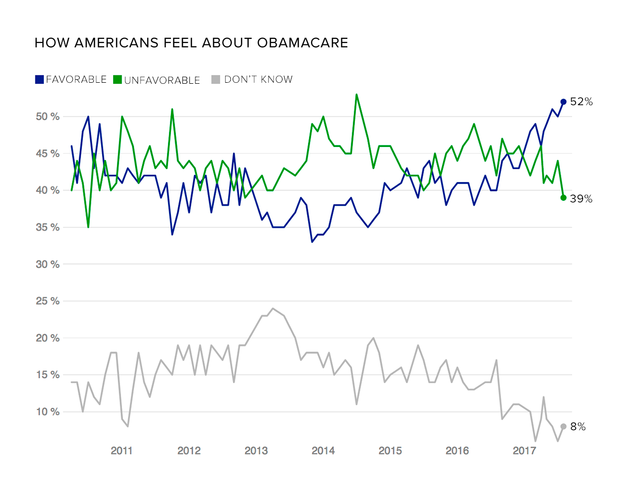
Underscoring the adage that you don’t know what you’ve got until it’s (almost) gone, the popularity of Obamacare is surging.

Only weeks after Republicans in Congress failed to repeal the landmark health reform law, 52 percent of respondents hold a favorable view of the Affordable Care Act (ACA), according to a recent Kaiser Family Foundation August poll. That’s up 10 percentage points since June of last year and nearly 20 points since November 2013, when public support for the ACA was at its nadir.

A July poll by CBS News after the repeal effort collapsed found that a plurality of Americans favor a bipartisan push in Congress to improve Obamacare.

The shift in sentiment coincides with other positive developments for Obamacare following its close call in Washington. With several large, and some smaller, insurers pulling out of the program over the past year or so, until recently it looked as if more than 92,000 participants spread out over 82 counties would have no insurer in their local health care exchanges, Cynthia Cox, associate director of Kaiser Family Foundation, said. But state insurance commissioners and other officials in states in jeopardy of losing Obamacare coverage have worked closely with insurers to negotiate continued coverage.

In Ohio, for instance, there were 20 counties without insurers, but officials ultimately convinced five health plans to cover all but one. Then, on August 24, the Ohio Department of Insurance announced that Paulding County, the last “bare county” in the country, would be covered by insurer CareSource.

In addition, the exchange marketplace overall has shown signs of stabilizing. After big financial losses in 2014 and 2015, individual market insurers saw improved performance in 2016, a trend that has continued this year, according to a different Kaiser Family Foundation study.

If Obamacare’s popularity is up, the program’s shortcomings remain clear. At last count, more than 2.6 million enrollees across 1,300 counties were expected to have only one insurer in their exchanges. More insurers also could pull out or move to sharply increase their premiums. The deadline for insurance companies to commit to participate in an exchange is September 27.

Until then, many insurers are watching closely to see if the Trump Administration will continue funding the federal cost-sharing subsidies that help low-income members pay for deductibles, co-pays and other out-of-pocket costs. Industry players are also waiting or Senate hearings to start after Labor Day in which which insurance commissioners, lawmakers and state governors are expected to testify about what can be done to stabilize the individual marketplace.

Meanwhile, some states are beginning to take matters into their own hands, moving to rewrite the ACA rules by applying for what’s known as a “Section 1332” waiver. Oklahoma is asking for a waiver to establish its own reinsurance program using some federal funds, which would cover the highest-cost individual marketplace cases. Alaska recently received approval for a similar reinsurance waiver. Oklahoma, however, is also looking ahead to more major structural changes that may spur debate.

Iowa, which is undergoing huge premium increases in its individual marketplace, has submitted a waiver that would overhaul the state’s insurance marketplace by redistributing federal tax credit money. The plan would create a single standard health plan and offer a flat tax credit based on age and income.

Critics argue this would increase health care costs significantly for Iowa’s low-income population, putting coverage out of reach for many. Proponents argue that increasing Iowa’s pool of healthy insured people is the best way to stabilize Iowa’s individual market and lower premiums for everyone.

State officials take center stage in ACA stabilization efforts

http://www.fiercehealthcare.com/aca/state-officials-take-center-stage-aca-stabilization-efforts?mkt_tok=eyJpIjoiTXpka1pUSXhNMll5WldZeiIsInQiOiJCNWJNNHZ4Y1RxVHpCckY1WSswVGsyMjVpNituQ2RVUVp0UElNMmtqTlhkVUVQWFVINFhNU1RwcE9aU0Rad3Y3aFNhNjZWVXY3Ym02bXVkZFk3U3F6Y1pvbGJ4Rno4ZWM2M21jTUpcL2pVM3BsSnJNU2RWcVE1NEZDV1wvaUZzR1FmIn0%3D&mrkid=959610&utm_medium=nl&utm_source=internal

John Kasich speaking at lectern

As efforts to stabilize the Affordable Care Act exchanges begin to take shape, it’s become increasingly clear that states will play a major role.

On Tuesday, Sen. Lamar Alexander, R-Tenn., and Sen. Patty Murray, R-Wash., announced that the Senate’s upcoming bipartisan healthcare hearings will feature testimony from “those closest to the problem”—state insurance commissioners and governors. The hearings are planned for Sept. 6 and 7.

“These state leaders understand full well the challenges facing healthcare today, and many have been outspoken about how the uncertainty caused by this administration has impacted the individual insurance market and therefore families’ premiums for 2018,” Murray said.

Alexander said the goal is to pass a “small, bipartisan and balanced” ACA exchange stabilization package before the Sept. 27 deadline for insurers to lock in their final plans for 2018. He also wants the package to fund cost-sharing reduction payments and “give states more flexibility in approving insurance policies” by improving section 1332 of the ACA.

Kasich, Hickenlooper join the fray

Two state governors, meanwhile, are preparing to offer up their own healthcare plan even before the Senate hearings begin. Ohio Governor John Kasich, a Republican, and Colorado Gov. John Hickenlooper, a Democrat, told Colorado Public Radio on Monday that they hope to unveil the plan within a week.

Previously, Hickenlooper and Kasich joined other state governors in speaking out against the House version of an ACA repeal-and-replace bill, arguing in a letter to Senate leaders that it “calls into question coverage for the vulnerable and fails to provide the necessary resources to ensure that no one is left out, while shifting significant costs to the states.”

That letter, as well as a Washington Post op-ed authored by Kasich and Hickenlooper, outlined a set of core principles for bipartisan healthcare reform—principles that their upcoming ACA stabilization plan will build upon, according to the CPR article. They include improving affordability, restoring stability to insurance markets, providing state flexibility, encouraging innovation and improving the regulatory environment.

Iowa submits stabilization plan

At least one state, though, isn’t waiting on Congress to rescue its individual health insurance market.

On Monday, Iowa officials submitted their application for federal regulators to approve the “Iowa Stopgap Measure,” a short-term stabilization plan formulated by the state’s insurance commissioner with the help of local health plans.

In the application (PDF), Iowa Gov. Kim Reynolds urged federal officials to quickly approve the measure, noting the state faces “an immediate collapsing market that could leave thousands without health insurance and the rest with 56% or higher premium rate increases.”

The plan, which requires the use of a section 1332 waiver, would redirect the $305 million in federal funding that currently goes toward the ACA’s premium tax credits and instead fund fixed, age- and income-based premium subsidies for consumers.

It would also use federal funds to implement a reinsurance program that will reimburse insurers for high-cost individuals who incur claims greater than $100,000 on an annual basis. As part of the program, insurers would have to agree to care-management protocols.


Special Report—How to fix the Affordable Care Act

Click to access FierceHealthcare-HowtofixtheAffordaleCareAct.pdf

Image result for aca

As Congress prepares to get back to business, the industry is holding its collective breath to see if healthcare reform will fall off the agenda. It’s pretty clear that rushing through repeal, replace or repair legislation or letting the Affordable Care Act fail isn’t the answer. In this special report, FierceHealthcare’s editors—experts on the business of healthcare—outline ways to fix the nation’s healthcare system.

Time Crunch Among Hurdles for Bipartisan Senate Push to Bolster ACA

https://morningconsult.com/2017/08/18/time-crunch-among-hurdles-bipartisan-senate-push-bolster-aca/

Image result for aca


The leaders of a key Senate committee say they are cautiously optimistic about reaching a deal to shore up the Affordable Care Act’s individual marketplaces, but even with a bipartisan effort, it is far from certain whether they can hash out an agreement in time.

The Senate Health, Education, Labor and Pensions Committee leaders of both parties have set a self-imposed mid-September deadline for a bipartisan agreement. To keep lingering animosity from the Obamacare repeal fight from seeping into negotiations, Chairman Lamar Alexander has made clear that what he’s seeking is far from comprehensive.

The bill will have to be “small, bipartisan and balanced,” the Tennessee Republican said in a statement Wednesday.

Above all, Democrats want to make sure insurers continue to receive payments that help them cover out-of-pocket costs for some low-income patients. President Donald Trump has threatened to cut off the payments, and the administration has kept insurers on tenterhooks by making them only on a month-to-month basis.

Without the subsidies, known as cost-sharing reductions, some insurers warn they’ll be forced pull out of the ACA markets or hike premiums. The companies need certainty about payments at the latest by Sept. 27, the final deadline for them to decide whether to sell Obamacare plans in 2018.

If the committee can reach agreement next month, it would still be a challenge to get a bill through the full Senate and House before the key deadline for insurers. And Trump would still have to sign a bill into law that extends payments he is loath to continue.

The potential for chaos was highlighted this week when the nonpartisan Congressional Budget Office released a report estimating average premiums would rise 20 percent next year and the federal deficit would grow by $194 billion by 2026 if the administration stops paying.

While some conservative hard-liners want to cut off the CSRs, Alexander and other top Republicans have shown they’re willing to work with Democrats to have Congress extend the payments.

Sen. Patty Murray of Washington, the panel’s ranking Democrat, on Thursday called for quick action.

“People across the country are facing much higher premiums next year because of uncertainty driven by the Trump Administration, so I hope Republicans will join Democrats to act quickly to protect patients and families from paying more for care they need — and then continue working in a bipartisan way to make health care more affordable, accessible, and higher quality for all,” Murray said in a statement.

Democrats also want some sort of reinsurance program, an idea that has bipartisan support and would help insurers pay for their most expensive enrollees.

But in return for extending CSRs and including reinsurance, Republicans want to give states more authority over their health care systems, and Democrats could balk at some of their proposals.

Alexander has specifically pointed to changing the ACA’s 1332 waiver program, which allows states to opt out of key ACA regulations as long as it doesn’t lead to reduced coverage, skimpier benefits, more expensive insurance or a higher federal deficit.

In remarks to reporters earlier this month, Alexander noted a proposal that would eliminate all of those requirements besides increasing the federal deficit, in order to give states “more of an opportunity to approve insurance plans.” The plan, which was included in Senate Republicans’ health overhaul bill, would also bar the administration from rejecting a waiver as long as it doesn’t increase the federal deficit.

Democrats would likely oppose that proposal, wary of allowing states to undercut key Obamacare requirements without those other conditions in place.

Sen. Tim Kaine (D-Va.) said he’s interested in a proposal from Sens. Bill Cassidy (R-La.) and Susan Collins (R-Maine) to let states replace Obamacare’s most contentious provision — the mandate requiring people to purchase health insurance or pay a penalty — with a system that automatically enrolls individuals in low-cost coverage if they don’t do so on their own.

Backers of this approach argue it would offer comparable coverage to the individual mandate while being less intrusive, allowing people to opt out.

“I think that’s intriguing,” Kaine said earlier this month in a brief interview. “We ought to have that discussion, but you can’t blow the mandate without something to bring people into the program and do what insurance needs to do, which is to spread risk.”

But auto-enrollment has raised concerns among some liberal health care analysts, including over how to implement and administer such a system. The outstanding questions cast doubt on whether it could garner enough backing to be included in the stabilization bill.