Softer bookings dampen Cerner’s Q3 growth

https://www.healthcaredive.com/news/softer-bookings-dampen-cerners-q3-growth/540694/

Dive Brief:

  • Cerner’s new bookings fell short of expectations in the third quarter of 2018, leading to lower than expected revenue for the period. While sales of licensed software grew 43% from a year ago to $1.59 billion, the EHR vendor didn’t match the second quarter’s $1.78 billion.  
  • Third quarter revenue totaled $1.34 billion, up 5% from the same period the prior year.
  • The earnings report comes as Cerner is under fire again for its performance on a Department of Defense contract. According to Politico, independent investigators for the Pentagon gave the company poor marks on its MHS Genesis EHR implementation, calling the system “not effective and not suitable” and “not interoperable.” The low assessment echoes an April DOD report.

Dive Insight:

Cerner attributed the lower-than-expected software bookings to timing and pointed to a strong pipeline of potential business hookups. Technology resales were also somewhat off in the third quarter.

“There isn’t anything that’s forcing clients to go get deals done,” Cerner CFO Marc Naughton said during a Thursday earnings call. “The market is still active. We just didn’t get much of it in Q3.”

Cerner also said it is not yet seeing the full impact of government contracts. Nonetheless, officials called it a strong quarter with solid results.

“We continue to have good contributions from our key growth areas” of population health, revenue cycle management and health IT outsourcing, said Chief Client Officer John Peterzalek, who replaces departing President Zane Burke starting next week.

“As we look at our portfolio and our investment plans, there’s some transformation of our own that we need to do to make sure we’re positioned well for the opportunities in front of us,” said Cerner Chairman and CEO Brent Shafer. “Part of that work is creating an operating model that is really designed to support innovation at scale. We are at scale now and want to continue to scale.”

Meanwhile, Cerner faces fresh competition from commercial health giant UnitedHealth, which is expanding into EHRs with a fully integrated system in 2019. During a recent earnings call, UnitedHealth CEO David Wichmann said the company will launch a “fully individualized, fully portable” EHR early next year leveraged off its Rally mobile wellness platform.


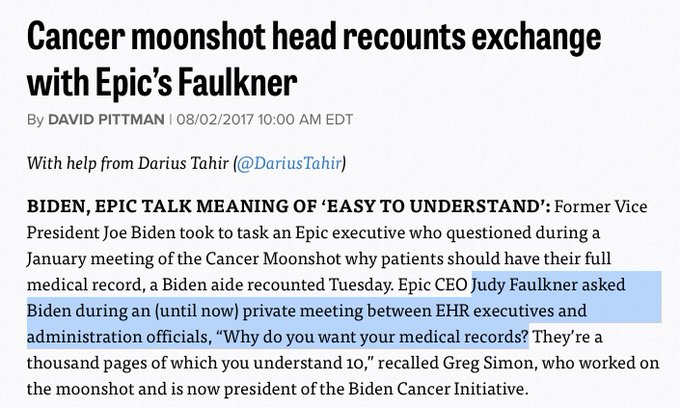
Editor’s Corner—Why the Biden-Faulkner exchange over EHR access touched a nerve

http://www.fiercehealthcare.com/ehr/editor-s-corner-why-biden-faulkner-exchange-over-ehr-access-touched-a-nerve?mkt_tok=eyJpIjoiTWpnMFlUY3dNREExTUdReSIsInQiOiJ4WGdTalwvWk9ZTVFSaXQ0Y2R4OEVqUHFBWFE5NllQc2xHVEl2Z2VYc1d0aTJwUnZwczE5Y1pNVGcxSGFIa2lhZFZaaVRHc0FhSGhwaVRiR3NuNWJRZDhFNW5COTAyRXpQODdJR2VIcDlHTHBcL0RDZ2ZFU2lCSWxyRWNKRTdEdXE3In0%3D&mrkid=959610&utm_medium=nl&utm_source=internal

Joe Biden

It’s hard to say exactly what transpired at that January meeting between then-Vice President Joe Biden and Epic CEO Judy Faulkner.

What we do know is that it triggered a visceral online reaction over the importance of interoperability and access to health data—and even some Twitter threads on the nuances of HIPAA. But that might be more telling about where the industry currently stands and the direction it’s quickly heading.

It began last week when Politico recounted the exchange between Biden and Faulkner as told by the vice president’s aide Greg Simon, who now serves as president of the Biden Cancer Initiative. The short version: Faulkner reportedly asked Biden why he wanted 1,000 pages of medical records to which Biden retorted, “None of your business.”

“It went downhill from there,” Simon said.

The story developed more on Monday, when former White House Chief Technology Officer Aneesh Chopra told CNBC the meeting was cordial and there “was a motivation and desire to work together to improve data access.” An Epic spokesperson told Health IT News that the company “supports patients’ rights to access their entire record,” adding that Biden was “consistently polite and positive” during the meeting.

By then, Twitter had worked itself into a full lather. Many were particularly incensed at Faulkner’s insinuation that that length and complexity of a medical record somehow rendered it useless to patients.

The reactions to Biden’s exchange with Faulkner may say more about the state of health IT than the interaction itself that was either contentious or cordial, depending on who you ask. There’s still a lot of frustration over the amount of money invested in EHR adoption and the fact that interoperability is still a challenging task.

At the same time, the vast majority of the industry is embracing the concept of replacing medical paternalism with patient-centered care, and more healthcare consumers are recognizing the benefits of having all of your health information at your fingertips.

In other words, demand is growing, but healthcare is still short on supply. That might explain the visceral reactions.

This week, Chilmark Research analyst Brian Eastwood argued that the debate over patient access to data revolves more around culture than software, and that’s probably true. Embracing the idea that patients should be able to access their medical record is a basic hurdle before anyone can tackle the technology that can make that happen.

But the heated debate that followed shows how much people across the healthcare industry see this as a core priority. It may not have infiltrated every corner of the ecosystem, but it touched a nerve that was far more basic than the technical minutia of interoperability or data standardization. It’s clear that the broader notion that patient records aren’t just the property of the health system—or even the software vendor—is carving out a substantial role in healthcare’s ongoing transformation. Any insinuation to the contrary is seen as shortsighted.

Clearly, it’s not ubiquitous yet, but there’s a strong undercurrent pushing the industry beyond the question of why patients might want their data and into the how. Perhaps that’s a small measure of progress. – Evan | @DB_Sweeney@FierceHealthIT

Most Significant Epic, Cerner Health IT Achievements of 2017

https://ehrintelligence.com/news/most-significant-epic-cerner-health-it-achievements-of-2017?elqTrackId=4b11abd211d24c9f83ccaccd2971835c&elq=2d2e530ff2ce491481cadbe37c8b232e&elqaid=3157&elqat=1&elqCampaignId=2929

Epic EHR, Cerner EHR


Epic and Cerner continue to dominate the healthcare industry and this year the two health IT companies have made key additions to their portfolios.

Epic Systems and Cerner Corporation solidified their status as top dogs in the health IT industry in 2017.

Both health IT companies scored massive contracts this year, with Epic continuing to gain popularity among the private sector and Cerner expanding its presence in the public sphere.

Cerner and Epic have also found success expanding their health IT offerings into other areas of care management, including population health and revenue cycle management. The companies have proven their ability to stay ahead of the curve by continuing to add more products and technologies to their arsenal in keeping with developments in the industry.

Over midway through 2017, here are a few of the most significant achievements of the year by the biggest players in health IT:

Cerner, Epic, McKesson Among Top 5 Global Health IT Vendors

https://ehrintelligence.com/news/cerner-epic-mckesson-among-top-5-global-health-it-vendors?elqTrackId=893d096a291d4cf5b90e75c601c7c5a1&elq=ff9dcb339dd14c5e807c6af05a723d2f&elqaid=2665&elqat=1&elqCampaignId=2463

EHR Vendors

IDC ranks Cerner, Epic, and McKesson Technology Solutions among the top 5 largest health IT vendors to healthcare payers and provider institutions.

The winners of the IDC Health Insights 2017 HealthTech Rankings released this week named Cerner, McKesson, and Epic Systems among the leading global health IT suppliers.

IDC Health Insights supplied the rankings indicating new benchmarks for health IT hardware, software, and services vendors.

Among the top five largest health IT companies worldwide are Cerner, Epic, and McKesson. This list is the second annual global revenue ranking by IDC Health.

The 2017 HealthTech Rankings comprise the following two lists:

  • The Top 50 features the largest companies that derive more than one third of their revenue from healthcare payer and/or provider institutions. The largest of the Top 50 companies is Optum, a subsidiary of UnitedHealth Group.
  • The Enterprise Top 25 features the largest companies that derive less than one third of their revenues from healthcare payer and/or provider institutions. The largest of the Enterprise Top 25 companies is IBM.

Cerner was listed as the second largest vendor in the HealthTech Top 50.

GE Healthcare ranked third, McKesson Technology Solutions came in fourth, and Epic Systems ranked as the fifth largest health IT vendor to healthcare payers and providers worldwide.

“IDC Health Insights is excited to release the second annual HealthTech Rankings,” said Research Vice President for IDC Health Insights Lynne Dunbrack. “These global revenue rankings offer a valuable industry benchmark of the leading global technology and service suppliers within the healthcare payer and provider services industry.”

The top five largest vendors listed in the HealthTech Enterprise Top 25 in descending order were IBM, Royal Philips, Siemens, Intel, and Microsoft.

A recent KLAS global EHR market share report similarly named Epic and Cerner among the EHR companies enjoying the highest level of worldwide success across the industry in 2016.

While Cerner maintained its hold as a top contendor, Epic Systems and InterSystems gained more clients than any other EHR vendor last year due in part to the technologies’ vast scope of functionalities and usability.

Epic and InterSystems both boast a wide array of functionalities and user-friendly technologies, but InterSystems won more contracts last year due to its more affordably priced product packages.

However, Epic contracted 8,190 beds in 2016—3,000 more than the next closest competitor.

While Cerner was less lucrative abroad in 2016 than it has been in years past, the vendor still earned the majority of the market share in foreign markets including the Middle East.

The recent spike in contracts for EHR vendors both within the US and abroad are indicative of the widespread adoption of EHR technology in healthcare systems around the globe.