Bringing Device Makers into the Hospital: Good Business or Ethical Risk?

http://www.medpagetoday.com/hospitalbasedmedicine/generalhospitalpractice/64239
Image result for Ethical Risk?

Medical device powerhouse Medtronic is testing the waters of hospital management, having begun operating a cardiac catheterization lab within a major U.S. hospital earlier this year.

UH Cleveland is the first U.S. facility to outsource its cath lab to a device maker – a new business model that’s met with some success in Europe, reportedly saving hospitals money while expanding Medtronic’s business portfolio.

With hospitals facing pressure to cut costs without sacrificing quality of care, they may be enticed to turn to well-heeled device and drug manufacturers willing to take over certain operations, and perhaps give their own products a boost in the process.

But such arrangements raise questions about how much control hospitals can retain over the operations — which run in their facilities and under their names — and how much freedom physicians will have to use devices from rival manufacturers.

Medtronic as Management

Medtronic launched its Hospital Solutions business in 2013, and its first foray into cath lab management came in 2014, when it acquired the Italian firm NGC Medical. It took over several outsourced catheterization labs in Italy, with the expectation of expanding NGC’s business outside that country.

Ron ten Hoedt, a Medtronic senior vice president and president for Europe, the Middle East, Africa & Canada, once said in a company meeting that Medtronic “needs to switch from a medical device company to a healthcare company,” according to a 2013 PriceWaterhouseCoopers report.

“If we want to be a part of the solution of the delivery of healthcare, then we need to risk-share, and we need to go into this market in a completely different way and with a completely different model,” ten Hoedt said.

Physician Concerns

Can doctors really remain unswayed in the hospital while working side by side with device company employees? Interventionalists said that freedom from pressure to use certain devices will be key to an ethical arrangement.

An anonymous source reported initial fears from UH Cleveland’s catheterization and electrophysiology lab operators that Medtronic would force them to use its durable goods when the deal was first proposed. They said their fears were assuaged, however, when it was clear that UH Cleveland was not going to push them to use Medtronic devices.

Morton Kern, MD, an interventionist and Chief of Medicine at VA Long Beach Health Care System in California, said doctors who work under this new management “will have to use their best judgment for which equipment to select.”

“If the equipment is equivalent, then it shouldn’t make a difference,” he said. “There is the perception that it could be a conflict, but it depends on who’s doing the ordering and the contracting. If it’s Medtronic, it doesn’t sound so kosher.”

“If there is separation between church and state, then there shouldn’t be a conflict of interest,” he added. “I don’t care who runs my lab as long as it works well and the equipment is current. From the doctor’s point of view, it should be invisible.”

Medical device powerhouse Medtronic is testing the waters of hospital management, having begun operating a cardiac catheterization lab within a major U.S. hospital earlier this year.

UH Cleveland is the first U.S. facility to outsource its cath lab to a device maker – a new business model that’s met with some success in Europe, reportedly saving hospitals money while expanding Medtronic’s business portfolio.

With hospitals facing pressure to cut costs without sacrificing quality of care, they may be enticed to turn to well-heeled device and drug manufacturers willing to take over certain operations, and perhaps give their own products a boost in the process.

But such arrangements raise questions about how much control hospitals can retain over the operations — which run in their facilities and under their names — and how much freedom physicians will have to use devices from rival manufacturers.


Is Your Company Using Employee Data Ethically?

https://hbr.org/2017/03/is-your-company-using-employee-data-ethically?utm_source=feedburner&utm_medium=feed&utm_campaign=Feed%3A+harvardbusiness+%28HBR.org%29

mar17-13-696134597

Potter Stewart, justice of the U.S. Supreme Court, once said, “Ethics is knowing the difference between what you have the right to do and what is right to do.” Associate Justice Stewart probably didn’t know how new data technologies would soon begin to blur those boundaries.

With the emergence of new information technologies, corporations can now amass and analyze unprecedented volumes of unstructured data — the data created by humans, such as the text contained in company documents, email, instant messaging, and social media. Collecting this data was originally driven by the obligation to produce evidence for litigation, to preserve business records, and to respond to regulators’ demands for information, but it has now dawned on corporations that all of that data can open up new vistas of management capabilities, such as visualizing employee interactions, mapping domain expertise, replaying past events, tracking employee sentiment, and providing insights into all human activity across the organization.

These capabilities are creating much excitement, angst, and debate. While the benefits are clearly far-reaching and potentially game changing, there are ethical questions to consider. When companies collect all the data their employees generate, there’s always the risk that employee privacy will be sacrificed for profit.

Consider the following ways that companies are using employee data:

Chris Van Gorder & Mike Williams: Tips for Career Advancement

http://blog.americashealthcareleaders.com/chris-van-gorder-mike-williams-tips-for-career-advancement/

cvgmw

Today’s segments feature clips from the exclusive interviews with Chris Van Gorder, president & CEO of Scripps Health in San Diego, CA, and Mike Williams, president & CEO of Community Hospital Corporation in Plano, TX. In both of these interviews, each of these leaders give a few tips for career advancement.

In the first segment, Chris Van Gorder talks about being present in your current situation and giving it the best you have. Too often people focus on the next big thing before doing what actually needs to be done:

“What I always try to tell people is I say, ‘Spend time really doing a good job. People will notice you if you’re doing a good job and they will grab you and pull you out and give you those opportunities. If you spend all your time looking for that next opportunity, it probably won’t happen.’”

In the second segment, Mike Williams discusses work ethic and motivations for success, stating:

“From the very beginning of your career think about what it is you can do for others. How can you make a contribution to the industry, to your colleagues, to those that you are serving? And if in fact you do that, not only will you be affirmed and satisfied, the opportunities for success will come.”

Each of these highly successful healthcare leaders has had immense success and they are valuable mentors from whom to learn. Two great lessons: do a great job where you are, and focus on serving others!

To watch the full segments, click below.

20 Quotes To Inspire Leaders in the New Year (Part 1)

20 Quotes To Inspire Leaders in the New Year (Part 1)

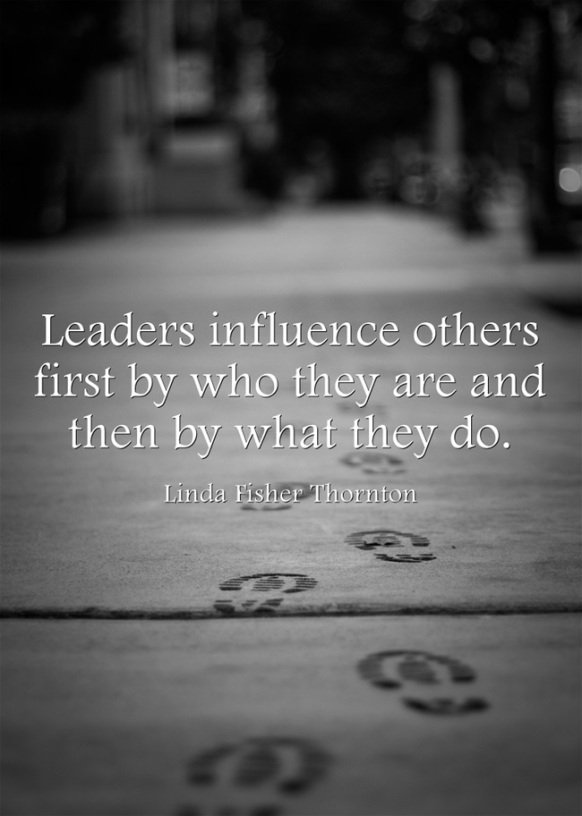
Leaders-influence-others (1)

In the New Year, we will deal with leadership challenges we cannot predict now. To be ready, we need to set our leadership and learning on the path to success.

This series includes 20 quotes (linked to posts with leadership guidance) that will help you leverage your leadership planning. Here are the first 10:

Ethical Leadership is a “Fear-Free” Zone

Ethical Leadership is a “Fear-Free” Zone

Fear is insidious. It changes how we see the world and how we treat others. Here are 5 important reasons why fear has no place in our workplaces, our families or our communities:

5 Reasons Fear Has No Place in Leadership

  1. Fear creates a dampening field that blocks positive interpersonal behavior including respect and care
  2. Fear-inducing relationships are damaging to human health
  3. When they are fearful, people spend time trying to protect themselves rather than reaching for their potential, and that reduces job satisfaction and productivity
  4. The damaged job satisfaction and productivity that are common in fear-based relationships translate into damaged organizational results
  5. Fear leads to unethical choices about people who are not like us

When You Feel Pressured to Do the Wrong Thing at Work

https://hbr.org/2016/11/when-you-feel-pressured-to-do-the-wrong-thing-at-work?utm_source=feedburner&utm_medium=feed&utm_campaign=Feed%3A+harvardbusiness+%28HBR.org%29

nov16-02-50405307

By now you’ve probably heard the story of the fraudulent business practices at Wells Fargo – the bank that pressured employees to create false credit card and deposit accounts. Have you asked yourself what you would do if you were an employee facing that kind of pressure? In other words, how do you handle a situation in which the incentives seem to be telling you to do something you believe is bad for your customers and clients, or maybe even illegal? And what if it’s clear your boss wants you to get with the program – and your bonus, a promotion, or even your job are on the line?

It’s easy to think that these situations are black and white. Either you go along or suffer the consequences. But sometimes these situations are gray, which I write about in Managing in the Gray. My central guidance is this: When you face a really tough problem, work through it as a manager and resolve it as a human being. This approach can help you avoid stark choices between getting ahead and doing something you believe is wrong.

Here’s how that advice applies to dealing with a situation where you think you are potentially being incentivized to do the wrong thing: