


Cartoon – Heads or Tails
https://www.axios.com/the-collapse-of-community-health-systems-2471839258.html
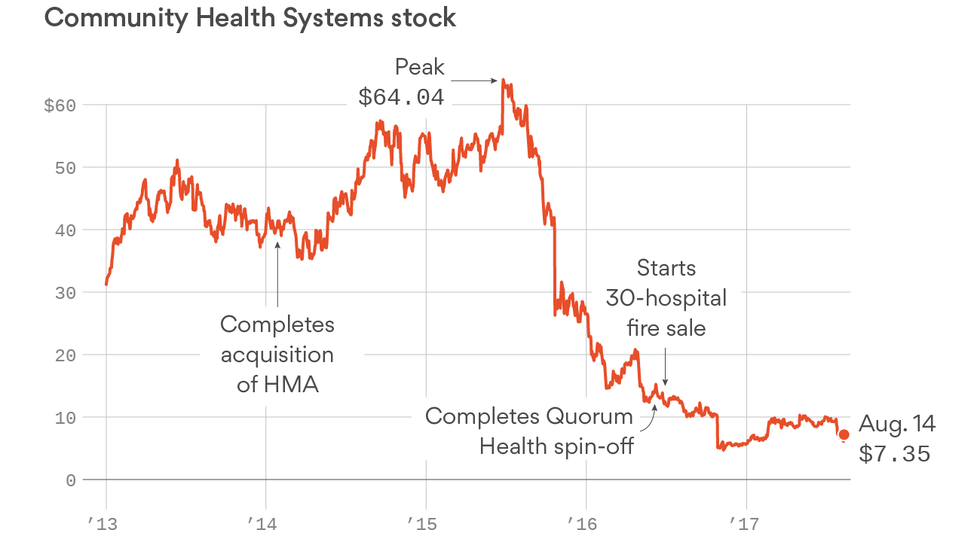
Just three years ago, Community Health Systems was the largest for-profit operator of hospitals with more than 200 facilities scattered in rural and suburban areas with growing populations. Now, the company is hemorrhaging money, sitting atop a mountain of debt and teetering on the edge of bankruptcy — all major reasons why CHS has lost almost 90% of its market value.
“I think the company has a nontrivial chance of defaulting,” said one CHS investor who asked to be unnamed because of the sensitivity of the issue. Tomi Galin, a CHS spokeswoman, did not make any company officials available for an interview, but said the company is confident it will have “a stronger core group of hospitals that are better positioned for long-term growth.”
Why it matters: CHS sits in a massive hole after a string of missteps, according to industry insiders. And it’s not likely to get better for CHS, or the local communities that rely on a CHS facility, as more people get treated in lower-cost outpatient centers instead of the hospital.
The collapse: It began in 2013 and continued into January 2014. That’s when CHS completed its acquisition of Health Management Associates, a for-profit hospital chain that had a slew of financial and legal problems. The deal was worth $7.6 billion, including debt, and made CHS the largest for-profit hospital company by number of facilities.
“That was the death knell,” a health care investment banker said. “HMA was a troubled company, and (CHS) thought bigger would be better.”
Here’s what has happened at CHS since then:
Looking ahead: CHS plans on divesting even more hospitals, executives said during their latest earnings call. They likely will be profitable hospitals, as buyers won’t touch money-losing inpatient facilities with dwindling admissions.
But large debt payments are due in 2019 through 2022. Short-term cash from transactions appears to be a bandage, and a subsequently smaller profit base won’t solve the big debt picture, making bankruptcy a real possibility, an investor said.
Galin, the CHS spokeswoman, said the money from the hospital sales “are being used to reduce our debt” and that “cash flow generation remains strong.”
Leadership questions: Many CHS executives have retired or left in the past two years, including longtime CFO Larry Cash. Wayne Smith, the CEO of the hospital chain since 1997, remains in his position. Smith is one of the highest earners among hospital executives and reaped more than $1 million in bonuses alone the past two years even though CHS’ stock price tanked.
Numerous sources would not go on the record to talk about CHS. One hospital industry analyst said this when asked how Smith still had his job despite the company’s problems: “Your question is very valid.”
 Per
Per
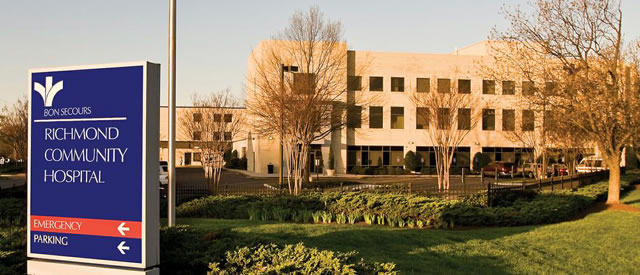
Bon Secours Richmond (Va.) Health System CEO Toni Ardabell, BSN, issued an order July 19 mandating select salaried workers at the health system take five paid days off to reduce the health system’s expenses by the end of its fiscal year Aug. 31, according to the Richmond Times-Dispatch.
A health system spokesperson said in a written statement to the Times-Dispatch Aug. 10 the order applies only to salaried management and professional personnel who accrued a large number of paid vacation days but had not used them during the first 10 and a half months of the fiscal year. The rule does not apply to employees who “have little or no accrued PTO … [or] those who have just returned from a leave of absence or those who may be getting ready to take one,” the spokesperson said.
Ms. Ardabell’s memorandum, obtained by the Times-Dispatch, called for “full compliance with these instructions,” provided the stipulation does not affect patient care or reduce patient volume. She also wrote management should not attempt to replace employees on leave with “other workers in a way that adds incremental expense.”
“Replacing a salaried employee with an hourly employee you have to pay doesn’t help,” Ms. Ardabell wrote. “However, if another salaried employee who is being paid anyway simply stretches to cover the work of two people for a few days, then we realize the savings.”
The spokesperson said the order does not reflect any financial distress at the health system. Bon Secours is “a financially strong and fiscally sound organization with consistently high bond ratings and financial performance,” she told the Times-Dispatch.

 HENRY KOTULA