Atrium, UNC Health put merger plan on ice

https://www.healthcaredive.com/news/atrium-unc-health-put-merger-plan-on-ice/518311/

Dive Brief:

  • Atrium Health, formerly known as Carolinas HealthCare System, announced Friday that its planned merger with UNC Health has been suspended because of disagreements between the two systems on which would control the combined company, The Charlotte Observer first reported. The now-stalled deal would have created a system with more than 50 hospitals and 100,000 employees.
  • The lapse in negotiations comes less than a month after Atrium signed a letter of intent to partner with Navicent Health.
  • Although consolidation among hospital systems has ramped up over the past year, the failure of the two groups to come to terms shows it’s not always a smooth path.

Dive Insight:

The merger plan was announced in September, but the deal now appears to be going nowhere.

“In our letter sent to UNC Health Care today, we informed them that while we have not been able to reach an agreement, our respect for UNC Health Care, its team and UNC Health Care’s accomplishments has grown through this process,” said an Atrium Health statement also obtained by Healthcare Dive.

Merger mania is still clearly evident in the industry, however.

Advocate Health Care and Aurora Health Care recently moved closer to merging to form the 10th largest nonprofit healthcare system in the U.S. after receiving regulatory approval from both the Federal Trade Commission and Illinois.

Meanwhile, Ascension and Presence Health recently signed a definitive agreement to combine, and Ascension is reportedly in talks to also buy Providence St. Joseph Health. Catholic Health Initiatives and Dignity Health are also working to merge into a new health system, which would have 139 hospitals operating in 28 states.

The mergers are evidence that health systems continue to search for ways to capture economies of scale and cut costs as hospitals face lower reimbursements and patient volumes. But despite the trend, combining massive health systems can be difficult with regulatory and other challenges.


UNC Health Care, Atrium execs reportedly frustrated by issue of control over merged entity

https://www.beckershospitalreview.com/hospital-transactions-and-valuation/unc-health-care-atrium-execs-reportedly-frustrated-by-issue-of-control-over-merged-entity.html

Image result for who's driving the bus


Executives at Chapel Hill, N.C.-based UNC Health Care and Charlotte, N.C.-based Atrium Health have reportedly addressed a number of shared concerns regarding their proposed merger. However, the issue of control over the merged organization has yet to be decided — a decision that will have ramifications for both institutions, according to The News & Observer.

William L. Roper, MD, CEO of UNC Health Care and dean of the UNC School of Medicine, provided an update about the organizations’ negotiations Feb. 20 following a closed-door session with a special committee of the UNC System’s board of directors earlier that same day.

“I had a lengthy conversation with our Charlotte friends this morning, and I think we are making some progress in narrowing the differences but we have not yet reached agreement,” Dr. Roper told The News & Observer. “Both sides are interested in the key questions of who’s in charge, how are decisions going to be made, how can we balance the interests so that both sides feel fairly represented in the decision-making process. Those are the big questions and we’re still working on them.”

The decision of who maintains control over the merged entity, which would comprise 60 hospitals and at least 90,000 employees, would have significant effects on UNC’s medical research and the UNC School of Medicine, a state-owned entity belonging to the UNC System.

The organizations entered into negotiations regarding a potential merger last August. At that time, officials selected Atrium Health CEO Gene Woods to serve as CEO and Dr. Roper as chair of the combined system’s board of directors. Dr. Roper said Feb. 20 that following the completion of his term as chairman, Atrium Health’s board chairman would assume the role. After that, UNC Health Care and Atrium Health would alternate appointing leaders to the role.

Dr. Roper’s update comes after multiple organizations, including the state’s largest insurer, Blue Cross Blue Shield of North Carolina, said they could not support the proposed merger. North Carolina Attorney General Josh Stein wrote a letter Feb. 15 to the chief executives of both health systems demanding additional information regarding the proposed deal, stating the systems had not provided enough information about how the transaction would affect healthcare costs for consumers.

Dr. Roper’s announcement Tuesday also reportedly did not satisfy concerns voiced by North Carolina Treasurer Dale Folwell, who last week called on UNC Health Care to issue a $1 billion performance bond to guarantee cost savings from the proposed deal.

Mr. Folwell said Tuesday Dr. Roper’s update did not provide assurance healthcare costs would decrease and that the update underscores the huge stakes involved in the negotiations, according to the report.

Baylor Hires COO, Splits President and CEO Roles

http://www.healthleadersmedia.com/leadership/baylor-hires-coo-splits-president-and-ceo-roles?spMailingID=11450593&spUserID=MTY3ODg4NTg1MzQ4S0&spJobID=1200956765&spReportId=MTIwMDk1Njc2NQS2#

Related image

Northwestern EVP and COO Peter McCanna will take over Baylor Scott & White’s president role and some responsibilities from CEO James Hinton.

Baylor Scott & White Health says it will split the office of President and CEO, a little more than six months into President and CEO Jim Hinton’s tenure at the Dallas- and Temple, Texas-based organization. Hinton had been serving in both roles since he took over the nonprofit health system in January, as had his predecessor Joel Allison, who retired.

Pete McCanna, who is currently executive vice president and chief operating officer at Chicago-based Northwestern Memorial Healthcare, will assume the new president role in September, and will take over a number of Hinton’s current duties, according to a press release.

While his expected duties as president were not immediately apparent, McCanna has ties to Hinton, having served as chief financial officer at Presbyterian early in Hinton’s 20-year career at that organization, where Hinton served as president and CEO before coming to Baylor Scott & White. Hinton said the new office of the president will expand the capabilities of the health system’s “already talented leadership team, helping us more rapidly evolve.”

Presumably that rapid evolution involves Hinton focusing more intently on integrating the Scott & White Health Plan into the entire organization.

In fact, one reason for Hinton’s appointment in the wake of Allison’s retirement was his extensive experience running an integrated delivery system at Presbyterian, where the provision of healthcare services is combined with a proprietary health plan, allowing for smoother integration of population health principles and tactics. Baylor Health Care System’s 2013 merger with Scott & White Healthcare created the blueprint for such an integrated system, which includes 48 hospitals, 44,000 employees, and the Scott & White Health Plan.

“We are committed to extending Baylor Scott & White’s long history of success by transforming into a nationally recognized, high-value integrated delivery network; and to transform, we must drive costs down, while making the right investments in key areas,” said Hinton, in the release.

McCanna should be instrumental in helping Baylor Scott & White achieve financial and strategic growth targets. In his 15 years at Northwestern, operating revenue grew from $700 million to more than $5 billion, while patient experience, employee engagement and quality goals exceeded targets.

He also gets credit for helping integrate the faculty physician practice plan at Northwestern University Feinberg School of Medicine with Northwestern Memorial Hospital.

“Pete is a highly respected senior executive with a track record of helping to grow organizations, create and implement successful, long-range strategic plans and lead financial turnarounds,” said Hinton. “He is one of the best and brightest in healthcare.”


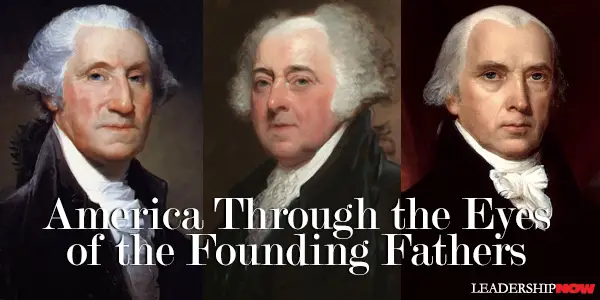
America Through the Eyes of the Founding Fathers

https://www.leadershipnow.com/leadingblog/2017/07/america_through_the_eyes_of_th.html?utm_source=feedburner&utm_medium=email&utm_campaign=Feed%3A+LeadingBlog+%28Leading+Blog%29

America Through the Eyes of the Founding Fathers

IN A LETTER from the second president of the United States, John Adams, to the Officers of the first Brigade of the third Division of the Militia of Massachusetts dated October 11, 1798, Adams cautioned the country against hypocrisy—saying one thing and doing another.

But laws he believed, could not prevent this hypocrisy. No law, no constitution could save an immoral people. While the Founding Fathers believed in the necessary separation of Church and State, they believed no discussion of morals was possible without an agreed upon philosophy – a philosophy that superseded the logic of men. So Adams concluded that “Our Constitution was made only for a moral and religious people.”

George Washington also said as much halfway through his Farewell Address of 1796. He stated: “Of all the dispositions and habits which lead to political prosperity, Religion and morality are indispensable supports.” He added, “And let us with caution indulge the supposition that morality can be maintained without religion. Whatever may be conceded to the influence of refined education on minds of peculiar structure, reason and experience both forbid us to expect that National morality can prevail in exclusion of religious principle.”

Both Adams and Washington are appealing to a morality that was eternal—beyond the customs of man. A morality that didn’t shift on convention.

John Adams wrote to the Massachusetts Militia:

While our country remains untainted with the principles and manners which are now producing desolation in so many parts of the world; while she continues sincere, and incapable of insidious and impious policy, we shall have the strongest reason to rejoice in the local destination assigned us by Providence.

But should the people of America once become capable of that deep simulation towards one another, and towards foreign nations, which assumes the language of justice and moderation, while it is practising iniquity and extravagance, and displays in the most captivating manner the charming pictures of candour, frankness, and sincerity, while it is rioting in rapine and insolence, this country will be the most miserable habitation in the world.

Because we have no government, armed with power, capable of contending with human passions, unbridled by morality and religion. Avarice, ambition, revenge and licentiousness would break the strongest cords of our Constitution, as a whale goes through a net. Our Constitution was made only for a moral and religious people. It is wholly inadequate to the government of any other. Oaths in this country are as yet universally considered as sacred obligations. That which you have taken, and so solemnly repeated on that venerable ground, is an ample pledge of your sincerity and devotion to your country and its government.

James Madison, the fourth President of the United States, believed that the governed were obliged to control itself. Furthermore, it was the responsibility of a virtuous people to select leaders that would reflect that ideal. Leaders that would be capable by virtue of their own character, adapt these eternal morals that Adams often spoke of, to particular circumstances. Madison wrote:

But I go on this great republican principle, that the people will have virtue and intelligence to select men of virtue and wisdom. Is there no virtue among us? If there be not, we are in a wretched situation. No theoretical checks–no form of government can render us secure. To suppose that any form of government will secure liberty or happiness without any virtue in the people, is a chimerical idea. If there be sufficient virtue and intelligence in the community, it will be exercised in the selection of these men. So that we do not depend on their virtue, or put confidence in our rulers, but in the people who are to choose them.