The different ways your health care costs are going up

https://www.axios.com/the-different-ways-your-health-care-costs-are-going-up-2471186113.html

Image result for The different ways your health care costs are going up


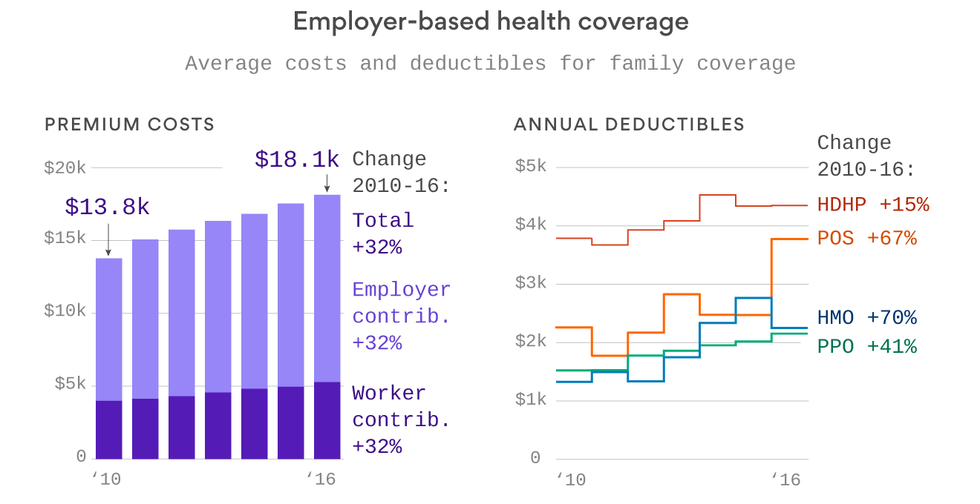
We’ve spent so much time talking about Affordable Care Act costs this year that it’s easy to forget what most people are actually paying for health care — the 156 million Americans who get their health coverage through the workplace. Turns out, most of us aren’t seeing sky-high premium increases. But it’s also worth remembering that deductibles matter too — because that’s what we pay out of pocket before insurance kicks in.

Take a look at these two graphics from Axios datavisuals genius Chris Canipe. The premium increases between 2010 and 2016 weren’t that bad — they’re single digits each year, and just add up over time. But you can see some big increases in deductibles, especially in point-of-service plans and HMOs.

Why it matters: That’s a big reason why people feel their health care costs going up, because it means they’re paying more out of pocket. And when prescription drug prices rise, they’re more likely to feel it directly.

Healthcare Triage News: The Advantages of Medicare Advantage

Healthcare Triage News: The Advantages of Medicare Advantage

Image result for Healthcare Triage News: The Advantages of Medicare Advantage

Many studies have demonstrated what economics theory tells us must be true: When consumers have to pay more for their prescriptions, they take fewer drugs. That can be a big problem. This is Healthcare Triage News.


The Wrong Way to Lower Health-Insurance Premiums

https://www.bloomberg.com/view/articles/2017-03-17/the-wrong-way-to-lower-health-insurance-premiums

Image result for high deductible health plan

For proponents of the American Health Care Act, perhaps the most encouraging nugget in the Congressional Budget Office’s otherwise critical analysis is that insurance premiums could fall by 10 percent on average by 2026. Even this prediction is more mirage than reality, however, in part because of an obscure concept known as “actuarial value.”

As many opponents of the Republicans’ Obamacare replacement legislation have already noted, for many people, the decline in premiums would be smaller than the cutback in their subsidies, so they would still end up paying more. And in any case, the predicted fall in premiums partly reflects a troubling rise in the share of older Americans without insurance, a change that would shift the enrollment pool to younger, less expensive beneficiaries.

Another factor, however, has received less attention, though it is hidden in plain sight in the CBO analysis: The premium reduction would occur in no small part because the insurance products wouldn’t be as good. In other words, their actuarial value would fall.

An insurance policy’s actuarial value is the share of total health-care costs paid by the plan rather than the policy holder, through deductibles and copayments. A plan with an actuarial value of 80 percent will pick up, on average, 80 percent of the cost of care. Plans with higher actuarial values have higher premiums, not surprisingly, because they provide deeper insurance. And if a plan’s actuarial value is very low, it may not really qualify as insurance at all.

The Affordable Care Act sets minimum actuarial values for each of the four tiers of plans that can be sold on the exchanges; the lowest, for bronze plans, is about 60 percent. The new legislation would repeal these minimums.

 In its analysis of the Republican proposal, the CBO found that insurers would offer lower-value policies “because they could offer a plan priced closer to the amount of the premium tax credit so that a younger person would have low out-of-pocket costs for premiums and would be more likely to enroll.” Similarly, insurers would hesitate “to offer plans with high actuarial values out of a fear of attracting a greater proportion of less healthy enrollees to those plans.” Since plans would still be required to cover 10 categories of essential health benefits, and since out-of-pocket limits would remain in place, plans would not dip too far below 60 percent, in the CBO’s estimation. But more plans would drop toward that level.

To see how big a deal this is, it is instructive to study the table toward the end of the CBO’s analysis, which calculates premiums under current law and under the AHCA. A 40-year-old single person could see his or her premium fall 7 percent — to $6,050, from $6,500. That’s only slightly less than the average 10 percent premium decline. Yet the actuarial value of the person’s plan would decline to 65 percent, from 70 percent or 87 percent, depending on his or her income.

To get some sense of what these lower actuarial values mean in terms of higher deductibles, we can look to the most recent Centers for Medicare and Medicaid Services calculator. It suggests that a plan with a $1,500 deductible, an 80 percent coinsurance rate (the plan pays 80 percent of costs above the deductible and below the maximum out-of-pocket threshold), and a $7,200 maximum out-of-pocket limit would have an actuarial value of 73 percent. The same plan with a $5,000 deductible would have an actuarial value of 61 percent. In other words, a decline in actuarial value of about 12 percentage points (not far from the average decline in the CBO examples) would raise the policy’s deductible by $3,500.

It’s no wonder that the premium for such a plan would be lower — in the same way that it’s no wonder a 12-ounce can of soda costs less than a 35-ounce bottle. It’s no great accomplishment to lower premiums by increasing other consumer costs.

As the CBO concluded, under the Republicans’ system, “individuals’ cost-sharing payments, including deductibles, in the nongroup market would tend to be higher than those anticipated under current law.” Indeed, according to an analysis from the Center for American Progress, average total costs to consumers would be significantly higher.

If you think that competition can fix this, note another problem that the CBO points out: Under Obamacare, the actuarial value requirements allow for easy comparison shopping; plan A can be directly compared with plan B. Under the Republican system, it would be harder to shop for a policy based on price.

Health-care reform is indeed complicated. Esoteric concepts like actuarial value have big effects on every family’s bottom line.


Payments for cost sharing increasing rapidly over time

http://www.healthsystemtracker.org/insight/payments-for-cost-sharing-increasing-rapidly-over-time/

Money Roll

Rising cost-sharing for people with health insurance has drawn a good deal of public attention in recent years.  For example, the average deductible for people with employer-provided health coverage rose from $303 to $1,077 between 2006 and 2015.

While we can get a sense of employees’ potential exposure to out-of-pocket costs by looking at trends in deductibles, many employees will never reach their deductibles and other employees may have costs that far exceed their deductibles.  In addition to deductible payments, some employees also have copayments (set dollar amounts for a given service) or coinsurance payments (a percentage of the allowed amount for the service).  To look at what workers and their families actually spend out-of-pocket for services covered by their employer-sponsored plan, we analyzed a sample of health benefit claims from the Truven MarketScan Commercial Claims and Encounters Database to calculate the average amounts paid toward deductibles, copayments and coinsurance.

We find that, between 2004 and 2014, average payments for deductibles and coinsurance rose considerably faster than the overall cost for covered benefits, while the average payments for copayments fell.

The Next Big Debate in Health Care

http://blogs.wsj.com/washwire/2016/06/30/the-next-big-debate-in-health-care/?utm_campaign=KFF-2016-Drew-WSJ-June-30-adequacy-coverage&utm_medium=email&_hsenc=p2ANqtz–xQ5m7mTzVOQDJ-gEuLbZl7pkPEfb_Iw0ezewQc1ln7AN8seXIMO73B28qbm9dojkj8aBYyKmMoIvL46iTkyv7FWksVw&_hsmi=31195410&utm_content=31195410&utm_source=hs_email&hsCtaTracking=ed044791-0cff-437c-b853-bcb03570f762%7C6f34b697-a7d1-4d2a-b580-e9d37afa69ac

Source: Kaiser Family Foundation analysis of Truven Health Analytics MarketScanCommercial Claims and Encounters Database, 2004-2014; Bureau of Labor Statistics, Seasonally Adjusted Data from the Current Employment Statistics Survey, 2004-2014 (April to April).

With 91% of the population now covered by some form of health insurance, and the coverage rate higher in some states, the next big debate in health policy could be about the adequacy of coverage. That particularly means rising payments for deductibles and their impact on family budgets and access to care. This is about not just Obamacare but also the many more people who get insurance through an employer.

It’s not clear whether deductibles will continue to rise as they have over the past decade. Rising cost-sharing is not employers’ preferred strategy  for containing health costs, but it’s the one they resort to when they need to quickly reduce their annual premium increase. If the economy weakens again employers will feel greater pressure to reduce their health-benefits costs, and the trend toward higher deductibles will be more likely to continue. The question of how much cost-sharing is too much, and what to do about it, could be the next big debate in health care–once the political world moves on from its focus on the ACA.

Filling A Prescription? You Might Be Better Off Paying Cash

http://khn.org/news/filling-a-prescription-you-might-be-better-off-paying-cash/?utm_campaign=KHN%3A+First+Edition&utm_source=hs_email&utm_medium=email&utm_content=30971433&_hsenc=p2ANqtz–rAQj-sGWH-JKBDVyBtJzuODQFe-bAF_J8z_ZoKZ4dV_VPRMdYkly_MVrJhTdTD6w_9hQLCFr7zZ59qZbt0C5LRhBjsw&_hsmi=30971433

Pharmacist scanning product

Some consumers who use health insurance copays to buy prescription drugs are paying far more than they should be and would be better off paying with cash, especially for generics. The added cost runs as high as $30 or more per prescription, say pharmacists, and the money is largely being pocketed by middlemen who collect the added profit from local pharmacies.

Cash prices started to dip below copays a decade ago when several big box stores started offering dozens of generics for as little as $4 per prescription. But as copays have risen and high-deductible insurance plans become more common, more consumers are now affected.

The phenomenon illustrates the complexity of how drugs are priced in the U.S. and has led to finger-pointing about who is benefitting or who’s to blame.