State officials plead for bipartisan ObamaCare fix

State officials plead for bipartisan ObamaCare fix

State officials plead for bipartisan ObamaCare fix

State insurance officials pleaded with senators on Wednesday to quickly act to stabilize the ObamaCare marketscalling for a multiyear extension of key payments to help fund premiums for low-income customers.

Congress must pass a fix by the end of September to shore up the wobbly individual markets, several officials said, in particular funding for key ObamaCare insurer payments known as cost-sharing reductions (CSR).

“The CSR funding issue is the single most critical issue that you can address to help stabilize insurance markets for 2018 and potentially bring down costs,” Tennessee’s insurance commissioner Julie Mix McPeak told the Senate Health Committee.

The panel kicked off a series of hearings Wednesday on stabilizing the markets. If Congress can pass a bill, it would represent the biggest bipartisan update since President Obama signed the law in 2010.

Health committee Chairman Lamar Alexander (R-Tenn.) wants to find consensus by the end of next week. To sell the fix, he and ranking member Patty Murray (D-Wash.) held a private meeting with senators not on the committee and the witnesses who testified as Wednesday’s hearing.

“If we can do two things, that would be two more things that we have agreed on in a bipartisan way in the last seven years in health insurance,” Alexander told reporters.

“And then let the leaders see if we can pass it, and hope the House does and that the president signs it.”

Despite some pushback that could still come from conservatives calling the payments an “insurer bailout,” Alexander and Murray hope to cobble together a bipartisan group that agree some continuation of the payments is necessary.

The cost sharing subsidies, which reimburse insurers for giving discounted deductibles and co-pays to low-income customers, have been made by the Trump administration on a month-to-month basis.

Republicans had sued the Obama administration over the payments, calling them unconstitutional, but many have since acknowledged they need to continue at least in the near term to prevent steep premium hikes.

Insurers have asked for long-term certainty on the payments, threatening to hike premiums and leave the ObamaCare markets altogether if they don’t get it.

Democrats, and some Republicans like Alexander, agree Congress should fund the payments, but there’s disagreement on the time frame.

Alexander wants to fund the payments through 2018 while Murray has pushed for multiple years.

“It is critical that we work toward a multiyear solution in order to provide the kind of certainty that will have the most impact on families’ premiums and choices in the marketplaces,” Murray said.

America’s Health Insurance Plans, the nation’s largest insurer trade association, and other stakeholder groups urged Congress to fund the payments through at least 2019.

“Without two years of CSR funding, uncertainty will persist and the Congress will need to address these same issues early next year,” the groups wrote in a letter to the committee Tuesday.

Meanwhile, Republicans say a bipartisan health bill must include changes to ObamaCare’s state waivers so states have more control over what their insurance plans look like.

Alexander said ObamaCare’s waivers should be amended so “states can have more flexibility to devise ways to provide more coverage with more choices and lower costs.”

“It just hasn’t been very appealing to states because it is a difficult tool to use,” he said.

This point was echoed by Pennsylvania’s insurance commissioner Theresa Miller, who called the process to get approved cumbersome.

“Baseline coverage requirements should be kept intact as much as possible … but make it easier for states to respond to market issues,” she said.

For example, it takes at least six months to get a waiver approved with the federal government, which the commissioners said made it difficult to quickly respond to market issues.

But Democrats have been wary of anything they say could result in coverage losses and the availability of less comprehensive insurance plans.

The Senate GOP’s ObamaCare repeal plan, which failed in a dramatic vote with Sen. John McCain (R-Ariz.) joining two other Republicans in opposition, contained language intended to make it easier for states to approve less comprehensive plans.

However, Democrats say that is going in the wrong direction.

We should be “moving forward not backward on affordability, coverage and quality of care,” Murray said.

“We’re all well aware threading this needle won’t be easy,” she said, “but I do believe an agreement that protects patients and families from higher costs and uncertainty, and maintains the guardrails in our current health care system, is possible.”

Several commissioners also recommended setting up a temporary reinsurance program to help insurers with high cost patients with the intent of lowering premiums for healthier ones.

“Congress should enact a federal reinsurance program with a minimum duration of three years,” said Washington state insurance commissioner Mike Kreidler, adding that it would “significantly help stabilize the individual health insurance market.”

But Alexander indicated it’s unlikely for the bill to include reinsurance funding, noting that the U.S. is already trillions in debt.

“If a reinsurance program is such a good idea … why don’t states do it?” he asked, suggesting states impose small fees on every insurance plan sold to help fund it.

Democrats are also pushing for a bill to restore ObamaCare outreach funding after the Trump administration announced drastic cuts to the program.

Alaska’s insurance director Lori Wing-Heier said the cuts concern her because “these programs reduce the number of uninsured citizens and maximize public participation.”

Insurance official to Congress: ObamaCare not collapsing

Insurance official to Congress: ObamaCare not collapsing

Insurance official to Congress: ObamaCare not collapsing

A Pennsylvania insurance official told Congress Wednesday that ObamaCare is not collapsing, as some Republicans have argued.

Speaking at a Senate Health Committee hearing on efforts to stabilize Affordable Care Act (ACA) markets, Teresa Miller, Pennsylvania’s acting Human Services secretary and former insurance commissioner, said that the notion is “just false.”

“I’m not going to sit here this morning and tell you that the ACA is perfect,” she said. “I think we all know that it’s not, but the narrative that the ACA is failing and imploding is just false.”

Miller, who works in the administration of Democratic Gov. Tom Wolf, noted that insurers in the state filed average premium increases of just 8.8 percent for next year, and that most enrollees receive government subsidies to help them afford premium costs.

While there have been “difficulties” in the market, she said, “our individual market is not collapsing.”

Other states have encountered more problems with their markets, but every state is on track to have at least one insurer offering ObamaCare coverage in every county next year, after some worries that there would be empty counties.

The insurance commissioners testifying largely called for efforts to further stabilize ObamaCare markets, for example by funding key payments known as cost-sharing reductions, which President Trump has threatened to cancel.

Multiple commissioners also called for a program called reinsurance that provides government funding to bring down premiums by paying for part of especially sick enrollees’ claims.

The Senate Health Committee is trying to reach a deal on a bipartisan stabilization bill by the end of next week, a tough task on such a polarizing issue.

A Glimmer of Bipartisanship on the ACA

http://www.commonwealthfund.org/publications/blog/2017/sep/bipartisanship-on-the-aca?omnicid=EALERT1267321&mid=henrykotula@yahoo.com

Image result for bipartisanship


With the eclipse of Republican efforts to repeal and replace the Affordable Care Act (ACA), bipartisan approaches to improving the law are having a moment in the sun. This week, Senators Lamar Alexander (R-Tenn.) and Patti Murray (D-Wash.) are cosponsoring hearings before the Senate Health, Education, Labor and Pensions (HELP) committee on bipartisan solutions to stabilizing private health insurance markets. The Problem-Solvers — a new caucus of House Democrats and Republicans — are similarly at work on a cross-party package of reforms. Eight governors have released a bipartisan plan, as has a group of health policy experts with mixed party affiliations.

The value of bipartisanship is indisputable. The alternative — on excruciating display over the last seven months — is ongoing partisan warfare that destabilizes our health care system. Health care providers and insurers cannot function effectively when changes in party control at the federal level threaten to upend the health care system every two to four years. And the fear of health coverage loss is unquestionably stressful for the millions of Americans who depend upon the ACA.

But the growing apparent consensus on key elements for a short-term, cross-party package is encouraging. These proposals focus on strengthening individual insurance marketplaces by legislating cost-sharing reduction payments; helping private insurers manage the risk of very high-cost patients using reinsurance and other means; creating a source of backup coverage for “bare markets” that lack private insurers; and offering states greater flexibility in implementing federal regulations governing private insurance markets.

Different groups propose additional bells and whistles, and there is much room for disagreement on how to design and implement specific provisions. But at least both parties are at the table. Where there’s a will, there may be a way.

Still, important practical questions remain. One is whether the will really exists. Republican supporters of repeal and replace continue to divide the Senate Republican caucus. Conservatives in the House — including the Freedom Caucus — will likely oppose anything that threatens their hope that the ACA will collapse of its own weight. And it is possible that President Trump, still grumbling about the failure of repeal and replace, will veto any narrow package that he believes pours salt in his health care wound.

Ironically, the failure of ACA markets to self-destruct may also sap the will for bipartisan reforms. Deadlines and crisis drive congressional action and, until recently, the threat that some individual markets — admittedly, small in number and population — would lack any insurer was an important spur for Congress to act. Now, that threat has receded as the last of the bare markets has found a carrier.  Bipartisanship is the legislative equivalent of nuclear fusion; it needs major external pressure to push those mutually repelling atoms together.

Even if there were a will, there might not be a way to get an ACA package into the queue. The fall congressional calendar is packed with other high-profile, high-stakes, deadline- and crisis- driven legislation. By September 30, Congress must reauthorize the Children’s Health Insurance Program (CHIP), which has traditionally enjoyed bipartisan support and is vital to the health care of more than 9 million American children. To respond to Hurricane Harvey, Congress also needs to rapidly enact emergency aid for Texas and Louisiana, which will require the extension of previously controversial flood relief legislation.

And these measures are just the beginning. Congress has to fund the federal government by September 30 — with or without support for the border wall — or face a government shutdown. There is the need to pass a controversial increase in the federal debt ceiling by the same date. And to have any hope of enacting major tax reform before the 2018 election, work must accelerate right after Labor Day. Putting the tax project off until after January is dangerous for proponents, because passing controversial tax legislation is infinitely more difficult in an election year.

Bipartisanship on health care action could lay vital groundwork in the short term for bolstering the individual health insurance market. Longer term, bipartisanship is essential for the kind of fundamental change that is necessary to increase coverage and contain costs in our health care system. We should not, however, underestimate the huge political and procedural obstacles that lie in the way of current admirable efforts to bring the two parties together on health care. It will take all the skill of committed Senate and House leaders from both parties to make progress on health care this year — or thereafter.

Bipartisan group of governors calls on Congress to shore up elements of Affordable Care Act

https://www.washingtonpost.com/national/health-science/bipartisan-group-of-governors-calls-on-congress-to-shore-up-elements-of-affordable-care-act/2017/08/31/7853b978-8e71-11e7-84c0-02cc069f2c37_story.html?utm_term=.3975c59ec12b

Image result for bipartisanship

A bipartisan group of governors is trying to jump-start efforts to strengthen private insurance under the Affordable Care Act, urging Congress to take prompt steps to stabilize marketplaces created by law while giving states more freedom from its rules.

In a blueprint issued Thursday, the eight governors ask House and Senate leaders of both parties to take several steps to reverse the rising rates and dwindling choices facing many of the 10 million Americans who buy health plans on their own through ACA marketplaces.

Specifically, the state leaders say Congress should devote money for at least two years toward “cost-sharing subsidies” that the 2010 health-care law promises to pay ACA insurers to offset deductibles and other out-of-pocket expenses for lower-income customers. The House sued the Obama administration over the subsidies’ legality, and President Trump has repeatedly suggested that he might halt the payments — sending tremors through insurance companies in the marketplaces.

Five days before the House and Senate return to Washington, the governors also recommend preserving “for now” the ACA’s requirement that most Americans carry health insurance. Though this rule is unpopular, they concluded that it is “for the time being … perhaps the most important incentive for healthy people to enroll in coverage.”

The proposal also calls for a federal fund, to be available for two years, to buffer insurers from high-cost customers, and for the government to foster competition in ACA marketplaces by encouraging insurers to move into counties with only one company. Those that do would have the law’s insurer taxes waived on health plans sold in those locations.

Led by Ohio Gov. John Kasich (R) and Colorado Gov. John Hickenlooper (D), the blueprint essentially fleshes out the contours of four principals that many of the same governors recommended to Senate leaders in June. It focuses on the insurance market for individuals and families that buy coverage on their own — a fraction of the country’s consumers with private insurance but a perennially shaky part of the industry that the ACA was designed to strengthen.

Greg Moody, a longtime health-care aide to Kasich, said the blueprint is also an acknowledgment of the failure this year of Republicans who control Congress to deliver on their years-long goal of replacing the ACA. “We’ve recently seen how difficult that is,” Moody said.

The blueprint envisions a quick federal boost to shore up the marketplace for the coming year, while deferring to states longer term to experiment with potential changes in insurance subsidies, for instance, or different forms of penalties for consumers who drop coverage.

The proposal was released Thursday so that it would attract attention before two days of hearings scheduled next week by the Senate’s health committee, which will explore bipartisan ideas for improving the law and its marketplaces.

The other governors who signed on are Brian Sandoval (R-Nev.), Tom Wolf (D-Pa.), Bill Walker (I-Alaska), Terry McAuliffe (D-Va.), John Bel Edwards (D-La.) and Steve Bullock (D-Mont.).

Despite jitters, some health insurers start to prosper

http://www.tampabay.com/news/business/1-inch-1-inch-of-body-type-1-inch-1-inch-of/2335280

Image result for health insurance company profits


It has not been a market for the faint of heart.

Supporters of the Affordable Care Act achieved a major victory this past week when, thanks to cajoling and arm-twisting by state regulators, the last “bare” county in the United States — in rural Ohio — found an insurer willing to sell health coverage through the law’s marketplace there. So despite earlier indications that insurance companies would stop offering coverage under the law in large parts of the country, insurers have now agreed to sell policies everywhere.

But a moment of truth still looms for the industry in the coming weeks under the law known as Obamacare. Companies must set their final plans and premiums by late September, even as the Trump administration continues to threaten to cut off billions of dollars in government subsidies promised by the legislation. Insurers are also awaiting Senate hearings set to start Sept. 6 for a hint of what steps, if any, lawmakers may take to stabilize the market.

With congressional Republicans’ yearslong quest to dismantle the Affordable Care Act dead for now, the fate of the landmark law depends in large part on the health of the insurance marketplaces and the ability of insurers to make a viable business out of selling coverage to individuals. When the law passed seven years ago, insurers saw a potential bonanza: tens of millions of brand-new paying customers, many backed by generous government subsidies and required by the new law to have health coverage. Now, about four years after the law’s marketplaces opened for business, most of the industry’s biggest players have pulled out.

Yet the continuing churn among insurers and the anxiety pervading the industry have obscured an encouraging fact: Many of the remaining companies have sharply narrowed their losses, analysts say, and some are even beginning to prosper.

“Outside of the noise,” the surviving companies “are seeing a path forward in this marketplace,” said Deep Banerjee, an analyst with Standard & Poor’s who has examined the financial results of more than two dozen Blue Cross insurers.

“It is still a new market,” he added, “and everyone is adjusting to it.”

The healthier business outlook has been achieved at a big cost to consumers. To stanch their losses, many companies raised their prices substantially for this year while narrowing their networks of providers to hold down costs.

In some cases, companies will seek even higher rates for 2018; the lone insurer left in Iowa is asking for a nearly 60 percent increase, on average.

Among the insurers now making money in the individual market and expanding is Centene, a for-profit company. Some of the Blue Cross insurers, including Health Care Service Corp., which operates plans in multiple states, including Texas and Illinois, and Independence Blue Cross, which has 300,000 customers in Pennsylvania and New Jersey, began to turn a profit in the market this year.

Oscar Health, a venture capital-backed insurance startup, lost roughly $200 million last year but, sensing a more promising future, plans to enter three more states and expand in California and Texas.

Centene made use of its experience, including setting up networks of hospitals and doctors that care for Medicaid patients, to sell coverage. The company now insures about 1.1 million people in the individual market.

“For 2018, we intend to grow this profitable segment of our business,” Michael Neidorff, the company’s chief executive, told investors last month.

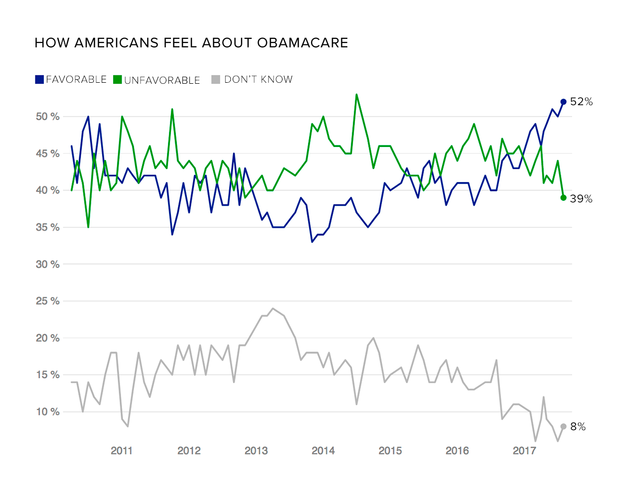
After repeal scare, Obamacare has never been more popular

https://www.cbsnews.com/news/obamacare-repeal-has-never-been-more-popular/

obamacare-sentiment.png

Underscoring the adage that you don’t know what you’ve got until it’s (almost) gone, the popularity of Obamacare is surging.

Only weeks after Republicans in Congress failed to repeal the landmark health reform law, 52 percent of respondents hold a favorable view of the Affordable Care Act (ACA), according to a recent Kaiser Family Foundation August poll. That’s up 10 percentage points since June of last year and nearly 20 points since November 2013, when public support for the ACA was at its nadir.

A July poll by CBS News after the repeal effort collapsed found that a plurality of Americans favor a bipartisan push in Congress to improve Obamacare.

The shift in sentiment coincides with other positive developments for Obamacare following its close call in Washington. With several large, and some smaller, insurers pulling out of the program over the past year or so, until recently it looked as if more than 92,000 participants spread out over 82 counties would have no insurer in their local health care exchanges, Cynthia Cox, associate director of Kaiser Family Foundation, said. But state insurance commissioners and other officials in states in jeopardy of losing Obamacare coverage have worked closely with insurers to negotiate continued coverage.

In Ohio, for instance, there were 20 counties without insurers, but officials ultimately convinced five health plans to cover all but one. Then, on August 24, the Ohio Department of Insurance announced that Paulding County, the last “bare county” in the country, would be covered by insurer CareSource.

In addition, the exchange marketplace overall has shown signs of stabilizing. After big financial losses in 2014 and 2015, individual market insurers saw improved performance in 2016, a trend that has continued this year, according to a different Kaiser Family Foundation study.

If Obamacare’s popularity is up, the program’s shortcomings remain clear. At last count, more than 2.6 million enrollees across 1,300 counties were expected to have only one insurer in their exchanges. More insurers also could pull out or move to sharply increase their premiums. The deadline for insurance companies to commit to participate in an exchange is September 27.

Until then, many insurers are watching closely to see if the Trump Administration will continue funding the federal cost-sharing subsidies that help low-income members pay for deductibles, co-pays and other out-of-pocket costs. Industry players are also waiting or Senate hearings to start after Labor Day in which which insurance commissioners, lawmakers and state governors are expected to testify about what can be done to stabilize the individual marketplace.

Meanwhile, some states are beginning to take matters into their own hands, moving to rewrite the ACA rules by applying for what’s known as a “Section 1332” waiver. Oklahoma is asking for a waiver to establish its own reinsurance program using some federal funds, which would cover the highest-cost individual marketplace cases. Alaska recently received approval for a similar reinsurance waiver. Oklahoma, however, is also looking ahead to more major structural changes that may spur debate.

Iowa, which is undergoing huge premium increases in its individual marketplace, has submitted a waiver that would overhaul the state’s insurance marketplace by redistributing federal tax credit money. The plan would create a single standard health plan and offer a flat tax credit based on age and income.

Critics argue this would increase health care costs significantly for Iowa’s low-income population, putting coverage out of reach for many. Proponents argue that increasing Iowa’s pool of healthy insured people is the best way to stabilize Iowa’s individual market and lower premiums for everyone.

How to keep ACA stabilization narrow

https://www.axios.com/aca-markets-narrow-problem-2479649219.html

When Congress returns next week, the health debate will shift from trying to pass sweeping legislation to stabilizing the non-group insurance market. This will be a different debate about a thorny but smaller problem. The weaknesses that need to be fixed are fairly specific, and they don’t affect the majority of Americans.

Data: Kaiser Family Foundation; Chart: Andrew Witherspoon / Axios

The bottom line: If Congress can keep the focus on market stabilization and doesn’t get mired in another divisive debate about health reform, and the news media can keep this relatively manageable problem in perspective for the public, there is at least a decent chance for bipartisan cooperation and a successful outcome.

The problem: Premiums in the Affordable Care Act marketplaces have been rising sharply, with the average increase for the benchmark “silver plan” up 21% this year. Proposed rates for next year will range from a 49% increase in Wilmington, Delaware to a 5% decrease in Providence, Rhode Island.

But the non-group market is actually fairly small, covering about 18 million people, with about 10 million of them in the ACA marketplaces which have received so much attention.

The perception: Kaiser Family Foundation poll this month found that when people read headlines or hear about “premiums soaring” in the ACA marketplaces, most Americans — 76% — they think they are hearing about their own premiums, even though the vast majority of Americans are not in the individual insurance market and are not affected. (A smaller but sizeable percentage believe they are affected when they hear about counties with no or limited insurance options in the ACA marketplaces.)

There are several reasons for this, and the media bears some of the responsibility. Health journalists have generally done an outstanding job covering the issue, but sloppy cable headlines, commentary from pundits, and spin from politicians have too often implied that everyone in America is affected when they are not.

For context: In fact, the rest of the health system where most Americans get their coverage looks very different from the non-group market. As the chart shows:

  • Average premiums in the employer insurance market, where 151 million Americans get their health coverage, rose by an average of just 3% last year. And we’re expecting continued moderation this year.
  • Likewise, per capita spending for Medicaid is projected to grow a modest 3% in 2017, with per capita Medicare spending growing by just 2 percent.

The back story: Insurers and regulators have been struggling with a unique set of issues in the non-group market, most especially a sicker than expected risk pool and the uncertainty surrounding Trump administration policies. The most important areas of uncertainty have been whether the administration will continue to pay out the $7 billion in cost sharing subsidies and enforce the individual mandate.

But even before the ACA, the non-group market was also the weak link of the insurance system, with sick people priced out or excluded from coverage altogether.

What to watch: Some think a deal on stabilizing the non-group market could be as narrow as an agreement to appropriate the $7 billion in federal cost sharing subsidies in exchange for greater flexibility for states under the ACA. That might not be a slam dunk if that flexibility trips over third rail issues, such as endangering coverage for people with pre-existing conditions.

But whether the formula for a bipartisan deal is that one or another one, policymakers will have a better chance of addressing the problems in the marketplaces if they forge a narrow agreement. And the debate stands a better chance of not spinning out of control if the news media works overtime to help the public understand who is affected and who is not.


Terminating Cost-Sharing Reduction Payments

http://www.healthaffairs.org/podcasts/terminating-cost-sharing-reduction-payments

Image result for the blame game

In a WTOP-FM interview, Alan Weil assesses the CBO’s report on the impact on premiums and the deficit if CSR payments were eliminated.


5 Outside-The-Box Ideas For Fixing The Individual Insurance Market

http://khn.org/news/5-outside-the-box-ideas-for-fixing-the-individual-insurance-market/?utm_campaign=KHN%3A%20First%20Edition&utm_source=hs_email&utm_medium=email&utm_content=55788948&_hsenc=p2ANqtz-8Lj78cF_NmoRuvutfOaMAjSMxSBfQwO9kWGZQ0tmdcqApzatJ32_CKq88odmT7deaTbnhlF9vd6ud7OAaZQtm97RS4AA&_hsmi=55788948


With Republican efforts to “repeal and replace” the Affordable Care Act stalled, tentative bipartisan initiatives are in the works to shore up the fragile individual insurance market that serves roughly 17 million Americans.

The Senate Health, Education, Labor and Pensions Committee launches hearings the week Congress returns in September on “stabilizing premiums in the individual insurance market” that will feature state governors and insurance commissioners. A bipartisan group in the House is also working to come up with compromise proposals.

Both before and after implementation of the federal health law, this market — serving people who don’t get coverage through work or the government — has proved problematic. Before the law, many people with preexisting health conditions could not get insurance at any price. Now, consumers in the individual market often face higher out-of-pocket costs and fewer choices of health care providers and insurers than in past years. More than 12 million people buy that insurance through the ACA’s marketplaces, while another 5 million buy it outside of the exchanges.

Policymakers generally agree on what immediate efforts to stabilize the market might include. At the top of most lists is ensuring federal payment of subsidies to insurers to pay the out-of-pocket expenses — such as deductibles and copayments — to protect customers with the lowest incomes. Insurers also want the federal government to continue enforcing the requirement that most Americans either have insurance or pay a tax penalty, and continuing efforts to get uninsured people to sign up for coverage during the upcoming open enrollment period, from Nov. 1 to Dec. 15. Those efforts are essential, insurers say, to help keep healthy customers in their risk pools to defray the costs of beneficiaries with medical needs.

But what about ideas that go beyond the oft-repeated ones? Here are five proposals that are more controversial but generating buzz.

State officials take center stage in ACA stabilization efforts

http://www.fiercehealthcare.com/aca/state-officials-take-center-stage-aca-stabilization-efforts?mkt_tok=eyJpIjoiTXpka1pUSXhNMll5WldZeiIsInQiOiJCNWJNNHZ4Y1RxVHpCckY1WSswVGsyMjVpNituQ2RVUVp0UElNMmtqTlhkVUVQWFVINFhNU1RwcE9aU0Rad3Y3aFNhNjZWVXY3Ym02bXVkZFk3U3F6Y1pvbGJ4Rno4ZWM2M21jTUpcL2pVM3BsSnJNU2RWcVE1NEZDV1wvaUZzR1FmIn0%3D&mrkid=959610&utm_medium=nl&utm_source=internal

John Kasich speaking at lectern

As efforts to stabilize the Affordable Care Act exchanges begin to take shape, it’s become increasingly clear that states will play a major role.

On Tuesday, Sen. Lamar Alexander, R-Tenn., and Sen. Patty Murray, R-Wash., announced that the Senate’s upcoming bipartisan healthcare hearings will feature testimony from “those closest to the problem”—state insurance commissioners and governors. The hearings are planned for Sept. 6 and 7.

“These state leaders understand full well the challenges facing healthcare today, and many have been outspoken about how the uncertainty caused by this administration has impacted the individual insurance market and therefore families’ premiums for 2018,” Murray said.

Alexander said the goal is to pass a “small, bipartisan and balanced” ACA exchange stabilization package before the Sept. 27 deadline for insurers to lock in their final plans for 2018. He also wants the package to fund cost-sharing reduction payments and “give states more flexibility in approving insurance policies” by improving section 1332 of the ACA.

Kasich, Hickenlooper join the fray

Two state governors, meanwhile, are preparing to offer up their own healthcare plan even before the Senate hearings begin. Ohio Governor John Kasich, a Republican, and Colorado Gov. John Hickenlooper, a Democrat, told Colorado Public Radio on Monday that they hope to unveil the plan within a week.

Previously, Hickenlooper and Kasich joined other state governors in speaking out against the House version of an ACA repeal-and-replace bill, arguing in a letter to Senate leaders that it “calls into question coverage for the vulnerable and fails to provide the necessary resources to ensure that no one is left out, while shifting significant costs to the states.”

That letter, as well as a Washington Post op-ed authored by Kasich and Hickenlooper, outlined a set of core principles for bipartisan healthcare reform—principles that their upcoming ACA stabilization plan will build upon, according to the CPR article. They include improving affordability, restoring stability to insurance markets, providing state flexibility, encouraging innovation and improving the regulatory environment.

Iowa submits stabilization plan

At least one state, though, isn’t waiting on Congress to rescue its individual health insurance market.

On Monday, Iowa officials submitted their application for federal regulators to approve the “Iowa Stopgap Measure,” a short-term stabilization plan formulated by the state’s insurance commissioner with the help of local health plans.

In the application (PDF), Iowa Gov. Kim Reynolds urged federal officials to quickly approve the measure, noting the state faces “an immediate collapsing market that could leave thousands without health insurance and the rest with 56% or higher premium rate increases.”

The plan, which requires the use of a section 1332 waiver, would redirect the $305 million in federal funding that currently goes toward the ACA’s premium tax credits and instead fund fixed, age- and income-based premium subsidies for consumers.

It would also use federal funds to implement a reinsurance program that will reimburse insurers for high-cost individuals who incur claims greater than $100,000 on an annual basis. As part of the program, insurers would have to agree to care-management protocols.