Medicaid Reform: The Elephant in the Room

http://www.realclearhealth.com/articles/2017/01/04/medicaid_reform_the_elephant_in_the_room_110358.html

While headlines fixate on the future of the Affordable Care Act’s health insurance exchanges, a more consequential fight is brewing over the future of Medicaid. Proposed reforms would affect tens of millions of Americans and state governments across the country. Previous attempts have failed, however, and longstanding roadblocks may sink this administration’s efforts as well.

With over 70 million enrollees, Medicaid covers more Americans than any other insurer.   Responsibility for funding the program – which accounts for nearly 20 percent of all healthcare spending – is shared between states and the federal government. At a minimum, the federal government covers 50 percent of costs, with that share rising to nearly 75 percent in the poorest states and more than 90 percent for those covered through ACA Medicaid expansions. This amounts to nearly $350 billion in federal funding per year.

Importantly, this money is allocated in an open-ended manner. As states increase the generosity of their Medicaid programs, the federal government is obliged to pay its portion of the higher costs.

During his campaign, Donald Trump joined a long list of Republican lawmakers who argue that this gives states the wrong incentives. Because the federal government covers at least half of each dollar spent, they argue, states may take less care to weed out inappropriate and inefficient spending as they otherwise would.

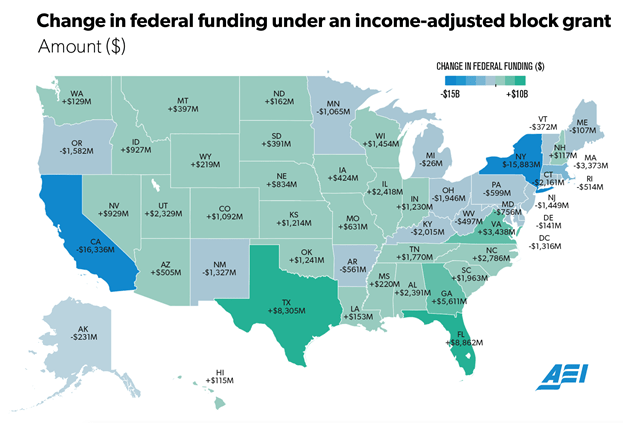
To eliminate this open-ended feature, Trump’s plan calls for federal money to be allocated in fixed lump sum payments known as block grants.

First proposed in 1981 by President Reagan, block granting of Medicaid hardly represents a novel policy option. Why then has the current system endured, and what does this portend for the resistance Trump’s efforts may encounter?

To understand, consider the most basic decision for any block grant policy: How should each state’s grant be initially determined?

Conservatives Urge Speed Up Of Health Law Repeal, Dismiss Calls for Caution

http://www.realclearhealth.com/articles/2017/02/08/conservatives_urge_speed_up_of_health_law_repeal_dismiss_calls_for_caution_110431.html?utm_source=RealClearHealth+Morning+Scan&utm_campaign=27c31f5bae-EMAIL_CAMPAIGN_2017_02_09&utm_medium=email&utm_term=0_b4baf6b587-27c31f5bae-84752421

Image result for Conservatives Urge Speed Up Of Health Law Repeal, Dismiss Calls for Caution

Leading conservative Republicans from the House and Senate say Congress is moving too slowly on efforts to “repeal and replace” the Affordable Care Act. But their potential resistance to compromise — even with other members of their own party — underscores just how hard a task Republicans have set for themselves.

“We think it’s time to do something, and that’s to get rid of this law,” Rep. Jim Jordan, R-Ohio, told reporters at an event sponsored by the conservative Heritage Foundation. “The biggest problem with waiting is that’s not what we told the voters.”

Sen. Mike Lee, R-Utah, one of the leading conservative voices in that chamber, said he will vigorously oppose efforts for Republicans to wait until they have a plan ready to replace the law before they repeal it. “There is a lot less agreement about what comes next,” he said. “If we load down the repeal bill with what comes next, it’s harder to get both of them passed.”

After getting off to a quick start, GOP efforts to dismantle the health law appear to have slowed considerably. House and Senate committees have already missed a deadline of Jan. 27 to write and pass their proposed repeal and replace provisions, although Senate leaders acknowledged early this year that marker would likely not be met. At a party retreat last month, Republicans still seemed uncertain exactly how and when they would proceed.

And in an interview that aired just before the Super Bowl, President Donald Trump for the first time acknowledged that the effort to remake the health law could last into next year.

Conservatives, however, are pushing back.


Since the Election, Americans Grow More Supportive of ACA

http://www.npr.org/2017/02/08/514161163/since-the-election-americans-grow-more-supportive-of-obamacare

Image result for Save the ACA

There are now more people who think Obamacare is a good idea than those who don’t. It’s basic human nature: People tend to get upset if they think they are about to lose something they feel entitled to or previously had. It’s also the idea that fueled Donald Trump’s electoral base, and ironically, now fuels those who are opposed to him.


Centene to stay on ACA exchanges; WellCare grows Medicaid membership

http://www.fiercehealthcare.com/payer/centene-to-stay-aca-exchanges-wellcare-adds-medicaid-members?utm_medium=nl&utm_source=internal&mrkid=959610&mkt_tok=eyJpIjoiTnpFeU1tVmxaV00yWmpRMCIsInQiOiJxQk1keWdtNzdGSUZvT2huUTZiZFJ4SDl4akhmRG1wMGE4ZzV2eGtIUXNmUGJ1TTJjbTRxRTJ4cjNcL3NvVWNZZUZlRWxnMnh2bHJVdiswWmVFR3VcL2l3RmpwWXFaZ3JBUG4ya3oyVGp5bHNoUjl4dU1wUnNNYWpTZmc1TURcL09LbyJ9

finance earnings

Unlike some of the other major for-profit health insurers, Centene has no plans to consider exiting the Affordable Care Act exchanges in 2018.

“I’m not backing off at all,” CEO Michael Neidorff said during the company’s fourth-quarter earnings call Tuesday. In recent discussions with the company’s board members, he said, “everybody is of one mind; you maintain business as usual.”

Recently, the CEOs of Anthem and Cigna both indicated they are still deciding whether to participate on the exchanges in 2018. Aetna, meanwhile, does not plan to re-enter any markets in 2018 after pulling out of many in 2017.

As of Dec. 31, Centene served about 540,000 exchange members, in line with its expectations, and it anticipates having a little more than 1 million paid members in 2017. Indications are that the demographics of these members will be consistent with years past, with 90% of them subsidy-eligible and most on silver-tier plans, Neidorff said.

While Centene is folding an “extra level of conservativism” into its expectations for its exchange products to guard against any uncertainty, it continues to expect that line of business to be profitable this year, he added.

Another ACA provision, Medicaid expansion, has also proved profitable for Centene. At the end of 2016, it had 1,080,500 members in Medicaid expansion programs in 10 states, compared to 449,000 members at the end of 2015, according to the company’s earnings statement.


Consensus builds that GOP will keep value-based focus for healthcare reimbursement

http://www.healthcarefinancenews.com/news/insurers-seek-market-stabilization-prior-april-rate-setting-deadline

Health Affairs report suggests new HHS leadership should expand state all-payer models, fine-tune accountable care organizations.

Another report suggest value-based payment models will continue even, if in a different form, under the new administration’s governance of the U.S. Department of Health and Human Services, according to a Health Affairs report.

“The election of Donald Trump might change the strategy of advancing healthcare reform, but the movement toward value-based care both preceded the Affordable Care Act and has bipartisan support,” the authors said.

If Tom Price is confirmed as secretary and Seema Verma administrator of the Centers for Medicare and Medicaid Services Administrator, the agencies will support new value-based payment models said authors David Muhlestein, Natalie Burton and Lia Winfield.

But Price has already voiced his opposition to mandatory models such as bundled payments.

CMS, which has 74 healthcare initiatives and programs in different stages of research, testing, and adoption, recently proposed to make its cardiac care bundle mandatory and said opportunities exist for bundles that consider multiple chronic conditions.

While payment innovation may continue, the agency needs to articulate its overall strategy in four focus areas, the authors said.

The first is the expansion of the population-based model and disease-specific model.

Could Minnesota Health Reforms Foreshadow Repeal And Replace?

http://www.healthleadersmedia.com/health-plans/could-minnesota-health-reforms-foreshadow-repeal-and-replace?spMailingID=10382992&spUserID=MTY3ODg4NTg1MzQ4S0&spJobID=1100574162&spReportId=MTEwMDU3NDE2MgS2#

Image result for Minnesota Health Reforms

In the midst of the uncertainty about the Affordable Care Act, Minnesota has taken three unusual actions.

What’s going to happen to the federal health law? The quick answer is no one knows. But in the midst of the uncertainty about the Affordable Care Act, states still must govern their insurance markets. Most have been muddling through with the 2017 status quo, but Minnesota is a special case, taking three unusual actions that are worth a closer look.

Last month, Minnesota:

  • Passed a one-time bailout for some consumers in the individual insurance market dealing with skyrocketing premiums.
  • Rejected an attempt to let insurers offer cheaper, bare-bones coverage.
  • Laid the groundwork for a sort of homegrown “public option” insurance plan.

Here’s more on each item.

Keeping Perspective During Turbulent Times

http://www.commonwealthfund.org/publications/blog/2017/feb/keeping-perspective?omnicid=EALERT1163749&mid=henrykotula@yahoo.com

At times of dramatic change in a nation’s history, fear and anxiety can become pervasive and overwhelming. Troubling visions of authoritarianism or chaos, of political persecution, and even civil war disturb our waking thoughts and nightly dreams. It can be emotionally, almost physically, paralyzing.

As Mark Twain allegedly quipped, “history doesn’t repeat itself, but it often rhymes.” Looking for those historical rhymes can provide perspective at times of disquiet, such as this. This may be particularly true for younger members of our attentive public, who have not lived through, and emerged safely from, some of the dark periods we have experienced as a country.

America’s 241 years of nationhood have been tumultuous. Events have repeatedly challenged the viability of our democracy.

Varied as these events were, they show how frequently crises test our democracy, and how resilient it has proven over time. They also show how important it is for defenders of our freedoms to remain vigilant. No civilization—no matter how mighty or seemingly stable—is invulnerable. All decline and pass eventually from the scene. Only the values and courage of a free citizenry and its leaders assure that we will continue to confront and rise to the challenges that we will inevitably encounter.

A critical role in preserving our values and our institutions falls to nongovernmental organizations that constitute our civil society. These institutions include our churches, synagogues, and mosques, our universities, and our many charitable and philanthropic organizations. The Commonwealth Fund is one of these. As an endowed philanthropy, The Commonwealth Fund has for 99 years enjoyed the extraordinary privilege of economic independence. Currently, the Fund is dedicated to creating a high performance health system in the United States. In pursuit of that goal, it will continue to provide an independent, nonpartisan, and objective view of our health care system, and of the events and developments that may affect the health and health care of Americans.

Is 3.49 more than 3?

Is 3.49 more than 3?

Image result for fuzzy math

HHS has already submitted a proposal of new rules to OMB. [Under the proposal,] insurers would have more leeway to vary prices by age, so that premiums for the oldest customers could be 3.49 times as large as those for younger customers. Today, premiums for the old can be only three times as high as premiums for the young, which is what the Affordable Care Act stipulates. According to sources privy to HHS discussions with insurers, officials would argue that since 3.49 “rounds down” to three, the change would still comply with the statute.

This is kinda dumb. It’s also not so legal. The ACA says that “the rates” for health plans “shall not vary by more than 3 to 1 for adults.” The statute couldn’t be clearer. As I said to Jonathan: ”If I told you not to sell something for more than $3.00, and you went ahead and sold it for $3.49, then you’ve disregarded my instruction. It doesn’t matter if it rounds to $3.00. It’s more than $3.00.”

Under Chevron, agencies have lots of room to interpret ambiguous statutes. But there’s no ambiguity here. The statute says no more than 3, period. As Monty Python might say, 3.49 is right out. (Here’s where I insert the standard caveat that the administration hasn’t offered a legal argument—or any public comment, for that matter—and it’s possible I’m missing something. Also, the rule could easily be amended during OMB review.)


Trump, GOP Lawmakers Back Off From Immediate Obamacare Repeal

http://www.npr.org/sections/health-shots/2017/02/06/513718166/trump-congressional-gop-back-off-from-immediate-obamacare-repeal

There’s a moment in the Broadway musical Hamilton where George Washington says to an exasperated Alexander Hamilton: “Winning is easy, young man. Governing’s harder.”

When it comes to health care, it seems that President Trump is learning that same lesson. Trump and Republicans in Congress are struggling with how to keep their double-edged campaign promise — to repeal Obamacare without leaving millions of people without health insurance.

But on Sunday, he dialed back those expectations in an interview with Fox News.

“It’s in the process and maybe it will take till sometime into next year, but we are certainly going to be in the process. It’s very complicated,” Trump said.

He repeated his claim that Obamacare has been “a disaster” and said his replacement would be a “wonderful plan” that would take time “statutorily” to put in place. And then he hedged the timing again.

“I would like to say by the end of the year, at least the rudiments,” he said.

Trump’s recent hesitation comes as Republicans in Congress tame their rhetoric surrounding the health care law.

Sen. Lamar Alexander, R-Tenn., chairman of the Senate health committee, said he’d like to see lawmakers make fixes to the current individual market before repealing parts of the law.

“We can repair the individual market, which is a good place to start,” Alexander said on Feb. 1.

A Guide to Budget Reconciliation: The Byzantine Rules for Disassembling the Health Law

http://www.realclearhealth.com/articles/2017/02/06/a_guide_to_budget_reconciliation_the_byzantine_rules_for_disassembling_the_health_law_110426.html?utm_source=RealClearHealth+Morning+Scan&utm_campaign=aaa496d476-EMAIL_CAMPAIGN_2017_02_07&utm_medium=email&utm_term=0_b4baf6b587-aaa496d476-84752421

Image result for A Guide to Budget Reconciliation: The Byzantine Rules for Disassembling the Health Law

After capturing the White House, Republicans put repealing the health law at the top of their to-do list. But since they can’t get around a Democratic filibuster in the Senate, they are forced to use an arcane legislative tool called budget reconciliation to disassemble parts of the law. KHN’s Julie Rovner and Francis Ying explain the process.