Value-Based Drug Pricing: Watch Out for Side Effects

http://www.commonwealthfund.org/publications/blog/2016/jul/value-based-drug-pricing

What would penicillin cost under value-based pricing, a system in which drug makers set prices based on the benefits of their products to consumers and the larger society, rather than drugs’ costs of production? Penicillin has saved millions of lives since its first use in 1942, and it still works for many patients despite growing bacterial resistance to the drug. (Fortunately, many fewer patients get infections with pneumococcus now because we have a good vaccine for it.) Surely, under value-based pricing, penicillin would sell for thousands or tens of thousands of dollars a dose.

Medicine depends on many cheap generic drugs like penicillin to treat conditions as diverse as acne, gout, hypertension, heart disease, and cancer. Pricing these drugs according to their value would make them unaffordable to uninsured and underinsured patients and dramatically increase the aggregate costs of pharmaceuticals.

There is a compelling superficial logic to value-based pricing. Why shouldn’t manufacturers charge the full value of the products they produce? Why shouldn’t consumers have to pay it? That logic begins to fray, however, when you think about how other markets work in our capitalist system.

On Medicare But At Risk: A State-Level Analysis of Beneficiaries Who Are Underinsured or Facing High Total Cost Burdens

http://www.commonwealthfund.org/publications/issue-briefs/2016/may/on-medicare-but-at-risk

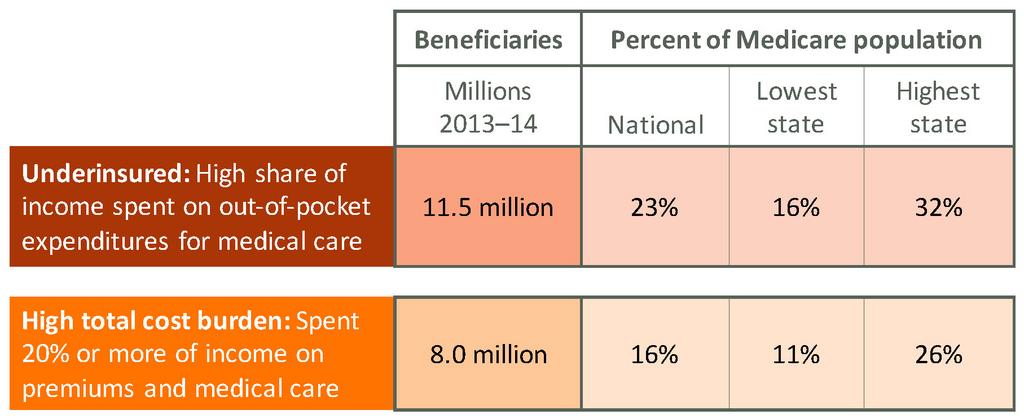
Medicare provides essential health coverage for older and disabled adults, yet it does not limit out-of-pocket costs for covered benefits and excludes dental, hearing, and longer-term care. The resulting out-of-pocket costs can add up to a substantial share of income. Based on U.S. Census surveys, nearly a quarter of Medicare beneficiaries (11.5 million) were underinsured in 2013–14, meaning they spent a high share of their income on health care. Adding premiums to medical care expenses, we find that 16 percent of beneficiaries (8 million) spent 20 percent or more of their income on insurance plus care. At the state level, the proportion of beneficiaries underinsured ranged from 16 percent to 32 percent, while the proportion with a high total cost burden ranged from 11 percent to 26 percent. Low-income beneficiaries were most at risk. The findings underscore the need to assess beneficiary impacts of any proposal to redesign Medicare.

Aiming Higher: Results from a Scorecard on State Health System Performance, 2015 Edition

http://www.commonwealthfund.org/publications/fund-reports/2015/dec/aiming-higher-2015

The fourth Commonwealth Fund Scorecard on State Health System Performance tells a story that is both familiar and new. Echoing the past three State Scorecards, the 2015 edition finds extensive variation among states in people’s ability to access care when they need it, the quality of care they receive, and their likelihood of living a long and healthy life. However, this Scorecard—the first to measure the effects of the Affordable Care Act’s 2014 coverage expansions—also finds broad-based improvements. On most of the 42 indicators, more states improved than worsened.

“On most of the 42 indicators, more states improved than worsened.”

By tracking performance measures across states, this Scorecard can help policymakers, health system leaders, and the public identify opportunities and set goals for improvement. The 50 states and the District of Columbia are measured and ranked on 42 indicators grouped into five domains: access and affordability, prevention and treatment, avoidable hospital use and cost, healthy lives, and equity. Individual indicators measure things like rates of children or adults who are uninsured, hospital patients who get information about how to handle their recovery at home, hospital admissions for children with asthma, and breast and colorectal cancer deaths, among many others.

The top-ranked states are Minnesota, Vermont, Hawaii, Massachusetts, Connecticut, New Hampshire, and Rhode Island. These states were also leaders in the 2014 Scorecard.

High-Need, High-Cost Patients: Who Are They and How Do They Use Health Care?

http://www.commonwealthfund.org/publications/issue-briefs/2016/aug/high-need-high-cost-patients-meps1

Image result for High-Need, High-Cost Patients: Who Are They and How Do They Use Health Care?

Issue: Finding ways to improve outcomes and reduce spending for patients with complex and costly care needs requires an understanding of their unique needs and characteristics.

Goal: Examine demographics and health care spending and use of services among adults with high needs, defined as people who have three or more chronic diseases and a functional limitation in their ability to care for themselves or perform routine daily tasks.

Methods:Analysis of data from the 2009–2011 Medical Expenditure Panel Survey.

Key findings: High-need adults differed notably from adults with multiple chronic diseases but no functional limitations. They had annual health care expenditures that were nearly three times higher—and which were more likely to remain high over two years of observation—and out-of-pocket expenses that were more than a third higher, despite their lower incomes. On average, rates of hospital use for high-need adults were more than twice those for adults with multiple chronic conditions only; high-need adults also visited the doctor more frequently and used more home health care.

Conclusion: Wide variation in costs and use of services within the high-need group suggests that interventions should be targeted and tailored to those individuals most likely to benefit.

Tailoring Complex Care Management for High-Need, High-Cost Patients

http://www.commonwealthfund.org/publications/in-brief/2016/sep/tailoring-complex-care-high-need-high-cost?omnicid=EALERT1104498&mid=henrykotula@yahoo.com

High-need, high-cost (HNHC) patients account for a disproportionate share of health care spending, and the complex care they need can be fraught with quality and safety issues. Any effort to address quality and cost challenges must focus on improving care for this population. The Commonwealth Fund’s David Blumenthal, M.D., and Melinda Abrams highlighted six key opportunities in this JAMA “Viewpoint.”

Remember The ‘Public Option’? Insurance Commissioner Wants To Try It In California

Remember The ‘Public Option’? Insurance Commissioner Wants To Try It In California

coveredcaliforniaenrollmentinsurers

With major insurers retreating from the federal health law’s marketplaces, California’s insurance commissioner said he supports a public option at the state level that could bolster competition and potentially serve as a test for the controversial idea nationwide.

“I think we should strongly consider a public option in California,” Insurance Commissioner Dave Jones said in a recent interview with California Healthline. “It will require a lot of careful thought and work, but I think it’s something that ought to be on the table because we continue to see this consolidation in an already consolidated health insurance market.”

Nationally, President Barack Obama and other prominent Democrats have revived the idea of the public option in response to insurers such as Aetna Inc. and UnitedHealth Group Inc. pulling back from the individual insurance market and many consumers facing double-digit rate hikes.

The notion of a publicly run health plan competing against private insurers in government exchanges was hotly debated but ultimately dropped from the Affordable Care Act when it passed in 2010.

Health insurers have long opposed the idea, and other critics fear it would lead to a full government-run system

Re-engaging in Health Care Reform

https://newsatjama.jama.com/2016/09/21/jama-forum-re-engaging-in-health-care-reform/?utm_campaign=KHN%3A+Daily+Health+Policy+Report&utm_source=hs_email&utm_medium=email&utm_content=34737932&_hsenc=p2ANqtz-9-P8BA0peIS06RN4V5K0lf6yRE72sRu4qrGYgK1Rjbo4orEnYHUfJNelSrWoPS_4RPHS1RCvpanquAbaxhxoxhnHx-_w&_hsmi=34737932

Image result for healthcare reform

As we approach the election this fall, it seems like the news media report on little else. Unfortunately, too little news coverage addresses health care reform. This is ill-advised because there is still much to be done to improve the cost, quality, and access for patients within the US health care system. In this post, I will attempt to cover most of the major issues related to health care coverage that US consumers face.

In a previous piece I wrote for the JAMA Forum, just before the last presidential election, I discussed how health care reform is all about tradeoffs. For example, one way to make an insurance plans cheaper is to offer narrow networks (reducing access to high-cost services or allowing access only to physicians who agree to accept lower payments in return for the promise of higher volume). That’s a tradeoff. Community ratings and government regulation lead to improved access for some but fewer options for carriers (worse access). Weak mandates allow for more freedom in deciding whether to purchase insurance but lead to increased rates for others and fewer carriers participating.

We should not lose sight of what has improved. An additional 20 million US residents who lacked health coverage are now insured. Spending has slowed to below what was predicted. But there is still much work to do. Calling for blanket repeal of the ACA and a return to the status quo is not an improvement. But failing to recognize shortcomings in reform and working to ameliorate them would be a failure as well.

Would You Like Some Insurance With Your Insurance?

http://khn.org/news/would-you-like-some-insurance-with-your-insurance/?utm_campaign=KHN%3A+Daily+Health+Policy+Report&utm_source=hs_email&utm_medium=email&utm_content=34662261&_hsenc=p2ANqtz-8_T7tLMkCX6Y6LfTReNo75vKpK1maHvHwggi_b0HJdFjSYivQggGeQ_9T7c_uhl0BRZml0KAXMIdJg7jjXJNAXcqcdiA&_hsmi=34662261

A screenshot from a video touting a gap plan called "Premium Saver." (Courtesy of Crema Design Studio)

Gap plans, used to cover out-of-pocket expenses like high deductibles, are becoming increasingly popular among consumers and businesses.

The rising price of insurance is driving the trend, explained insurance broker Ryan Hillenbrand, president of the Missouri Association of Health Underwriters.

“People see the prices of individual insurance and they say, ‘Boy, a $6,000 deductible seems really high. I don’t want something that gives me that much risk,’ ” Hillenbrand said. “That’s why [the gap insurance] market is heating up a little bit more.”

Gap insurance is in a category of insurance known as “limited benefit.” No matter how bad a person’s situation, the plan will pay out only a certain amount of money. “Mini-med” policies, now illegal under the Affordable Care Act, are another example of a limited benefit plan

Now, there’s renewed interest in gap plans. With monthly premiums on health insurance going up, more people are choosing cheaper, high-deductible options. In 2016, more than90 percent of people buying insurance under the ACA chose plans with an average deductible of $3,000 or higher.

Next year, the cost of one of the most popular plans available under the Affordable Care Act could increase by 10 percent on average across the country. That comes on top of a 5 percent jump the year before.

When consumers see those prices, Hillenbrand said, “they get sticker shock.”

“If you don’t qualify for a subsidy, you’re bearing the brunt of all that cost,” Hillenbrand said. “And here come the gap plans.”

The Opportunities and Challenges of the MSSP ACO Program: A Report From the Field

https://www.aledade.com/new-journal-article-a-report-from-the-field/

table

The trillion dollar shift in healthcare payment “from volume to value” is well underway with both public and private payers and purchasers pushing provider organizations to participate in outcome-based risk contracts, stepping up from pay-for-performance and medical home models to a variety of accountable care and bundled payment programs.

But what are we to take away from the mixed results of these programs — from the lack of savings in the Comprehensive Primary Care demonstration, to the dropouts from the Pioneer program, the recently released underwhelming results from the first year of the Bundled Payment for Care Improvement Initiative, or the 2015 results from the Medicare Shared Savings Program?

One approach would be for partisans for each of these approaches to search for positive nuggets in the results from their preferred program, while heaping scorn on the other “competing” reforms.

Another would be to retreat altogether from the aspirations of achieving better care at lower cost, towards either resignation towards ever-escalating health care costs or more likely to (altogether regretful!) rationing of access to good healthcare for the most vulnerable in our society.

A third path would be to acknowledge that there is no magic bullet for “transforming healthcare” overnight, and that the work of redesigning our delivery systems to meet the expectations of the outcome-based payment models will be slow, hard, and uneven. We would accept that there are likely multiple payment reforms that will need to be implemented alongside each other, targeting different healthcare markets and different participants. (Capitated payments for truly integrated delivery networks. Mandatory bundled payments for proceduralists and hospitals. Accountable care for independent physician networks). And each model will need to be iterated and tweaked and incrementally improved.

That is what I choose to believe.

We are publishing today in the new issue of the American Journal of Managed Care, “A Report From the Field,” the detailed description of what our two ACO “freshman” accomplished in 2015, and openly discussing the challenges we faced, what we are doing differently now, and some policy changes that can put more wind to the backs of those in these trenches.

Here are a few of the key findings:

http://www.ajmc.com/journals/issue/2016/2016-vol22-n9/The-Opportunities-and-Challenges-of-the-MSSP-ACO-Program-A-Report-From-the-Field

Conclusions:

We have learned that, given the right support and incentives, independent primary care practices can embrace population health and practice redesign. These efforts can begin to bear fruit in improved patient access, quality of care, and appropriate utilization in the short term. We strongly believe that the benefits of the program to patients and the taxpayer are not limited to those ACOs that received shared savings distributions. However, lack of recognition of these contributions may stifle continued innovation and physician engagement with alternative payment models. Aledade is committed to navigating these challenges and we are committed to sharing our learning so that more independent physician-led ACOs can succeed in their mission to profitably deliver better care at lower cost. We also hope that policy makers and commercial payers continue to work to remove the unintended policy headwinds ACOs must presently overcome. – See more at: http://www.ajmc.com/journals/issue/2016/2016-vol22-n9/the-opportunities-and-challenges-of-the-mssp-aco-program-a-report-from-the-field/P-5#sthash.3V1BtAtZ.dpuf


ACO inside report details challenges of ‘regulatory headwinds’

http://www.healthcaredive.com/news/aco-inside-report-details-challenges-of-regulatory-headwinds/426663/

Image result for regulatory headwinds

  • A new report from Aledade, a company that helps physicians form and operate accountable care organizations (ACOs), says its groups have successfully increased primary care utilization and revenue, decreased lab and imaging costs, and decreased emergency department and hospital utilization and readmissions.
  • The findings were shared to provide a “frontlines” perspective on the challenges and lessons learned in delivering value as a Medicare Shared Savings Program (MSSP) ACO.
  • The report calls out “regulatory headwinds” that it says are currently working against ACOs in the program, including the national benchmark used to determine savings. Although the implementation of regional benchmarking will provide a more accurate measurement in years 4-9, in the meantime it still leaves some ACOs facing a longer stretch of time to achieve financial success.