Here’s What’s Really Driving Healthcare Costs

https://www.medpagetoday.com/publichealthpolicy/healthpolicy/69102?pop=0&ba=1&xid=fb-md-pcp
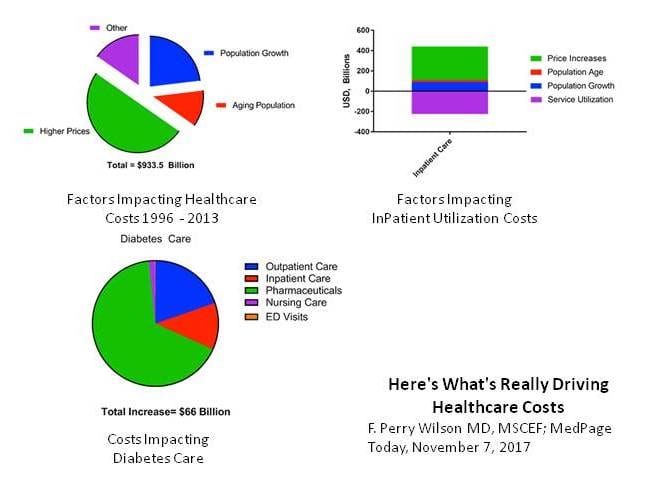
Image result for Here's What's Really Driving Healthcare Costs


The market economy fails when applied to healthcare.

That healthcare expenditures in the US are high and rising rapidly is nothing new, but this study appearing in the Journal of the American Medical Association identifies the exact components of healthcare that are driving those soaring costs. As F. Perry Wilson, MD points out in this 150 Second Analysis, the data suggest traditional economic forces break down in the US healthcare market.

Transcript:

It’s no secret that healthcare costs in the United States are exceedingly high, and rising.

The US spends the most of any country in the world on healthcare in terms of percent of GDP, sitting around 18% as of the most recent data.

But to address the issue, we need to understand what is driving this increase, and a new study appearing in the Journal of the American Medical Association does the best job yet in decomposing the factors behind the rising costs.

The researchers used data from the US Disease Expenditure Project, which utilizes 183 data sources and 2.9 billion patient records to quantify where each healthcare dollar is being spent in this country.

Here’s the top level overview. After accounting for inflation, healthcare expenditures increased by $933.5 billion between 1996 and 2013. To put that into perspective, that’s enough money to create 9 additional interstate highway systems. We could fully fund 3 NASAs every year.

Or we could provide 400 malaria nets to every man, woman, and child in Africa. We could even do something crazy like pay down the debt.

But to save money in the future, we have to know why we keep spending more. Here’s the breakdown.

Some of the increase in spending comes from the aging of the US population and population growth. Not much we can do about that. But 50% of the increase was simply due to higher prices.

This is distinct from healthcare utilization. In fact, healthcare utilization was decreased a bit over this time period. This is shown most dramatically in the data for inpatient care. Take a look at this bar chart.

Use of inpatient care (that’s service utilization – in purple) went down substantially from 1996 – 2013 as we moved to more outpatient treatment. But this may have been a Faustian bargain. The price of the inpatient care that remained went up much more – increasing overall inpatient spending by around 250 billion dollars.

Let’s take a moment to realize how weird this is, economically. Demand for healthcare decreased over time. Prices increased. That is not an efficient market.

Different chronic diseases had different patterns of price increases. The biggest increase was seen in diabetes care, as you can see here, driven largely by rising costs of pharmaceuticals.

Regardless of the disease, though, it is clear that it is the price of what we’re buying – whether a drug, an ED visit, or a hospital stay – not the amount of what we’re buying that is the major driver of cost increases. Efforts to reduce the consumption of healthcare, therefore, may not bend the cost curve as much as efforts to reduce its price. That’s just my 2 cents.

Healthcare spending, price growth slows in 2017 but job growth spikes

http://www.healthcarefinancenews.com/news/healthcare-spending-price-growth-slows-2017-job-growth-spikes?mkt_tok=eyJpIjoiT0RCalpUWTNNbU16TmpJeiIsInQiOiJyUTBEc0s5clMzSUUyRVV4UGJEam9ZOTBVVW5uWmVzQnpMa1hTSjY0clYyK3FGcmtPOFNQelVtd2hRQmZ3aFwvZndPUDNoZk8zOXBBcHNGQzh6U0ErRnhFSmc3RlVzelhoMXp4SjQ5bU02NDQ4K3Badyt4dFhUMzB3ajZ3U0hhNWIifQ%3D%3D

Altarum report finds spending grew by only 4.6 percent in 2016.

Healthcare spending growth slowed in 2016, and the trend appears to be continuing, according to the August 2017 Altarum Institute Center Health Sector Trend report.

According to the report, spending grew by only 4.6 percent in 2016 and estimates based on new data have the downward trend continuing with growth for the first half of 2017 at 4.4 percent. Altarum said the estimates illustrate the impact of expanded coverage, and its subsequent leveling off, on healthcare utilization. Coverage expansion was concentrated in 2014 and 2015, leading to a jump in health services utilization. That peaked at at 5.1 percent in 2015.

“Coverage leveled off in 2016 and, in response, the growth in health services utilization has been trending back toward pre-expanded coverage rates,” Altarum said.

Healthcare price growth has also dropped in 2017, from 2 percent in the first quarter to 1.6 percent in the second quarter.

Though much higher than healthcare services, prescription drug price growth slowed to 3.6 percent in the second quarter 2017. However it is important to note that the impact of rebates are not reflected in these data, and that drug pricing controversies like the one surrounding Mylan’s EpiPen were recently resolved and some generic alternatives have been made available at lower prices.

Finally, health employment grew an average of 21,000 jobs per month during the first 5 months of 2017 then unexpectedly rebounded to 38,000 in June and July. The jump in June and July was a surprise, and was focused mainly in ambulatory settings.

“Growth averaged 32,000 during 2015 and 2016, and the decline in monthly growth during the first 5 months of 2017 was expected due to slower growth in health care utilization driven by the leveling off in expanded coverage,” Altarum said.

The American Hospital Association’s February 2017 Cost of Caring report also illustrated the increased utilization in 2014 and 2015, due to expanded healthcare coverage and more intense utilization of services like chronic disease management.

However, the report mentioned that statistics also suggested that hospitals are trying to hold costs down. For instance, hospital price growth in 2015, as measured by the Hospital Producer Price Index, was .9 percent, a 13-year low and a notable drop from the rate of 4.4 percent in 2006, the report said.

Growth in Medicare spending for all hospital services, both inpatient and outpatient, is at a 17-year low, and inpatient spending dropped 1.9 percent in 2015.

So it is possible that along with a leveling off of coverage and utilization, successful hospital attempts at stabilizing or reducing cost of care could be responsible for the lower spending. The slowing in hospital price growth in the Altarum report is also illustrative of these theories.

However, the hospital industry faces serious challenges that can slow efforts to reduce costs, including drug prices and regulatory compliance, the AHA report said.

Electronic health records have also proven to be big resource absorbers for providers. AHA estimates show that from 2010 to 2014 hospitals spent over $47 billion annually on IT. Increasing regulatory requirements are also fueling increases in administrative expenses and compliance staffing demands, the AHA report said.

Click to access Altarum%20RWJF%20Trend%20Report%20Aug%202017_1.pdf


Few Young Doctors Are Training To Care For U.S. Elderly

http://www.healthleadersmedia.com/physician-leaders/few-young-doctors-are-training-care-us-elderly?spMailingID=9208161&spUserID=MTMyMzQyMDQxMTkyS0&spJobID=961199903&spReportId=OTYxMTk5OTAzS0#

“With the growing elderly population across America and West Virginia, obviously we need healthcare providers,” Goldberg said. That includes geriatricians — physicians who specialize in the treatment of adults age 65 and older — as well as nurses, physical therapists and psychologists who know how to care for this population.

“The current workforce is inadequately trained and inadequately prepared to deal with what’s been called the silver tsunami — a tidal wave of elderly people — increasing in the population in West Virginia, across America and across the world really,” Goldberg said.

The deficit of properly trained physicians is expected to get worse. By 2030, one in five Americans will be eligible for Medicare, the government health insurance for those 65 and older.

How Many Doctors Does It Take to Start a Healthcare Revolution? A New Freakonomics Radio Podcast

http://freakonomics.com/2015/04/09/how-many-doctors-does-it-take-to-start-a-healthcare-revolution-a-new-freakonomics-radio-podcast/

Freakonomics Radio

You’ll also hear about the fascinating research done by Amir Hetsroni, an Israeli professor of communications. He and his students watched numerous episodes of ER, Chicago Hope, andGrey’s Anatomy, keeping detailed coding books on every patient – their race, approximate age, their malady, the treatment, and whether they lived or died. Their resulting paper was called “If You Must Be Hospitalized, Television Is not the Place.” This, like many facts in this episode, may well surprise you — and change the way you think about modern healthcare.

The COMMONWEALTH FUND Issue Brief (February 2015): How Will the Affordable Care Act Affect the Use of Health Care Services?

http://www.commonwealthfund.org/~/media/files/publications/issue-brief/2015/feb/1804_glied_how_will_aca_affect_use_hlt_care_svcs_ib_v2.pdf?la=en

The Commonwealth Fund