Who will pay more without CSR subsidies

https://www.axios.com/vitals-2497054515.html

Good morning … Last week gave us an executive order and an end to cost-sharing payments. Can’t wait to find out what the health policy universe has in store for us this week.

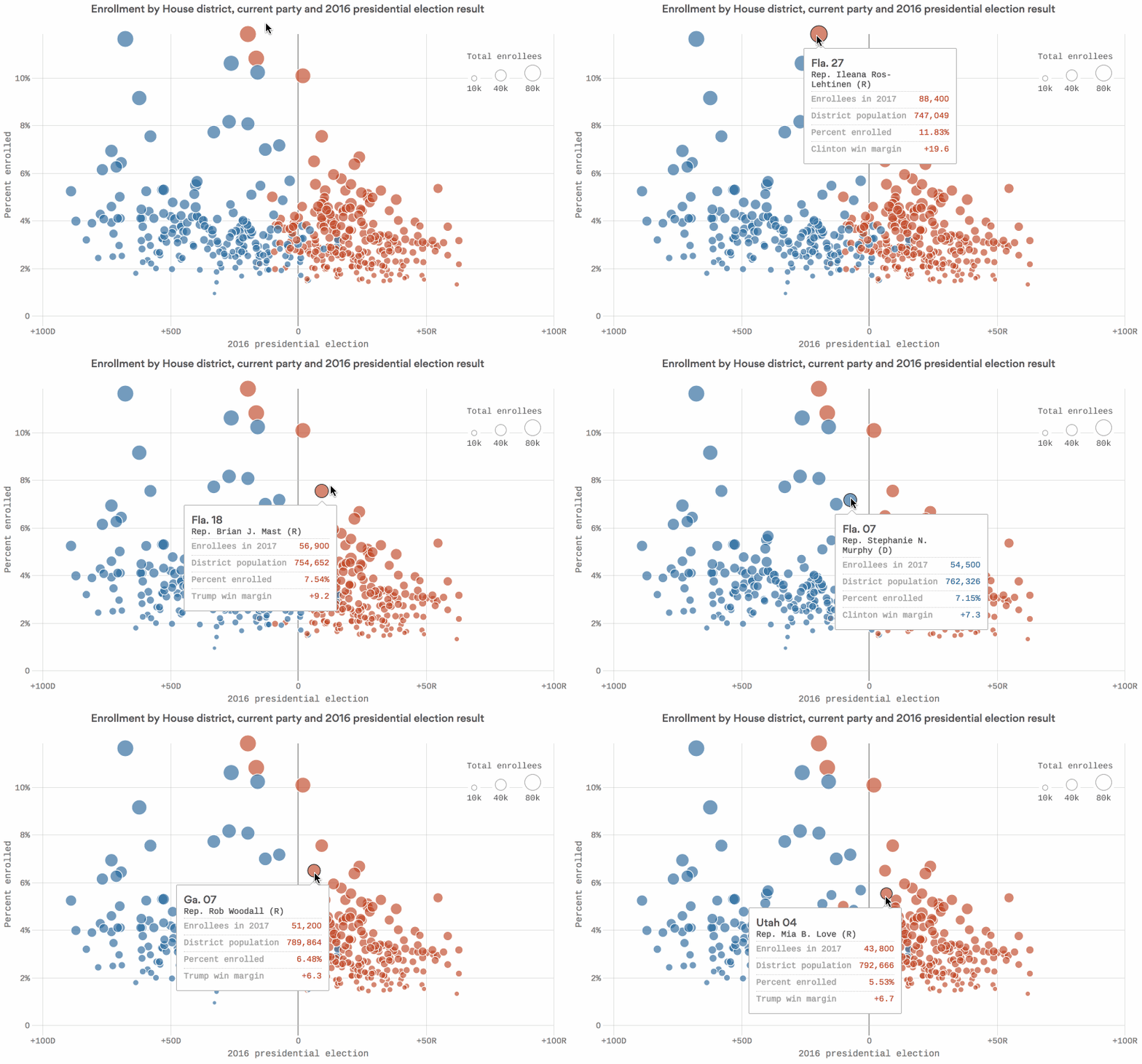
Who will pay more without CSR subsidies

Data: Kaiser Family Foundation; Daily Kos Elections; Census Bureau; Chart: Chris Canipe / Axios

The Trump administration’s decision to stop paying the Affordable Care Act’s cost-sharing reduction subsidies will affect ACA customers in Republican-leaning congressional districts as well as Democratic ones. Here’s a look at how many people could feel the impact in districts that voted for President Trump, compared with those in districts that voted for Hillary Clinton.

The details: This year, 11.1 million people were enrolled in ACA marketplace plans or in a Basic Health Plan created by the law. Of those, 5.9 million live in Republican-held congressional districts and 5.2 million live in districts held by Democrats, per the Kaiser Family Foundation.

The impact: The CSR subsidies are going to 58% of the people who are enrolled in ACA marketplace plans. In all, about 7 million people don’t receive any financial assistance with their premiums, so they’d pay the full cost when health insurance companies raise their rates. But others could be affected if health insurers decided to pull out of the markets rather than deal with the instability.

The flaws in Trump’s legal rationale

There are broader implications of the Trump administration’s decision to lean so heavily on a legal rationale for cutting off the CSR subsidies: institutional divisions between the executive and legislative branches.

Between the lines: The White House said it was ending the payments in part because of a ruling last spring that said it was unconstitutional to make the payments without an explicit appropriation from Congress. As part of that process, Attorney General Jeff Sessions wrote a memo saying, in effect, there was no point appealing that ruling.

  • “Opening the door to lawsuits initiated by Congress over the specifics of how the executive branch spends tax dollars would be a marked change and a potential threat to the White House,” the New York Times’ Carl Hulse noted over the weekend.
  • Trump might particularly wish he hadn’t conceded that point if Democrats retake control of the House and/or Senate while he’s still president. Divided government is how this lawsuit started, after all.

Real talk: Former White House strategist Steve Bannon, speaking at the Values Voters Summit over the weekend, cut to the heart of Trump’s decision: “Not going to make the CSR payments, going to blow that thing up; going to blow those exchanges up, right?”

Administration’s Ending Of Cost-Sharing Reduction Payments Likely To Roil Individual Markets

http://healthaffairs.org/blog/2017/10/13/administrations-ending-of-cost-sharing-reduction-payments-likely-to-roil-individual-markets/

Yesterday, October 12, 2017, the White House press office announced that the administration will no longer be reimbursing insurers for the cost-sharing reductions they are legally required to make for low-income individuals. The Affordable Care Act requires insurers to reduce cost sharing for individuals who enroll in silver plans and have household incomes not exceeding 250 percent of the federal poverty level. These provisions reduce the out-of-pocket limit for these enrollees—particularly for those with incomes below 200 percent of poverty—and sharply reduce deductibles, coinsurance, and copayments. The reductions cost insurers around $7 billion a year currently.

The press secretary’s statement said:

Based on guidance from the Department of Justice, the Department of Health and Human Services has concluded that there is no appropriation for cost-sharing reduction payments to insurance companies under Obamacare. In light of this analysis, the Government cannot lawfully make the cost-sharing reduction payments. The United States House of Representatives sued the previous administration in Federal court for making these payments without such an appropriation, and the court agreed that the payments were not lawful. The bailout of insurance companies through these unlawful payments is yet another example of how the previous administration abused taxpayer dollars and skirted the law to prop up a broken system. Congress needs to repeal and replace the disastrous Obamacare law and provide real relief to the American people.

Acting HHS Secretary Hargan and CMS Administrator Verma issued a similar statement:

It has been clear for many years that Obamacare is bad policy. It is also bad law. The Obama Administration unfortunately went ahead and made CSR payments to insurance companies after requesting—but never ultimately receiving—an appropriation from Congress as required by law. In 2014, the House of Representatives was forced to sue the previous Administration to stop this unconstitutional executive action. In 2016, a federal court ruled that the Administration had circumvented the appropriations process, and was unlawfully using unappropriated money to fund reimbursements due to insurers. After a thorough legal review by HHS, Treasury, OMB, and an opinion from the Attorney General, we believe that the last Administration overstepped the legal boundaries drawn by our Constitution. Congress has not appropriated money for CSRs, and we will discontinue these payments immediately.

The Legal Background

In fact, the ACA requires the federal government to reimburse insurers for these reductions. This is not a bailout. It is rather a statutory obligation of the federal government to pay insurers for services they have provided as required by law. In 2014, the House of Representatives sued the Obama administration in House v. Burwell (now House v. Price) claiming that the cost-sharing reduction (CSR) payments to insurers had never been appropriated by Congress and were thus illegal. A district court judge accepted this argument in the spring of 2016 and enjoined their payment, as President Trump’s statement says, but stayed her order pending appeal. The Obama administration appealed, arguing that there was in fact an appropriation. Until yesterday, the Trump administration had not taken a position on whether there was an appropriation or not.

The appeal is still pending, with the House and the Trump administration having agreed to stay the appeal several times. At the end of August, the D.C. Circuit Court of Appeals allowed 19 state attorneys general to intervene to protect their citizens. For more on the CSR backstory see here and here; for more on the intervention, see here; and for Health Affairs Blog posts on cost-sharing reduction payments, see here.

The Consequences Of Ending The CSR Payments

The effect of terminating the payments has been well analyzed, including a report from the Congressional Budget Office. It will drive up premiums as insurers attempt to cover the cost of the reductions. As premiums go up, so will premium tax credits. Indeed, the government will probably pay more in premium tax credits than it saves in cost-sharing reduction payments. Individuals who earn too much to receive tax credits will be particularly hard hit by the premium increases. Some of these could decide to pursue new forms of coverage that might be made available under the measures announced in President Trump’s October 12 executive order.

Ending the CSR payments could also drive some insurers out of the exchanges. Under their contract with the federal exchange, insurers may terminate participation if cost sharing reduction payments are terminated, but they are still subject to state laws on market withdrawal, which limit their ability to do so. They may not terminate their exchange enrollees unless they fail to pay their premiums, which many likely would do once an insurer left the exchange and premium tax credits were no longer available.

The effect of CSR payment termination, however, will depend heavily on how insurers deal with the change. In several states, including California, insurers have anticipated the termination and have already loaded the lost payments into their on-exchange silver plansIn other states, however, insurers have to date been instructed to assume that the payments will be made, or have been given no instructions whatsoever. In these states, the change is likely to cause considerable confusion. Insurers will have to refile their rates and will likely not be able to do so before open enrollment begins in three weeks. For more on the different responses insurers may have take, see here.

What Might Happen Now

It is possible that the states that have intervened in the House v. Price appeal will seek to block the withdrawal of the funds. It is also very possible that the state attorneys general or a consumer or insurer will sue to block the CSR withdrawal. New York Attorney General Eric Schneiderman issued a press release yesterday threatening legal action if President Trump withdraws the payments, and the California Attorney General has also threatened suit.

It is also possible that Congress will adopt a specific appropriation to fund the CSRs, putting to rest the question of whether such an appropriation exists. The Senate Health, Education, Labor, and Pension Committee held hearings on bipartisan solutions to health reform problems in September and virtually every witness, including insurance commissioners and governors supported removing the uncertainty around the payments and making it clear that they would continue. Support for continuing CSR funding has come from insurers, consumers, the National Association of Insurance Commissioners, and virtually all other stakeholders. The President’s statement, and the likely consequent chaos in the individual marketplaces, may be enough to finally prompt action.

In any event, ending the CSR payments is another sign that President Trump is doing what he can to undermine the stability of the individual market under the ACA. This action will have a much more immediate impact than the measures Trump announced in yesterday’s executive order.

The High Cost of Trump’s Controversial Obamacare Decision

Image result for sabotaging aca

The Trump administration announced late Thursday that it would stop paying subsidies to insurers that help cover the cost for about 6 million low-income customers on the Obamacare exchanges. The Department of Health and Human Services said that the cost sharing reduction (CSR) payments “will be discontinued immediately.”

Although eliminating the payments will save several billion dollars in the short run – the payments cost roughly $7 billion in 2017 and were set to rise to $10 billion in 2018 – the federal government will end up spending more on Obamacare subsidies due to the higher cost of health insurance. A CBO analysis from August found that terminating the payments “would increase the federal deficit, on net, by $194 billion from 2017 through 2026.”

Here’s what the controversial decision means:

Trump is clearly looking to destroy Obamacare: Combined with Trump’s executive order Thursday undercutting Affordable Care Act markets, this move represents taking a sledgehammer or a chainsaw to Obama’s signature law. “President Trump left little doubt yesterday that he intends to do as much damage as he can to the Affordable Care Act’s insurance markets,” Axios’s Sam Baker writes. “And he can do a lot.”

Many Americans, and insurers, will be hurt: Insurers have locked in their rates for 2018, but some may try to secure increases or decide to pull out of some markets. “This action will make it harder for patients to access the care they need. Costs will go up and choices will be restricted,” the Blue Cross Blue Shield Association and the health insurance trade association said in a joint statement. If premiums do jump as expected, low-income enrollees who get federal subsidies to cover the cost of their plans won’t feel the pinch, but millions of Americans who earn too much to qualify for the subsidies will face sharply higher costs.

It’s hard to find any winners here: “Trump’s new policy will increase premiums by 20%, cost the government $194 billion, increase the deficit, destabilize insurance markets, and increase the number of uninsured Americans,” Vox’s Ezra Klein tweeted. “There is nothing it makes better; it’s pure policy nihilism.”

Though some call it a win for the Constitution: The administration justified its move by citing a Justice Department decision that the payments were illegal without Congressional appropriation, a question at the heart of a lawsuit by House Republicans. “Today’s decision … preserves a monumental affirmation of Congress’s authority and the separation of powers,” the House Speaker Paul Ryan said in a statement late Thursday.

Not every Republican is pleased: “Cutting health care subsidies will mean more uninsured in my district. @potus promised more access, affordable coverage. This does opposite.” – Rep. Ileana Ros-Lehtinen (R-FL) tweeted. And Nevada Gov. Brian Sandoval said, “It’s going to hurt people. It’s going to hurt kids. It’s going to hurt families. It’s going to hurt individuals. It’s going to hurt people with mental health issues. It’s going to hurt veterans. It’s going to hurt everybody.”

And Democrats want to make sure Trump owns health care now – and “will pay the price for it”: “Sadly, instead of working to lower health costs for Americans, it seems President Trump will single-handedly hike Americans’ health premiums. It is a spiteful act of vast, pointless sabotage leveled at working families and the middle class in every corner of America,” House Minority Leader Nancy Pelosi (D-CA) and Senate Minority Leader Chuck Schumer (D-NY) said in a joint statement. “Now, millions of hard-working American families will suffer just because President Trump wants them to.”

Lawsuits are already in the works: “A coalition of U.S. states lined up on Friday to sue” to prevent the subsidy cuts, Reuters reports. Democratic attorneys general in New York and California are joining with other states, including Kentucky, Massachusetts and Connecticut, to file suit in federal court in California. Insurers, who are required by Obamacare to reduce out-of-pocket costs for low-income enrollees, could also sue to get the compensation the law promises in return.

The pressure will be on Congress to step in: “President Trump is once again the bull in the china shop, telling Congress, ‘I broke it, you buy it,’” ABC News says. Congress can have the subsidies resume by appropriating money for them, and Sens. Lamar Alexander (R-TN) and Patty Murray (D-WA) are negotiating an Obamacare fix that would include that, but they reportedly still have a long way to go to reach an agreement.

And Trump may still be open to a deal: “I will say the Democrats should come to me, I would even go to them,” Trump said Friday. “I’m only interested in one thing: getting great health care for this country.” But Mick Mulvaney, director of the White House Office of Management and Budget, said Friday that Trump would oppose a compromise along the lines of the one being negotiated. The question then is what else Trump might want in return.

President Moves to Weaken Health Care Law

http://www.aarp.org/politics-society/advocacy/info-2017/trump-sign-order-eliminating-aca-rules-fd.html

President Executive order Moves to Weaken Affordable Care Act

Two new decisions would lead to higher health costs for older and sicker Americans.

A new executive order and a subsequent announcement on health care subsidies will shake up the insurance market.

President Trump has delivered a one-two punch to the Affordable Care Act (ACA). Late Thursday he announced the elimination of the subsidy payments to insurers that help lower-income Americans afford health care. That move came just hours after he signed an executive order that he says will promote more competition in the health insurance market.

The payments to insurers help fund subsidies that assist lower-income Americans in paying for deductibles, copays and other out-of-pocket health care expenses. The president had been threatening to cut off the subsidy payments for months.

The nonpartisan Congressional Budget Office had earlier estimated that if subsidy payments were withheld, premiums for individuals who buy the most popular health plans on the ACA health insurance marketplace would soar by 20 percent next year and 25 percent by 2020.

The president’s moves come just two weeks before the start of marketplace open enrollment. Insurers had threatened to abandon the marketplace if the subsidies were cut off. Some states have already signaled plans to challenge that action in court.

Congress has tried repeatedly over the past few months to repeal and replace the ACA. Thursday’s announcements are part of the president’s latest strategy to continue those attempts in the absence of congressional action. AARP has strongly opposed any repeal of the health care law.

The executive order directs the secretary of labor to consider expanding the ability of small businesses to form so-called association health plans. These plans may be able to avoid many state and federal insurance regulations. They could, for example, be exempt from the ACA rules that protect older Americans and people with preexisting health conditions from being charged far higher premiums as well as the ACA requirement to provide essential health benefits — such as emergency room care and mental health services.

The impact of these changes would potentially sting millions of older and sicker Americans. That’s because the new insurance options would likely attract low-risk individuals — who are generally healthier — leaving older, sicker people in the current individual market. Since those plans would be so heavily weighted with sick people, policyholders would pay significantly higher premiums.

“The order aims to create loosely regulated insurance plans that could provide skimpier benefits and cheaper premiums to young and healthy people, but that would make coverage more expensive for older people and those with preexisting conditions,” said Larry Levitt, senior vice president for special initiatives at the nonpartisan Henry J. Kaiser Family Foundation. “However, there are still a lot of unanswered questions about how this would all work and how much legal authority the administration really has.”

The order also paves the way for broader use of short-term policies that are not required to include essential health benefits nor cover people with preexisting medical conditions. Such short-term plans often serve as a bridge for people between jobs. Under the previous administration, individuals could buy the plans for only three months. The order would expand their duration to nearly a year.

And the president is asking the secretaries of labor, treasury, and health and human services to allow more businesses to use health reimbursement arrangements. Under the arrangements, businesses could use pretax dollars to reimburse employees for out-of-pocket medical costs and premiums.

Insurance premiums already are in place for 2018, and most insurers had anticipated the loss of the subsidy payments and set rates considerably higher to take that into account. Those that haven’t may ask state insurance commissioners to allow them to increase premiums.

There Are Few Silver Linings to Trump’s Health-Care Order

https://www.bloomberg.com/news/articles/2017-10-12/trump-s-health-care-executive-order-few-silver-linings

Image result for weak leader


The only question is how much it will weaken the ACA and hurt insurers.

The messy saga of the Affordable Care Act just got even messier.

President Donald Trump on Thursday signed an executive order aiming to make it easier for Americans to buy skimpier and cheaper health insurance. The order isn’t as aggressive as it might have been in undermining the ACA, but that’s scant reassurance for insurers, who face an administration that seems actively hostile to a law it’s supposed to enforce.

The order aims to let association health plans — groups of small employers banding together to buy insurance — offer coverage throughout the U.S. Insurers consistently oppose selling health insurance across state lines because of varying regulations. If plans are permitted to cross state borders, then insurers fear a regulatory race to the bottom, where cheaper and less-comprehensive plans from states with lax rules would attract the healthiest patients, leaving insurers in more-regulated states with a sick and expensive group of enrollees.

Insurers like Anthem inc. have pruned back their participation in the ACA to states where they feel safe. This order could shake up even those stable markets where the ACA is doing relatively well.

Allowing insurance sales across state lines may not make much of a difference. Insurance plans need a network of health-care providers in places wherever they offer insurance, and that’s difficult to create from scratch in a new state. But anything that makes state markets less predictable is a negative for insurers.

Trump’s order has the potential to siphon young and healthy patients from the ACA’s individual insurance markets to less-regulated plans and to raise premiums for sicker Americans, even if everyone stays within state borders. It instructs federal agencies to work to expand access to cheaper insurance that skirts the ACA’s regulations, both through association plans as well as skimpy, short-term insurance plans. Tennessee, where people can already sign up for cheaper association plans, has one of the sickest ACA marketplace populations.

A number of questions remain. An outline of the order suggests access to looser association plans may be limited to employers. But if self-employed individuals can sign up — an option the administration says it’s still considering — then it will be far more damaging to the individual market.

It’s also unclear whether people who purchase cheap, short-term insurance will be able to skirt the ACA’s individual mandate. If they can, then those plans will likely be substantially more popular. And it’s unclear how much power states will have to regulate such plans.

But even in mild form, these efforts will damage an already fragile market over time. And the uncertainty about these questions will have insurers running scared for the foreseeable future as agencies work on rules. Little about this administration suggests it will push for options that will make the ACA more functional.

Trump to cut off key ObamaCare payments

http://thehill.com/policy/healthcare/355258-trump-to-cut-off-key-obamacare-payments-report?rnd=1507863218

Related image

President Trump will end key payments to insurers selling ObamaCare plans, the White House announced late Thursday, marking Trump’s most aggressive move yet to dismantle the law after multiple GOP efforts to repeal and replace it failed this year.

The Trump administration has continued making the the disbursements to insurers, known as cost-sharing reduction payments, on a monthly basis. But Trump had consistently threatened to end the payments, which are worth an estimated $7 billion this year.

“Based on guidance from the Department of Justice, the Department of Health and Human Services has concluded that there is no appropriation for cost-sharing reduction payments to insurance companies under Obamacare. In light of this analysis, the Government cannot lawfully make the cost-sharing reduction payments,” the White House said in a statement late Thursday night.

The payments were created as part of the Affordable Care Act but were then the subject of a lawsuit by House Republicans during the Obama administration. A federal court ruled the payments were being made illegally, but the Obama administration appealed.

Congress could still decide to appropriate the payments, and there is bipartisan agreement that they should be made. But no action has been taken, and some Republicans are hesitant to vote for what they see as a bailout of ObamaCare.

“The bailout of insurance companies through these unlawful payments is yet another example of how the previous administration abused taxpayer dollars and skirted the law to prop up a broken system. Congress needs to repeal and replace the disastrous Obamacare law and provide real relief to the American people,” White House press secretary Sarah Huckabee Sanders said.

The administration’s decision is likely to lead to lawsuits. It also puts enormous pressure on lawmakers to reach a deal on funding the payments, adding yet another partisan battle to an already full calendar.

Senate Minority Leader Charles Schumer (D-N.Y.) and House Minority Leader Nancy Pelosi (D-Calif.) issued a joint statement calling the decision a “spiteful act of vast, pointless sabotage … now, millions of hard-working American families will suffer just because President Trump wants them to.”

Meanwhile, Speaker Paul Ryan (R-Wis.) praised the decision to end the Obama administration’s appeal of the subsidies.

“Today’s decision … preserves a monumental affirmation of Congress’s authority and the separation of powers,” Ryan said in a statement. “Obamacare has proven itself to be a fatally flawed law, and the House will continue to work with the Trump administration to provide the American people a better system.”

Cutting off the subsidies could throw the ObamaCare marketplace into chaos.

The Congressional Budget Office (CBO) said in August that about 1 million additional people would be uninsured in 2018 and insurance companies would raise premium prices by about 20 percent for ObamaCare plans if the payments were cut off.

The CBO also said halting the payments would increase the federal deficit by $194 billion through 2026, largely because federal assistance to buy ObamaCare plans rises when premiums do.

The payments help low-income people afford co-pays, deductibles and other out-of-pocket costs associated with health insurance policies. Insurers have called the payments critical, saying that without them, they would have to massively increase premiums or exit the individual market.

Many insurers have already priced their plans for the coming open enrollment period, which begins Nov. 1.

The leaders of Senate Health Committee have been working toward a bipartisan deal to fund the payments for two years in order to stabilize the markets in the short term.

But progress was halted when lawmakers tried to pass a last-ditch ObamaCare repeal bill from Sens. Lindsey Graham (R-S.C.) and Bill Cassidy (R-La.) last month, and the sides have still not reached an agreement.

The decision on the payments comes after Trump on Thursday signed an executive order aimed at loosening ObamaCare restrictions on insurance plans, which also could help destabilize the law.

Trump administration ends cost-sharing reduction payments under ACA

http://www.healthcarefinancenews.com/news/trump-administration-ends-cost-sharing-reduction-payments-under-aca?mkt_tok=eyJpIjoiT1RBNVlqQXdaRE0xWXpFdyIsInQiOiJ2M3NQUWhiN2Z3RUV3UXpVQUUrVmR0MkRiXC9VcU1ZZGhGR2xIdGJoc2dhd1dwd0Zpa0lOM1RqREwxU2tIbVBnemVMdHYrRVg0NTdlZ2UydE9EeFR4MG5nNjc0d3BzeW9yZ2xlZFNzTE9xc3FlVkdsMDlvdHJRUHBmVmEwNDRpQW4ifQ%3D%3D

Image result for back door

Insurers have said the move will destabilize the individual market and increase premiums by at least 20 percent.

In a move insurers have long said would destabilize the individual market and increase premiums by at least 20 percent, the Department of Health and Human Services late Thursday ended cost-sharing reduction payments.

At least one state attorney general, AG Eric Schneiderman of New York, has said he would sue the decision. The court granted a request to continue funding for the subsidies, Schneiderman said.

California may also sue the administration over the decision.

“I am prepared to sue the #Trump Administration to protect #health subsidies, just as when we successfully intervened in #HousevPrice!” California AG Xavier Becerra tweeted Thursday night.

In May, Schneiderman and Becerra led a coalition of 18 attorneys general in intervening in House v. Price over the cost-sharing reduction payments.

The cost-sharing reductions payments will be discontinued immediately based on a legal opinion from Attorney General Jeff Sessions, said Acting HHS Secretary Eric Hargan and Centers for Medicare and Medicaid Services Administrator Seema Verma.

“It has been clear for many years that Obamacare is bad policy.  It is also bad law,” HHS said. “The Obama Administration, unfortunately, went ahead and made CSR payments to insurance companies after requesting – but never ultimately receiving – an appropriation from Congress as required by law. In 2014, the House of Representatives was forced to sue the previous Administration to stop this unconstitutional executive action. In 2016, a federal court ruled that the Administration had circumvented the appropriations process, and was unlawfully using unappropriated money to fund reimbursements due to insurers.  After a thorough legal review by HHS, Treasury, OMB, and an opinion from the Attorney General, we believe that the last Administration overstepped the legal boundaries drawn by our Constitution.  Congress has not appropriated money for CSRs, and we will discontinue these payments immediately.”

Trump tweeted this morning, “The Democrats ObamaCare is imploding. Massive subsidy payments to their pet insurance companies has stopped. Dems should call me to fix!”

Insurers reached and America’s Health Insurance Plans did not have an immediate comment on the ending of the subsidies.

The move to end CSRs comes weeks before the start of open enrollment on Nov. 1, but many insurers had submitted rates reflecting the end of the subsidies that allowed them to offer lower-income consumers lower deductibles and out-of-pocket costs.

America’s Essential Hospitals said it was alarmed by news of administration decisions that could create turmoil across insurance markets and threaten healthcare coverage for millions.

“This decision could leave many individuals and families with no options at all for affordable coverage,” said Bruce Siegel, MD, CEO of America’s Essential Hospitals. “We call on Congress to immediately shore up the ACA marketplace and to work in bipartisan fashion, with hospitals and other stakeholders, toward long-term and sustainable ways to give all people access to affordable, comprehensive care.”

Today’s CSR decision follows yesterday’s executive order from President Trump to allow for association health plans that could circumvent Affordable Care Actmandates on coverage. The executive order must go through the federal rulemaking process and may also face legal challenges.

AHIP was swift to react to Trump’s order.

“Health plans remain committed to certain principles. We believe that all Americans should have access to affordable coverage and care, including those with pre-existing conditions. We believe that reforms must stabilize the individual market for lower costs, higher consumer satisfaction, and better health outcomes for everyone. And we believe that we cannot jeopardize the stability of other markets that provide coverage for hundreds of millions of Americans,” said spokeswoman Kristine Grow. “We will follow these principles – competition, choice, patient protections and market stability – as we evaluate the potential impact of this executive order and the rules that will follow. We look forward to engaging in the rulemaking process to help lower premiums and improve access for all Americans.”

The American Academy of Family Physicians and five other medical associations representing more than 560,000 doctors have expressed serious concerns over the effect of President Trump’s executive order directing federal agencies to write regulations allowing small employers to buy low-cost insurance that provides minimal benefits.

In a joint statement, the AAFP, the American Academy of Pediatrics, the American College of Physicians, the American Congress of Obstetricians and Gynecologists, the American Osteopathic Association and the American Psychiatric Association strongly rejected the order they said would allow insurers to discriminate against patients based on their health status, age or gender.

Republicans tried to repeal and replace the ACA, and since that failed are trying to end consumer protections under the law, according to U.S. Representative Bill Pascrell Jr., a Democrat from New Jersey and a member of the Ways and Means Committee.

“Republicans have been on the warpath trying to end important consumer protections that the ACA affords, including protections for people with pre-existing conditions and required coverage for services that people actually need, like mental health care,” Pascrell said. “Now that they’ve failed in that endeavor, the Trump Administration is trying to use the back-door with this executive order.”

Congressional Budget Office analysis released in August said the CSRs, which cost an estimated $7 billion a year, could end up costing the federal government $194 billion over a decade.

Trump’s (overlooked) plans for employer coverage

https://www.axios.com/vitals-2495705081.html

Image result for pre existing conditions

Trump’s executive order will likely include a provision making it easier for employers to set aside some money, tax-free, to help their workers pay insurance premiums. This one hasn’t gotten as much attention yet as some of the other policies Trump is expected to pursue, but it’s a big deal — one insurers fear could push more people into a shaky market.

The details: Employers already can set aside some pre-tax dollars to help cover employees’ health care costs. Trump’s executive order will likely expand those programs so that they can be used to help employees cover the premiums for an individual insurance policy, an insurance industry official told me.

The reactions:

  • Insurers are afraid this will give employers an incentive to stop offering traditional health benefits: Why go to all the trouble of finding and offering a health care plan if you can just offer your workers some money to go buy their own?
  • “That would be survivable, I think,” if the individual market were more stable, the official said. But because that market is shaky, insurers are nervous.
  • Another fear: Employers might be able to offer coverage to their younger employees, while using these new funds to shift older workers, who tend to have higher health care costs, into the individual market.

The unknowns: Dumping workers into the individual market, even with help paying their premiums, would likely trigger penalties under the Affordable Care Act’s employer mandate, the insurance official said. That might be a disincentive to use these new options — if the Trump administration were planning tough enforcement of the employer mandate.

The bottom line: Other sections of Trump’s executive order will likely pull healthy people out of the individual market; this one could push unhealthy people into it. Insurers are uneasy about both sides of that equation, and say they haven’t had a chance to offer the policy feedback previous administrations would have sought out.

What else to expect from Trump’s executive order

Here’s a quick rundown of what else to expect from today’s executive order:

  • The order itself probably won’t fill in the details of how its policy changes would work. Look for broad outlines, with the nitty-gritty coming separately — probably in the form of a proposed rule from the Labor Department.
  • Although the public will technically have an opportunity to comment on that proposed rule, the insurance industry official told me the final version is largely already written.

The policy:

  • Association health plans: Trump will likely make it easier for individuals (for example, a group of freelancers) to band together and buy insurance like a large employer would.
  • New associations will likely need some form of approval before they can start buying insurance, but insurers don’t expect that process to be much more than a rubber stamp.
  • Short-term plans: Trump is expected to let people hang onto short-term, stopgap policies for a full year; they’re currently limited to three months. Those plans don’t cover much and don’t have to comply with many of the ACA’s consumer protections.
  • Total impact: Insurers and independent policy experts fear that both of those measures would weaken the individual market by pulling healthy people out of it and into skimpier, cheaper coverage.

BREAKING: Trump undercuts ACA with new plan options

http://www.healthcaredive.com/news/trump-healthcare-executive-order/507148/

Image result for pre existing conditions

Dive Brief:

  • President Donald Trump signed an executive order Thursday that rolls back a number of Affordable Care Act (ACA) provisions that set minimum requirements for health plans.
  • The order will allow small businesses and groups of people to band together and buy insurance as an association. The association health plans (AHP) available to them do not have to meet the requirements of the ACA, such as protection for people with pre-existing conditions and essential health benefits.
  • In addition, the order expands the use of short-term plans that also have looser requirements and allows plans to be sold across state lines.

Dive Insight:

Broadly, the executive order loosens the requirements health plans must meet and shifts regulation away from federal levels. This could lower out-of-pocket costs for people who don’t use much care, but would likely result in major cost increases for people with pre-existing conditions.

The biggest concern with offering these plans is that it would lead payers to cherry pick young, healthy people who are less expensive for payers. But separating them from people who will need services creates an unbalanced risk pool. That can quickly lead to prohibitive out-of-pocket costs for people who have a pre-existing condition or who unexpectedly need high-cost care.

There are still several steps to be taken before the order could have a real impact. HHS and the Department of Labor have been instructed to write new regulations which will go through the regular notice and comment process. The specifics of those regulations will be important to how the order ultimately plays out. Also, the order will almost certainly see a legal challenge. Still, it signals that Trump’s White House is ready to find ways of undercutting the ACA despite the high-profile legislative failures earlier this year.

It’s far from the first sign, though. HHS has drastically cut back efforts to promote this year’s open enrollment period, which begins Nov. 1. The ACA’s overall advertising budget was slashed by 90%, community groups that receive federal funding to help people enroll have been devastated by cuts and HHS recently barred regional directors from participating in enrollment events.

Short-term plans are inexpensive for people who are healthy, but they can exclude people with pre-existing conditions. They have previously been allowed for a limited stretch, such as three months, but extending that time and allowing these plans to count toward the individual mandate will mean an unstable risk pool.

Allowing plans to be sold across state lines is a staple of conservative health policy, but there is little reason to believe it would actually lower costs. There are also many unanswered questions about how these plans would be relegated.


Trump’s executive order would mean cheaper insurance premiums for healthy Obamacare customers

http://www.washingtonexaminer.com/trumps-executive-order-would-mean-cheaper-insurance-premiums-for-healthy-obamacare-customers/article/2637105

Image result for underinsured


President Trump is expected to sign an executive order on Obamacare this week that would allow people to buy cheaper health insurance with fewer regulations, targeting healthcare goals that eluded congressional Republicans all year.

The full details of the executive order have not been released, but enough information has been reported to reveal its overall framework. Trump would direct the Departments of Labor, Treasury and Health and Human Services to make changes to regulations so more people could band together to buy “association health plans” which would allow individuals or small businesses to band together, such as members of a Chamber of Commerce, to buy plans sold across state lines. The order also would allow people to buy short-term health insurance plans for longer than the Obama administration allowed and would encourage the use of health savings accounts.

Both association health plans and short-term plans are less expensive than Obamacare plans because they offer limited coverage. They don’t guarantee same-cost coverage, or any coverage, for people with pre-existing illnesses and they do not cover a broad range of medical care, from addiction treatment to maternity care.

Critics have referred to the plans as “junk insurance,” warning that expanding access to them would take customers back to the days before the passage of Obamacare, formally known as the Affordable Care Act. They also warn that providing such options would peel more people from Obamacare’s exchanges, leaving an even sicker — and costly — population with Obamacare plans.

But people who don’t receive federal help paying for their premiums, meaning people who make more than $48,240 for an individual or $98,400 for a family of four, and who do not have a pre-existing illness, may look to use one of the options. Many of those customers are facing double-digit premium increases in 2018. The number of people who have unsubsidized health insurance is pegged at anywhere from 6 to 9 million people. Some will face insurance that is so expensive that under Obamacare they will not be required to pay the law’s penalty if they decide not to get coverage.

The executive order could offer an alternative, but it’s not clear how quickly the plans will become available to customers. Open enrollment for Obamacare begins Nov. 1 and runs through Dec. 15, and officials at the different agencies may not be able to change regulations in time for the start of 2018. The White House declined to provide details about the timeline for implementing the executive order.

Kathy Bakich, national health compliance practice leader at Segal Consulting, said the association health plan regulations may take longer than the short-term plans because the administration may have to propose new rules and take public comments, which could take months. The original rules took more than a decade to create, she said.

“There is a legitimate need in the marketplace for new types of systems to allow small employers to band together,” she said. “Whether this is the right way to do it is a tough question.”

It’s not clear how far the changes to the regulations can go. Depending on how they are written, they raise potential openings for fraud or for insolvency if claims exceed an association’s ability to pay them out, because states won’t be able to regulate plans that are sold elsewhere to crack down on problems or revoke licensing. Bakich raised the possibility of another option, known as reinsurance, that would inject federal funding into the exchanges so that higher-cost claims were paid for while others who have coverage would not see premium increases, but there is little appetite among most Republicans for such a proposal.

Instead, association health plans have been pushed even among House members, who passed a bill to allow more of them earlier this year.

“Unlike larger organizations, America’s small businesses are limited in their ability to negotiate for lower healthcare costs for their millions of employees,” said Rep. Virginia Foxx, R-N.C., chairwoman of the House Education and the Workforce Committee. “It’s time to level the playing field. That’s why the committee advanced and the House passed common-sense legislation to allow small businesses to band together through association health plans.”

Trump had been discussing the idea of association health plans with Sen. Rand Paul, R-Ky., for months. On Tuesday he said on Twitter that he was moving to act because Congress “can’t get its act together on healthcare.” Paul chimed in as well, sharing Trump’s tweet and calling it a “great plan” and a “big deal for millions of Americans.”

“Sen. Paul brought this idea to President Trump as a way to fix many problems in the individual market without more regulations and spending,” Doug Stafford, chief strategist for Paul’s political action committee, said in an email. “They have worked on this for quite some time now and are pleased it will be enacted soon.”

The association health plans could allow members of different industries to band together or allow individuals to join in. The proposal has been billed as one that would allow people to buy insurance across state lines because health plans could be located in states with fewer regulations, which would make them less expensive.

The proposal on short-term plans may be easier to tackle. The Obama administration changed the rules for short-term plans in fall 2016, saying they could be offered for only 90 days at a time, meaning that a customer’s deductible would renew if he were to purchase a plan again at a later date. Prior to that, insurers stretched the definition of “short-term,” with some providing coverage for as long as 364 days. It’s not clear what the difference in pricing will be, but in 2016 the average price for an Obamacare premium was $393 a month and short-term plans averaged about $124 a month. By 2017 unsubsidized premiums for mid-level Obamacare plans had risen across the country by an average of 22 percent and are expected to rise in the double-digits again next year.

Insurers have said that the increases are a result of uncertainty over how the Trump administration or Congress would change Obamacare, but also from incurring losses from selling the plans, which younger, healthier and cheaper enrollees haven’t flocked to.

Obamacare, Bakich said, left a gap in terms of dealing with people who don’t think they can afford the robust coverage and also say they don’t want a wide range of services.

“They just want to be protected from bankruptcy and buy the catastrophic plan and be protected from losing everything in a medical crisis,” she said.

Kev Coleman, head of research and data for HealthPocket, a website that helps consumers compare and buy health plans, said he is a proponent of allowing short-term plans to be used for a longer period, saying that industry data show people use them for about six months and that they are meant to be transitional.

Short-term plans and Obamacare plans have locked in rates with states for 2018 and that will not change the individual market, he said.

He also disputed that the short-term plans would be destabilizing to the Obamacare exchange, noting that the Obama-era regulations went into effect in April and that the number of people who used them previously were small. Data from 2015 peg customers at 148,100.

“This market has been around for decades and it hasn’t been a destabilizing force,” Coleman said.

Larry Levitt, senior vice president for special initiatives at the Kaiser Family Foundation, said on Twitter that people who don’t receive subsidies but who have pre-existing illnesses such as cancer or diabetes would be particularly vulnerable because the short-term and association plans wouldn’t cover their medical needs.

“Short-term insurance plans can offer inexpensive coverage to currently healthy people, but they would exclude people with pre-existing conditions,” he wrote. “If healthy people can enroll in short-term plans and avoid the individual mandate penalty, the ACA marketplaces could collapse. Anything that creates a parallel insurance market for healthy people will lead to unaffordable coverage for sick people.”

But Coleman said working within the existing Obamacare system hasn’t worked.

“Politicians interested in optimizing the health of ACA risk pools would be well-advised to work backwards from consumers’ insurance priorities in order to arrive at a compelling market solution,” Coleman said. “You can’t achieve healthy risk pools without a product that has broad appeal.”