

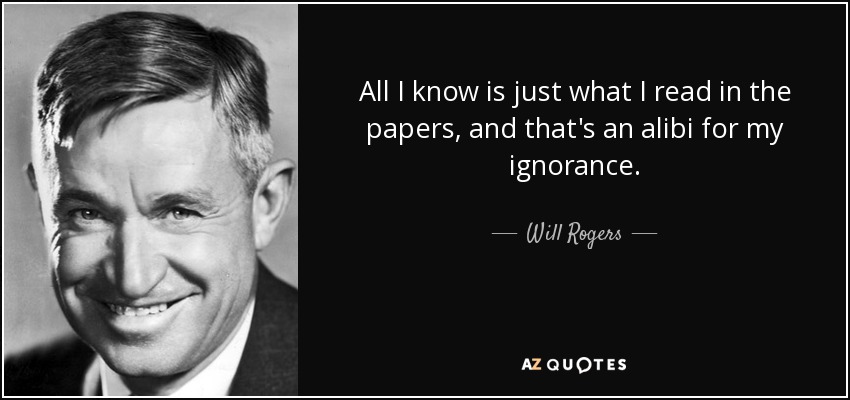
Cartoon – Alibi for Ignorance

Listening is a vast ocean surrounded by empty beaches.
I’ve been paying attention to listening, both my own and others. You’re more likely to meet a red-crested tree rat* than to meet someone who actually listens.
5 reasons shallow listening is normal:
Set the stage for deep listening:
Unfocused conversations feel like chasing chickens.
Establish conversational direction or you’ll end up exhausted and disappointed.
Three C’s for listening like a leader:
#1. Character.
#2. Calmness.
Breathe deeply.
Although listening takes energy, it requires a calm spirit.
Inner agitation blocks listening.
#3. Compartmentalization.
Set a fence around your listening space. You don’t have anything else to do except attend to the person speaking.
Explain time limits before you begin. Because listening requires rigor, you might need to set short-time limits.
After explaining limits, attend fully.
The character of a listening leader:
#1. Courage.
Churchill put it this way, “Courage is what it takes to stand up and speak; courage is also what it takes to sit down and listen.”
#2. Compassion.
“Compassion is the quality of having positive intentions for others. … It’s the ability to understand others and use that as a catalyst for supportive action.”**
#3. Confidence.
Insecurity seems to loosen tongues and close ears.
#4. Openness.
A closed mind lies behind closed ears.
Poor listening is a character issue.
What’s one thing you could do that would make you a better listener?

EQ is often cited as the difference between winners and losers. Use these quotes to up your game.
As far as I know, my MBA program didn’t teach any classes in emotional intelligence. While I got a solid education, I can’t help but think that I might have been served better by taking a course or two in EQ. After all, study after study has shown that emotional intelligence is the different between a successful CEO and an also-ran.
Here are some of the best quotes to inspire you to become a more emotionally intelligent leader:
What’s your favorite quote about emotional intelligence that needs to be added to this list? What inspires you to develop your EQ further on an ongoing basis?

Knowledge is power. Yet Congress has limited its own access to facts vital to understanding the nation’s gun violence pandemic. That’s because, since 1996, Congress has effectively prevented the Centers for Disease Control and Prevention from continuing public health research into the consequences of gun violence.
At the same time, while Congress forever proclaims its support of the men and women in blue, lawmakers have fettered law enforcement around the country in understanding gun-crime trends by restricting how the Bureau of Alcohol, Tobacco, Firearms and Explosives can share its gun-trace data.
Assuming Ohio’s congressional delegation doesn’t confuse talk with action, Ohio’s two senators and 16 U.S. House members — three of whom represent portions of Cuyahoga County, thanks to gerrymandering — should work together to eliminate these grotesque and paradoxical restrictions.
They blind congressional decision-making about gun policy – and about the extent and results of illegal gun trafficking.
The United States is awash in weapons, with more guns per 100 residents (89) than any other nation, reports CNN, citing the Swiss-based Small Arms Survey. The next closest is war-torn Yemen, with 55 guns per 100 inhabitants.
With crime guns relatively easy and cheap to obtain, cities like Cleveland are seeing steadily rising rates of gun violence. In Cuyahoga County, gun deaths as a percentage of overall homicides rose more than 14 percent in the last 25 years, according to data from the county medical examiner’s office.
Why would Congress tie the hands of police and policymakers to address this scourge? It makes no sense.
Even the late sponsor of the congressional amendment that precipitated the prohibition on CDC gun research, then-Rep. Jay W. Dickey Jr., an Arkansas Republican, later regretted it publicly.
“I wish we had started the proper research and kept it going all this time,” Dickey, who died last year, told the Huffington Post in 2015, in a story updated last year. “I have regrets.”
Dickey said such gun violence research might have developed safety measures or mechanisms for guns, as highway safety research has made roads safer: “If we had somehow gotten the research going, we could have somehow found a solution to the gun violence without there being any restrictions on the Second Amendment,” he said. “We could have used that all these years to develop the equivalent of that little small [highway barrier] fence.”
It’s not too late to restart this important research effort.
After accomplishing that, Ohio’s delegation should next work to repeal the Tiahrt amendment, named for then-Rep. Todd Tiahrt, a Kansas Republican. As modified, the 2003 amendment has added to the budget a nondisclosure requirement for ATF’s gun-trace efforts.
ATF says this doesn’t bar it from sharing gun-trace data with a law enforcement agency engaged in a “bona fide” criminal investigation, or from doing jurisdictional-specific gun trend investigations, but the amendment limits broadly how ATF can share its gun-trace data. That in turn creates critical knowledge barriers on crime-gun trends for officials in Ohio and every other state.
Repealing the Dickey and Tiahrt amendments wouldn’t crimp the rights of law-abiding gun owners. Instead, unlocking those congressional handcuffs would empower Congress by providing accurate information on which to fashion fair and practical legislation.
That assumes, of course, good faith rather than bombast on the part of Congress and the men and women Ohio sends to the U.S. House and Senate.
Twelve of Ohio’s 16 U.S. representatives, plus Sen. Rob Portman, of suburban Cincinnati, are Republicans, the congressional majority party.
That gives them leverage on eliminating these gun-ignorance amendments. They need to use that leverage. If they don’t, Ohio voters may remind them sooner rather than later that they want their lawmakers armed — with knowledge, not ignorance.
 HENRY KOTULA