In-home elder care cost is rising more than three times faster than inflation

https://www.axios.com/2025/10/30/trump-immigration-elder-care
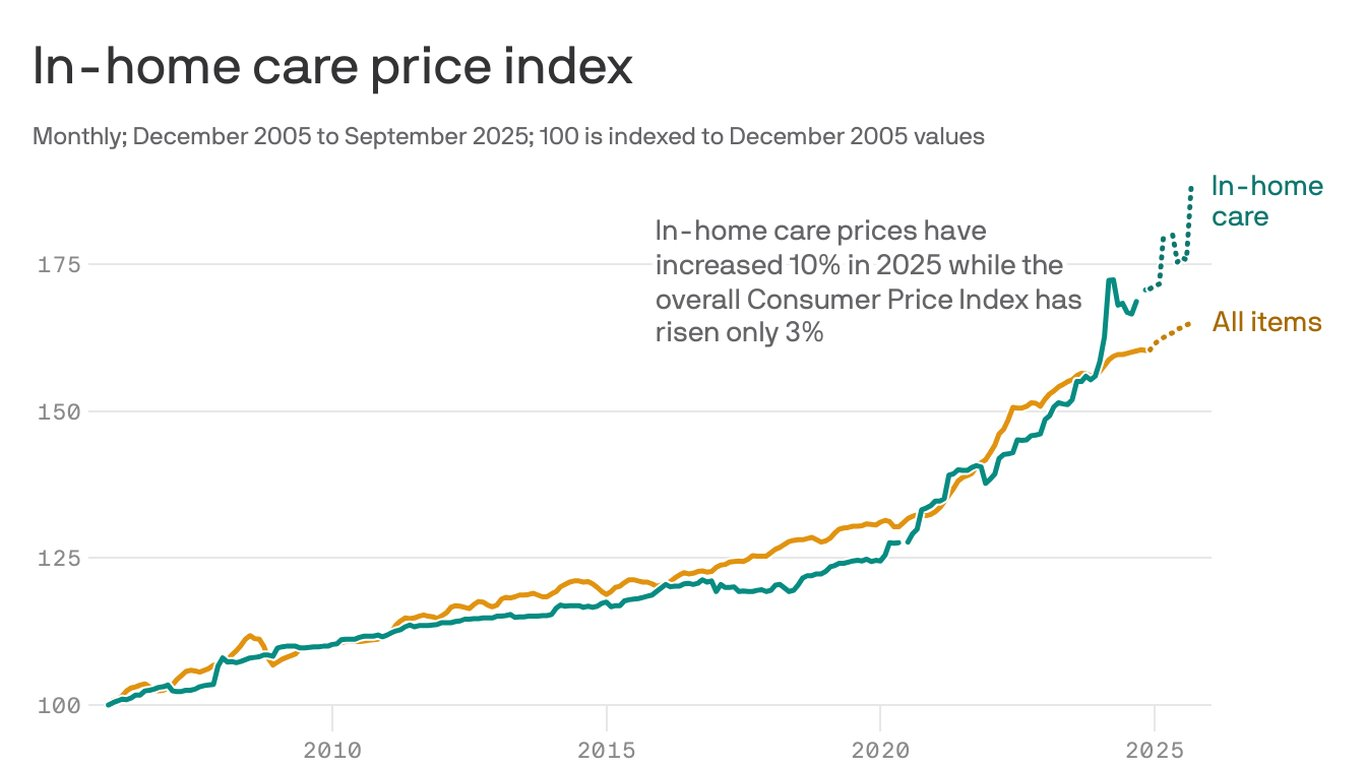
The cost of hiring help to care for an elderly or a sick person at home is skyrocketing.

Why it matters: 

A labor shortage and surging demand from an aging population was already driving up prices, and now the White House’s crackdown on immigration and funding cuts are making things worse.

By the numbers: 

So far this year, the price of in-home care for the elderly, disabled or convalescent at home is up 10%, compared with a rise of 3% for prices overall, according to government data.

  • From just August to September, prices for home health care spiked a staggering 7%.

Zoom in: 

Rising prices and the limited availability of people who do this work are pushing families to make hard choices. Some will put relatives and loved ones into institutions, a more expensive and often less desirable option than staying at home.

  • Others will drop out of the workforce or cut back their hours to care for parents, relatives or partners.
  • The supply of workers is not keeping up with demand, Matthew Nestler, senior economist at KPMG, writes in a post. “That hurts workers and their families, employers and the overall U.S. economy.”

Friction point: 

Last year, employment was surging in home health care, with an average of 13,500 jobs added each month.

  • But after the Trump administration immigration crackdown began in January, employment dropped off, falling into negative territory for three consecutive months in the spring, Nestler noted this summer.
  • This isn’t a matter of demand falling, but a cutoff in supply, he explained.

How it works: 

Immigrants make up 1 in 3 workers in home care settings, per data from KFF, a health care research organization.

  • The severe crackdown this year on undocumented immigrants and the Trump administration’s removal of legal status from workers who are here from Venezuela and other countries are making it hard to find workers, says Mollie Gurian, vice president of policy and government affairs at LeadingAge, an aging-services nonprofit.
  • The supply of workers was already so low,” she says. With fewer folks available, the companies that provide these service are raising prices to put pressure on demand. Others are raising prices in anticipation of cuts to Medicaid funding, she says.

The big picture: 

At the same time that the supply of people to do this work is falling, the number of Americans who need care is rising, as a silver tsunami of baby boomers ages.

The bottom line: 

We are only at the very beginning of a dramatic demographic shift, Nestler says.

  • Elder care is a “ticking time bomb that no one’s talking about.”

Immigration crackdown sets off alarms in hospitals

The Trump administration’s rollback of a policy that prohibited immigration enforcement in hospitals is sparking fear and confusion in exam rooms and emergency departments amid a surge in ICE arrests.

Why it matters: 

Health care workers say stepped-up enforcement is interfering with care in some instances, and lawyers say it has created enough privacy concerns that some are erasing whiteboards on patient floors and concealing medical records.

  • Many hospitals don’t have clear protocols, Sandy Reding, president of the California Nurses Association and vice president for National Nurses United told Axios.
  • That’s put nurses and other health workers in situations in which they have to confront ICE agents carrying warrants in unauthorized areas.

State of play: 

A Homeland Security Department directive in January rescinded a Biden administration policy that designated hospitals, schools and churches “sensitive locations” that were off limits to immigration enforcement.

  • That had the effect of giving Immigration Customs and Enforcement more leeway to detain individuals in hospitals. They are also able to closely monitor people in their custody who are brought in for medical care.
  • Health systems have been seeking legal advice and stepping up training for employees about what’s permissible in public and private spaces.
  • “The judicial warrant needs to be specific as to the place and who you’re looking for. It’s not going to say you can just walk into the ICU and check everybody,” Douglas Grimm, head of ArentFox Schiff’s national health care practice and a former hospital administrator, told Axios.

Zoom in: 

The legal gray areas were driven home by physicians at a Los Angeles hospital who told LAist that ICE personnel interfered with the care of a detainee. Medical personnel were not able to call the patient’s family, even to find out health history, and agents refused to leave during confidential medical conversations.

  • Adventist Health White Memorial, in a statement, said it provides the same level of care to patients who come in while in government custody. “Our guidelines for caring for patients who are in custody are based on legal requirements. Our primary goal is to ensure the health and safety of our patients, staff and visitors,” the hospital operator said.
  • Elsewhere, a UCLA emergency nurse said she was blocked from assessing a screaming patient by an ICE agent, the Guardian reported.
  • And a Chicago alderwoman was arrested by ICE agents while checking on detainee at hospital in Humboldt Park, CBS reported.

Between the lines: 

Distinguishing which areas are public and which are private is the first order of business, said Maria Kallmeyer of Quarles & Brady. So is laying out a protocol, including a phone tree with whom to call if ICE agents arrive, for front desk receptionists.

  • Staff are generally told to inform ICE that they don’t have the authority to grant access and should keep them in the lobby until they are able to reach a supervisor, she said.
  • Agents can access private areas like patient rooms if they have a judicial warrant or if they brought the patient in for care while in ICE custody.
  • In such scenarios, Grimm said, he advises health facilities to have a plan for wiping whiteboards and ensuring that all medical records on paper or on screens are put away.
  • Grimm noted past instances in which one officer enters a patient’s room while a second wanders the halls. In those scenarios, it’s up to the nurse manager or compliance manager to orally point out the officer is not authorized to be anywhere but with the specific patient.
  • “If the officer keeps walking, you have to take the next step, which is just try and record that. But don’t try and impede their progress,” Grimm said.

The other side: 

ICE did not respond to requests for comment from Axios.

  • A spokeswoman previously told LAist the agency “is not denying any illegal alien access to proper medical care or medications” and that it’s “longstanding practice to provide comprehensive medical care from the moment an alien enters ICE custody.”

Yes, but: 

Reading of the California Nurses Association said she received an Instagram video from some of her union members this summer showing ICE agents with large guns sitting behind a hospital reception desk. She learned they were there because they had brought a patient in custody to the facility.

  • It was intimidating for visitors and staff alike, and also created a clear potential privacy violation for any patient entering and being asked to provide personal information as they enter the building, she said.
  • “The nurses couldn’t do their work unencumbered because they were worried about the ICE agents,” she said. “There was one [agent] that was found in another unit which was off limits. They had to ask that person to leave because they weren’t supposed to be in patient care areas. So it became very clear that we need some rules.”
  • California Gov. Gavin Newsom (D) recently signed into law a requirement that hospitals have protocols prohibiting health providers from giving immigration authorities access to non-public areas unless there’s a warrant or court order. It also expanded the definition of protected “medical information” to immigration status.

It’s an important step toward setting some ground rules, but certain health facilities are still seeing dramatic drops in caseloads as patients forgo care.

  • “It is creating an atmosphere of fear,” Céline Gounder, clinical professor at NYU, told CBS Mornings about her experience in New York. “My colleagues and I have had numerous patients tell us that they hesitated or waited too long to come in for health care.”