Yes, I’m still talking about it: Last week at our CEO Exchange in Avon, Colorado, even more became very clear: if you’re still thinking of a hospital as a destination, you’re already behind.
I’ve been watching health system strategy evolve, but the conversations I heard in the Rockies felt like a definitive pivot. The “four walls” of the hospital are officially a thing of the past. CEOs are now designing systems around an ambulatory-first, “no wrong door” philosophy.
We heard about integrated care sites that mash together primary care, behavioral health, dental, and even optometry under one roof. One of my favorite moments was hearing two CEOs who, historically, were supposed to spend their careers hating each other, decided instead to build a shared walk-in clinic.
It turns out that when leaders stop protecting their turf and start looking at what the community actually needs, everyone—including the bottom line—wins.
But how do you scale that without losing your soul? That’s the part that always gives the C-suite a headache. The consensus in the room was pretty straightforward: centralize the “boring” stuff like revenue cycle and marketing (hey, I didn’t say it!!), but keep decision-making local. As one executive put it, “Implementation is local.“ If the people on the front lines feel like they’re just taking orders from a corporate office three states away, your strategy is dead on arrival.
Also today, a reality check on the relationship between nursing and HR.
Jennifer Spinelli, director of system talent acquisition at Beebe Healthcare, joins us on HL Shorts to discuss a disconnect I’ve seen play out in a hundred different ways. You have nurse leaders who are feeling the immediate, visceral burn of a staffing gap on the floor, and TA leaders who are trying to balance that urgency with the cold reality of the labor market.
How do you bridge that gap without someone ending up frustrated? It comes back to transparency and shared data. When everyone is looking at the same map, it’s a lot easier to agree on the destination.
Both stories point to a new era of healthcare leadership that values partnership over competition and operational alignment over corporate mandates. Whether you’re building a new clinic or a new workforce pipeline, the most successful leaders are the ones willing to tear down the silos they spent years building.
An emergency helicopter flight, life-saving surgeries and a health insurer that said it wasn’t medically necessary.
When Pamela Talley came home from an Arizona cycling vacation with a surgically repaired broken left wrist and elbow, she knew – as a retired family physician – that she’d be facing a tough recovery.
What the 62-year-old Colorado retiree wasn’t expecting was the letter she received not long after she got home last year from her health insurer, Anthem Blue Cross and Blue Shield. It informed Talley that her hospitalization in Tucson – where they’d helicoptered her after the nasty gravel spill which left part of her broken wrist protruding through her skin – was “medically unnecessary,” and the two emergency surgeries were not covered by her policy, either.
It said that she would be responsible for the medical costs that Anthem — which is part of the giant for-profit insurance conglomerate called Elevance Health — would not cover: $490,000.
“I’m still on narcotics,” Talley recalled of that moment. “I’m three days post-op. I’m in pain. I’m in a pretty vulnerable position. But my initial reaction – honestly, I think – as a physician was, ‘This is preposterous. I’m going to be able to resolve this with a telephone call.’”
Talley was not able to resolve this with a telephone call. Instead, the letter was just the beginning of an ordeal that lasted for 13 months and involved many two-hour phone calls, often waiting on hold, contradictory statements and explanations, and finally a plea for state regulators to help convince her insurer to pay.
The enormous dollar figure makes Talley’s battle somewhat unique, but receiving an insurance company denial letter is an experience that is painfully familiar to millions of Americans – and the problem is only getting worse. Exact numbers are hard to come by, but one 2023 study of patients covered in the Affordable Care Act (ACA) Marketplace found insurers initially denied 20% of claims.
Studies have also shown that it’s highly possible that patients who appeal these rejections can get them overturned, and yet very few – as few as 1%, it’s been reported – actually do fight back against rejections. Talley’s case arguably is a window into why, and why insurers count on this lack of appeals as they post record profits every year. Studies have shown that the cost of coverage denials falls hardest on lower-income Americans who lack the time and resources to fight back.
If a doctor like Talley with a lifetime of health care experience had to fight for more than a year for a fair resolution, what chance do the rest of us have?
Talley retired early from her second career in public health to move back to Colorado, where she had planted some roots and could better indulge her passion for the great outdoors. It was that hobby that took her with her two adult sons on the bicycle tour on scenic gravel trails in Arizona, near the border with Mexico.
On the second day of that excursion, Talley was moving quickly downhill on what the guides called a difficult “technical stretch,” and was clipped into her bicycle, when she fell – hard. As she lay on the gravel, she looked at her left arm, which she’d used to break the fall. Her wrist was clearly broken – a part of the bone was protruding through the skin – and it appeared her elbow was broken as well.
Between the pain and the remote site of the accident, Talley’s insurance coverage wasn’t on the top of her mind as the tour van trailing the cyclers picked her up and began the arduous task of getting her the urgent medical care she needed. It took two hours just to get to an emergency clinic near the border, where she was sedated, X-rayed, had the wrist placed in a splint – and where it was decided she’d need to get to a Level 1 trauma center. The nearest one was in Tucson, which was five hours away by car or 45 minutes by medical helicopter.
Knowing the risks of delaying an operation, she chose the helicopter.
“It was clear I needed surgery,” she recalled. But getting to Tucson was only the first step. “They see me, then I sit on a gurney in the hall in the emergency department for about eight hours,” she recalled. And then, because they had no beds upstairs, I was ultimately put into the labor and delivery ward overnight because that’s where they had a bed.”
Finally, she underwent two separate surgeries with hand and elbow specialists over a period that lasted nearly a day, as well as a procedure to alleviate nerve pressure. Talley would spend a couple nights in the hospital, first to get intravenous antibiotics and for observation, and also until she could arrange a flight back to Denver.
“So the day after I got back to Denver, I got a notice from Anthem that my $490,000 hospitalization bill was denied as medically unnecessary,” Talley said.
Too young for Medicare when she retired, Talley had signed up for Anthem’s high-deductible health insurance plan in the Affordable Care Act Marketplace. She said she knew she’d be liable for the first $10,000 or so in annual medical expenses, and she was OK with that. But she said she never expected that the giant insurer would find a plethora of grounds for not covering her emergency – that out-of-state care wasn’t eligible, or that her surgeons were out-of-network, or that some of her treatment was excessive.
Talley waited a couple days until she felt better to call Anthem, and then waited two hours to speak with someone who contradicted himself on the call, first stating that the denied care wasn’t medically necessary and then saying that actually the issue was that it occurred in Arizona and not in Colorado.
“Preposterous,” she said. “Come on, this was an emergency. It’s not like I went to get a hip replacement at the Mayo Clinic, which is what my plan is trying to prevent.” The Anthem representative promised her case would be reviewed, but nothing happened for a couple of months.
As bills for Talley’s complicated care trickled in, she was befuddled to see which services were covered and which were not. For example, Anthem was paying the anesthesiologist for her operation, but not the surgeons.
By now, Talley was calling Anthem about every three weeks, typically spending a couple of hours on hold each time. “I would get to a person, this conversation would start and they would hang up on me. And it got to the point where I felt like, oh, there’s a pop-up that says, ‘Hang up on this person. She’s persistent.’”
Talley filed a formal appeal within the six-month time period, and – again, with significant delay – finally received the guidelines for this policy upon which she argued that all of her care should have been covered. When Anthem denied her appeals, she looked into hiring a lawyer when she learned from a family member that the Colorado Department of Insurance had helped resolve a disputed claim for a much smaller amount. Talley convinced the state agency to help intervene in her matter.
Her last-gasp plea for government intervention worked, as regulators reminded Anthem of relevant state and federal statutes – such as the 2022 No Surprises Bill – intended to ensure claims such as Talley’s are covered. Still, the bills were resolved in pieces, not one fell swoop. By this spring, Talley was down from the initial $490,000 to one final $135 radiology bill, yet she continued to contest it.
“I’m stubborn,” she said with a laugh, and ultimately Anthem paid that bill as well. It took 13 months, but Talley ultimately only paid the $10,000 under her deductible.
But the big picture, unfortunately, is that there are too many other cases like Talley’s out there, and the number is likely to rise. For one thing, artificial intelligence, or AI, is increasingly used by Big Insurance to review claims, and often deny them, in the most coldly calculating fashion.
But also, the refusal late last year by the Republican-led Congress to extend subsidies that allowed millions of Americans to afford their monthly ACA premiums has forced many families to seek inferior alternatives – including high-deductible plans such as Talley’s. These policies typically have more loopholes that insurers can invoke to deny claims – exactly what happened to Talley.
However, as Talley herself pointed out, the tiny minority of patients who appeal these denials are often successful, especially when they are persistent, or make use of every available resource. For example, one KFF survey of 2022 data found that appeals of insurance companies’ prior authorization rejections successfully overturned them more than 82% of the time.
She also advised patients to study their insurers’ guidelines ahead of time. “I had never read my contract in detail,” Talley said. “What’s covered, what’s not covered. I’d never had the reason to do that, but now I know.”
Today, recovered from her Arizona accident, Talley is looking forward to her next outdoorsy travel adventure, in Europe. This time, she said she won’t clip into her bicycle – and she’s also getting trip insurance. She said: “I don’t want to not do things that have some risk, you know?”
To understand how private equity, or PE, may be reshaping the way physicians experience the practice of medicine and their relationships with hospitals, insurers, and patients, we interviewed six doctors who have worked for PE-backed practices and four advisers who guide physicians through the partnership process.
We wanted to know if an infusion of capital from private investors with plans for expanding or restructuring a practice makes it easier for physicians in private practice to maintain a sense of independence and even lessens burnout. Or instead, if these transactions convert once-independent doctors into employees with less agency than before.
The physicians we interviewed included two urologists who ran one of the largest PE-backed specialty practices in the United States before it sold to Cardinal Health; two orthopedic surgeons and one obstetrician/gynecologist (ob/gyn) whose practices were acquired; and an anesthesiologist who saw his own practice disrupted when two PE-backed staffing companies shook up the local market. All but one agreed to speak on the record about their experiences. The other asked to remain anonymous because his comments focused largely on former colleagues.
When Investors View Doctors as Partners, Satisfaction with Private Equity Deals Is Higher
For physicians, the value of private equity investment is very much in the eye of the beholder, and it’s largely contingent on whether physicians are treated by the investors as employees or as business partners. The PE deals that go awry — sometimes publicly, due to litigation or physician departures — often involve ventures where PE firms extract profit by changing productivity standards, staffing models, and hours of operations. When profits are achieved by expanding a practice’s services or its geographic reach, there’s more opportunity, if not incentive, for partnership.
Specialties in which changes in technology or treatment protocols are redefining the role of physicians can create growth opportunities for PE firms and the practices themselves. Urology provides an instructive example. Over the past three decades, as treatment modalities for prostate cancer have evolved, urologists have assumed a more sizeable role in cancer care. While it can be lucrative to provide radiation therapy, immunotherapy, and oral oncolytics or infusions in outpatient settings, or establish ancillary businesses such as pharmacies, these require upfront capital and management expertise. Practices with 10 or fewer urologists, once the norm in the U.S., may lack the resources to take advantage of these opportunities. They also may struggle to compete with nearby health systems that command higher payments from insurers and larger discounts from suppliers.
Add in the difficulty of recruiting younger urologists to replace retiring doctors and administrative burdens such as managing payer contracting and cybersecurity threats and PE begins to look more like a savior than a threat. Indeed, while nearly half of urologists were employed by hospitals or other institutions as of 2019, PE acquisitions of urology practices have become a dominant form of practice consolidation in recent years.
Upfront Payment Leads to Practice Changes and a Big Payday
Solaris Health, at one point the largest of at least six PE-backed urology practices in the United States, scaled quickly — from 130 physicians when it was launched in 2020 to almost 800 in August 2025. It did so by pitching itself as a national practice controlled by physicians but backed by Lee Equity, a firm with investments in many specialties. Those who signed on received stock and a lump-sum payment that, in keeping with the conventions of PE transactions, was a multiple of a practice’s future income that physicians were willing to forgo. Although the cash is an advance on future earnings, the payment is often taxed at a capital gains rate, enabling physicians to reduce their tax burden and begin investing.
“I always tell doctors if you’re tempted to buy a boat with the money, don’t. Take the cash and invest it,” says Gary Kirsh, MD, cofounder of Solaris Health. He served as the company’s CEO until Cardinal Health, a pharmaceutical and medical products supplier, paid $1.9 billion for the business in 2025.
In the lead-up to such sales, PE firms recoup their investment through what’s known as “the scrape” — taking a percentage of practice profits, typically between 20 percent and 30 percent. While this makes a sizeable dent in physicians’ take-home pay, many PE firms promise to restore income to previous levels by increasing practice revenues or reducing expenses. Known as “income repair,” it’s a process that can take a few years to play out.
Raj Patel, MD, a urologist from Homewood, Ill., who joined Solaris Health in 2021 and served on its corporate board, was initially skeptical of promises of revenue growth because he was already so entrepreneurial. He also valued his independence. “I would tell my partners, our group doesn’t need private equity,” Patel says.
Over time, however, Patel began to see that joining a large PE-backed practice, with more than 120 urologists in the Chicago area alone, might be a way to enhance access for patients and professional satisfaction for doctors. Instead of everyone performing the same procedures and sending advanced cases to large health systems, they could begin to subspecialize and refer patients to one another.
While the MSO took a share of profits, it also assumed an equal share of an individual practice’s expenses, including the cost of hiring advanced practice providers to handle low-acuity cases and manage calls from staff in local emergency departments — a pain point for Patel’s practice, as this support was expected by hospitals but not reimbursed. Solaris also hired navigators to support patients as they explored different options for treatment. And it had the financial resources to invest in a laboratory for genetic testing, a pharmacy, and the data analytics to determine why some practices had better clinical outcomes or financial performance than others. Although clinicians are expected to follow clinical pathways, Patel says those are determined by clinicians that advise the MSO. “Physicians really need to lead that,” he says.
After he joined, Patel was also able to begin enrolling his patients in clinical trials, another income stream. As revenues increased, Patel achieved income repair in just one year. While some might worry this may lead to higher health care costs, Kirsh believes the opposite is true — that consolidation of physician practices enables clinicians to steer patients to outpatient settings, which, he says, can be significantly cheaper than hospital-based care due to lower fixed costs and the avoidance of facility fees.
Our business model is not to acquire scale and hold insurance companies hostage on rates. We’re creating a national network that shares best practices, professional management, and ancillary services, and doing it in a way that streamlines care for patients.
Gary Kirsh, MDcofounder, Solaris Health
Cardinal Health says it hasn’t made changes to Solaris’s operations or pricing since the acquisition; whether that holds true remains to be seen. Its management services organization, The Specialty Alliance, formed in 2025, now has a stake in the practices of roughly 3,000 providers specializing in gastroenterology and urology. The company also has acquired practices affiliated with Integrated Oncology Network, which has 50-plus community-based oncology centers and more than 100 providers. Sen. Elizabeth Warren (D–Mass.) has raised concerns that the company is buying physician practices as a means of locking customers and physicians into restrictive contracts for drugs and other supplies, reducing competition among wholesalers, and driving up costs. She’s also concerned that practice acquisitions will reduce competition between hospitals and nonhospital providers and has called on the Federal Trade Commission to scrutinize pending sales.
Soon after the deal was announced, Kirsh retired as CEO, handing the reins to James Weber, MD, a gastroenterologist from Southlake, Texas, who became CEO of Specialty Care Alliance after Cardinal acquired a majority stake in GI Alliance in November 2024 for $2.8 billion. Weber says Cardinal’s investment enabled his group to get off the private equity “merry-go-round” and begin partnering with urologists and other specialists who aren’t solely dependent on hospitals for delivering care. Instead of buying a stake in the MSO only to sell it again, as a private equity investor might, Cardinal sees value in building a long-term relationship with physicians as this diversifies its customer base and opens up the possibility of selling higher-margin products and services, Weber says. Rather than forcing such supplies and services upon doctors, Cardinal competes with other vendors in an open-bidding process and profits when the MSO gets the best deal it can — even if it’s from a competitor, he says.
Where Growth Is Harder to Achieve, Tensions Are Magnified
Partnering with private equity firms may have less upside for specialists who have reduced practice expenses to the bare minimum; have maximized their income from ancillary services like imaging, physical therapy, and durable medical equipment; or are working at full tilt. In these instances, income repair may be impossible, especially if the firm tacks on new charges or takes away benefits.
Two orthopedic surgeons we spoke with, one in Pennsylvania and the other in Florida, said partnering with PE had cost them financially. Both had worked in what they described as well-respected practices that faced competition from large academic medical centers intent on expanding, in one case by buying up primary care practices that influenced local referrals patterns. As nonprofits, the systems had several advantages: a lower tax rate and access to the federal 340B Drug Pricing Program, which allows safety-net providers to purchase drugs at a discount and receive reimbursement from insurers at market rates.
Adrienne Towsen, MD, an orthopedic surgeon from West Chester, Pa., says that after her 75-physician practice was sold in 2022 to a management company backed by PE, promised changes to back-office functions never materialized, and the accounting grew more opaque. Then came cuts. Doctors were told they needed to start paying for their own cellphone plans, as well as life and disability insurance. Management fees also increased, and the ancillary income physicians once earned from physical therapy and MRIs — worth as much $100,000 a year to each doctor — was carved out of their compensation.
While she had received an upfront payment, she found it didn’t make up for the cuts in her take-home pay. Towsen says part of the problem was that the revenue target she and her colleagues needed to hit to bring fees down was set at an all-time high, the year of the sale.
Towsen says she started to feel like she was caught in a bad relationship. Problematic behavior was followed by unfulfilled promises from management to do better. She wanted to exit, but the contract required her to pay back the lump sum if she left before three years. Leaving also would trigger a noncompete clause, severing relationships with patients she’d built over two decades. She resigned the first day she could, giving up her shares in the company.
Equally painful was the disruption in her relationships with patients. “I had very frank discussions with patients and told them exactly why I was leaving. They were upset,” she says. Many reported experiencing similar problems with other specialists.
I kept hearing, ‘I’m losing all my good doctors.’ It makes you feel so guilty.
Adrienne Towsen, MDorthopedic surgeon
When the Math Doesn’t Add Up
R. James Toussaint, MD, an orthopedic surgeon in Florida who worked in investment banking before going to medical school, chose to join The Orthopaedic Institute in Gainesville because it had a reputation for high-quality care and was large enough for him to subspecialize in foot and ankle surgery. When PE firms came calling in 2017, he had a hard time persuading his partners that it would be the PE firm that benefited, not them. “I had structured deals like this myself and knew what the benefits and drawbacks were. I also knew once you sell your house, it’s nearly impossible to buy it back,” he says.
Once the sale went through, he says the firm added new layers of management overhead, including executives tasked with business development and marketing. “These aren’t positions generating revenue the way surgeons do. They’re essentially cost centers,” Toussaint says.
Since he had already maximized the hours he worked, as well as opportunities to earn income from ancillary services like MRIs, physical therapy, and durable medical equipment, there wasn’t a way to offset these expenses and other management fees by working longer hours. “There’s no eighth day in the week to work,” he says.
He says the lump-sum payment he’d received wasn’t sufficient to cover the loss of income. After a couple of years, he decided to resign and negotiated a settlement to release him from the noncompete clause. He then joined the academic medical center that was once viewed as a competitor, a move he wishes he made sooner. “Looking back, the whole transaction just made no sense. I should have just left immediately because there literally was no upside.”
Toussaint says in some cases patients are left in the dark when physicians leave. “It’s embarrassing for the group,” he says. “So they just say they left or they retired and the patients are left trying to figure out where their doctor is. It’s unfortunate.”
We reached out to the private equity–backed ventures that help run the two orthopedic surgery practices for comment. Both offered to connect us to physicians with a different perspective.
John Stevenson, MD, a neurosurgeon who’s been at The Orthopaedic Institute for three decades, agreed the early days of partnering with a private equity–backed firm had its ups and downs, in part because they were the first orthopedic practice to do so and it took time to develop and execute a growth strategy. But over the long run, he says he’s come out ahead because he’s been able to see more patients with the help of midlevel clinicians and gained access to better insurance contracts, lower-cost supplies, and other resources that help patients, including staff with pain management expertise.
Jason Sansone, MD, an orthopedic surgeon in Madison, Wis., found it helpful to partner with the private equity–backed venture Towsen did — Healthcare Outcomes Performance Company (HOPCo). He’d been employed by a multistate health system but found its bureaucracy and the inability to innovate stifling. “We wanted more autonomy and offered to assume financial risk in exchange for it,” he says, but the health system insisted on an employment model.
In 2023, he and 10 other doctors struck out on their own, betting they could negotiate contracts with payers that would reward them based on the value of services they provided rather than the volume. “Sometimes that means more conservative treatments and other times, it’s just doing surgery instead of requiring patients to go through physical therapy and steroid injections that you know aren’t going to help,” he says. Having fought for their independence, he and his partners were reluctant to give up equity in their practice, so they hired HOPCo to provide management services and built an ambulatory surgery center as a joint venture. Sansone says he’d only consider giving up equity in the practice itself to fund an expansion. “We view private equity as a source of capital for growth rather than a means of generating liquidity,” he says.
From Boutique to Big Box Store
The ob/gyn we spoke with, now working in North Carolina, joined a large obstetrics practice just three months before its partners voted to sell it to a PE-backed venture. As a new hire, Dr. M (who asked for anonymity because his comments focused largely on former colleagues) wasn’t eligible for the lump-sum payment, but he figured that banding together with other doctors in his state would improve payer contracts and make it easier to participate in value-based contracts.
Dr. M didn’t anticipate how hard it would be to lose the ability to make business decisions — like choosing a vendor or launching an infusion clinic so pregnant patients experiencing nausea didn’t seek emergency care. Merging practices brings standardization that tends to lift low performers but restricts the flexibility of high performers, he says. “It’s like going from being a boutique specialty store to being bought out by Walmart. We were doing everything in-house and doing things well. It cheapened our brand.”
Dr. M also didn’t like having salaries capped. He figured his fellow physicians were leaving as much as $200,000 on the table each year despite seeing as many as 35 patients per day.
I think there are people who are happy just going to work and getting a paycheck, but if you are in medicine to take care of patients and be in business, private equity ownership is a frustrating thing.
Dr. MOb/gyn
After three years, Dr. M left to become a “locum tenens” provider, a temporary worker paid at a premium by a hospital to fill a critical workforce gap. While there is a baseline level of job insecurity inherent in being a locum provider, they usually command high hourly rates for short-term work, giving providers flexibility but potentially disrupting relationships between patients and providers. “Locums is inherently bad for obstetrics,” he says, and some doctors may avoid it because they can’t foster long-term relationships with patients, but he believes younger patients view doctors more interchangeably and prioritize having timely access to any doctor rather than a specific one. “They’re not necessarily as sentimental as their parents were,” he says.
Dr. M thinks locums jobs may be increasingly attractive to physicians with young families who want substantial time off and to new residency graduates who don’t want to work as employees in large provider groups but have trouble identifying smaller independent practices. As for his old colleagues, he says, “I’m not mad at them that they joined with private equity. I am more frustrated by the fact that they felt like they had to.”
Trying to Sidestep Private Equity
Not all medical specialties draw interest or upfront cash from private equity firms. Since the No Surprises Act went into effect in 2021, preventing hospitals from charging out-of-network rates for the services of emergency physicians, anesthesiologists, and other emergency care providers who opt out of insurance networks, PE firms have had less incentive to invest in their practices.
Marco Fernandez, MD, an anesthesiologist and former president of Midwest Anesthesia Partners, the largest group of independent anesthesiologists in Illinois, turned down such offers when they came in because he doesn’t like how PE-backed anesthesia groups tend to assign cases to certified nurse anesthetists and make physicians their supervisors. “We wanted to do our own cases and take care of our own patients,” he says. “If we’d sold or joined a staffing company, we’d be managing as many as 10 surgeries at once. It would make us glorified rescuers, running in for emergencies and filling out paperwork,” he says. “It’s a different level of stress.”
Retaining hospital contracts for the then-300-physician group became much harder when PE-backed staffing companies using such models stepped into the market, offering a less expensive service. “Within a two-week span, we lost two contracts,” Fernandez says. Some physicians in the group opted to join PE-backed ventures or become hospital employees. The remaining 100, who wanted to retain their model, now primarily serve ambulatory surgery centers or work in three hospitals as locum providers. Similar disruptions are playing out in other markets, leading to delays in surgeries.
Fernandez worries that not having the same anesthesia staff in facilities will impede communication and quality improvement, but he hasn’t found hospitals willing to subsidize a physician-centric approach. In 2022, he joined three other anesthesia groups in forming the Association for Independent Medicine, an advocacy organization that’s been calling for greater regulatory oversight of PE ventures and protections of clinicians’ decision-making. Another organization, the Coalition for Patient-Centered Care, is pursuing a similar mission, in part by asking state and federal lawmakers to apply antikickback and fraud and abuse laws to PE acquisitions of physician practices.
Partnership Is Crucial
The experiences of these physicians, while purely anecdotal, suggest private equity investment can be advantageous if the partnership is structured in a way that aligns physician and investor interests. “A lot of the bad case studies you see involve private equity firms turning physicians into employees whose income is tied to what they generate, mirroring what health systems do,” says Robert Aprill, a partner with Physician Growth Partners, an investment banking and advisory firm that represents physicians in transactions with PE firms. There’s higher satisfaction when investors tie compensation to practice profitability and add value by helping clinicians gain access to data and discounts on supplies, he says. “Private equity can become a vehicle to create super groups across state lines.”
Physicians have to be flexible, Patel says. “Whenever you sell to private equity, it’s not a lifetime achievement award where you walk away with a check. It’s a growth model. That’s where I see private equity deals fail. Both sides aren’t willing to grow together.”
If a partnership goes awry, there can be severe consequences for physicians. Toussaint says that half of the partners at his former practice were gone at the time he spoke with us, and that there was a “mind-boggling” amount of litigation happening. While MSOs typically pick up the cost of a defense, such expenses cut into the profitability, and thus the resale value, of the business. Towsen has also seen instances in which doctors departing from PE-backed ventures had to hire lawyers and forensic accountants to protect their interests.
Keep the Exit Pathway Clear and Well Lit
Too often physicians get distracted by the lump sum that private equity firms offer and sign away rights via letters of intent before showing them to a lawyer, says Randal Schultz, JD, CPA, a health care lawyer with Lathrop GPM in Kansas City. He encourages his clients to capture what matters most to them in contracts, including the hours and years they are expected to work, the terms of compensation that can and cannot be altered, and, perhaps most important, the circumstances under which they can exit without being subject to a noncompete clause or a clawback of the initial payment. “If you get terminated without cause, or they breach the contract, you should be able to walk away without any restrictions,” he says.
PE firms often understand and will try to exploit physicians’ risk aversion, Toussaint says. They know that clinicians with children and tuition bills in their future may be hesitant to start practicing in a new area. In addition to uprooting a family, they’d be subjecting themselves to additional background checks and licensing paperwork. “It’s really time-consuming and draining,” he says.
Ericka Adler, JD, LLM, who leads the health law practice at Roetzel and Andress in Chicago, encourages physicians to think about how they will continue to practice if things go south. “I’ve seen doctors who were terminated from their practices after selling it be subject to a noncompete clause,” she says. Adler also sees a lot of young doctors who are very opposed to working with a PE firm. They want an exit pathway written into their contracts if the practice they join decides to sell to one, so they can move on to a practice that isn’t PE-owned or PE-managed.
Invest in Yourself
Toussaint hopes physicians will consider a third way: capitalizing themselves. “If you have a good management team for your practice, tell them to borrow money to pay partners who want to retire. Then use some of that money to stay true to your growth strategy,” he says.
Now in academia, Toussaint warns the residents he trains to preserve their freedom at all costs. “I tell them your entire life as a doctor has been trying to get in — to the best high school, the best college, and the best medical school. Now your goal when you are negotiating these contracts is to figure out how the hell to get out.”
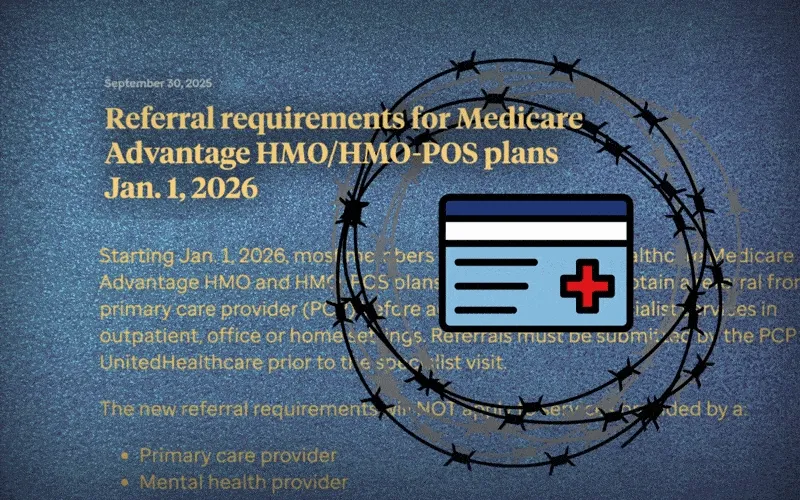
New referral requirement for HMO and HMO-POS plans alarms patients and doctors, who predict bureaucratic delays and reduced access to care.
Theresa Schwartz, a 66-year-old Milwaukee plumber, says she’s one of those people who never went to a doctor before she was 40. That has changed in the second half of her life as she has dealt with major health issues, including lung cancer and rheumatoid arthritis.
In recent years, her regular visits to the Milwaukee Rheumatology Center have been covered, without hassle, by her Medicare Advantage insurance provided through the nation’s largest health insurer, UnitedHealthcare. But Schwartz was surprised and became upset during her most recent visit there when she was told that — because of a new UnitedHealthcare policy — she will now need a referral from a primary care physician to be covered.
Schwartz said she’s never had a primary care physician.
“I’m just spinning the hamster wheel,” said Schwartz, who said in a phone interview that she is already confused and frustrated by the new policy and has little patience or interest in finding a UnitedHealthcare in-network physician. She even offered to pay cash for her visits, which the Milwaukee clinic said it cannot accept for Medicare patients.
Schwartz’s discontent over the new UnitedHealthcare policy — which launched at the beginning of the year, with reimbursements for visits without referrals to certain types of specialists set to stop after April 30 — is hardly unique. Health care advocates say the policy change affects a large pool of senior citizens in the insurer’s HMO and HMO-Point of Service (POS) Medicare Advantage plans. This is a healthy chunk of the estimated 8.5 million seniors who get their Medicare Advantage coverage through UnitedHealthcare — one of every four MA enrollees.
“I have patients in their 90s who are now facing this, if you can imagine,” said Nilsa Cruz, the tireless patient advocate for Milwaukee Rheumatology Center who frequently speaks out at the Wisconsin state capitol and elsewhere about health care issues. “And they don’t understand their insurance cards, anyway.”
Cruz predicted “a total disaster” when the UnitedHealthcare policy, which is currently in a sort of soft-launch mode, takes full effect in May, as both patients — many who’ve been seeing a specialist for 15 or 20 years without ever needing a referral — and their doctors struggle to adapt to an onerous new system.
The change, which is likely to have the effect of reducing specialist visits and thus saving UnitedHealthcare millions if not billions of dollars, isn’t taking place in a vacuum. Rather, it’s one more assault on seamless and efficient health care coverage. Patient inconvenience seems to be a cornerstone of this icon of Big Insurance’s plan for dealing with what its executives claimed last year were $6.5 billion in annual higher costs.
In recent months, UnitedHealthcare has dropped as many as 180,000 enrollees from its Medicare Advantage plans in targeted geographic areas and plans to drop more than a million by the end of this year. It has also “narrowed” its provider networks, relegating certain clinical practices, such as rheumatology clinics, which provide costly infusion therapies, to out-of-network status.
Some analysts had predicted a kinder, gentler UnitedHealth after a tragedy that made national headlines — the murder in New York of UnitedHealthcare CEO Brian Thompson in December 2024 — focused new attention on the company’s aggressive use of prior authorization to deny coverage for medically necessary care. Instead, the giant insurer has doubled down on ways to drive the highest-cost patients and providers from its system, making it necessary for millions of seniors to scramble to find either new MA insurers or new doctors. Many undoubtedly will go untreated.
The unwelcome requirement for many of UnitedHealth’s Medicare Advantage patients to get primary-doctor referral for treatments they’ve often been getting for years from a specialist looks to be one more way the company is nickel-and-diming a path back to higher profits on the backs of patients with chronic health issues.
Needless to say, UnitedHealthcare, whose financial performance has disappointed investors for more than a year, doesn’t portray the change that way. In announcing the move late last year the company hailed it as a way to improve communication between its affiliated providers and prevent unnecessary tests or procedures, or visits to a specialist that aren’t really necessary.
“The goal of this referral process is to help increase primary care provider (PCP) engagement with patients and help foster collaborative partnerships between PCPs and specialists,” is the upbeat jargon UnitedHealthcare used to explain the change on its provider portal.
Since Jan. 1, the change has been in what UnitedHealthcare considers “a trial period,” which means that while it wants patients to begin getting primary-care referrals before seeing certain types of specialists, visits without a referral are still covered for now. That will no longer be the case after April 30.
The policy does exempt more than a dozen specialists or types of visits — most notably oncology, as well as mental health treatment, physical therapy, and some other common medical treatments. It also won’t affect MA enrollees in California, Texas, and Nevada where referrals were already required.
Madelaine Feldman, M.D., the New Orleans-based immediate past president of the Coalition of State Rheumatology Organizations, said she imagines dire scenarios in which a patient with a sudden flare-up cannot get speedy treatment because of the inability to get a speedy referral, or visits that aren’t covered because the referral is mishandled.
“So the fact that UnitedHealthcare has decided that rheumatologists are not capable of deciding when a patient needs to be seen is ludicrous, capricious, and most importantly, dangerous,” Feldman said. She added that situations that are harmful for patient care “will be seen more and more as a result of policies enacted to improve UnitedHealthcare’s bottom line.”
But for people enrolled in the company’s HMO and HMO-POS Medicare Advantage plans, the new policy seems less a way of improving communication than an additional and unwanted barrier to receiving care.
“Today I found out about it, and I don’t think it’s fair,” said Pamela Matias, a 63-year-old infusion-therapy patient at the Milwaukee Rheumatology Center who filmed a video after learning of the change. “I’ve been getting this medication for 20 years and never needed a referral.”
Unlike Schwartz, Matias does see a primary care doctor, but she still worries that the extra hassles of getting a referral — and making sure it goes through properly — have longtime rheumatoid arthritis patient alarmed. “Without my medication, I would not be able to walk,” she said. “I’ll be in 100% pain all day long.”
Cruz, the center’s patient advocate, said that during this trial period, it’s not just patients who are disoriented. An early problem she’s seen with the program is that doctors’ offices are often faxing or attempting to call in patient referrals when UnitedHealthcare is only recognizing those that are made electronically through its online portal. What’s more, she said doctors need to specify how many visits are covered during a six-month window.
Cruz said even one of the largest health care practices in Wisconsin was improperly faxing the referrals. “I think they were faxing up until the other day — you know, a month and a half, almost, into this thing,” she said. “So that tells you something. Andrimary care physicians were not all fully informed.” Even if they are trained, primary-care doctors don’t always know how many specialist visits a patient will need until they are reevaluated by the specialist and begin their treatments.
If doctors don’t understand the new UnitedHealthcare policy, she worries, then how will elderly Medicare patients — including some with major disabilities — be able to follow the rules? Furthermore, if a patient’s current primary-care doctor retires or relocates, it often takes months in today’s frenzied health care environment to get an appointment with a new one, which could delay critical care.
As a rabble-rousing patient advocate, Cruz seems somewhat ahead of the curve in anticipating a crisis. Many specialists are just beginning to absorb the changes and won’t feel a real impact until May, when UnitedHealthcare stops paying specialists for their patients who didn’t obtain referrals.
But Cruz said she is already lobbying the Coalition of State Rheumatology Organizations, where she is a highly active member, to take a stand against UnitedHealthcare’s new policy, noting that it targets only the lowest-cost Medicare Advantage HMO plans and not the higher-end PPO policies, let alone its commercial insurance customers. To her mind, that is discrimination. “They’re doing the HMO — the sickest patients,” she said. “The sickest.”
This and other moves from UnitedHealthcare and its competitors have the effect of pushing the sickest and most expensive patients off their rolls, either by dropping customers outright or making it harder for them to access the medical care they so desperately need. Forcing sick people to make extra doctor visits to get treatment undoubtedly will cause many to delay or even forgo care — which, sadly, seems to be what UnitedHealthcare is going for as it tries to get back into Wall Street’s good graces.
The Trump administration’s rollback of a policy that prohibited immigration enforcement in hospitals is sparking fear and confusion in exam rooms and emergency departments amid a surge in ICE arrests.
Why it matters:
Health care workers say stepped-up enforcement is interfering with care in some instances, and lawyers say it has created enough privacy concerns that some are erasing whiteboards on patient floors and concealing medical records.
Many hospitals don’t have clear protocols, Sandy Reding, president of the California Nurses Association and vice president for National Nurses United told Axios.
That’s put nurses and other health workers in situations in which they have to confront ICE agents carrying warrants in unauthorized areas.
State of play:
A Homeland Security Department directive in January rescinded a Biden administration policy that designated hospitals, schools and churches “sensitive locations” that were off limits to immigration enforcement.
That had the effect of giving Immigration Customs and Enforcement more leeway to detain individuals in hospitals. They are also able to closely monitor people in their custody who are brought in for medical care.
Health systems have been seeking legal advice and stepping up training for employees about what’s permissible in public and private spaces.
“The judicial warrant needs to be specific as to the place and who you’re looking for. It’s not going to say you can just walk into the ICU and check everybody,” Douglas Grimm, head of ArentFox Schiff’s national health care practice and a former hospital administrator, told Axios.
Zoom in:
The legal gray areas were driven home by physicians at a Los Angeles hospital who told LAist that ICE personnel interfered with the care of a detainee. Medical personnel were not able to call the patient’s family, even to find out health history, and agents refused to leave during confidential medical conversations.
Adventist Health White Memorial, in a statement, said it provides the same level of care to patients who come in while in government custody. “Our guidelines for caring for patients who are in custody are based on legal requirements. Our primary goal is to ensure the health and safety of our patients, staff and visitors,” the hospital operator said.
Elsewhere, a UCLA emergency nurse said she was blocked from assessing a screaming patient by an ICE agent,the Guardian reported.
And a Chicago alderwoman was arrested by ICE agents while checking on detainee at hospital in Humboldt Park,CBS reported.
Between the lines:
Distinguishing which areas are public and which are private is the first order of business, said Maria Kallmeyer of Quarles & Brady. So is laying out a protocol, including a phone tree with whom to call if ICE agents arrive, for front desk receptionists.
Staff are generally told to inform ICE that they don’t have the authority to grant access and should keep them in the lobby until they are able to reach a supervisor, she said.
Agents can access private areas like patient rooms if they have a judicial warrant or if they brought the patient in for care while in ICE custody.
In such scenarios, Grimm said, he advises health facilities to have a plan for wiping whiteboards and ensuring that all medical records on paper or on screens are put away.
Grimm noted past instances in which one officer enters a patient’s room while a second wanders the halls. In those scenarios, it’s up to the nurse manager or compliance manager to orally point out the officer is not authorized to be anywhere but with the specific patient.
“If the officer keeps walking, you have to take the next step, which is just try and record that. But don’t try and impede their progress,” Grimm said.
The other side:
ICE did not respond to requests for comment from Axios.
A spokeswoman previously told LAist the agency “is not denying any illegal alien access to proper medical care or medications” and that it’s “longstanding practice to provide comprehensive medical care from the moment an alien enters ICE custody.”
Yes, but:
Reading of the California Nurses Association said she received an Instagram video from some of her union members this summer showing ICE agents with large guns sitting behind a hospital reception desk. She learned they were there because they had brought a patient in custody to the facility.
It was intimidating for visitors and staff alike, and also created a clear potential privacy violation for any patient entering and being asked to provide personal information as they enter the building, she said.
“The nurses couldn’t do their work unencumbered because they were worried about the ICE agents,” she said. “There was one [agent] that was found in another unit which was off limits. They had to ask that person to leave because they weren’t supposed to be in patient care areas. So it became very clear that we need some rules.”
California Gov. Gavin Newsom (D) recently signed into law a requirement that hospitals have protocols prohibiting health providers from giving immigration authorities access to non-public areas unless there’s a warrant or court order. It also expanded the definition of protected “medical information” to immigration status.
It’s an important step toward setting some ground rules, but certain health facilities are still seeing dramatic drops in caseloads as patients forgo care.
“It is creating an atmosphere of fear,” Céline Gounder, clinical professor at NYU, told CBS Mornings about her experience in New York. “My colleagues and I have had numerous patients tell us that they hesitated or waited too long to come in for health care.”
They were late filing a claim. Now I’m in collections.
Hey there —
I get a lot of questions from An Arm and a Leg listeners. Sometimes I write back with advice. So: Why not share? Welcome to an experiment: Our occasional advice column!
Maybe let’s call it: Can they freaking DO that?!?
Disclaimer: I don’t know everything, I’m not a lawyer, and I haven’t done new reporting for this. It’s the kind of advice I’d give a friend.
Or, in this case, a listener named Chris.
Q: Can they charge me $47,000 for their mistake?
I had an emergency appendectomy. The hospital rang me up for about $47,000 — but, insurance denied the claim because they say the hospital didn’t submit it to them until eight months after the fact — beyond their 60-day “timely filing” limit in the contract [between the hospital and the insurance company].
After that, the hospital started billing me.
I have spent hours and hours on the phone over the last two months with various people in their billing department. I followed their recommendation to send a letter, and an email, requesting that they write off these charges since it was their billing error — and nothing has been fixed.
Now they’ve sent me to collections.
What do I do now? Do I sue? How can I sue? Help!
Chris
A: Don’t run for a lawyer (yet)
Chris, thanks so much for writing in — and YIKES.
I think you’re zeroing in on the right question, which is: How can you demand redress?
Put another way: Where’s your leverage? How can you get them to see they’re better off dealing with you in good faith, versus… getting themselves in actual trouble?
I don’t think you need to run out and hire a lawyer. But there’s a bunch of homework to do.
Start with your insurance
Because it’s their job to protect you from getting unfairly harassed like this.
Sounds like the hospital promised the insurance company — in a contract — to submit bills within 60 days.
That contract probably does not say, “and if we’re late on that, we’ll just go after Chris.”
No. I’m thinking it says, “If we don’t get you that bill on time, that’s just too bad for us.”
So: the insurance company has a right — and an obligation to you — to tell the hospital where to stick that bill.
So ask your insurance company: What’s *supposed* to happen if a hospital doesn’t submit a bill on time? What’s their process for getting things fixed? Can they tell the hospital to just knock it off, already?
And while you’ve got them, you may as well ask: If the hospital had submitted the bill on time, what would you have been on the hook for?
…because when this gets fixed, you’ll probably owe that amount.
If your insurance won’t cough up the info and won’t go to bat for you, get help. If you get your insurance through work, call HR. Otherwise, ring up your state insurance regulator.
Dispute the bill in collections
Meanwhile, you’ve got the hospital siccing a collection agent on you. That’s not right.
Notify the collection agency that you’re disputing this debt, as described in this recent First Aid Kit — which includes a dispute-letter template. (While you’re at it, send a copy to the hospital billing office.)
Document your efforts to get the hospital to see the light on this. If you’ve written to them, attach copies of previous correspondence. If it’s been all phone calls, document them: You called them on this day, at that time, etc.
If you haven’t been logging calls — keeping a set of notes with times, dates, who you spoke to, and where things stood at the end of the call — start now.
Let the hospital know: They could get in trouble
Your state’s consumer-protection office might take a dim view of what the hospital is doing here.
I mean, I’m not a lawyer, but I’m pretty sure there are laws against chasing you for money you don’t actually owe.
Look up that consumer-protection office here. If you can talk with someone there, great. If your state’s consumer-protection laws are easy to find online (and understand), also great.
(If not, consider calling your local public library. Seriously, librarians are amazing at helping dig up useful information.)
Once you’ve got some sense of your legal rights — from the hospital’s contract with the insurance company, from your state’s consumer-protection laws…
Start writing letters. To the hospital, to the collection agency — saying: Let’s get this settled before I have to complain to regulators about this. (When you write to the hospital, maybe cc the General Counsel’s office.)
Let them know how you expect things to go, and indicate — subtly but clearly —that you know what kind of trouble they could be in and why.
The person who gets the letter has to make the decision: “Do I ignore this, or do I bring it to my manager?”
And if I was that person and [the letter-writer] was very calm — just saying, “this is happening, and it’s starting to look like this [legal issue] and I want this to be handled according to your processes,” that’s the part I’d find alarming.
If I was that person, I would either make sure it’s handled according to my processes, or give my manager a heads up: that there’s a grownup who seems somewhat irritated.
Somehow, we never actually used that tape, even though I think about it all the time — until now. Thanks for the chance to bring it back.
This segment reviews traditional American values and philosophical principles that can help resolve the core dilemma that has stopped us from fixing US healthcare for years – the unresolved conflict between “social justice” and “market justice.”
In the first six Segments, we reviewed the relentless growth of healthcare spending. And how rising costs are literally built into the system as it is now.
In Segment 7 we talked about some landmines that lurk beneath the surface of fixing healthcare – power and politics.
In this Segment, we will look at traditional American values and at philosophical principles that can help us resolve the core dilemma that has stopped us from fixing US healthcare all these years.
Let’s start with the American traditions. Some of these have been a bit romanticized in our imagination. So we’ll look at each of them in more detail.
Freedom of the individual is pretty clear. It brings to mind the pioneer spirit of early adventurers and settlers.
There is a presumption for rugged individualism and against government entanglement. But even by the time of the Revolutionary War and Constitutional Convention growing colonial cities were developing governmental and civic services like fire departments and sanitation programs.
Free enterprise is a core American value. But here again, there are examples from earliest Colonial days of collective projects, such as the Boston Commons, schools, and toll roads that stood alongside freestanding farms and shops.
Next is “Yankee ingenuity.” Americans are entrepreneurs, innovators, practical problem solvers. We have never been bound by tired old ideas from Europe or elsewhere. We come up with our own ideas and forge ahead with progress. We’ll come back to these concepts.
There is an American tradition to distrust government. But if we look more closely at what this meant to the Founding Fathers, it was not government itself that they distrusted. In fact, Americans never embraced anarchy; they always set up orderly civic structures in every settlement and colony. What they abhorred was tyranny, the concentration of power in the hands of a sometimes capricious and self-serving autocrat. Further, they distrusted any individual person wielding authority. And so the Constitutional Framers crafted a government with the right balance between too much and too little authority, separate branches, and checks and balances. Today’s institutions – including healthcare – will do well to build in the same kind of accountability, transparency and checks and balances, especially since so much money and power is involved.
And so I am going to rename this tradition, Distrust of Tyranny (and of Human Fallibility).
Lastly is our tradition to protect under the law outcasts, the weak, and the vulnerable. Colonial settlers were often themselves oddballs or failures, seeking the opportunity for a new life in America. They enshrined protections for themselves in law, notably the Bill of Rights.
Since a large group of Americans today express misgivings that government involvement in healthcare would be a betrayal of our Founding traditions, I would like to offer several more reflections.
Look at the principles listed in the Declaration of Independence and the Preamble to the Constitution – life, liberty and pursuit of happiness.
More perfect union, justice, domestic tranquility, general welfare, and the blessings brought by liberty to ourselves and our posterity. These sound to me like values that would flow from a people who don’t worry about getting care when they become sick, and who willingly embrace practical healthcare reforms that advance the common good. This is a far cry from the notion that the Framers would have wanted to freeze us into their time – 1788, to be exact. I have a feeling that the Founding Fathers were too practical minded, ingenious and adaptable to lock themselves into even their own ideas. Rather, I think they would try to honor American traditions, compromise over seemingly different viewpoints, seek solutions that bring us together and bind us together, promote the common good, and maximize our freedom, wellbeing (or “welfare,” to use their terminology), and stewardship of our great blessings.
Not to belabor this point, but I’d like to look back at Dr. Benjamin Rush, who we met in Segment 2 as a prominent doctor in the Revolutionary period who signed the Declaration of Independence. Recollect that he received his medical training at University of Edinburgh, the foremost medical school of that time, which in the European system was state-run. He supported publicly-funded mental asylums and is considered to be the father of American psychiatry. In 1794 he was inducted as a foreign member of Swedish Academy of Medicine, which is the historic root of Sweden’s modern-day national healthcare system. Rush supported public health and sanitation initiatives, such as rerouting Dock Creek and draining its surrounding swamp on the east side of Philadelphia to eliminate mosquito breeding grounds. He established a public dispensary for low income patients. And he founded the Pennsylvania Prison Society to protect rights of prisoners and promote their humane treatment.
Based on this profile, I don’t think it’s a stretch to believe that this 18th century Founding Father might support innovative public and private partnerships ensuring healthcare for all citizens if a time machine could transport him into the 21st century.
Now let’s now look at what some healthcare philosophers in this century say about fair ways to run the system. The basic principles of healthcare ethics are autonomy (which is self-determination), justice (fair distribution of costs and benefits), beneficence (the most good for all), and professional integrity (meaning that society has a stake in the independence of doctors).
One philosopher who has applied these principles to modern healthcare is Paul Menzel from Pacific Lutheran University in Washington state.
He has been writing on the ethics of the healthcare system since 1983, when he came to Washington DC to apply his philosopher’s methodology to the issue, until his retirement in 2012. Here are his view of the features of a fair system of healthcare delivery and financing.
The system should provide costworthy care, and costworthy care only, no wasteful treatments.
The system should provide financial protection to sick individuals who need care.
The system should make health care equitably accessible to all.
The system should equitably distribute the costs of care between the ill and the well
The system should justly allocate the costs of care between the rich and the poor.
The system should respect autonomy of patient choice.
The system should respect provider choice.
Two other philosophers, one an ethicist and the other a doctor, have laid out fair, publicly acceptable ways to set limits on healthcare spending. There needs to be:
Open, transparent deliberations
Use of relevant criteria agreed on by all
An appeals procedures for individual extenuating cases.
Uniform standards and regulations applying to all delivery and financing systems.
Let’s end on a key philosophical controversy in the US – market justice versus social justice. Market justice means, in starkest form, that consumers can buy only what they can afford, and that giving them something they have not earned is ethically and economically wrong. Social justice sees equitable distribution of health-care as a societal responsibility, without regard to ability to pay. (Note that I am purposely avoiding the loaded words – “rights” and “privileges,” which tend to inflame this controversy.)
It has been said that progress on healthcare reform is stymied by our country’s inability to choose one or the other – we’ve been caught between the two ideas of justice.
In the next Segment I will ask whether the two sides of the argument can come together. Does it need to be either-or? Or can we blend market justice and social justice? Can the US take what’s best from both the commercial business world and the public sector world?
My answer is Yes. And we’ll look at a successful plan that did just that 20 years ago.