New analysis shows hospitals are increasingly closing in poorer communities while new facilities are built in wealthier ones, reshaping access to care along economic lines.
As I wrote a few days ago, 700 rural hospitals are in danger of closing because they’re not getting enough money from either private insurers or Medicare and Medicaid to stay open. That would be on top of the 743 general acute-care hospitals that have closed across the United States since 2000. In that same stretch of years, however, hundreds more hospitals have opened. Taken together, that sounds almost reassuring — a sector in churn, but not in freefall. Yale’s Health Care Affordability Lab, which just published the most comprehensive accounting of this churn to date, even framed it that way: for every ten hospitals that closed, eight opened.
But churn isn’t neutral. It matters enormously where the closing happens and where the opening happens, because, as it turns out, they are not the same places.
I pulled the underlying hospital-level data behind Yale’s new numbers and matched every closure and opening since 2000 to its county, then layered in U.S. Census data on income, poverty, and population density. The pattern that emerged is clear: The hospitals closing serve poorer communities than the hospitals opening. Almost all of the new hospitals were built in zip codes with wealthier residents.
The median household income in counties where hospitals closed was $45,992. In counties where hospitals opened, it was $52,873 — nearly $7,000 higher.
Breathe data into income quintiles and the divide sharpens further. Hospitals closing in the poorest fifth of U.S. counties outnumber hospitals closing in that same tier by three-to-one compared with openings. Meanwhile nearly three-quarters of all new hospitals — 73% — have opened in the richest 40% of counties. The country isn’t just losing hospitals and gaining hospitals. It’s losing them in one America and gaining them in another.
The easy explanation is that this is just population following growth — hospitals close in the declining Rust Belt and open in the booming Sunbelt, and income differences are just a side effect of which regions are growing. I checked for that, because it would matter: if that’s all this is, it’s a story about demographic drift, not about who a health system chooses to serve.
It isn’t just that. I broke the same comparison out by state, and in 23 of the 24 states with enough closures to compare, the hospitals that closed were in lower-income counties than the hospitals that opened — within that same state. Illinois lost hospitals in counties averaging $52,693 in household income while gaining them in counties averaging $65,217. Minnesota: $51,525 versus $72,971. North Carolina: $38,090 versus $49,874. Even in Texas — which added a net 40 hospitals, the best record of any state — the closed hospitals were in counties averaging nearly $10,000 less than the counties where new ones opened. The only state in the sample where this didn’t hold was Arizona, and there it was essentially a wash.
That consistency shows this isn’t primarily a story about regional growth patterns. It’s a story about who health systems — hospital operators, investors, health systems chasing better payer mix — decide is worth building for, and it’s happening inside the same state borders, sometimes inside the same metro areas, at the same time.
What “closure” actually means depends on the zip code
It’s important to be somewhat specific about which facilities are closing, because “hospital closure” isn’t one phenomenon. Some of what shows up in this data is the slow bleed familiar to anyone who’s covered rural health care: all too often, the last hospital in a county goes away and with it obstetrics, the ER, and in many cases the last stable employer in town. But some of the closures in dense urban counties are something else — consolidation, where systems fold a facility into a nearby campus.
What both kinds of closures share, though, is the income pattern. Whether it’s the last rural hospital in a county or an urban system trimming a facility in a lower-income neighborhood, the destination for new capital is disproportionately a wealthier community or across the state.
If you live in the county that lost its hospital, the fact that a gleaming new facility opened forty minutes away in a wealthier suburb does not shorten your ambulance ride, doesn’t help you deliver a baby, and doesn’t change the calculation an uninsured or underinsured patient makes about whether a symptom is worth the trip.
Health systems, quite rationally from a balance-sheet perspective, build where the payer mix is better — commercial insurance, higher reimbursement, wealthier patients who can absorb high-deductible cost-sharing. They close or shrink where the payer mix is worse — more Medicaid, more Medicare Advantage, more uninsured, more bad debt. Every individual decision can make business sense. The aggregate effect, repeated in state after state for a quarter century, is a health care system quietly re-sorting itself by income, county by county.
For more than half a century, physicians ranked among the most trusted professionals in America. Even before modern medicine, when treatments usually failed, patients admired their doctors’ knowledge, dedication and compassion. Today, that trust has eroded, with profound implications for the future of U.S. healthcare.
Gallup polling shows just 44% of Americans rate the quality of care they receive as “good” or “excellent,” the weakest showing since Gallup began asking the question in 2001. Meanwhile, trust in doctors’ honesty and ethics has dropped 14 points since 2021, falling to its lowest point this century.
At first glance, you might assume that this decline resulted from recent developments: COVID-19, political polarization and rising vaccine skepticism. Instead, today’s drop in confidence is the predictable result of decisions set in motion some 20 years ago.
How the arc bent
To understand why patients now rate their doctors so poorly, we need to trace the full arc of modern medicine: how trust was built, how it peaked and why it declined.
The arc began with the arrival of antibiotics in the 1920s and ‘30s. Before then, doctors more often offered patients hope and compassion rather than cures. But with the availability of sulfa drugs and, later, penicillin, a doctor’s visit was more likely to prolong a life than shorten it.
The second half of the 20th century became medicine’s golden era. In this next section of the arc, breakthroughs in surgery, transplantation, chemotherapy and vaccines were paired with broader access through employer-sponsored insurance and the creation of Medicare and Medicaid. Life expectancy climbed year after year, and public confidence in doctors soared.
But every arc bends. By the 1990s, the daily demands of clinical practice had shifted. Acute problems like pneumonia or broken bones — conditions that often could be treated in a single encounter — gave way to chronic illnesses such as diabetes, heart failure and hypertension. These conditions demand lifelong management: frequent monitoring, medication adjustments and repeated follow-ups.
As chronic disease became more common, and as patients and patients struggled to manage these ever-present conditions, the result was an epidemic of heart attacks, strokes, cancers and kidney failures. Costs soared while clinical outcomes stagnated.
Insurers, caught between surging costs and payer resistance, had only one lever to pull: rationing. They rolled out high-deductible plans, imposed prior authorization requirements and denied more claims. Doctors, meanwhile, reassured by high patient satisfaction scores, resisted transformation. Most kept practicing in small, siloed offices under fee-for-service, a payment model that rewards volume over outcomes. Many who sought stability and greater reimbursement sold their practices to hospitals or private equity firms. Few found the relief they hoped for.
Why patients feel differently now, why doctors denied it
As the gap between patient needs and physician capacity widened, access to care steadily eroded. Appointments that once took days to schedule began stretching into weeks or even months, both in primary and specialty care. And when patients finally got through the door, visits felt hurried. With doctors averaging just 17 minutes per encounter, there was little time to listen fully, explain thoroughly or follow up afterward.
The consequences were predictable. Delayed appointments allowed medical problems to worsen. Rushed exams led to misdiagnoses. And for patients left waiting, worrying or returning with complications, the logical conclusion was that their doctors didn’t care.
Even as patients noticed the increasingly compromised quality, most medical professionals clung to the belief that small fixes could repair the system and restore the doctor-patient bond. They lobbied for a few more dollars from Medicare, a little less billing paperwork and fewer insurer-imposed prior authorizations. But with less than half of Americans now confident in the quality of care they receive — and premiums projected to rise nearly 9% next year — physicians can see that major healthcare reform is required. The era of denial is ending.
Patient confidence has now collapsed. A minority of Americans rate their care as excellent, and the data back them up. Life expectancy remains the same in the United States today as it was in 2010. And healthcare now consumes nearly one-fifth of the nation’s GDP, with half of Americans struggling to afford their medical bills. The question clinicians are asking is what can we do? Other industries provide answers.
Lessons from business turnarounds
Clay Christensen observed that companies and their leaders resist transformation until it is too late, and disaster strikes. Intel’s recent struggles illustrate how even once-great companies can go from the world’s best to an “also ran.” The lesson for the medical profession: that recognize the crisis early enough and embrace bold strategies are the ones that survive.
Their approach and ultimate success fall into two categories:
They maximize operational excellence to close the gap between demand and capacity. In the 1970s, for example, Southwest couldn’t match the major carriers on brand reputation, so it had to become cost effective. It chose to maximize collaboration. Pilots, flight attendants and ground crews operated as a tightly integrated team, following consistent steps at every airport. Planes turned around in 10 minutes, not 30. That efficiency allowed Southwest to schedule six flights a day (one more than the competition) without purchasing more planes or adding staff.
They embrace new technologies that can increase quality and lower cost. Take Netflix as an example. What began as a DVD-by-mail service pivoted early to streaming. Even before broadband was widespread, Netflix bet on the future. The model slashed costs, improved accessibility and delivered higher-quality viewing. Subscriptions stayed affordable, households remained loyal, and the company reshaped an entire industry.
Healthcare can learn from this. In this scenario, doctors would join together to achieve economies of scale, collaborate across specialties to avoid duplication of services and minimize resource waste through clinical care coordination. Moreover, they would apply the principle of specialization to create high-volume centers of excellence capable of providing consistently high quality with far greater efficiency and significantly lower costs.
Medicine could emulate this approach. Physicians would embrace generative AI, take financial risk under a capitated model, find ways to better control chronic disease and empower patients to take on more of their own care. This would decrease demand on doctors, free-up time for their most complex patients and reduce burnout. But this scenario won’t happen if the payment methodology remains “pay-for-volume,” or if new technologies are relegated to administrative tasks rather than applied to improve clinical effectiveness and efficiency.
Of course, there is a third possibility: doctors cling to denial.In this scenario, they keep running faster and faster on the treadmill, cutting more corners each year and hoping small fixes will make a difference.
If this is the path medicine follows, annual costs will outpace inflation, quality will continue to decline, and the gap between healthcare prices and what patients can afford will widen. To fill in the void, entrepreneurs will seize the opportunity and develop generative AI tools that replace (rather than complement) physicians. When that day comes, doctors will regret not acting while they still could.
Try making a doctor’s appointment at your primary care provider’s office or an urgent care clinic, and often, it won’t be with an MD or DO. As more people need more care—and as more types of preventative care are available—offices are increasingly relying on nurse practitioners (NPs) and physician assistants (PAs) to see patients and save costs.
That’s not necessarily a bad thing; though they don’t have as extensive training as an MD or DO, both nurse practitioners and physician assistants can deal with many of the complaints someone would have at their primary care office.
“An experienced PA or NP can do most of what a primary care physician does,” says Perri Morgan, a professor in family medicine and community health at Duke University School of Medicine who focuses on PAs and NPs in the health care work force. “And many practices find them to be a welcome addition to the bottom line” because they cost less to employ than physicians.
Nurse practitioners and physician assistants are paid less than doctors are, but in some states they can generate nearly as much income for practices because they can bill at the same rate as doctors, says Dr. David Chan, a professor at the University of California, Berkeley who studies health economics. Doctors make, on average, $239,200 a year, according to the Bureau of Labor Statistics—nearly double what physician assistants and nurse practitioners make.
In 2023, the most recent year for which data are available, there were 340,319 primary care physicians in the U.S., according to the National Center for Health Workforce Analysis. By contrast, there were an estimated 374,970 nurse practitioners and 29,433 physician assistants working in primary care in 2024.
Estimates suggest that in a decade, there will be many more NPs and PAs than MDs and DOs across medicine. While the number of physicians in the U.S. is projected to grow by just 3% between 2024 and 2034, according to the Bureau of Labor Statistics, the number of physician assistants is expected to grow by 20%, and the number of nurse anesthetists, nurse midwives, and nurse practitioners is expected to grow by 35% over that time.
In some states, nurse practitioners and physician assistants must be supervised by a physician to practice. But groups that represent the interests of NPs and PAs are advocating for more independence. They have persuaded many states to pass legislation that allows them to operate without a supervising physician. The American Medical Association, however, has worked to defeat such bills, calling the practice “scope creep” and arguing that it makes patients less safe.
Here’s what patients should know about PAs, NPs, and what you might get from one type of provider vs. another.
What is a nurse practitioner (NP)?
The technical name for a nurse practitioner is an advanced practice registered nurse, or APRN. There are four main types of APRNs: nurse practitioners, certified registered nurse anesthetists, certified nurse-midwives, and clinical nurse specialists.
Nurse practitioners can diagnose and treat illnesses, prescribe medications, manage chronic conditions, order and interpret diagnostic tests, and provide preventative care, says Valerie J. Fuller, president of the American Association of Nurse Practitioners (AANP). Fuller says NPs are unique because they are trained in nursing and so are extremely patient-centered. “I think patients who choose a nurse practitioner are really looking for a clinician who can diagnose, treat, manage their health needs, but who also takes the time to listen,” she says.
To become a nurse practitioner, you need an undergraduate nursing degree and a registered nurse license. Then you must go back to school to pursue a graduate degree: either a master of science in nursing or a doctor of nursing practice. After your graduate degree, you must pass a national certifying exam; only then can you receive an APRN license. (Not all states issue a specific APRN license; some issue similar authorization but call it a certification or registry.)
Nurse practitioners have what’s called full practice authority in 27 states, meaning they can practice without being supervised by a physician. That’s up from just 14 states in 2010. And although some states have passed legislation that requires visits with nurse practitioners to be compensated at the same rate as physicians, that’s not the case in all states. Medicare reimburses nurse practitioners at 85% of what they reimburse for physicians, Fuller says.
Fuller argues that allowing NPs to practice without a physician’s supervision encourages them to open up practices, helping close gaps in care. When Arizona allowed full practice authority, she says, the nurse-practitioner workforce grew by more than 50%. Millions of Americans don’t have access to basic primary care services, she says, and nurse practitioners can step up to help if they’re allowed.
What is a physician assistant (PA)?
Physician assistants came about in the wake of the Vietnam War, when thousands of medics were returning from overseas and looking for a place to fit in the medical field, says Morgan, of Duke. Today, to recognize their independence, the American Academy of Physician Associates (AAPA) is advocating for PAs to be referred to as “physician associates” rather than “physician assistants.”
PAs help fill gaps in medical care, just like NPs do. “They are trained as core generalists,” says Chantell Taylor, head of advocacy at AAPA. “They’re attractive to employers looking to lower wait times and increase patient access, particularly in rural and underserved areas.”
To start a PA program, students must have a bachelor’s degree, complete prerequisite coursework, and enter PA school with more than 3,000 hours of patient-contact experience, Taylor says. PA programs usually last three academic years that include more than 2,000 hours of clinical experience.
That clinical experience includes rotations in family medicine, emergency medicine, surgery, pediatrics, and other specialties, and prepares graduates to evaluate, diagnose, and treat patients across a broad range of medical specialties and practice settings. PAs graduate with a master’s degree—usually a Master of Science in physician assistant studies or a Master of Clinical Health Services—and then must pass the physician assistant certifying exam to receive national certification and obtain a state license.
Some PAs practice in primary care, but others specialize in surgery, oncology, and other areas, assisting doctors and making them more productive, says Morgan. A PA could prep patients for surgery and close a patient up after surgery, for instance, allowing the surgeon to see more patients, she says. “PAs in specialties add at least as much value as ones in primary care,” she says.
The AAPA is advocating for states to lift the requirement that PAs be supervised by a physician; so far, nine states have done so. Five states have passed legislation to change the title of PA from physician assistant to physician associate.
Are NPs and PAs as effective as MDs and DOs?
Patients may be hesitant to see a NP or PA because they have less education and medical training than a doctor. There have been recent reports of poorly trained NPs missing key indicators of illness, most notably in a Bloomberg series about the rising numbers of nurse practitioners.
Both AAPA and AANP say that PAs and NPs are essential to provide care in rural and underserved areas with physician shortages, and that having more non-physicians providing care helps increase access for all Americans. The American Medical Association, on the other hand, says that while it supports the role of non-physicians, “they are not a substitute for physicians,” and that numerous studies show that patients want care led by physicians.
The training differences are stark. Physicians complete four years of medical school plus a three-to-seven year residency program, which can include 12,000 to 16,000 hours of clinical training. Nurse practitioners do not have a residency requirement and have about 500-720 hours of clinical training, and PAs are required to have about 2,000 hours of supervised clinical practice.
“The country is facing a health care workforce shortage, including shortages of both physicians and nurses,” the American Medical Association said in a statement provided to TIME. “One way to alleviate this shortage is by supporting physician-led care teams that leverage the skills of non-physician practitioners while ensuring that all members of the care team work together, under the direction of a physician, toward optimal care for patients.”
What does the research show about the effectiveness of each type of provider? It depends on the study, says Chan of UC Berkeley, who has examined the difference between NPs and physicians in an emergency-room setting. In one study, Chan looked at what happened in emergency rooms when the Veterans Health Administration began allowing nurse practitioners to practice without physician supervision in 2016. His work suggested that NPs ordered more external tests than did physicians, had more patients returning to the ER with infections than did physicians, and were more likely than physicians to prescribe antibiotics. But “the evidence is still kind of limited,” Chan says. Some doctors will have better patient outcomes than some nurse practitioners, but the reverse is true, too.
Other research suggests that both NPs and PAs can be as effective as doctors at taking care of chronic conditions in medically complex patients—and that they can help save money. One study of patients with diabetes seen at the VA found no clinically significant differences in diabetes outcomes of patients seen by a NP, PA, or physician.
Another study of VA patients with diabetes found that the health care costs were about 7% lower for NP and PA patients than patients who saw a physician, because patients who saw a doctor were more likely to use the emergency room and inpatient services. Morgan of Duke, the lead author of that study, speculates that this is because it might be easier for patients to reach their PA or NP than their physician, allowing their provider to help them address concerns or adjust medications quickly without having to go to the emergency room.
What’s most important, experts say, is that NPs and PAs work together with physicians to help fill care gaps and treat patients. Exactly how that team works together is still up for debate. Taylor, of the AAPA, calls the physician-led model “outdated” and argues that it “doesn’t fully leverage all provider types.” The AMA, on the other hand, argues that physician-led, team-based care is higher quality and more cost effective. And both have a number of studies to point to that prove their point.
“Increasingly, health care is about teams,” Chan says. “So the next question is: How do we best organize teams with NPs and doctors and others?”
In a 2015 commencement address at George Washington University, Apple CEO Tim Cook told graduates that their values should serve as their “North Star.” Work, he said, takes on new meaning when people feel pointed in the right direction. Otherwise, “it’s just a job, and life is too short for that.”
For generations, American medicine was built on a similar idea: that being a doctor was not just a job, but a calling rooted in service.
Doesn’t seem so long ago that most physicians practiced in small, independent offices, deciding for themselves which patients to see, how long to spend with each and how care would be delivered. Their identity and purpose were clear. They were doctors, trained through years of sacrifice to keep people healthy, relieve suffering and save lives.
That era of medicine has been replaced by one in which physicians increasingly struggle to balance mission and financial stability. In that tradeoff, most have chosen stability.
All but 38% of physicians have left or sold their practices. The majority now work for hospital systems, private equity firms or insurers in return for greater negotiating clout, administrative support and economic security. Among those who remain independent, a growing number have embraced concierge medicine, a model in which patients pay an annual fee (typically several thousand dollars, with some practices charging $20,000 or more) for enhanced access and personalized care. For physicians, the appeal is clear: fewer patients, more time per visit and higher income.
These choices are rational. For most doctors, they feel like the only way to protect their families, preserve their careers and survive inside an increasingly unforgiving system.
CFOs often say there can be no mission without margin. They are right. Financial stability matters in medicine, as it does in every profession. But the reverse is also true: without mission, medicine risks becoming, in Tim Cook’s words, “just a job.”
That is the danger many physicians may not fully recognize when they trade independence, access or autonomy for financial security. The gain is visible immediately. The loss only becomes clear only over time.
Cook’s recent retirement, and the debate over his legacy, offers a powerful case study in what happens when institutional optimization and personal values collide. His story helps illuminate the choices now facing medicine, and the consequences that follow when mission and margin move in opposite directions.
The tradeoffs behind Tim Cook’s success
By almost every measurable business standard, Tim Cook’s tenure as Apple CEO was a historic success. After succeeding Steve Jobs in 2011, he transformed Apple from a beloved consumer tech company into one of the most valuable corporations in history.
In the years that followed, Apple’s market capitalization rose from roughly $350 billion to nearly $4 trillion. Annual profits more than quadrupled. Products like the Apple Watch and AirPods became major revenue drivers, while Apple’s services business fundamentally reshaped the company’s economics.
Through this financial lens, Cook’s leadership received near-universal praise. But those metrics do not capture the personal compromises he made to achieve that level of performance or the price those choices likely carried. Cook’s public persona rested on discipline, restraint and values-based leadership. He framed privacy as a “fundamental human right” and argued that technology should be built around trust, accessibility and respect for users.
But his actions told a different story. And when the values people expound and the actions that they take deviate from one another, psychologists describe the result as cognitive dissonance: an uncomfortable internal conflict.
News articles and podcast retrospectives have questioned Cook’s $1 million donation to Trump’s 2025 inauguration, the custom glass plaque mounted on a 24-karat gold base he gave the president and his attendance at a private White House screening ofMelania. There is nothing intrinsically wrong with cultivating a president’s favor, but it is hard to reconcile these actions with Cook’s public image and stated values.
From a financial and shareholder-value perspective, the strategy appears to have worked. As Trump ratcheted up tariffs on imports from India in 2025, the president exempted smartphones and semiconductors, sparing Apple significant costs.
A similar conflict between values and margin appears in Cook’s dealings with China. Over 15 years, he built one of the most sophisticated global supply chains in history, giving Apple a massive competitive advantage. But doing so tied the company to a government known for censorship, human rights violations and a manufacturing system long criticized for its working conditions. To critics, Cook’s willingness to accept those tradeoffs once again ran contrary to his public commitments to privacy, dignity and human-centered technology.
The leaders of publicly traded companies may view such compromises as essential to business success. But what happens when financial optimization pulls clinicians away from their “North Star”?
How financial incentives reshaped medical practice
In 1970, economist Milton Friedman famously argued that the social responsibility of business was to increase profits for shareholders, so long as companies followed the rules of the game. That idea helped define modern American capitalism and the expectations placed on corporate executives.
But medicine is not just another business. Here, the question is what happens to mission-driven doctors when they pursue a finance-first approach, either for their own financial benefit or for the benefit of the hospital, private equity firm or insurer that owns their practice?
Most physicians will never again have the combined autonomy and financial security of previous generations. Industry consolidation has shifted negotiating power away from doctors and toward large hospital systems, insurer-owned medical groups and private equity-backed organizations. These entities have the scale to negotiate higher reimbursement rates, spread administrative costs and operate more efficiently than smaller, independent practices.
Moreover, physician reimbursements from Medicare and Medicaid aren’t keeping pace with inflation. Prior authorization requirements alone force physicians and their staff to spend an average of 13 hours each week navigating approvals, time that could otherwise be spent caring for patients. Furthermore, these financial pressures come on top of the rising cost of staffing, technology, compliance and malpractice coverage.
It is no wonder more than 60% of U.S. physicians are now employed by hospitals, health systems or corporate entities, a dramatic shift from about 40% just a decade ago. Physicians know that joining one of these hospital systems can increase reimbursement rates by 8% to 10% on average, creating a level of financial stability they could not achieve on their own.
Private equity investment has accelerated as well, with roughly 8% of physicians now practicing in PE-backed groups, nearly doubling since 2022. Doctors hope that by selling their practice to private equity, they will receive operational support and long-term financial gain.
In parallel, concierge and direct primary care practices have expanded greatly in recent years. According to Health Affairs, the number of physicians practicing in these models more than doubled between 2018 and 2023, with continued growth since.
What is rarely discussed outside policy circles are the consequences of these financial choices on patient care.
Join a hospital system, and physicians may earn more, but healthcare becomes more unaffordable for both patients and small business owners. Sell a practice to private equity, and studies show the transition is followed by staffing reductions, higher utilization and declines in multiple measures of care quality. Become a concierge doctor, and a physician may earn more caring for 500 patients than previously earned with a panel of 2,000. But that decision also means telling the other 1,500 patients who cannot afford a multi-thousand-dollar annual fee to find another doctor.
The hidden cost of rational decisions
Just as Cook’s financial choices likely caused him cognitive dissonance, physicians who entered medicine with a mission to heal will experience a similar discomfort when their professional choices move them further from their purpose.
Although medical school applications continue to rise, fulfillment among practicing physicians is low. Nearly half of all U.S. physicians report feelings of burnout. Many prefer the term “moral injury” to describe their experience. The phrase, first introduced by psychiatrist Jonathan Shay in the context of war, gained traction in healthcare after physicians Simon Talbot and Wendy Dean argued in 2018 that doctors were not simply burned out, but constrained from delivering the care they knew was right.
However, moral injury implies a lack of agency. It suggests that clinicians are simply victims of forces beyond their control. But it often is applied in ways that obscure the consequences of the choices physicians make when they join a hospital system controlled by a non-clinical administrator, sell to a private equity firm or move into concierge medicine.
This analysis is not a condemnation of those choices. It is an acknowledgment of what has become standard in American medicine and a warning for future generations of physicians. Tim Cook’s story teaches that financial tradeoffs frequently come at personal cost. Legacy is not only about economic results or what others say about us in retrospect. It is built by the choices and decisions we make in real time.
The financial upsides of corporate medicine are clear, but the psychological consequences are rarely discussed. When doctors sell their practices to these entities, part of the quid pro quo is that they will abide by the incentives, constraints and values of the purchasers. And that comes at a steep price.
To understand how private equity, or PE, may be reshaping the way physicians experience the practice of medicine and their relationships with hospitals, insurers, and patients, we interviewed six doctors who have worked for PE-backed practices and four advisers who guide physicians through the partnership process.
We wanted to know if an infusion of capital from private investors with plans for expanding or restructuring a practice makes it easier for physicians in private practice to maintain a sense of independence and even lessens burnout. Or instead, if these transactions convert once-independent doctors into employees with less agency than before.
The physicians we interviewed included two urologists who ran one of the largest PE-backed specialty practices in the United States before it sold to Cardinal Health; two orthopedic surgeons and one obstetrician/gynecologist (ob/gyn) whose practices were acquired; and an anesthesiologist who saw his own practice disrupted when two PE-backed staffing companies shook up the local market. All but one agreed to speak on the record about their experiences. The other asked to remain anonymous because his comments focused largely on former colleagues.
When Investors View Doctors as Partners, Satisfaction with Private Equity Deals Is Higher
For physicians, the value of private equity investment is very much in the eye of the beholder, and it’s largely contingent on whether physicians are treated by the investors as employees or as business partners. The PE deals that go awry — sometimes publicly, due to litigation or physician departures — often involve ventures where PE firms extract profit by changing productivity standards, staffing models, and hours of operations. When profits are achieved by expanding a practice’s services or its geographic reach, there’s more opportunity, if not incentive, for partnership.
Specialties in which changes in technology or treatment protocols are redefining the role of physicians can create growth opportunities for PE firms and the practices themselves. Urology provides an instructive example. Over the past three decades, as treatment modalities for prostate cancer have evolved, urologists have assumed a more sizeable role in cancer care. While it can be lucrative to provide radiation therapy, immunotherapy, and oral oncolytics or infusions in outpatient settings, or establish ancillary businesses such as pharmacies, these require upfront capital and management expertise. Practices with 10 or fewer urologists, once the norm in the U.S., may lack the resources to take advantage of these opportunities. They also may struggle to compete with nearby health systems that command higher payments from insurers and larger discounts from suppliers.
Add in the difficulty of recruiting younger urologists to replace retiring doctors and administrative burdens such as managing payer contracting and cybersecurity threats and PE begins to look more like a savior than a threat. Indeed, while nearly half of urologists were employed by hospitals or other institutions as of 2019, PE acquisitions of urology practices have become a dominant form of practice consolidation in recent years.
Upfront Payment Leads to Practice Changes and a Big Payday
Solaris Health, at one point the largest of at least six PE-backed urology practices in the United States, scaled quickly — from 130 physicians when it was launched in 2020 to almost 800 in August 2025. It did so by pitching itself as a national practice controlled by physicians but backed by Lee Equity, a firm with investments in many specialties. Those who signed on received stock and a lump-sum payment that, in keeping with the conventions of PE transactions, was a multiple of a practice’s future income that physicians were willing to forgo. Although the cash is an advance on future earnings, the payment is often taxed at a capital gains rate, enabling physicians to reduce their tax burden and begin investing.
“I always tell doctors if you’re tempted to buy a boat with the money, don’t. Take the cash and invest it,” says Gary Kirsh, MD, cofounder of Solaris Health. He served as the company’s CEO until Cardinal Health, a pharmaceutical and medical products supplier, paid $1.9 billion for the business in 2025.
In the lead-up to such sales, PE firms recoup their investment through what’s known as “the scrape” — taking a percentage of practice profits, typically between 20 percent and 30 percent. While this makes a sizeable dent in physicians’ take-home pay, many PE firms promise to restore income to previous levels by increasing practice revenues or reducing expenses. Known as “income repair,” it’s a process that can take a few years to play out.
Raj Patel, MD, a urologist from Homewood, Ill., who joined Solaris Health in 2021 and served on its corporate board, was initially skeptical of promises of revenue growth because he was already so entrepreneurial. He also valued his independence. “I would tell my partners, our group doesn’t need private equity,” Patel says.
Over time, however, Patel began to see that joining a large PE-backed practice, with more than 120 urologists in the Chicago area alone, might be a way to enhance access for patients and professional satisfaction for doctors. Instead of everyone performing the same procedures and sending advanced cases to large health systems, they could begin to subspecialize and refer patients to one another.
While the MSO took a share of profits, it also assumed an equal share of an individual practice’s expenses, including the cost of hiring advanced practice providers to handle low-acuity cases and manage calls from staff in local emergency departments — a pain point for Patel’s practice, as this support was expected by hospitals but not reimbursed. Solaris also hired navigators to support patients as they explored different options for treatment. And it had the financial resources to invest in a laboratory for genetic testing, a pharmacy, and the data analytics to determine why some practices had better clinical outcomes or financial performance than others. Although clinicians are expected to follow clinical pathways, Patel says those are determined by clinicians that advise the MSO. “Physicians really need to lead that,” he says.
After he joined, Patel was also able to begin enrolling his patients in clinical trials, another income stream. As revenues increased, Patel achieved income repair in just one year. While some might worry this may lead to higher health care costs, Kirsh believes the opposite is true — that consolidation of physician practices enables clinicians to steer patients to outpatient settings, which, he says, can be significantly cheaper than hospital-based care due to lower fixed costs and the avoidance of facility fees.
Our business model is not to acquire scale and hold insurance companies hostage on rates. We’re creating a national network that shares best practices, professional management, and ancillary services, and doing it in a way that streamlines care for patients.
Gary Kirsh, MDcofounder, Solaris Health
Cardinal Health says it hasn’t made changes to Solaris’s operations or pricing since the acquisition; whether that holds true remains to be seen. Its management services organization, The Specialty Alliance, formed in 2025, now has a stake in the practices of roughly 3,000 providers specializing in gastroenterology and urology. The company also has acquired practices affiliated with Integrated Oncology Network, which has 50-plus community-based oncology centers and more than 100 providers. Sen. Elizabeth Warren (D–Mass.) has raised concerns that the company is buying physician practices as a means of locking customers and physicians into restrictive contracts for drugs and other supplies, reducing competition among wholesalers, and driving up costs. She’s also concerned that practice acquisitions will reduce competition between hospitals and nonhospital providers and has called on the Federal Trade Commission to scrutinize pending sales.
Soon after the deal was announced, Kirsh retired as CEO, handing the reins to James Weber, MD, a gastroenterologist from Southlake, Texas, who became CEO of Specialty Care Alliance after Cardinal acquired a majority stake in GI Alliance in November 2024 for $2.8 billion. Weber says Cardinal’s investment enabled his group to get off the private equity “merry-go-round” and begin partnering with urologists and other specialists who aren’t solely dependent on hospitals for delivering care. Instead of buying a stake in the MSO only to sell it again, as a private equity investor might, Cardinal sees value in building a long-term relationship with physicians as this diversifies its customer base and opens up the possibility of selling higher-margin products and services, Weber says. Rather than forcing such supplies and services upon doctors, Cardinal competes with other vendors in an open-bidding process and profits when the MSO gets the best deal it can — even if it’s from a competitor, he says.
Where Growth Is Harder to Achieve, Tensions Are Magnified
Partnering with private equity firms may have less upside for specialists who have reduced practice expenses to the bare minimum; have maximized their income from ancillary services like imaging, physical therapy, and durable medical equipment; or are working at full tilt. In these instances, income repair may be impossible, especially if the firm tacks on new charges or takes away benefits.
Two orthopedic surgeons we spoke with, one in Pennsylvania and the other in Florida, said partnering with PE had cost them financially. Both had worked in what they described as well-respected practices that faced competition from large academic medical centers intent on expanding, in one case by buying up primary care practices that influenced local referrals patterns. As nonprofits, the systems had several advantages: a lower tax rate and access to the federal 340B Drug Pricing Program, which allows safety-net providers to purchase drugs at a discount and receive reimbursement from insurers at market rates.
Adrienne Towsen, MD, an orthopedic surgeon from West Chester, Pa., says that after her 75-physician practice was sold in 2022 to a management company backed by PE, promised changes to back-office functions never materialized, and the accounting grew more opaque. Then came cuts. Doctors were told they needed to start paying for their own cellphone plans, as well as life and disability insurance. Management fees also increased, and the ancillary income physicians once earned from physical therapy and MRIs — worth as much $100,000 a year to each doctor — was carved out of their compensation.
While she had received an upfront payment, she found it didn’t make up for the cuts in her take-home pay. Towsen says part of the problem was that the revenue target she and her colleagues needed to hit to bring fees down was set at an all-time high, the year of the sale.
Towsen says she started to feel like she was caught in a bad relationship. Problematic behavior was followed by unfulfilled promises from management to do better. She wanted to exit, but the contract required her to pay back the lump sum if she left before three years. Leaving also would trigger a noncompete clause, severing relationships with patients she’d built over two decades. She resigned the first day she could, giving up her shares in the company.
Equally painful was the disruption in her relationships with patients. “I had very frank discussions with patients and told them exactly why I was leaving. They were upset,” she says. Many reported experiencing similar problems with other specialists.
I kept hearing, ‘I’m losing all my good doctors.’ It makes you feel so guilty.
Adrienne Towsen, MDorthopedic surgeon
When the Math Doesn’t Add Up
R. James Toussaint, MD, an orthopedic surgeon in Florida who worked in investment banking before going to medical school, chose to join The Orthopaedic Institute in Gainesville because it had a reputation for high-quality care and was large enough for him to subspecialize in foot and ankle surgery. When PE firms came calling in 2017, he had a hard time persuading his partners that it would be the PE firm that benefited, not them. “I had structured deals like this myself and knew what the benefits and drawbacks were. I also knew once you sell your house, it’s nearly impossible to buy it back,” he says.
Once the sale went through, he says the firm added new layers of management overhead, including executives tasked with business development and marketing. “These aren’t positions generating revenue the way surgeons do. They’re essentially cost centers,” Toussaint says.
Since he had already maximized the hours he worked, as well as opportunities to earn income from ancillary services like MRIs, physical therapy, and durable medical equipment, there wasn’t a way to offset these expenses and other management fees by working longer hours. “There’s no eighth day in the week to work,” he says.
He says the lump-sum payment he’d received wasn’t sufficient to cover the loss of income. After a couple of years, he decided to resign and negotiated a settlement to release him from the noncompete clause. He then joined the academic medical center that was once viewed as a competitor, a move he wishes he made sooner. “Looking back, the whole transaction just made no sense. I should have just left immediately because there literally was no upside.”
Toussaint says in some cases patients are left in the dark when physicians leave. “It’s embarrassing for the group,” he says. “So they just say they left or they retired and the patients are left trying to figure out where their doctor is. It’s unfortunate.”
We reached out to the private equity–backed ventures that help run the two orthopedic surgery practices for comment. Both offered to connect us to physicians with a different perspective.
John Stevenson, MD, a neurosurgeon who’s been at The Orthopaedic Institute for three decades, agreed the early days of partnering with a private equity–backed firm had its ups and downs, in part because they were the first orthopedic practice to do so and it took time to develop and execute a growth strategy. But over the long run, he says he’s come out ahead because he’s been able to see more patients with the help of midlevel clinicians and gained access to better insurance contracts, lower-cost supplies, and other resources that help patients, including staff with pain management expertise.
Jason Sansone, MD, an orthopedic surgeon in Madison, Wis., found it helpful to partner with the private equity–backed venture Towsen did — Healthcare Outcomes Performance Company (HOPCo). He’d been employed by a multistate health system but found its bureaucracy and the inability to innovate stifling. “We wanted more autonomy and offered to assume financial risk in exchange for it,” he says, but the health system insisted on an employment model.
In 2023, he and 10 other doctors struck out on their own, betting they could negotiate contracts with payers that would reward them based on the value of services they provided rather than the volume. “Sometimes that means more conservative treatments and other times, it’s just doing surgery instead of requiring patients to go through physical therapy and steroid injections that you know aren’t going to help,” he says. Having fought for their independence, he and his partners were reluctant to give up equity in their practice, so they hired HOPCo to provide management services and built an ambulatory surgery center as a joint venture. Sansone says he’d only consider giving up equity in the practice itself to fund an expansion. “We view private equity as a source of capital for growth rather than a means of generating liquidity,” he says.
From Boutique to Big Box Store
The ob/gyn we spoke with, now working in North Carolina, joined a large obstetrics practice just three months before its partners voted to sell it to a PE-backed venture. As a new hire, Dr. M (who asked for anonymity because his comments focused largely on former colleagues) wasn’t eligible for the lump-sum payment, but he figured that banding together with other doctors in his state would improve payer contracts and make it easier to participate in value-based contracts.
Dr. M didn’t anticipate how hard it would be to lose the ability to make business decisions — like choosing a vendor or launching an infusion clinic so pregnant patients experiencing nausea didn’t seek emergency care. Merging practices brings standardization that tends to lift low performers but restricts the flexibility of high performers, he says. “It’s like going from being a boutique specialty store to being bought out by Walmart. We were doing everything in-house and doing things well. It cheapened our brand.”
Dr. M also didn’t like having salaries capped. He figured his fellow physicians were leaving as much as $200,000 on the table each year despite seeing as many as 35 patients per day.
I think there are people who are happy just going to work and getting a paycheck, but if you are in medicine to take care of patients and be in business, private equity ownership is a frustrating thing.
Dr. MOb/gyn
After three years, Dr. M left to become a “locum tenens” provider, a temporary worker paid at a premium by a hospital to fill a critical workforce gap. While there is a baseline level of job insecurity inherent in being a locum provider, they usually command high hourly rates for short-term work, giving providers flexibility but potentially disrupting relationships between patients and providers. “Locums is inherently bad for obstetrics,” he says, and some doctors may avoid it because they can’t foster long-term relationships with patients, but he believes younger patients view doctors more interchangeably and prioritize having timely access to any doctor rather than a specific one. “They’re not necessarily as sentimental as their parents were,” he says.
Dr. M thinks locums jobs may be increasingly attractive to physicians with young families who want substantial time off and to new residency graduates who don’t want to work as employees in large provider groups but have trouble identifying smaller independent practices. As for his old colleagues, he says, “I’m not mad at them that they joined with private equity. I am more frustrated by the fact that they felt like they had to.”
Trying to Sidestep Private Equity
Not all medical specialties draw interest or upfront cash from private equity firms. Since the No Surprises Act went into effect in 2021, preventing hospitals from charging out-of-network rates for the services of emergency physicians, anesthesiologists, and other emergency care providers who opt out of insurance networks, PE firms have had less incentive to invest in their practices.
Marco Fernandez, MD, an anesthesiologist and former president of Midwest Anesthesia Partners, the largest group of independent anesthesiologists in Illinois, turned down such offers when they came in because he doesn’t like how PE-backed anesthesia groups tend to assign cases to certified nurse anesthetists and make physicians their supervisors. “We wanted to do our own cases and take care of our own patients,” he says. “If we’d sold or joined a staffing company, we’d be managing as many as 10 surgeries at once. It would make us glorified rescuers, running in for emergencies and filling out paperwork,” he says. “It’s a different level of stress.”
Retaining hospital contracts for the then-300-physician group became much harder when PE-backed staffing companies using such models stepped into the market, offering a less expensive service. “Within a two-week span, we lost two contracts,” Fernandez says. Some physicians in the group opted to join PE-backed ventures or become hospital employees. The remaining 100, who wanted to retain their model, now primarily serve ambulatory surgery centers or work in three hospitals as locum providers. Similar disruptions are playing out in other markets, leading to delays in surgeries.
Fernandez worries that not having the same anesthesia staff in facilities will impede communication and quality improvement, but he hasn’t found hospitals willing to subsidize a physician-centric approach. In 2022, he joined three other anesthesia groups in forming the Association for Independent Medicine, an advocacy organization that’s been calling for greater regulatory oversight of PE ventures and protections of clinicians’ decision-making. Another organization, the Coalition for Patient-Centered Care, is pursuing a similar mission, in part by asking state and federal lawmakers to apply antikickback and fraud and abuse laws to PE acquisitions of physician practices.
Partnership Is Crucial
The experiences of these physicians, while purely anecdotal, suggest private equity investment can be advantageous if the partnership is structured in a way that aligns physician and investor interests. “A lot of the bad case studies you see involve private equity firms turning physicians into employees whose income is tied to what they generate, mirroring what health systems do,” says Robert Aprill, a partner with Physician Growth Partners, an investment banking and advisory firm that represents physicians in transactions with PE firms. There’s higher satisfaction when investors tie compensation to practice profitability and add value by helping clinicians gain access to data and discounts on supplies, he says. “Private equity can become a vehicle to create super groups across state lines.”
Physicians have to be flexible, Patel says. “Whenever you sell to private equity, it’s not a lifetime achievement award where you walk away with a check. It’s a growth model. That’s where I see private equity deals fail. Both sides aren’t willing to grow together.”
If a partnership goes awry, there can be severe consequences for physicians. Toussaint says that half of the partners at his former practice were gone at the time he spoke with us, and that there was a “mind-boggling” amount of litigation happening. While MSOs typically pick up the cost of a defense, such expenses cut into the profitability, and thus the resale value, of the business. Towsen has also seen instances in which doctors departing from PE-backed ventures had to hire lawyers and forensic accountants to protect their interests.
Keep the Exit Pathway Clear and Well Lit
Too often physicians get distracted by the lump sum that private equity firms offer and sign away rights via letters of intent before showing them to a lawyer, says Randal Schultz, JD, CPA, a health care lawyer with Lathrop GPM in Kansas City. He encourages his clients to capture what matters most to them in contracts, including the hours and years they are expected to work, the terms of compensation that can and cannot be altered, and, perhaps most important, the circumstances under which they can exit without being subject to a noncompete clause or a clawback of the initial payment. “If you get terminated without cause, or they breach the contract, you should be able to walk away without any restrictions,” he says.
PE firms often understand and will try to exploit physicians’ risk aversion, Toussaint says. They know that clinicians with children and tuition bills in their future may be hesitant to start practicing in a new area. In addition to uprooting a family, they’d be subjecting themselves to additional background checks and licensing paperwork. “It’s really time-consuming and draining,” he says.
Ericka Adler, JD, LLM, who leads the health law practice at Roetzel and Andress in Chicago, encourages physicians to think about how they will continue to practice if things go south. “I’ve seen doctors who were terminated from their practices after selling it be subject to a noncompete clause,” she says. Adler also sees a lot of young doctors who are very opposed to working with a PE firm. They want an exit pathway written into their contracts if the practice they join decides to sell to one, so they can move on to a practice that isn’t PE-owned or PE-managed.
Invest in Yourself
Toussaint hopes physicians will consider a third way: capitalizing themselves. “If you have a good management team for your practice, tell them to borrow money to pay partners who want to retire. Then use some of that money to stay true to your growth strategy,” he says.
Now in academia, Toussaint warns the residents he trains to preserve their freedom at all costs. “I tell them your entire life as a doctor has been trying to get in — to the best high school, the best college, and the best medical school. Now your goal when you are negotiating these contracts is to figure out how the hell to get out.”
Elevance’s Anthem Blue Cross plans are joining Big Insurance’s latest profit play — cutting payments to hospitals and providers under the pretense of reducing patients’ out-of-pocket costs.
Anthem Blue Cross plans have joined UnitedHealth and Cigna in taking extreme measures to satisfy Wall Street but penalize hospitals and potentially thousands of doctors and physician groups that Anthem excludes from its provider networks.
What Anthem is proposing is not only extreme but brazen in that it goes way beyond what any managed care company I know of has ever undertaken to pad its bottom line by reducing patient choice. It wouldn’t just restrict access to certain providers, it would effectively eliminate access.
Anthem, which is owned by the for-profit corporation Elevance Health Inc., has notified hospitals in 11 of the 14 states where it operates that starting in January it will slash reimbursements by 10% every time a doctor who works in the hospital – but who is not in Anthem’s network – provides care to a patient enrolled in an Anthem health plan.
The move clearly will save Elevance money and help it meet its shareholders’ profit expectations, but it will be a potential nightmare and administrative expense for thousands of hospitals and outpatient facilities. And it could put many independent physician practices out of business.
As Fierce Healthcare reported Friday, Anthem will impose an administrative penalty equal to 10% of the allowed amount on a hospital or outpatient facility’s claims that include out-of-network providers. If those facilities don’t meet Anthem’s terms, they will be at risk of being dropped from Anthem’s network.
Anthem’s announcement comes on the heels of UnitedHealth’s disclosure to investors last month that it plans to dump thousands of doctors from its networks to boost profits. A UnitedHealth executive said during the company’s third quarter call with shareholders that there were too many doctors in the company’s network who were not aligned with UnitedHealth’s business model, which he called “value-based care.”
“We are moving to employed or contractually dedicated physicians wherever possible,” said Patrick Conway, CEO of UnitedHealth’s Optum division, which has bought hundreds of physician practices over the past several years. UnitedHealth is already the biggest employer of doctors in the country.
And last month, Cigna began reducing payments to many doctors automatically by resurrecting a practice called downcodingthat was banned by a federal court more than two decades ago. Cigna also is threatening to drop hundreds of hospitals and outpatient facilities operated by Tenet Health from its provider network next year.
The stock prices of all three insurers have been under pressure this year as shareholders have sold millions of their shares in reaction to what they consider bad news from the companies. Most investors consider increases in paid medical claims to be bad news and a threat to the value – and earnings potential – of their holdings.
Anthem claimed in its notice to hospitals and other facilities last month that it is implementing the new policy “to support patient care and to help reduce out-of-pocket expenses for our members.” The notice went on to say that, “As a participating facility in Anthem’s care provider network, your role in guiding members to in-network care providers is vital in ensuring members receive high-quality, cost-effective, and coordinated care.”
Sounds good, right? But how is a patient to know that the doctors in Anthem’s network are really the ones that truly deliver high-quality coordinated care? Could it be that the top priority of the insurer is to include providers in its network who agree, first and foremost, to reimbursement terms especially favorable to the insurer?
And for hospitals, this could lead to higher administrative costs in trying to figure out which doctors are available at any given time to treat an Anthem patient. A highly regarded anesthesiologist might be just fine – and available – to treat patients insured by Cigna or Aetna or Humana, but off limits to treat an Anthem-insured patient. The hospital will have to be especially vigilant to keep that doctor out of the operating room when an Anthem patient needs surgery. If it slips up the hospital could get booted out of Anthem’s network. The doctor, however, would not be able to bill the patient for any amount because of the federal No Surprises Act (NSA), which prohibits balance-billing.
Anthem’s claim that it is taking this action to reduce patients’ out-of-pocket expenses is especially rich when you remember that Anthem and other big insurers created the problem Anthem says it is seeking to address. Anthem, Cigna, UnitedHealth and other big insurers led what became an industry-wide strategy in the early 2000s to force as many of their health plan enrollees as possible – and as soon as possible – into high-deductible plans. That strategy was so successful that more than 100 millions Americans – the vast majority of whom have health insurance – are mired in medical debt.
Fierce Healthcare quoted an Elevance executive as saying that the new Anthem policy “was designed in response to provider behavior under the independent dispute resolution (IDR) process” established by the No Surprises Act. He said Anthem had seen “a consistent pattern of IDR being used as a ‘back-door payment channel’ for pricey, nonemergent procedures.”
But as HEALTH CARE un-covered reported recently, research is showing that insurers are manipulating the IDR process to their advantage by exploiting loopholes in the NSA. Doctors have told me that even when they prevail in a dispute, insurers often refuse to pay promptly, if at all, and they report long delays, repeated administrative hurdles, and in some cases outright nonpayment of arbitration awards. And a report published last week in Health Affairs describes the “hidden incentives” of insurers in the IDR process that the authors say add costs to health plans and beneficiaries “and the health care system at large.”
Independent practice physicians have begun raising alarms about Anthem’s new policy. And on Wednesday, medical societies representing thousands of doctors sent a letter to Elevance CEO Gail Boudreaux protesting Anthem’s plans and asking for a meeting.
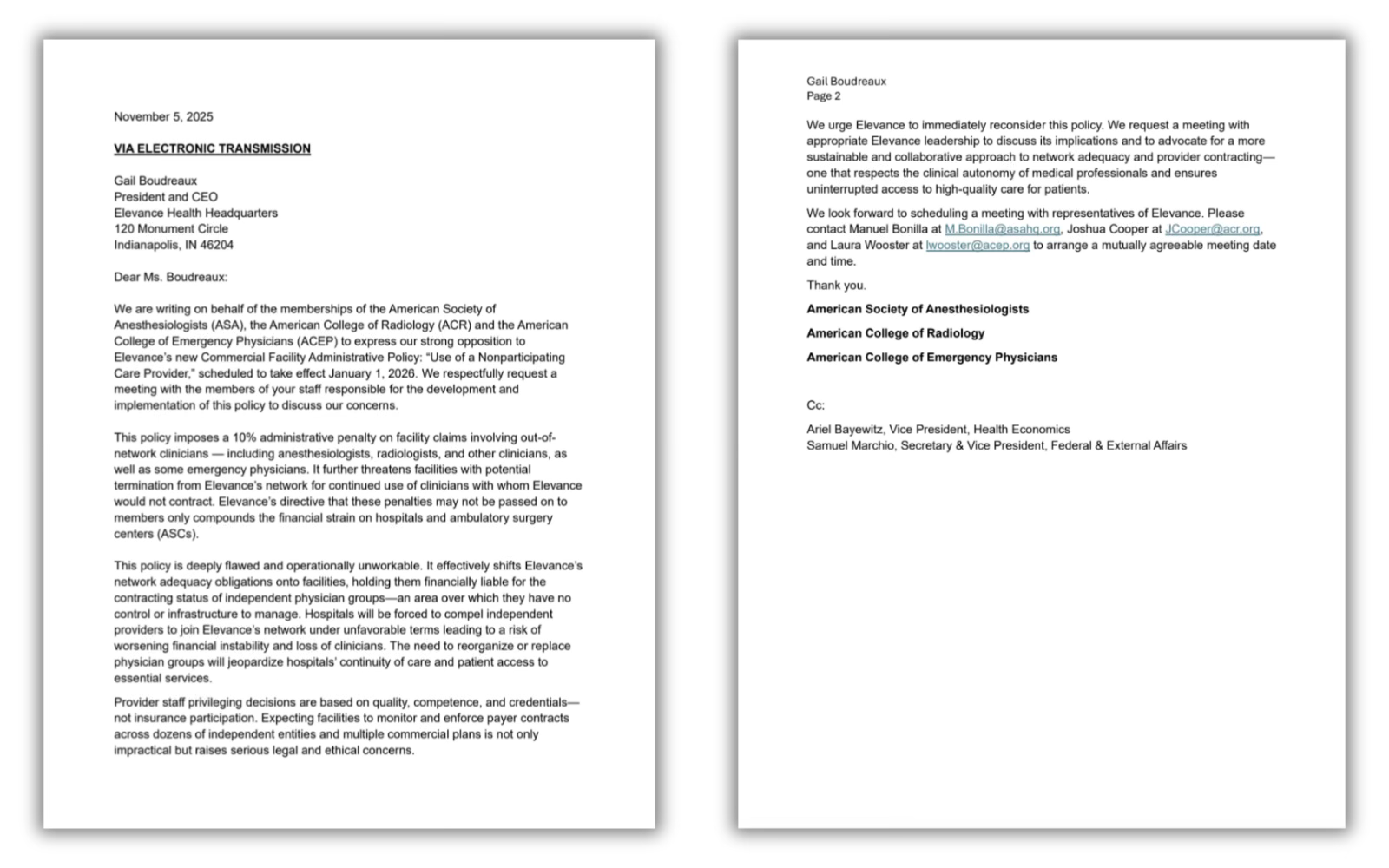
Letter sent to Elevance CEO Gail Boudreaux, by the American Society of Anesthesiologists, American College of Radiology and American College of Emergency Physicians.
“This policy is deeply flawed and operationally unworkable,” they wrote. “It effectively shifts Elevance’s network adequacy obligations onto facilities, holding them financially liable for the contracting status of independent physician groups–an area over which they have no control or infrastructure to manage. Hospitals will be forced to compel independent providers to join Elevance’s network under unfavorable terms leading to a risk of worsening financial instability and the loss of clinicians. The need to reorganize or replace physician groups will jeopardize hospitals’ continuity of care and patient access to care.”
The letter went on to say that, “Expecting facilities to monitor and enforce payer contracts across dozens of independent entities and multiple commercial plans is not only impractical but raises serious legal and ethical concerns.”
If the doctors can’t persuade Boudreaux to ditch the new policy, people enrolled in Anthem plans who need care in a hospital or outpatient facility next year could face confusion and delays in getting that care, and the facilities currently in their network might be kicked out of it if they make any mistakes.
Doctors’ concern about Anthem’s policy cannot be dismissed as an overreaction to one company’s business decision. It poses an existential threat to physician practices that want to stay independent and not sell out to either a hospital system or an insurance company. If the other health insurers follow Anthem’s lead – and there is no reason to think they will not – the number of doctors in independent practice in the United States will dwindle to extinction. There aren’t many left as it is.
Because of the control Wall Street now has over the health insurance industry, Boudreaux is likely less concerned about physician autonomy than what investors think and want, and she is under the gun to get back into their good graces in a matter of months. Her company’s shares have lost a third of their value since the first of this year. If she can’t demonstrate that she’s getting Elevance back on track to profitable growth, she’ll be out of a job soon.
Lawmakers and regulators at all levels of government need to keep an eye on this and intervene if doctors and Anthem patients can’t change her mind.








 HENRY KOTULA