​The ACA is the ultimate survivor

​https://newsatjama.jama.com/2017/11/20/jama-forum-the-health-care-law-that-continues-to-escape-death/

The Affordable Care Act has survived more assassination attempts than Fidel Castro — and it’s still kicking. The Kaiser Family Foundation’s Larry Levitt has a piece in the JAMA Forum laying out the argument that the ACA “continues to escape death.”

  • Levitt’s piece is mostly focused on the Senate’s repeal-and-replace efforts and the Trump administration’s implementation decisions — cutting off payments for cost-sharing subsidies and dramatically scaling back enrollment outreach.
  • “If these efforts were intended to make the marketplace implode, they may, in fact, be backfiring,” Levitt says, citing the weird abundance of plans with $0 monthly premiums and enrollment totals that are beating some experts’ expectations.

This is just the latest chapter. The ACA has been a fixture of public debate since 2009, and it has never veered far from death’s door. In that time, it has survived:

  • Any number of make-or-break moments during the legislative debate
  • Two potentially disastrous Supreme Court challenges
  • The Republican waves of 2010 and 2014, and the countless repeal votes that followed
  • A slew of self-inflicted wounds, from provisions that proved unworkable to the hot mess that was the HealthCare.gov launch.

Between the lines: The ACA has definitely taken some hits — it’s not as strong its drafters might have hoped on the day it passed. But congressional Republicans’ failure to repeal it, and President Trump backing into a massive increase in its subsidies, are just the latest signs of the law’s surprising durability.

Until Congress repeals the individual mandate, anyway…


CBO Projects 13 Million More Nonelderly Uninsured by 2025 if the Individual Mandate is Repealed

CBO Projects 13 Million More Nonelderly Uninsured by 2025 if the Individual Mandate is Repealed


Podcast: ‘What The Health?’ Tax Bill Or Health Bill?

https://khn.org/news/podcast-what-the-health-tax-bill-or-health-bill/?utm_campaign=KFF-2017-The-Latest&utm_source=hs_email&utm_medium=email&utm_content=58570997&_hsenc=p2ANqtz-90FnDooDrGIdtTTHP8VfZovw1vS_Y_js4RdDwCCIwslKGDgrqu1yZ6bbcLJ5AbWfyJaM2B3HhQ9fR9txLD5dY-TnO3HA&_hsmi=58570997

Image result for kaiser podcast what the health?


Republican efforts to alter the health law, left for dead in September, came roaring back to life this week as the Senate Finance Committee added a repeal of the “individual mandate” fines for not maintaining health insurance to their tax bill.

In this episode of “What the Health?” Julie Rovner of Kaiser Health News, Sarah Kliff of Vox.com, Joanne Kenen of Politico and Alice Ollstein of Talking Points Memo discuss the other health implications of the tax bill, as well as the current state of the Affordable Care Act.

Among the takeaways from this week’s podcast:

  • The tax bill debate proves that Republicans’ zeal to repeal the Affordable Care Act is never dead. The new congressional efforts to kill the penalties for the health law’s individual mandate could seriously wound the ACA since the mandate helps drive healthy people to buy insurance.
  • One of the most overlooked consequences of the tax debate is that it could trigger a substantial cut in federal spending on Medicare.
  • A $25,000 MRI? That’s what one family paid to go out of their plan’s network to get the hospital they wanted for the procedure for their 3-year-old. Such choices are again drawing complaints about narrow networks of doctors and hospitals available in some health plans.
  • Although they don’t likely say it in front of cameras, many Democrats are relieved at President Donald Trump’s choice to head the Department of Health and Human Services, former HHS official Alex Azar.
  • Federal officials have given 10 states and four territories extra money to keep their Children’s Health Insurance Programs running but it’s not clear what couch they found the money hidden in.
  • And in remembrance of Uwe Reinhardt, a reminder that he always stressed that a health care debate was about more than money — it was about real people.

Plus, for “extra credit,” the panelists recommend their favorite health stories of the week they think you should read, too.

The Senate Tax Bill Threatens Access to Health Care

https://www.americanprogress.org/issues/healthcare/news/2017/11/16/442906/senate-tax-bill-threatens-access-health-care/

Image result for individual mandate

This week, Senate Republicans announced that they plan to pay for their tax cuts for large corporations and millionaires not only by imposing tax increases on the middle-class but also by undermining people’s access to health care. Specifically, they have proposed eliminating the Affordable Care Act’s (ACA) individual mandate, which helps keep premium costs affordable by ensuring that both healthy and sick people have health insurance.

Repealing the mandate would drive up premiums by 10 percent in 2019 and lead to 13 million fewer people having health insurance by 2025. A Congressional Budget Office (CBO) report also revealed that the similar House version of the tax bill would result in $25 billion in cuts to Medicare in fiscal year 2018 and hundreds of billions of dollars of cuts to the program overall. Taken as a whole, the tax bill would not only increase taxes for millions of middle-class families but would also have disastrous effects on people’s health care.

A typical middle-class family buying individual market insurance would see premiums increase nearly $2,000

The Senate tax bill would substantially increase premiums in the individual market for health insurance, and middle-class families would bear the brunt of the price hike. The bill would eliminate the individual mandate—the requirement that people maintain health coverage or pay a penalty. Without the mandate, people would only purchase coverage when they needed it, resulting in adverse selection that would drive up premiums. The CBO estimates that premiums would increase about 10 percent as a result of this adverse selection.

The Center for American Progress estimates that this premium increase translates to an extra $1,990 for benchmark plan coverage for an unsubsidized middle-class family of four. Families with incomes above 400 percent of the federal poverty level (FPL)—more than $98,400 for a family of four in the lower 48 states—are not eligible for premium tax creditsto reduce the cost of marketplace coverage. The 10 percent increase would be an even greater financial burden for families in states with higher premium levels, increasing costs by $2,900 in Alaska, $2,350 in Maine, and $2,060 in Arizona.

13 million more people would be uninsured by 2025

The CBO estimates that repeal of the mandate would result in 4 million fewer people having coverage in 2019 and 13 million fewer with coverage by 2025. As a result, about 16 percent of the nonelderly population would not have health insurance by 2025, compared with about 10 percent currently.

The individual mandate is necessary because of the consumer protections put in place by the ACA. The ACA banned discrimination by insurance companies against people with pre-existing conditions, required that people be charged the same amount regardless of health status, and eliminated annual and lifetime limits on coverage. But these protections would also make it easy for people to game the system by only buying health insurance once they needed it. To address this concern, the ACA coupled these reforms with an individual shared responsibility provision, also known as the individual mandate, which requires that everyone maintain health insurance coverage so that the overall insurance risk pool is healthy and premium rates are kept in check.

Repeal of the mandate would have two effects on the individual market. First, people who expect to be healthy would avoid purchasing coverage until they need it. As a result, the remaining enrollees in the individual market would be sicker on average, and insurance companies would need to raise rates to cover the increased average cost. Second, the resulting higher premiums would discourage additional people from purchasing coverage through the individual market. Those who become uninsured would no longer have financial protection against catastrophic medical costs, and hospitals and other providers would be forced to provide more uncompensated care.

Medicare would be cut by $25 billion in 2018

In addition to its frontal assault on health care for the middle class, the Senate bill would also secretly cut Medicare. Because the tax cuts for the wealthy in the proposed bill are not fully paid for, they would increase the deficit by more than $1.4 trillion over 10 years. But the little-known Statutory Pay-As-You-Go Act of 2010 requires that any deficit-increasing legislation be offset with cuts to other mandatory programs, including Medicare. The CBO has estimated that the offsetting spending reductions for the similar House version of the tax bill would cut Medicare by about $25 billion in fiscal year 2018. Given that similar cuts would be required in subsequent years, the total cost imposed on the Medicare program would be hundreds of billions of dollars over the next decade. This would have a particularly harmful effect on rural hospitals with thin margins, which could be at risk of closure as a result.

Asking millions of middle-class families to pay more in taxes so that corporations and the wealthy few can pay less in bad enough. But to use those cuts to also undermine health care for middle-class families is unconscionable. Once again, the congressional majority seems to be doing everything in its power to make life harder for everyday Americans, just so it can provide giveaways to the wealthy few.

Methodology

Our estimated reduction in coverage in 2025 due to repeal of the mandate is based on national projections by the CBO. The CBO estimates that 13 million fewer people will have coverage in 2025, including 5 million fewer people with Medicaid, 5 million fewer people with individual market coverage, and 3 million fewer people with employer-sponsored insurance. We used data from the 2016 American Community Survey Public Use Microdata Sample (ACS PUMS), available from the IPUMS-USA to tabulate the number of nonelderly people in each state by primary coverage type using a coverage hierarchy. We then assumed that each state’s reduction in coverage was proportional to its share of the national total for each of those three coverage types. For more on the IPUMS-USA data set, see Steven Ruggles and others, “Integrated Public Use Microdata Series: Version 5.0” (Minneapolis: Minnesota Population Center, 2010).

We made two adjustments to our ACS PUMS tabulations to account for potential effects of Medicaid expansion in Maine, given voters’ recent approval of expansion. We increased the number of Medicaid enrollees in Maine by 51,000 based on projections by the Urban Institute. We also decreased the number of people with coverage through Maine’s individual market by 20 percent to account for the fact that some enrollees will lose access to marketplace premium subsidies when they become Medicaid eligible under expansion. Enrollment data from the Centers for Medicare and Medicaid Services (CMS) show that 27 percent of 2017 marketplace plan selections were by people with family incomes between 100 and 150 percent of the federal poverty level.

Our estimates of 2019 premium increases are based on the CBO projection that mandate repeal will increase individual market premiums 10 percent. We used the HealthCare.govplan information to calculate the 2018 average marketplace benchmark—second-lowest cost silver—plan in each state, weighting by the geographic distribution of current marketplace enrollment. We then inflated that premium to 2019 levels according to National Health Expenditure projections for per-enrollee cost growth. To calculate the 2019 average benchmark premium specific to a typical family of four, we borrowed the example family composition that the U.S. Department of Health and Human Services uses in its reports: 40-year-old and 38-year-old parents and two children. We estimated that the family would pay an additional 10 percent of that 2019 benchmark due to mandate repeal. Premium data were not available for all states.

Finally, our estimates of state-level cuts to Medicare in fiscal year 2018 divided the $25 billion total Medicare funding reduction projected by the CBO proportional to each state’s share of national Medicare spending as of 2014, the most recent year for which CMS National Health Expenditure data is available, using data published by the Kaiser Family Foundation.

Health Care for Millions at Risk as Tax Writers Look for Revenue

https://www.bloomberg.com/news/articles/2017-11-16/health-care-for-millions-at-risk-as-tax-writers-look-for-revenue

Image result for individual mandate

The Republican tax plans are suddenly looking a lot more like health-care bills, with provisions that may affect coverage and increase medical expenses for millions of families.

The House version of the tax bill, which President Donald Trump endorsed on Tuesday, would end a deduction that allows families of disabled children and elderly people to write off large medical expenses. The Senate plan would repeal the Obamacare requirement that most Americans carry insurance, a move that insurers promise would raise premiums in the nationwide individual insurance market.

The provisions would help offset the cost of large tax cuts for corporations and individuals. But the move has sparked a new wave of opposition from the health-care industry and others who are concerned about its impact — the same political headwinds that tanked Republican efforts to repeal the Affordable Care Act earlier this year.

Either proposal, if signed into law, “could be devastating for some families with disabilities,” said Kim Musheno, vice president of public policy at the Autism Society, a Bethesda, Maryland, organization that advocates for people with autism. “Families depend on that deduction. And if they deal with the individual mandate, that’s going to cut 13 million people from their health care,” she said, citing a Congressional Budget Office estimate.

Republicans and some conservative groups, though, argue that removing the penalty for uninsured individuals would represent a tax cut for many low-income people who pay it now. Americans for Tax Reform, the group led by anti-tax crusader Grover Norquist, said that Internal Revenue Service data from tax year 2015 show that 79 percent of households that paid the penalty earned less than $50,000 a year.

Most Americans already think the tax legislation is designed to benefit the rich and oppose the bill by a two-to-one margin, according to a Quinnipiac University poll released on Wednesday. The survey was conducted between Nov. 7 and Nov. 13 — before the repeal of the Obamacare mandate was introduced — and has a margin of error of 3 percentage points. Some of the details in both tax plans have changed since the survey, and the Senate tax-writing committee is still working on its draft.

Republican Concerns

Few Republicans have spoken out about the House bill’s repeal of the medical-expense break. The bill faces a vote on the House floor Thursday. But some criticism has begun to surface as advocacy groups including the AARP and the American Cancer Society have highlighted the harm the House bill could have on families battling diseases and on the elderly. People with tens of thousands of dollars in annual medical expenses often rely on the tax deduction to make ends meet.

Representative Walter Jones, a North Carolina Republican, said Wednesday he’ll vote against the House bill in part because it eliminates the deduction for out-of-pocket medical expenses.

“There are a lot of seniors in my district and this is life and death for them,” he said.

The deduction is allowed under current law if medical expenses exceed 10 percent of a taxpayer’s adjusted gross income. Almost 9 million taxpayers deducted about $87 billion in medical expenses for the 2015 tax year, according to the IRS.

Representative Greg Walden, an Oregon Republican who chairs the Energy and Commerce Committee, said some of his constituents who live in expensive elder-care facilities could be harmed if the deduction is scrapped.

“I think it’s one we have to continue to massage a bit,” he said. “There’s a lot of things out there and there’s maybe going to be an opportunity to adjust some of them.”

He declined to elaborate.

Obamacare Repeal

On the other side of the Capitol, Senate Republican leaders’ sudden decision to add a partial Obamacare repeal to their bill has energized Democratic opposition.

“You don’t fix the health insurance system by throwing it into a tax bill and causing premiums to go up 10 percent,” Senator Sherrod Brown, an Ohio Democrat, told reporters Wednesday.

Were the ACA’s insurance mandate repealed absent a new policy to compel the purchase of coverage, the CBO projects that premiums would rise 10 percent for people who buy insurance on their own and more than 13 million Americans would lose or drop their coverage.

But a reduction in the number of people with insurance also translates to less taxpayer money spent to provide subsidies for premiums under the ACA. Ending the requirement as of 2019 would save the government an estimated $318 billion, helping to offset the cost of lowering the corporate tax rate.

In addition, the Senate’s tax plan could trigger sharp cuts to Medicare and other programs in order to meet budget deficit rules, according to CBO.

Easy Ads

The move to target Obamacare comes after Republicans lost elections in Virginia and other states earlier this month. Health care was a significant factor in those races and Republicans will face punishing campaign ads if they try to chip away at Obamacare or end the medical-expense deduction while cutting taxes, said political analyst David Axelrod, a former top adviser to President Barack Obama.

“The thing that makes it more of a potent issue is that it’s all being done to facilitate what essentially is a massive corporate tax cut and an individual tax cut that’s skewed to wealthy Americans,” he said in an interview. “You don’t have to work very hard to make those ads.”

The White House argues that the ACA’s insurance mandate isn’t popular and disproportionately affects low- and middle-income Americans who are forced to buy insurance that may be more expensive than they can afford.

“The President’s priorities for tax reform have been clear from the beginning: make our businesses globally competitive, and deliver tax cuts to the middle class,” White House spokesman Raj Shah said in a statement. “He is glad to see the Senate is considering including the repeal of the onerous mandates of Obamacare in its tax reform legislation and hopes that those savings will be used to further reduce the burden it has placed on middle-class families.”

‘Cut Top Rate’

Trump, though, has said proceeds from repealing the insurance mandate should be used to cut taxes even further for wealthy people.

“How about ending the unfair & highly unpopular Indiv Mandate in OCare & reducing taxes even further?” Trump said Monday in a tweet. “Cut top rate to 35% w/all of the rest going to middle income cuts?”

Like Republicans’ failed attempts to repeal the ACA, the tax plan is amassing a growing list of opponents from the world of medicine.

Insurers, hospital groups and disability advocates have spoken out forcefully against the health-care proposals in the bill. Hospitals and insurance groups wrote a letter to Congressional leaders on Tuesday warning of dire health-care outcomes if the tax measure becomes law.

“Repealing the individual mandate without a workable alternative will reduce enrollment, further destabilizing an already fragile individual and small group health insurance market on which more than 10 million Americans rely,” said the letter, signed by six health-care groups, including the American Hospital Association and America’s Health Insurance Plans.


Poll: Ahead of House Tax Reform Vote, Americans are More Likely to Rank Children’s Health Care, Hurricane Relief and Other Issues as Top Priorities for Washington

http://connect.kff.org/poll-ahead-of-house-tax-reform-vote-americans-are-more-likely-to-rank-childrens-health-care-hurricane-relief-and-other-issues-as-top-priorities-for-washington?ecid=ACsprvumAORaSTpZGqmqhYQaXpeqtZoXjMxf6lbzmdUaIsV8vQ82Gwn_2PBBsI5zIiSuUzZ5w8-C&utm_campaign=KFF-2017-November-Poll-Tax-Reform-Vote&utm_source=hs_email&utm_medium=email&utm_content=58466081&_hsenc=p2ANqtz-8Cag0QgNSRgFKsxX_UJAz_sPw8ZG2hIH2l7nv8vGW9Dn5a8w_Mcy5njs5Hwf79zPT3e9Z8cecPnIWqwTXGvfb_qKXqRg&_hsmi=58466081

tax reform poll chart 2.png

Controlling Immigration Tops Republicans’ Priority List, With Tax Reform among a Number of Second-Tier Issues Including Hurricane Relief and ACA Repeal

Most of the Public Initially Favors Getting Rid of the ACA’s Individual Mandate As Part of Tax Reform, But Some Become Opponents When Presented with Facts and Arguments for Keeping the Mandate

As the House prepares to vote Thursday on its tax reform bill, a new Kaiser Family Foundation poll finds almost three in 10 Americans (28%) view tax reform as a top priority for President Trump and Congress.

That’s significantly fewer than the share that say the same about reauthorizing funding for the Children’s Health Insurance Program (62%), hurricane recovery funding (61%), stabilizing the Affordable Care Act’s insurance marketplaces (48%) and addressing the prescription painkiller epidemic (43%).  Two immigration-related issues – strengthening controls to limit who enters the country (35%) and passing legislation to allow the Dreamers to legally stay (34%) – also rank higher, while a similar share (29%) say repealing the Affordable Care Act is a top priority.

Among Republicans, half (51%) say reforming the tax code is a top Washington priority, behind strengthening immigration controls (69%) but similar to the share who consider hurricane recovery funding (52%), repealing the Affordable Care Act (50%), stabilizing the insurance marketplaces (46%) and reauthorizing CHIP funding (46%) to be top priorities.

In a tweet Monday, President Trump called on Congress to end the Affordable Care Act’s individual mandate, which requires most Americans to have health insurance or pay a tax penalty and has long been the least popular provision in the law. While the House tax reform bill does not currently address the mandate, key Republican senators said Tuesday that they will include such a provision in their version of the bill.

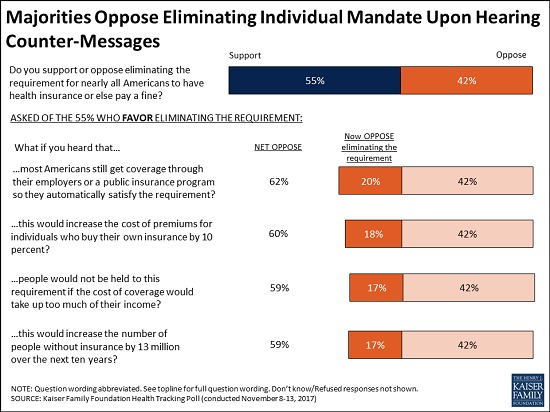
The new poll finds that most Americans (55%) initially support eliminating the mandate as part of tax reform, while four in 10 (42%) oppose it. Most Republicans (73%) and independents (58%) support ending the mandate, while most Democrats (59%) oppose it.

These views are malleable, with about a third of supporters (representing a fifth of the public overall) switching to oppose the mandate’s repeal when presented with facts and arguments about who is impacted and potential consequences of its repeal.

For example, the share who oppose eliminating the mandate can rise as high as 62 percent when initial supporters hear that most Americans get coverage through their employers or government programs that meets the mandate’s requirements. Similar majorities ultimately oppose eliminating the mandate when presented with other arguments against it, including that premiums for people who buy their own health insurance would go up, that people are exempted from the mandate if the cost of coverage takes up too much of their income and that getting rid of the mandate would result in 13 million more people being uninsured over the next 10 years, as the Congressional Budget Office has estimated.

One provision in the House bill would eliminate a tax deduction that allows people with high medical costs to deduct any medical and dental expenses that exceed 10 percent of their income.  A majority (68%) of the public – including majorities of Democrats (77%), independents (66%), and Republicans (61%) oppose eliminating the tax deduction for individuals who have high health care costs.

More than four in 10 (44%) of the public think eliminating the deduction for high medical costs will affect them and their families, though in reality a much smaller share of the public uses that deduction in any given tax year. According to the Internal Revenue Service, about 17 percent of taxpayers who file itemized deductions use this deduction (approximately 6% of all taxpayers and 3% of the public).

Looking ahead to the 2018 midterm elections, the public is divided over whether not passing a tax reform plan or not repealing the ACA would be a bigger deal for President Trump and Republicans. Nearly half of the public say it will be a bigger problem if the president and Republicans are unable to pass their tax reform plan (47%), similar to the share who say it will be a bigger problem if they are unable to revive a repeal of the ACA (44%). Republicans are also divided, with similar shares saying   it would be a bigger deal if President Trump and Republicans are unable to repeal the ACA (50%) and if they are unable to pass tax reform (45%).

Designed and analyzed by public opinion researchers at the Kaiser Family Foundation, the poll was conducted from November 8 – 13, 2017 among a nationally representative random digit dial telephone sample of 1,201 adults. Interviews were conducted in English and Spanish by landline (415) and cell phone (786). The margin of sampling error is plus or minus 3 percentage points for the full sample. For results based on subgroups, the margin of sampling error may be higher.

Senate Tax Plan Aims to Repeal Obamacare Mandate

The Obamacare repeal debate is on again. Senate Republicans decided on Tuesday to include the elimination of the Affordable Care Act’s individual mandate in their tax plan, a risky move that would raise hundreds of billions of dollars to help pay for their desired tax cuts but is also sure to reignite intense clashes over health care coverage. Here’s a quick look at this latest twist in the tax reform effort:

Why They’re Doing It: Repealing the mandate, which requires individuals to buy health insurance or pay a penalty, helps solve the difficult math problems Senate tax-writers faced. The Senate tax bill can add up to $1.5 trillion to the debt over 10 years, and it can’t add to the deficit after that period. President Trump and some Senate Republicans had urged that the mandate repeal be included in the tax plan since it saves a projected $338 billion over 10 years, according to the Congressional Budget Office.

“Repealing the mandate pays for more tax cuts for working families and protects them from being fined by the IRS for not being able to afford insurance that Obamacare made unaffordable in the first place,” Sen. Tom Cotton (R-AR), who had proposed the move, said after the decision was announced. And if the repeal passes as part of a tax cut package, Trump and congressional Republicans would deliver on two promises to voters in one bill.

What It Means: Repealing the mandate may help Republicans chalk up a big win on taxes, but it also comes at a cost. The move raises revenue because it would lead to 13 million fewer people having health insurance, according to the CBO, and thus reduces the amount the government must shell out for insurance subsidies and care. Analysts also warn that, without the mandate, premiums will rise and some insurers might not participate in Obamacare markets that require them to cover pre-existing conditions. “Eliminating the individual mandate by itself likely will result in a significant increase in premiums, which would in turn substantially increase the number of uninsured Americans,” a coalition of insurers, hospitals and doctors wrote in a letter to congressional leaders on Tuesday.

Those expected effects carry significant political risk. For one thing, it could reawaken the liberal base that mobilized so effectively against Obamacare repeal and turn their focus to the tax bill. Michael Linden, a liberal policy expert, tweeted that “Reducing the corporate tax rate to 23% instead of 20% generates the SAME savings as repealing the ACA mandate. They could cut taxes for corporates just a little less, but instead they’re cutting health care.” Democratic leaders are already slamming the decision. “Republicans just can’t help themselves,” Sen. Chuck Schumer said. “They’re so determined to provide tax giveaways to the rich that they’re willing to raise premiums on millions of middle-class Americans and kick 13 million people off their health care.”

Will It Pass? A “skinny” Obamacare repeal bill that would have eliminated the individual mandate failed in the Senate in July when Republican Sens. John McCain, Lisa Murkowski and Susan Collins voted against it. But Senate Majority Leader Mitch McConnell told reporters that including the repeal provision would make it easier for the tax bill to pass. As part of the deal, the Senate would also reportedly vote on another bill to restore federal payments to insurers that the president had halted last month. Sen. John Thune (R-SD) said that a whip count had been done and expressed confidence that Republicans had the 50 votes they need.

Why Tax Reform Could Be a Serious Threat to Health Care

http://www.commonwealthfund.org/publications/blog/2017/nov/why-tax-reform-could-be-a-serious-threat-to-health-care

After nine months of unsuccessful efforts to repeal and replace the Affordable Care Act (ACA), Congress has moved on to the challenge of reforming the U.S. tax code. At first glance, it may appear that Congress has shifted priorities: The House tax proposal released last week doesn’t propose to repeal the Affordable Care Act’s individual mandate requiring health insurance, nor does it fund tax reform with cuts to Medicaid.

However, this shift in congressional focus does not mean that Republicans in Washington are done with the ACA. The executive branch continues to undermine the individual health insurance marketplaces. As Sara Collins points out in a recent post on To the Point, two presidential actions last month — the first bypassing ACA consumer protections to allow multistate association health plans, and the second ending payments to insurers for cost-sharing subsidies — are likely to increase premiums on the marketplaces by 2019. Executive branch decisions to cut funding for marketplace outreach are already making it difficult for young, healthy people to explore their insurance options, which could depress enrollment for 2018 and further destabilize the marketplaces.

Moreover, this shift in focus does not mean that the attempts to deeply cut federal health care programs are over, either. Even if congressional leaders lose their appetite for full-scale ACA repeal bills, the futures of tax reform and health care will be intertwined for at least three reasons.

First, some conservatives in the House and Senate remain committed to including ACA repeal provisions in the tax bill. And, while they initially lost in their efforts to attach a repeal of the individual mandate to the current House Bill, conservatives may withhold support unless such a provision is included in the final bill.

Second, the House tax proposal is expensive: the proposed tax cuts total $5 trillion. The budget resolution Congress passed last month allows up to $1.5 trillion of the total cost of the tax cut to be paid for with an increase in the federal deficit. That means the U.S. Treasury will have to borrow money to cover 30 percent of the cost of the House bill — a notable departure from Reagan-era tax cuts that were fully offset. This shortfall will go up over time, because several of the bill’s tax code changes expire in a few years.

While the current House proposal includes $3.5 trillion in revenue-generating provisions to help pay for the remaining 70 percent of the tax cuts, several provisions are unpopular with rank-and-file Republicans. These include a 50 percent cut to the maximum home mortgage deduction and elimination of the current deduction for state and local income taxes. If some Republicans force these provisions out of the bill or modify them to affect fewer taxpayers — changes likely to be sought by Republicans representing districts in large Blue states with high housing costs and high state taxes — then the bill will not raise the revenue required by the budget resolution. Congressional leadership would be forced to pay for tax cuts with other sources of revenue or with cuts in federal spending. Key targets would be cuts to Medicaid and Medicare.

Third, tax reform may ultimately affect access to health care in the not-so-distant future, even if specific health provisions are not included in the bill. Should it pass, the ballooning federal deficit that will follow its implementation will invariably lead to calls to reduce federal spending. Medicaid, Medicare, and ACA coverage will again be in the crosshairs given the portion of federal spending — 28 percent in 2017, growing to 40 percent in 2037 according to the Congressional Budget Office — these health programs represent.

GOP unlikely to repeal ObamaCare mandate in tax measure

GOP unlikely to repeal ObamaCare mandate in tax measure

Image result for aca individual mandate

The House is unlikely to repeal the mandate to buy insurance under ObamaCare as part of its tax-reform bill, GOP sources say, though the issue could return down the road.

President Trump and conservative lawmakers are pushing for the individual mandate to be repealed in the bill, but House Ways and Means Committee Chairman Kevin Brady (R-Texas) has expressed worry that the controversial measure would jeopardize the broader tax-reform bill, given the Senate’s failure on health care earlier this year.

“It hasn’t ever been in the [House] bill,” said one Republican on the Ways and Means Committee who has been taking part in the negotiations. “I expect that it will be added somewhere down the sausage-making venture.”

“I agree there is a chance, but I think if it gets included, it would be on the Senate side,” added a second Ways and Means Republican.

Senate GOP leaders said they plan to roll out their own tax bill on Thursday. Sen. Tom Cotton (Ark.) has been the leading GOP senator pushing to include repeal of the mandate in the tax bill.

House leaders emerging from a meeting Monday evening said no final decision has been made on the individual mandate issue, and Brady and Speaker Paul Ryan (R-Wis.) both said in interviews in recent days that they have not ruled out the idea.

“We have an active conversation with our members on a whole host of ideas on things to add to this bill and that’s one of the things being discussed,” Ryan said during an appearance on “Fox News Sunday.”

But Brady expressed concerns about including the mandate’s repeal at an event last week.

“There are pros and cons to this,” Brady said at an event Friday hosted by Politico. “Importing health care into a tax-reform debate has consequences.”

If Congress doesn’t act, Trump has vowed that he will. The president is reportedly considering taking executive action on the insurance mandate if Congress leaves it out of the tax-reform bill.

A lobbyist told The Hill the administration is working on guidance, which might not be in the form of an executive order, that would expand what are known as “hardship exemptions” that allow people to be exempted from the mandate’s requirement to have health insurance or pay a fine.

Brady said Monday that repeal of certain ObamaCare taxes would not be included in tax reform. Instead, he said he is working with Democrats on temporary relief from measures like the medical device tax and health insurance tax.

“We are working on common-sense temporary and targeted relief from many of these taxes to be acted on in the House before the end of the year,” Brady said.

Repealing the mandate could destabilize health insurance markets, experts warn, by removing an incentive for healthy people to enroll. The Congressional Budget Office has previously estimated that repealing the mandate would increase premiums by 20 percent.

Trump has been pushing to repeal the mandate in the tax-reform bill. Brady said last week that Trump had asked for it twice on the phone and once in person. Trump also told a meeting of Republican lawmakers at the White House last week that he wanted to repeal the mandate in tax reform and floated adding it in the Senate, attendees said.

Two conservative leaders, House Freedom Caucus Chairman Mark Meadows (R-N.C.) and Republican Study Committee Chairman Mark Walker (R-N.C.), have been pushing leadership to repeal the mandate in the tax bill. Walker has been slightly more aggressive, calling it a “good move.”

“When given the opportunity to actually address even part of an ObamaCare repeal with a simple majority, our leadership consistently finds excuses to justify their failure,” said a conservative House lawmaker who favors adding repeal to the bill.

“The individual mandate will be repealed by the president while Congress makes excuses.”

A number of lawmakers — both on and off the Ways and Means panel — are predicting the tax legislation Brady unveiled last week would attract the 218 GOP votes needed for passage.

While a handful of vocal New York and New Jersey Republicans are objecting to a provision of the bill that scraps or limits state and local tax deductions, most moderate Republicans have signaled they will go along with the legislation rather than derail one of the GOP’s top campaign promises of the 2016 elections.

So there is a reluctance among GOP vote-counters to add the insurance provision and upset that fragile balance.

“I believe it’s going to be a very strong vote based on my interactions with members and their passion to reform the tax code,” Rep. Jason Smith (R-Mo.), who serves on both the Ways and Means Committee and Ryan’s leadership team, said of the current version of the bill.

Clean Up on Aisle 12! The Obamacare Pop-Up Store is Open but Stocks are Limited

Clean Up on Aisle 12! The Obamacare Pop-Up Store is Open but Stocks are Limited

Image result for ACA

The fifth Open Enrollment period under the Affordable Care Act (ACA) started on November 1st, and will continue for a scant 45 days ending on December 15, 2017. This year, not only has the Open Enrollment been cut in half, but obstacles abound – obstacles that were not part of the 2016 Open Enrollment Period. For example:

  • Healthcare.gov is undergoing maintenance that could interfere with access during the Open Enrollment Period;
  • Federal support for Open Enrollment outreach and advertising is substantially lower this year than it has been in prior Open Enrollment periods; and
  • The number of health insurers participating in the exchanges has dropped significantly from last year (prompted in part by well-founded concerns regarding the future of federal cost-sharing reduction (CSR) payments), and in some counties, only one plan is available to individuals and families seeking coverage through the exchanges.

Plan Departure: A Continuing Trend from Prior Years

In 2016, a significant number of large, national insurance companies announced that they were withdrawing from the exchanges and would no longer offer health insurance coverage during 2017. As for 2018, the following chart identifies, as of October 12, 2017, both (1) those national insurance companies that will fully withdraw from one or more exchanges effective January 1, 2018, and (2) those national insurance companies that will continue to offer plans on the state exchanges in 2018 as they did in 2017.

Insurance Company: Insurance Exchange Exits for 2018: Insurance Exchange Participation in 2018:
Aetna Delaware, Iowa, Nebraska, Virginia None
Anthem Indiana, Maine, Missouri, Nevada, Ohio, Wisconsin California, Colorado, Connecticut, Georgia, Kentucky, Missouri, New Hampshire, New York, Virginia
Centene None Arizona, Arkansas, California, Florida, Georgia, Indiana, Kansas, Mississippi, Missouri, Nevada, New Hampshire, Ohio, Texas, Washington
Cigna Maryland Colorado, Illinois, Missouri, North Carolina, Tennessee, Virginia
Molina Wisconsin, Utah California, Florida, Michigan, New Mexico, Ohio, Texas, Washington
Humana Florida, Georgia, Illinois, Louisiana, Kentucky, Michigan, Missouri, Mississippi, Ohio, Tennessee, Texas None
UnitedHealthcare Virginia Nevada, New York

Who Ordered the Retreat?

There are a variety of reasons that large national insurers are retreating from the federal and state exchanges, but as a general rule, they stem from uncertainty regarding the profitability of state exchange participation.

CSR Funding Uncertainty

President Trump’s inauguration spurred speculation that the ACA’s CSR subsidy payments could be discontinued, and insurance companies priced exchange plans accordingly. The Congressional Budget Office estimated that the cessation of CSR payments for the 2018 calendar year – which has since come to pass – would result in a 25% increase in premiums by 2020 and at least a temporary increase in the number of areas with zero individual exchange offerings (as a result of further insurer exits and stifled entry / expansion).

The Individual Mandate

One year-over-year driver of the insurance company exodus from the exchanges is the weakness of the individual mandate.

The individual mandate is critical to whether the health insurance companies can turn a profit on the exchange plans. In an ideal world, the individual mandate would successfully induce all eligible citizens to obtain health coverage. Under such circumstances, health insurers would have a much easier time estimating enrollment, risk pools and, ultimately, profits from participation on the insurance exchanges. In practice, however, many of the “young invincibles” whose participation in the health insurance market could offset the costs of insuring older and sicker populations elect to incur the relatively modest tax penalty resulting from a failure to obtain coverage.

Even if the penalty were tougher (and as a consequence, presumably more effective), enforcement is rather lax, and the Trump administration has signaled in 2017 it may instruct the Internal Revenue Service to deprioritize enforcement of the individual mandate.

Enrollee Fraud and Gaming the System

The large national insurance companies have also complained about enrollee fraud that increases the actuarial unpredictability of the performance of a particular risk pool. For example, insurers have complained that enrollees in an exchange plan may have an expensive procedure early in the year, and then stop paying premiums after the insurance plan has paid for the procedure.

The Importance of the Big Players in the ACA Exchanges

Because they have greater resources to understand, and hedge, the actuarial risks of the exchange plans – including balancing the prospects of fraud, unhealthy patient mix and less then desirable compliance with the individual mandate – large national health insurers are better positioned than their smaller counterparts to succeed in the ACA exchanges.

As such national insurers have migrated away from exchange participation, they have in many instances been replaced by regional players, such as health plans associated with regional hospital systems, physician groups and faith-based organizations. Such entities generally do not have the same financial wherewithal as the large national insurance companies to successfully diversify risk or endure greater potential losses with respect to the exchange risk pools. As a result, many healthcare analysts and commentators have concluded that regional plans are ill-equipped to fully replace the large national insurance plans if the large national insurance plans continue to leave the state exchanges.

Notwithstanding the foregoing concerns regarding regional plan participation on the exchanges, Centene Corporation, a publicly-traded healthcare company that is the parent corporation of multiple state-based plans that participate in the state exchanges, has elected to expand its participation in 2018. Whether Centene Corporation succeeds with its expansion into more state ACA exchanges, and whether it chooses to further expand in future years, will be an important indicator of the health of the ACA health insurance exchanges in years to come.

“Repair and Encourage”

The remedy for stabilizing the exchanges is not overly complicated, and realizable, if the political will existed to accomplish what needs to be done.

A strong first step would be changing the conversation in Washington D.C. about the ACA – get rid of the “repeal and replace” mantra and instead make the conversation about “repair and encourage.” The point is that the manner in which the political class is addressing healthcare and the ACA is toxic, and the result is driving the insurance companies away from participation. A change in tone from our elected leaders would probably do remarkable good in stabilizing the state insurance exchanges over time.

In addition to calming the political dialogue regarding the ACA, for 2018 (ahead of the 2019 open enrollment period), we propose some specific policies that we think would help encourage participation by the large, national insurance companies in the exchanges in 2019 and beyond:

  • The judicial branch needs to resolve, ideally favorably, whether CSRs will continue.
  • The individual mandate needs to be strengthened by increasing the applicable tax penalty and more vigorously pursuing enforcement.
  • Congress should consider incentives, whether tax-based or otherwise, to specifically encourage the large, national insurance companies to increase participation on the exchanges.

In the current political climate, such dedicated action seems unlikely, but the political winds may yet shift and blow the health insurers safely home to the exchanges.