CEO of U of Maryland Medical System to take leave of absence amid scandal

https://www.beckershospitalreview.com/hospital-management-administration/ceo-of-u-of-maryland-medical-system-to-take-leave-of-absence-amid-scandal.html

Image result for fiduciary duty

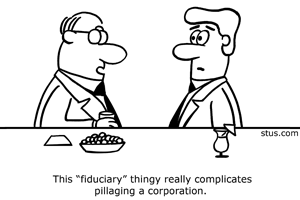
The president and CEO of Baltimore-based University of Maryland Medical System agreed to take a leave of absence, effective March 25, amid a scandal involving business deals between the system and several of its board members, according to The Washington Post.

Six things to know:

1. UMMS Board Chairman Stephen Burch announced the board’s unanimous decision March 21 to have President and CEO Robert Chrencik take a leave of absence. The system will also hire an independent accounting and legal firm to audit the board’s contracts, and the search for an independent third party will begin immediately.

“Over the past week, I’ve had the proper time to listen to concerns and reflect. The board and I am firmly committed to evolving our governance principles and operating with even more transparency,” Mr. Burch said.

2. John Ashworth, senior vice president of network development at UMMS and associate dean at the Baltimore-based University of Maryland School of Medicine, will serve as interim president and CEO of the 13-hospital system.

3. The leadership changes follow the resignations of three UMMS board members, including Baltimore Mayor Catherine Pugh. At least four other board members have taken a leave of absence. The deals have been sharply criticized by state lawmakers, including Gov. Larry Hogan.

4. Ms. Pugh resigned from the board after facing criticism for a $500,000 book deal she made with UMMS. A spokesperson for the mayor’s office said March 20 Ms. Pugh has returned $100,000 in profit to the health system because production on the books was delayed and they were not actually delivered to UMMS, which had planned to distribute the books to city schools.

5. Hours before Mr. Burch notified the public of Mr. Chrencik’s leave of absence, the Maryland House of Delegates unanimously fast-tracked a bill to overhaul UMMS’ 27-member board of directors, The Washington Post reports.

6. Amid the scandal at UMMS, The Baltimore Sun reviewed state disclosure and tax forms for several other health systems in the state and found at least five other systems have engaged in business deals with members of their board. The American Hospital Association’s guidance on the issue does not prevent such deals from taking place, but asks that leadership ensure “certain preconditions … to make sure that the organization’s interests prevail in the board’s decision-making.


I am not a salesman

I am not a salesman

Abstract: This article looks into the importance of selling in business and the relevance of the development of selling skills to career success regardless of your role in an organization.

Really?  You’re not a salesman or saleswoman or salesperson?  What are you then?  Zig Ziglar and others argue that everyone is in selling whether he or she recognize or acknowledge it or not.  I have come across people that say that they consciously and intentionally do not know anything about selling or that selling is below their station in life.  Some of them have no idea that some of the best-compensated people in society achieve the success they enjoy from being successful in sales.

What is selling anyway?   I would define selling as bringing someone else around to your way of thinking.  The hoped result of the selling process is that the other party will decide to act upon your suggestions and recommendations (closing questions).  Sometimes this results in a sale for value in which goods or services are exchanged. In other cases, you are selling a concept or ideas like a strategy or recommended course of action to a decision maker that must put their reputation and possibly their job on the line by committing to your proposed course of action.

When some people hear the term ‘salesman’ the image that pops up in their mind is the high-pressure wielding scoundrel at the ‘buy here, pay here, Se Habla Español’ used car dealership with the moussed hair, polyester leisure suit, braided leather suspenders, and patent leather platform shoes.   The sales weasel is the offensive stereotype that ‘professionals’ avoid at all costs. However, the argument can be made that the scoundrel has a much easier way of making a living than those of us that make our living by selling ideas, concepts, and strategies into sophisticated organizations.  He is not up against counterparties that in many cases are considerably more experienced, educated, credentialed or intelligent than he is.  More often than not, the reverse is true.

If you would just as soon not be bothered with selling, my suggestion is that you dispense with aspirations of obtaining or staying in a C-Suite role.  What is a C-Suite?  One definition is that it is a marketplace of ideas.  The environment is characterized by continuous, ongoing debate of concepts and strategies to move the organization forward or respond to problems and threats.  If you are not effective in getting your ideas heard, debated and accepted, you might want to start thinking about finding another way to make a living.  If you cannot successfully sell your fair share of ideas in what is usually a very intimidating, competitive and sometimes hostile environment, your perceived value will fall along with the probability of achieving your career ambitions.

What types of selling occur?  Direct selling involves interactions with the intended purpose of an agreement to exchange goods or services for money.  What I will refer to as professional selling is focused on winning in the marketplace of ideas.  In other words, getting decision-makers to take your advice, respond to your counsel or choose a course of action based primarily upon your input. Professional selling is infinitely more difficult because it has a variable that is usually not present in direct selling – politics.  The politics are carried out generally behind the scenes by competitors of yours that could be trusted co-workers that advocate for their ideas behind the scenes or behind your back, without giving you the courtesy or respect of a face-to-face argument.  They use whatever leverage is available to them behind the scenes, under the table, and behind your back to advance their causes, frequently resulting in decisions that do not make rational sense.  Suboptimal results occur because, in the presence of politics, decision making is usually irrational.

For example, I experienced a situation where some physicians were not happy with some of the decisions coming out of the boardroom and the front office.  Do you know how many visits I had from any of the doctors?  The answer is zero!  Instead, they took their grievances directly to members of the board or county commission that humored and engaged them possibly in utter and absolute ignorance of the degree to which this amounted to the active undermining of the leadership team of the organization.  I learned that one board member was accosted in the church vestibule and never made it into the sanctuary to join their family for the service.  Others are caught at their places of work or during unrelated social events.  As we are seeing in our society right now, people that are sufficiently strident about their position will resort to extreme means including violence to have their ideology imposed upon the rest of us.  If you are in a board meeting and something entirely unexpected comes out of left field and derails something that you have put a lot of time and energy into, there is a good chance you are a victim of cowardly, destructive politics.

The stakes of success in a political environment are exponentially higher.  If you are to be successful when you are up against political resistance, your arguments or the effectiveness of your selling must be sufficiently compelling to not only overcome the logical burden of your case but the political forces that may be working against you behind the scenes or maybe more accurately stated, behind your back.  If this is not selling, I don’t know what is.  Most of the time, to one degree or another, your career is potentially on the line when you are selling to your leader or a board of trustees.  Must close selling puts you in an Apollo 13 situation where failure is not an option.  I sold vacuum cleaners in college.  I learned these concepts early on.  In-home vacuum selling can be very intense, high-pressure selling.  That said, selling vacuum cleaners is infinitely more comfortable than surviving in the shark tank that is the C-Suite of most organizations I have experienced.  I guess that’s why good vacuum cleaner salesmen make around $50K and C-Suite roles pay into seven figures.

So, the obvious question is what you should be doing?  My recommendation is that you start dedicating significant time and energy to learning as much as you can about selling.  The quintessential sales trainer is Zig Ziglar. He is one of the best but not the only one.  I would also recommend Harvey Mackay. Both of these guys are retired, but their work is as relevant as ever. Effective selling requires a healthy positive attitude.  There are many excellent motivational speakers. Some of my favorites are Les Brown, Earl Nightingale, Dr. Angela Duckworth, Zig Ziglar, and Ed Foreman.  Don’t overlook some of the incredible ministers that deliver messages of hope and inspiration.  For starters, I recommend Charles Stanley, Johnny Hunt, Robert Schuller, and Joel Osteen.  I have found that the more time I spend listening to these inspiring people, the luckier I become in the marketplace of ideas in a consulting firm, among my compadres, in a hospital C-Suite or down at the local watering hole.

Contact me to discuss any questions or observations you might have about these articles, leadership, transitions or interim services.  I might have an idea or two that might be valuable to you. An observation from my experience is that we need better leadership at every level in organizations. Some of my feedback is coming from people that are demonstrating an interest in advancing their careers, and I am writing content to address those inquiries.

The easiest way to keep abreast of this blog is to become a follower.  You will be notified of all updates as they occur.  To become a follower, click the “Following” bubble that usually appears near the bottom of each web page.

I encourage you to use the comment section at the bottom of each article to provide feedback and stimulate discussion.  I welcome input and feedback that will help me to improve the quality and relevance of this work.

This blog is original work.  I claim copyright of this material with reproduction prohibited without attribution. I note and provide links to supporting documentation for non-original material.  If you choose to link any of my articles, I’d appreciate notification.


Broward Health offers CEO job to indicted interim leader

http://www.sun-sentinel.com/local/broward/fl-sb-broward-health-ceo-meeting-20180130-story.html

Broward Health wraps up interviews with CEO finalists

The board of Broward Health rejected all four finalists for the chief executive officer’s job Wednesday and voted to give it to their current interim CEO, Beverly Capasso, who is under indictment.

Capasso, who earned $650,000 a year as interim CEO, faces criminal charges along with four other current or former Broward Health leaders over alleged violations of Florida’s open-meetings law in the firing of a previous interim CEO. But board members said she has done an excellent job restoring stability to the organization, with several strong hires in executive positions, and that none of the four finalists turned out to be the stellar candidate with whom they had hoped to fill the job.

At the meeting, none of them mentioned the indictments, focusing instead on Capasso’s efficiency in beefing up the system’s managerial ranks, its improved finances and the apparent end of the crises that had plagued it.

“I think she’s done an amazing job and has an amazing team,” said board member Steven Wellins.

The job of leading the five-hospital, taxpayer-supported system came open more than two years ago, when its last permanent CEO killed himself with a bullet to the chest. Since then, the system has been run by a series of interim leaders, as the board, which is appointed by Gov. Rick Scott, lurched from one hiring process to another, creating instability that affected everything from employee morale to the system’s bond rating.

The vote was 4 to 1 to give the job to Capasso, with board chairman Rocky Rodriguez dissenting from an action that he said would “corrupt the process” of hiring a new leader.

Nancy Gregoire, the newest board member, made the motion to offer Capasso the job, saying she would hold the position until the expiration of a federal oversight agreement, expected some time late in 2020. By then, she and other board members said, they hope Broward Health will have a strong enough national reputation to attract higher-quality CEO candidates.

Gregoire said in an interview that the indictment was a concern, but that the charges were only second-degree misdemeanors and that Capasso should be considered innocent until proven guilty.

“Certainly it bothers me,” she said. “However, I really believe that the four candidates we had to review were not the best thing for Broward Health right now. I’d hate to make a mistake and make matters worse.”

Several board members pointed to the mediocre scores the four finalists received from executives of Broward Health’s hospitals, who had met with the finalists. Their scores ranged from 1.7 to 2.9 on a 5-point scale.

Capasso, a registered nurse, rose through the ranks to become a hospital executive, eventually becoming chief executive of Jackson Memorial Hospital in Miami.

The job description distributed by Broward Health says the CEO position requires a master’s degrees. Capasso has one in health administration, but it’s from a defunct mail and online institution called Kennedy-Western University that federal investigators identified as a diploma mill, an institution that confers degrees for little or no academic work.

Former Broward Health board member Joseph Cobo denounced the decision to hire her. There’s talk that the whole process was a “sham,” he said, and that the plan was always to give Capasso the job.

“I have never, ever, in the 40 years I’ve been around this place, seen a staff more scared from the retaliation that has been occurring,” he said. “You need a change. Yes, there are some very good people in this organization. But a lot of people have been hurt.”

Capasso, a former Broward Health board member who lives in Parkland, was indicted along with Rodriguez, board member Christopher Ure, former board member Linda Robison and general counsel Lynn Barrett for allegedly violating the state’s open-meetings law in the secretive manner in which they handled the investigation and firing of previous interim CEO Pauline Grant. All have denied wrongdoing. The cases are pending.

The firing of Grant, one of the county’s highest-ranking black officials, gave a racial tinge to the debate over the CEO job, with many black leaders denouncing the move. But at the meeting Wednesday, five black clergymen, some of whom had criticized the board in the past, spoke in favor of giving the job to Capasso.

“From my understanding of talking with different individuals and having real heart-to-heart conversations, I think the current interim CEO and the team that she’s put together is taking the ship in the right direction,” said Pastor Allen B. Jackson, of Ark Church of Sunrise. “I think they are doing a great job bringing the ship through the storm and taking the ship where it needs to go.”

In explaining his opposition, board chairman Rodriguez said he didn’t believe in springing something at the 11th hour and that there had been an explicit and public understanding that Capasso would serve only on a temporary basis.

“We made a promise to this community that this was not going to happen,” Rodriguez said.

“But we’ve heard from the community,” Gregoire said.

“Well, they’re part of the community,” Rodriguez responded. “With all due respect, they’re a huge part of the community, but there’s other people in the community that are not here.”

Capasso was not present at the meeting, which was a special meeting called just to discuss the CEO issue. But she was in attendance at the subsequent regular meeting, where she said she would accept.

“I’m humbled and honored to accept the terms of the contract,” she told the board. “We have stabilized Broward Health. We will continue to stabilize Broward Health for our patients, our community and the 8,000 employees of Broward Health.”


Talbert leaving Rock Hill’s Piedmont Medical Center

http://www.heraldonline.com/news/local/article160701949.html

Image result for Talbert leaving Rock Hill Piedmont Medical Center


Piedmont Medical Center’s chief executive officer will leave his post at the end of July — after 13 months in charge.

A hospital spokesperson said Brad Talbert, who took the job as chief executive officer in June 216, will soon take a job in Jacksonville, Fla. The spokesperson said she did not know at which hospital Talbert would be working.

“He’s doing what’s best for his family,” said Shelly Weiss, director of public relations for Piedmont Medical Center. “I think that he has a really strong affinity for Piedmont and Rock Hill. The decision to leave the organization was a difficult one, but he and family are looking forward to the next chapter, and it’s exciting for him.”

Chief financial officer Steve Gilmore will take over for Talbert while the hospital begins a nationwide search, Weiss said.

Talbert’s job will not be within the Tenet Healthcare Corporation, Weiss said. Talbert joined Tenet in 2008.

The CEO position oversees all areas of operations at the Rock Hill hospital. Talbert joined Piedmont Medical Center after a stint at Coastal Carolina Hospital in Hardeeville, S.C.

Under Talbert’s leadership, Coastal Carolina Hospital twice received Tenet’s Circle of Excellence Award, the company’s highest recognition for hospitals that show exceptional performance in quality, patient satisfaction and operational excellence.

Talbert has more than 16 years of hospital executive leadership and management experience at hospitals in South Carolina, Georgia, Mississippi and Tennessee.

WHY ENGAGE AN INTERIM CHIEF EXECUTIVE OFFICER?

Click to access EBriefings_V10N3_May2013_Why-Engage-an-Interim-CEO-2.pdf

Make the right move.

http://www.jacksonexecutives.com/2016/04/27/engage-interim-chief-executive-officer/