


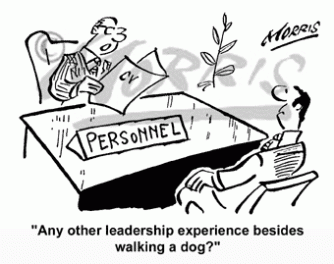
Cartoon – A Good Listener

I recently heard a great speaker in Atlanta named Clay Scroggins (Author, How to Lead When You’re Not in Charge). He made this point:
“Arrogant people don’t ask questions.”
I had to think about that. Test it against my experience. See if it was an exaggeration – or could it be so?
He went on to say….”they not only don’t ask you questions, they do not ask themselves questions either.”
Hmmm. Thinking over all the arrogant people I’ve ever met. List very long. May take a while to conclude.
(a minute passes)
Dang. I think it’s true!!!
Here are three easy ways to find out if a leader is arrogant…
THE TELL-ASK RATIO:
Count the number of things the leader came to TELL you, compared to the number of open-ended questions they ASKED you. Anything above a 3:1 ratio may indicate a problem (just a hunch).
A surrogate for this test would be – how long did they talk relative to how long they listened. Try this in your next project meeting with your supervisor.
THE DON’T ASK/DON’T KNOW SCAM:
If you think you are working for someone arrogant, take note of how many times they declare things to the organization that they do not actually know to be true.
THE KNOW ME/KNOW THEE TEST:
Ask the leader to share one of their most difficult experiences and what they learned from it. If they can’t think of one, well, you know what that means.
Another version of this test? Ask them to name your three children at the next company picnic. If they smile, nervous laugh, and walk away…
3 WAYS TO PRACTICE HUMILITY:
That’s humility. And it drives performance.
Serve well.
What are some signs that a leader is arrogant?
How might leaders practice humility?

People tend to choose urgent tasks they can complete quickly and put off important tasks that take longer to complete. (The Mere Urgency Effect)
Important tasks take longer and are more demanding than unimportant urgencies.
The Mere Urgency Effect:
You tend to delay important tasks by saying, “Just let me finish this and I’ll do that later.” But we all know that ‘later’ seldom comes.
The Mere Urgency Effect indicates …
We choose unimportant tasks with lower payoffs over important tasks with better payoffs.
We let artificial deadlines drive us to choose unimportant tasks.
You didn’t change the oil in your car because you had more urgent things to do. One day the car starts making scary noises. You neglected the important – scheduled maintenance. Now you have an urgency.
The same can be said for relationship building. You just don’t have time! But skillful leaders build and strengthen relationships before they need them.
In an age when running around with your hair on fire is desired and admired, important work gets pushed aside.
5 ways to choose important over urgent:
Put important work on your calendar. Expect important work to take longer than expected.*
Use values to guide decisions.
Establish short-term goals for long-term projects. Suppose you have an important task due at the end of the week.
Create effective urgency by setting a goal to be completed by 3:00 p.m. today. (Set short-term daily goals for important long-term work.)
Turn off social media. Check email at scheduled intervals. Turn off email alerts. (Yes, not everyone can do this.)
Bonus: Identify important work with your team or boss. Ask, “What’s important this week?” It helps to know what’s important if you plan to do what’s important.
How might leaders choose important over urgent?
How might leaders distinguish between important work and unimportant urgencies?

“Dare to reach into the darkness, to pull someone into the light. Remember strong people not only stand up for themselves, they stand up for others too.” – unknown

We’ve surveyed hundreds of leaders about their greatest leader, the most important natural behaviors beyond character and hard worker were Results and Relationships.
Where do you tilt on the results and relationships scale?
Check out this free infographic, and please tell others about it!


The courage to ‘not know’ may be the greatest leadership courage of all.
Mark Miller, the VP of High Performance Leadership at Chic-fil-A, told me that he would tell his younger self, “Stop trying to have all the answers.”
Not-knowing seems weak. Ego hides behind a facade of knowledge and competence.
Don’t pretend you know when you don’t. Most people know you’re faking it anyway.
Double benefit:
Humility enables leaders to not-know and makes space for others TO know.
Everyone waits for instructions from the all-knowing leader. Can you afford to have people waiting?
Courage to not-know instills boldness in others.
If you always know, they’ll stop offering suggestions.
Courage to not-know honors the skill and creativity of the people around the table.
Brave enough to seek advice:
Greg Dyke, Director of the BBC from 2000 to 2004 asked two questions when he took the helm of the struggling company.
Francesca Gino observes that new leaders often feel a need to have answers (Like Mark Miller) and explain THEIR vision. It might seem weak to ask questions before establishing your competence as a leader.
Gino’s research indicates the opposite, “… asking for advice increases rather than decreases how competent you are perceived to be.” (Rebel Talent)
Tip: The use of “could” is better than “should”. There’s more space to answer openly if you ask, “What’s one thing I COULD do to make things better for you?”
Action steps for today:
Where might leaders need to practice not-knowing a little more?
How might leaders not-know in a leaderly manner?


 HENRY KOTULA