


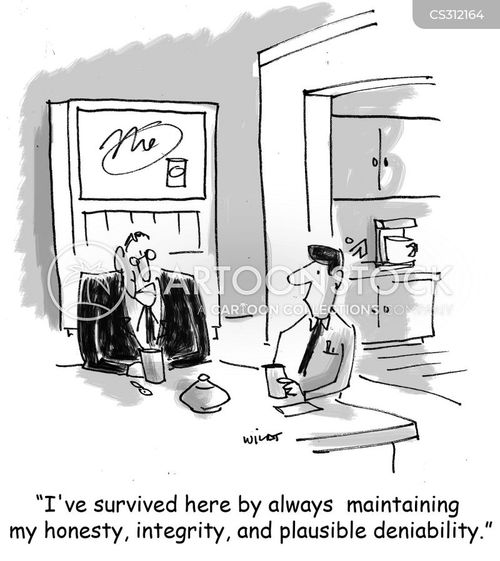
Cartoon- New Slogan on Our Company Mugs


It’s natural to think of yourself as the most important person in the world. You think your own thoughts. You have your own perspective. You seek your own enjoyment. You dream your own dreams.
The pain of realizing the world doesn’t revolve around you blocks the light from shining through.
Who is the most important person in your organization? I don’t know. But I know it isn’t you.
Deception:
The belief that you are the center of the universe is a great deception that prevents you from reaching your potential as a leader.
It’s a small universe if you are its center.
Would you want to play in a symphony where the musicians ignored each other and followed their inner voice? What happens when symphonies ignore each other and turn a blind eye to the conductor?
Symphony becomes cacophony when each member does their own thing.
You become bigger when you give yourself to something bigger than yourself.
Others make you matter:
In its simplest form, a leader is a person with followers. In other words, leadership REQUIRES others.
Without others, you aren’t a leader.
How you view others determines the nature of your leadership.
Enough ego:
You need enough ego to want to make a difference, but not so much that life is all about you. David Letterman’s service to Habitat for Humanity illustrates the point.
“When you help others, you feel better about yourself. ” David Letterman
The search to feel better about himself led him to serve others. That’s healthy ego. Unhealthy ego serves only itself.
Another center:
Barack Obama spoke the following words at Senator John McCain’s memorial service.
“By his own account, John was a rebellious young man. In his case, that’s understandable, what faster way to distinguish yourself when you’re the son and grandson of admirals than to mutiny. Eventually, though, he concluded that the only way to really make his mark on the world is to commit to something bigger than yourself.” (September 1, 2018.)
What does it mean to live for something bigger than yourself? It means you are no longer the center.
Your most frightening and fulfilling power is placing something other than yourself at the center of your life.
Leaders who live for themselves live small disappointing lives.
7 ‘bigger than yourself’ practices:
When leaders lives for something bigger than themselves, what are they like?
https://interimcfo.wordpress.com/2018/08/30/take-off-your-clothes/

Abstract: This article takes a look at the role of culture in organizational performance.
It has been a while since I have written for my blog. I’ve been a little busy on an engagement that has taken a lot of my time. One of the most challenging aspects of working with organizations in transition is dealing with culture. I have written a lot about culture in my blog and it continues to be one of the most vexing aspects of leadership and Interim Executive Consulting. The following story is true and it happened almost spontaneously. I now use this experience to make a point that people will remember about how they allow their cultural limitations to limit their capability.
I was listening to a group of managers debating the hospital’s preparedness for a regulatory survey. Concern was being expressed about the fact that there were multiple known deviations from standards. The longer I listened to this, the more frustrated I became. At the breaking point of my patience, I stood up and said, “OK, that’s enough.” “Everyone in the room, take off your clothes.” The shock and awe were palpable. People sat staring at me as they tried to comprehend what they had just heard. I said, “I’m serious. Everyone. Take off your clothes right now.” My audience was dumbfounded. I suspect some of them were wondering if the psychiatrist was in the building.
I said, “Let me ask you folks a question. If I continue to press this point, my prediction is that at least one of you will take the position that you will not take off your clothes. You will refuse to do this because you have modesty, morals, ethics, decency and or religious convictions upon which you will base your refusal.” My question was, “If you have standards that prevent you from taking your clothes off when all that is involved is a simple violation of modesty, how do you rationalize having knowledge of regulatory deficiencies in your areas of responsibility and not having done enough to resolve them when patient safety may be compromised?” Remember the movie, ‘A Few Good Men?’ Tom Cruise asked, “Can you explain this?”
And so, I had another head-on collision with entrenched dysfunctional culture. Several years ago, I had the privilege of doing work with Northside Hospital in Atlanta. Northside’s culture as it relates to regulatory compliance is very simple: Every department is expected to operate 100% compliant with applicable standards 100% of the time. As a result, a compliance survey is or should be a non-event at Northside. This is dramatically different from the culture in other hospitals I have worked in that go through episodes of horror when they are in the survey window and word comes that surveyors have been spotted in the next town. These hospitals have a culture that says it is OK to have a laissez-fair attitude and approach toward regulatory compliance until they think they might be surveyed. Then there is a mad rush to get into compliance.
I told the leadership team that the Board of Trustees had decided to commit the hospital to applicable accreditation standards. Therefore, the question as to whether or not managers are expected to follow regulations is off the table. Anyone that does not agree with this position of the Board should ‘punch the clock and get over the hill,’ as my dad would say. I went on to tell the group that in deciding to comply with regulatory standards, the Board had a reasonable right to expect that the standards were being followed on a continuous basis and not just when the hospital was in the survey window.
I told the group that I needed a volunteer, someone that could explain to the Board if the survey turned out as bad as they predicted, how the organization had developed a culture of tolerance of areas of non-compliance with so many standards. To my chagrin, I did not get a volunteer. I told the group that this depressed me so much that I was going to go to the store, buy a bottle of wine and drink the whole thing, I was then going to bring the bottle back to the next meeting and use it to play spin the bottle to determine who the spokesman from the group to the Board would be. I then exited the room.
Over the next couple of weeks, the leadership team of the organization responded admirably. There was no need to go back to the meeting to play spin the bottle. Every manager of every department went to work, around the clock in some cases to bring their areas into compliance with regulations. Sure enough, in less than two weeks, the surveyors showed up. The hospital had one of the best if not the best surveys in its history.
Was this result due to me making a speech? I don’t think so. All I did was challenge the hypocrisy of a dysfunctional culture that in some cases could potentially jeopardize patient safety. What changed was that a group of managers decided independently that they were no longer going to be associated with substandard compliance in their areas of responsibility. There is a one-liner that states that “You don’t have to move all of the cattle to change the direction of a herd. All you have to do is to change the direction of the lead steer.” Peer influence in an organization is extremely powerful. This is what led me to redefine my own understanding of the word ‘culture.’ Webster defines culture as the beliefs, customs, arts, etc., of a particular society, group, place, or time: a particular society that has its own beliefs, ways of life, art, etc.: a way of thinking, behaving, or working that exists in a place or organization. I define culture as the lowest level of excellence a group will accept as tolerable and normal. Groups in my experience do a very good job of enforcing the culture of the organization on their peers for better or worse. When a group decides to hold itself to a higher level of performance or rejects the mediocrity that has held it back, its performance improves measurably.
So, I conclude with questions for you. To what degree are you being limited by the culture that is surrounding you in your present situation? What are you doing to change the culture? Do you have the support you need to get the culture from where it is to where it needs to be?
Remember my challenge to take off your clothes. Give some thought to where you will draw the line when it comes to the level of mediocrity you will accept and tolerate.
Please feel free to contact me to discuss any questions or observations you might have about these blogs or interim executive services in general. As the only practicing Interim Executive that has done a dissertation on Interim Executive Services in healthcare in the U.S., I might have an idea or two that might be valuable to you. I can also help with career transitions or career planning.
The easiest way to keep abreast of this blog is to become a follower. You will be notified of all updates as they occur. To become a follower, just click the “Following” link or bubble that usually appears near the bottom of this web page.
There is a comment section at the bottom of each blog page. Please provide input and feedback that will help me to improve the quality of this work.
If you would like to discuss any of this content or ask questions, I may be reached at ras2@me.com. I look forward to engaging in productive discussion with anyone that is a practicing interim executive or a decision maker with experience engaging interim executives in healthcare.


John McCain died of brain cancer on August 25, 2018.
Newt Gingrich shared a surprising story about McCain.
Standing with:
Gingrich writes, “One of my most personal encounters with John was in 1986 when I was in a very intense fight with the House Democratic leadership. Two physically large House Democrats came over and said they were sick and tired of what I was doing and I ought to know there would be a payback. One of them said, ‘We are coming for you.’
I had not realized that McCain had calmly come over to stand next to me. When the Democrat sounded threatening, John instinctively stepped closer to me and said, ‘When you come for Newt, come for me too, the name’s McCain.’”
McCain was a first term congressman when this happened.
Theatrics:
You might be tempted to attribute McCain’s behavior to political theatrics. I heard people say that McCain understood and leveraged political theatrics. But when you know that he refused early release in the late 1960’s from the Hanoi Hilton to stand with his fellow POW’s, you realize that McCain knows how to stand with people.
Cost:
It costs a leader to stand with others. It’s so costly that some leaders hang team members out to dry when they screw up.
You probably know what it’s like to drive a stake in the ground beside a team member only to have him casually drive a stake in your back. It might have been ignorance on their part. It may have been malice, but the pain is the same.
Advantage:
There IS advantage to standing with others when it seems there’s only disadvantage. Frankly, that’s the time it matters most.
You earn trust when you stand with others.
How might you stand with others today?
https://www.leadershipnow.com/leadingblog/2018/08/engagement_isnt_built_its_unco.html

But over the years, depending on our upbringing, our schooling, and our work, our desire to engage gets suppressed. It gets covered up.
Our job as leaders is to uncover and rekindle that child-like desire to engage with others and our environment. We can’t create engagement, but we can uncover it.
I was reading a remarkable little book written for teachers by retired professor Calvin Luther Martin entitled, Successful College Teaching Begins with Throwing Away Your Lecture Notes. We can learn a lot here because teaching, like leading, is about serving others while achieving a result. Indeed, teaching is a function of leading.
We teach much more than our subject matter; we teach trust or distrust, courtesy or discourtesy, warmth or coldness—the lessons between the lines.
The people we lead are not coming to us from our perspective. They have their own that has been years on the making.
Bear in mind that you are teaching young men and women with an educational past that has shaped them.
We bring our whole selves to work. Our hope, our scars, our dreams, our fears, our expectations, and our assumptions. Our childhood sense of wonder has been abused. It’s there, but it is cautious. We are conditioned to want to be right more than we want to be accurate.
Behold the class before you. They are not blank slates, nor are they ignorant. There is plenty written on those slates and your task is to rewrite much of that text—if they will trust you and if your good enough to get that close to them. They sit before you, thoroughly trained (brainwashed might be a better word) in ways of pedagogy that will determine how they hear you, what they hear and cannot hear, and how they will absorb what you say.
We are not leading another version of us. We are leading a human being similar in form but different in substance.
These people come to you with layers of expectations that have been created starting in the first grade. Like an old kitchen countertop, they have been painted over and over. The oak, cherry, or maple cabinet beneath is smothered by an amour of paint. It’s a bland countertop now. The fine wood underneath is unknown; it’s merely a rigid structure useful for covering with paint and, after that, supporting pots and pans.
Thirty countertops, each covered with a dozen coats of paint, file into your room, take a seat, and open their spiral-bound notebooks. They’re ready for yet another coat of paint, Professor Martin. They know the drill; go ahead, start brushing it on.
The sorrow of this parable is that they expect it. They actually expect you to drone on, giving them fact after fact while they fill their notebook and worry about memorizing all this information.
Surprise them; don’t do it.
A leader has to peel off the old paint and get to that desire to engage that has been unwittingly covered over. We have to uncover the desire to engage. The desire to learn. The desire to connect.
The tendency is to be instructing. We do need to instruct but it needs to be part of a larger, coherent story that people can feel a part of.
We are wired to engage. It’s already within us. Our task as leaders is to uncover what is already there.
Martin explains that to teach or to lead “is to give a concert, to perform a beautiful, passionate concerto which everyone in the audience yearns to play, improvise on, and even improve.”
We don’t build engagement, we uncover it.
Uncover engagement in your organization

 HENRY KOTULA