Network adequacy standards

Network adequacy standards

Image result for Network adequacy standards

Like everything in health care, network adequacy is complicated, with numerous measures and differing regulations by program. This post offers a flavor and a bit of organization of that complexity, based on some of our recent reading.

Medicare Advantage

When is network adequacy assessed? CMS is only certain to assess a plan’s network upon application for a new contract or expansion of a contract’s service area. At its discretion, CMS may review networks at other times, for instance when a plan terminates a contract with a provider, when it changes ownership, or when there are network access complaints or plan-identified network deficiencies.

What types of entities are assessed for adequacy? There are different network adequacy standards for each of 27 practitioner specialty types (e.g., primary care, cardiology, urology) and 23 facility types (e.g., acute inpatient hospitals, outpatient dialysis, mammography).

Are all markets treated equivalently? No. CMS places each county into one of five categories: Large Metro, Metro, Micro, Rural, or CEAC (Counties with Extreme Access Considerations). Within each practitioner and facility type, there are different network adequacy standards by county type. These can change from year-to-year as well.

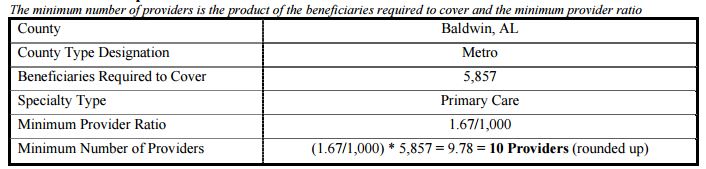
How is network adequacy measured? The gist is that each plan must contract with a specified number of providers of each type. Moreover, 90% of beneficiaries in the county must live within specified travel distance and travel time from at least one provider of each type. To calculate the minimum number of providers, each county receives a population of beneficiaries (termed “beneficiaries required to cover” in the table below) that is equal to the 95th percentile of penetration in all plans in its county type, multiplied by the total number of beneficiaries in the county. That’s a mouthful, but roughly speaking it means that CMS makes sure that each plan can serve a number of beneficiaries larger than it is ever likely to enroll.

This is rather abstract. How about a concrete example? Sure! The following tables should help. The first illustrates the calculation of the number of primary care providers a plan in Baldwin, AL must contract with (10) for 5,857 beneficiaries.

The next table shows that in Baldwin, AL, at least one primary care provider must be within 10 miles and 15 minutes of travel time for 90% of beneficiaries in the county. Additionally, a PCP who is not within the time and distance requirements of at least one beneficiary, will not count towards the minimum number of providers required. Moreover, because at least 90% of beneficiaries must be within the time and distance requirements, a plan may have to contract with more than the minimum number of providers required to meet these requirements.

Where can I learn more? Here are some potentially helpful links:

  • Most of the foregoing can be found in this CMS guidance document.
  • Additional details on how time and distance to providers are calculated can be found in this memo.
  • Here is the most recent file that specifies year-specialty-county type network adequacy regulations.

Marketplaces

The following is for federally facilitated marketplaces, but concludes with a comment about state facilitated ones.

When is network adequacy assessed? As best we can tell, network adequacy is assessed for each plan every year.

What types of entities are assessed for adequacy? CMS focuses on a subset of specialist areas and facility types that have been associated with network adequacy problems in the past: hospital systems, dental providers (if applicable), endocrinology, infectious disease, mental health, oncology, outpatient dialysis, primary care, and rheumatology. That other specialists and facility types are not necessarily scrutinized is one limitation of the approach.

Are all markets treated equivalently? No. CMS places each county into the same categories used for MA plans’ network adequacy: Large Metro, Metro, Micro, Rural, or CEAC (Counties with Extreme Access Considerations). Within each practitioner and facility type, there are different network adequacy standards by county type. Presumably, these can change from year-to-year as well.

How is network adequacy measured? The approach is similar to that for MA plans: 90% of enrollees must have access to at least one provider/facility type within specified travel distances and travel times. A key difference is that there does not appear to be a minimum number of each provider type every plan must contract with. It’s reasonable to hypothesize, therefore, that marketplace plans would have much more narrow networks than MA plans, but no direct comparison exists, to our knowledge.

What is a SNP?

http://bettermedicarealliance.org/snps?utm_source=rollcallheadlines&utm_medium=email&utm_campaign=newsletters

Image result for special needs plan


SNPs are a type of Medicare Advantage plan that are paid and regulated in the same way as other Medicare Advantage plans, but have the authority to provide specialized care to serve beneficiaries who are dually-eligible for Medicare and Medicaid, have certain chronic conditions, or receive long-term care in an institutional setting such as a Skilled Nursing Facility. In addition to providing all Medicare Part A and Part B benefits, SNPs must also exceed these core benefits by providing reduced cost sharing, individualized care plans, and other tailored benefits related to mental health, social services, and wellness.

Dynamics of Decline: The Truth About HMOs

http://www.chcf.org/articles/2016/11/dynamics-decline-truth-hmos

California Commercial HMO Enrollment, Kaiser Foundation Health Plan ("Kaiser") vs. Non-Kaiser, 2004-2015

California’s commercial health maintenance organization population shrank from 11.9 million to 9.8 million enrollees between 2004 and 2015 (see figure below), a 17.5% decline. But the decline has not been consistent across all HMOs — Kaiser’s commercial enrollment has actually grown during this period.

Two new publications from CHCF take a closer look at how commercial managed care enrollment (including individual enrollment) and the public sector’s embrace of managed care are shifting the way physician organizations are paid — important trends that could affect California’s delivery system.

The first report, As Commercial Capitation Sinks, Can California’s Physician Organizations Stay Afloat?, by Laura Tollen uses quantitative data and findings from stakeholder interviews to shed light on the extent to which commercial capitation is losing ground in California.

A companion set of charts and graphics compiled by Katherine Wilson provides additional detail on health plan enrollment and changes in HMO participation over the past decade.

It is important to look separately at Kaiser and non-Kaiser enrollment. Kaiser is characterized by a mutually exclusive relationship between the health plan (Kaiser Foundation Health Plan) and its two associated Permanente Medical Groups in Northern and Southern California. While Kaiser is by far the largest HMO in California, the health plan offers capitated contracts only to these two medical groups.

Kaiser HMO enrollment increased from 5.6 million to 6.1 million in the last decade, while commercial HMO enrollment for all non-Kaiser plans plummeted, from 6.3 million in 2004 to the current 3.6 million — a loss of more than 40%.

Uncertain Future

The impact of these trends on the state’s non-Permanente physician organizations is uncertain. While declining commercial capitation has not yet had a big effect on their operations, medical group leaders suspect it will soon, according to interviews. The change in commercial payment methods has been slow enough that their organizations have been able to adapt, repurposing some of their HMO-based infrastructure (utilization management tools, for example) for value-oriented payment programs that are FFS-based, such as private accountable care organizations (ACOs).

Among the other findings from the interviews were:

  • Declining capitation and rising fee-for-service will not influence individual physicians’ clinical decisions. All interviewees noted that their organizations’ strong culture of providing high-value care would prevent them from fundamentally changing the way they practice, regardless of payment type.
  • Despite commercial trends, capitation from Medicare Advantage and Medi-Cal managed care plans is on the rise. However, neither of these types of capitation is seen as a substitute for commercial capitation in terms of supporting infrastructure. While the perception is that Medicare Advantage capitation rates are generous, there is also recognition that these patients are costly. Interviewees said Medi-Cal capitation rates are inadequate.
  • Along with the decline in commercial capitation, interviewees expressed alarm at the large increases they observed in patient cost-sharing requirements. All said they fear that patients will not obtain the care recommended by their providers because of high out-of-pocket costs, and some said they already see this happen frequently.

Why This Matters

As more employers shift coverage from HMOs to preferred provider organizations (PPOs) and other non-capitated plans to achieve lower premium rates, they are sacrificing quality and financial protection for employees in exchange for short-term premium savings.

A recent CHCF blog post by Jeff Rideout of the Integrated Healthcare Association highlights the patterns of higher quality / lower cost that distinguish HMO plans in the state (compared to PPOs and other plan types). Large multispecialty physician organizations, which have flourished in California, have a long history and significant expertise in managing risk and coordinating care. These are the very skills that health care purchasers demand from value-based payment programs. Without sufficient infrastructure — which is supported by capitation/prepayment — the foundation of high-value care could crumble.

Given these trends, are employers being penny-wise but pound-foolish in pursuing short-term savings at the expense of longer-term value?


Whistleblowers: United Healthcare Hid Complaints About Medicare Advantage

http://www.healthleadersmedia.com/leadership/whistleblowers-united-healthcare-hid-complaints-about-medicare-advantage?spMailingID=11626431&spUserID=MTY3ODg4NTg1MzQ4S0&spJobID=1220355933&spReportId=MTIyMDM1NTkzMwS2#

Die Whistleblower


The suit, filed by United Healthcare sales agents accuses the giant insurer of keeping a “dual set of books” to hide serious complaints about its services

United Healthcare Services Inc., which runs the nation’s largest private Medicare Advantage insurance plan, concealed hundreds of complaints of enrollment fraud and other misconduct from federal officials as part of a scheme to collect bonus payments it didn’t deserve, a newly unsealed whistleblower lawsuit alleges.

The suit, filed by United Healthcare sales agents in Wisconsin, accuses the giant insurer of keeping a “dual set of books” to hide serious complaints about its services and of being “intentionally ineffective” at investigating misconduct by its sales staff. A federal judge unsealed the lawsuit, first filed in October 2016, on Tuesday.

The company knew of accusations that at least one sales agent forged signatures on enrollment forms and had been the subject of dozens of other misconduct complaints, according to the suit. In another case, a sales agent allegedly engaged in a “brazen kickback scheme” in which she promised iPads to people who agreed to sign up and stay with the health plan for six months, according to the suit.

Though it fired the female sales agent, United Healthcare concluded the kickback allegations against her were “inconclusive” and did not report the incident to the Centers for Medicare & Medicaid Services, according to the suit.

Asked for comment on the allegations in the suit, United Healthcare spokesman Matt Burns said: “We reject them.”

Medicare serves about 56 million people, both people with disabilities and those 65 and older. About 19 million have chosen to enroll in Medicare Advantage plans as an alternative to standard Medicare. United Healthcare is the nation’s biggest operator, covering about 3.6 million patients last year.

The whistleblowers accuse United Healthcare of hiding misconduct complaints from federal officials to avoid jeopardizing its high rankings on government quality scales. These rankings are used both as a marketing tool to entice members and as a way for the government to pay bonuses to high-quality plans.

Medicare paid United Healthcare $1.4 billion in bonuses in fiscal 2016 based upon their high quality ratings, compared with $564 million in 2015, according to the suit. CMS relies on the health plans to report problems and does not verify the accuracy of these reports before issuing any bonus payments.

The suit alleges the bonuses were “fraudulently obtained” because the company concealed the true extent of complaints. In March 2016, for instance, the company advised CMS only of 257 serious complaints, or about a third of the 771 actually logged, according to the suit.

The suit was filed by James Mlaker, of Milwaukee, a sales agent with the insurance plan in Wisconsin, and David Jurczyk, a resident of Waterford, Wis., a sales manager with the company.

The suit says Jurczyk had access to “dual” complaint databases, described as “the accurate one with a complete list of complaints and more details of the offenses and the fraudulent, truncated one provided to CMS.”

Jurczyk “has direct, personal knowledge of dozens of cases in Wisconsin alone in which customer complaints raising serious issues were routinely determined and falsely documented as either “inconclusive” or “unsubstantiated” by the company, according to the suit. Overall, about 84 percent of complaints alleging major infractions, such as forging signatures on enrollment forms, were determined to be inconclusive or unsubstantiated, according to the suit.

According to Mlaker, one sales agent faced little disciplinary action even after allegedly forging a customer’s signature on an enrollment form. The customer was “shocked” to learn that the agent had enrolled him because he had told the agent he was “not interested and did not want to enroll,” according to the complaint.

As a result, according to the suit, CMS officials never learned of these customer complaints.

The two men said that in early 2013 they began noticing that investigations of serious customer complaints that previously would have been completed “swiftly” instead “were drawn out; little actual inquiry was made, or even worse, known facts were ignored and discounted to falsify findings,” according to the suit.

Complaints also brought “much fewer and less serious corrective or disciplinary actions,” according to the suit. According to the suit, United Healthcare took steps to encourage any members with complaints to report them directly to the company rather than to complain to CMS.

The unsealing of the Wisconsin cases comes as United Healthcare and other Medicare Advantage plans are facing numerous cases brought under the Federal False Claims Act. At least a half-dozen of the whistleblower suits have surfaced since 2014.

The law allows private citizens to bring actions to recover damages on behalf of the federal government and retain a share. The Justice Department elected not to take over the Wisconsin case, which could limit the amount of money, if any, recovered. United Healthcare spokesman Burns said the company agreed with that decision.

In May, the Justice Department accused United Healthcare of overcharging the federal government by more than $1 billion by improperly jacking up risk scores over the course of a decade.

How GOP Will Still Carve Up Medicare

https://www.forbes.com/sites/johnwasik/2017/07/19/how-gop-will-still-carve-up-medicare/#48a9aa5943f1

Image result for assault on medicare

Now that the GOP’s plan for repealing and replacing Obamacare seems to be in a coma, the party has turned its attention to the 2018 federal budget.

Although specific spending details in the House committee mark-ups are still being hammered out, the GOP is back to its old script.

The GOP has a working blueprint to cut billions out of federal programs and balance the budget without tax increases. And, among other items, it still wants to privatize Medicare.

Speaker of the House Paul Ryan (R-WI). (Photo by Win McNamee/Getty Images)

Medicare covers more than 55 million Americans. Most of them are 65 or older and millions are permanently disabled. It’s the nation’s second-largest government-managed single-payer plan after Medicaid, which covers some 70 million.


While Medicare provides coverage for doctors and hospitals, it also covers prescription drugs if you pay an additional premium. You also have the option to buy into private policies through Medicare Advantage — if you don’t want the fee-for-service part of basic Medicare.

The rehashed House GOP budget blueprint wants to reshape Medicare into more of a Medicare Advantage model, which now covers some 19 million Americans.

What does that mean? Funding for the guaranteed part of Medicare would be shifted into the privatized scheme. You’d receive a fixed stipend or “premium support” to buy a private policy on an exchange.

Buying private plans on an exchange? Where have we heard that before? Oh yes, that was the model for the Affordable Care Act, or Obamacare, which the GOP has spent the last seven yearstrying to repeal. It’s been a staple of House Speaker Paul Ryan’s policy platform for years.

According to the House Budget Committee blueprint:

“The Medicare improvements envisioned in this budget resolution would adopt the popular simplified coverage structure of Medicare Advantage, and allow seniors greater plan choices while reducing costs.

It would resemble the private insurance market, in which the majority of Americans select a single health care plan to cover all their medical needs.”

In theory, having private insurers compete with the government to provide more coverage at a lower cost sounds like a good idea. But is it possible, given the government’s massive economies of scale?

Without generous subsidies, the prospect of insurers offering a better Medicare deal is like the corner grocer trying to compete with Wal-Mart. Moreover, using Medicare Advantage as a model is a horrible idea.

Medicare Advantage insurers have been embroiled in numerous billing scams, according to the non-partisan Center for Public Integrity. The Center, an independent watchdog, has published more than two dozen pieces on this ongoing morass. Here’s a summary of their findings:

“Congress created private Medicare Advantage health plans 11 years ago to help control health care spending on the elderly. But a Center for Public Integrity investigation found that billions of tax dollars are wasted every year through manipulation of a Medicare payment tool called a “risk score.”

The formula is supposed to pay health plans more for sicker patients and less for healthy people, but often it pays too much. The government has for years missed opportunities to corral tens of billions of dollars in overcharges and other billing errors tied to abuse of risk scores.

Meanwhile, the growing power of the Medicare Advantage industry has muzzled many critics in Congress, and turned others into cheerleaders for the program.”

Back to the main story: What House Speaker Paul Ryan and GOP congressional leaders are proposing is to tear down and remold basic Medicare into the troubled Medicare Advantage program, which would be like throwing kerosene on a house fire.

There’s even more of a muddle on how the GOP would calculate how much to give seniors for their yearly stipend to cover private premiums. What if policy costs go up double digits and the stipend doesn’t keep pace with the private market?

Would private insurers offer lower rates to healthier seniors and price less-healthy Americans out of the market? Although basic Medicare would still be available, wouldn’t the money diverted to premium support undermine funding for the traditional Medicare Hospital Trust Fund, which may be insolvent by 2029?

I think there’s a reason why there’s a billboard in Kenosha, Wisconsin — in the heart of Ryan’s Congressional District — that shows Ryan in a robber’s mask. There’s an attempted theft in progress, but older Americans and the disabled will be the victims.

1 in 3 People in Medicare is Now in Medicare Advantage, With Enrollment Still Concentrated Among a Handful of Insurers

Medicare Advantage 2017 Spotlight: Enrollment Market Update

Medicare Advantage plans have played an increasingly larger role in the Medicare program as the share of Medicare beneficiaries enrolled in Medicare Advantage has steadily climbed over the past decade.  The trend in enrollment growth is continuing in 2017, and has occurred despite reductions in payments to plans enacted by the Affordable Care Act of 2010 (ACA).  This Data Spotlight reviews national and state-level Medicare Advantage enrollment trends as of March 2017 and examines variations in enrollment by plan type and firm. It analyzes the most recent data on premiums, out-of-pocket limits, and quality ratings.  Key findings include:

  • Enrollment Growth. Since the ACA was passed in 2010, Medicare Advantage enrollment has grown 71 percent. As of 2017, one in three people with Medicare (33% or 19.0 million beneficiaries) is enrolled in a Medicare Advantage plan (Figure 1).


  • Market Concentration. UnitedHealthcare and Humana together account for 41 percent of enrollment in 2017; enrollment continues to be highly concentrated among a handful of firms, both nationally and in local markets. In 17 states, one company has more than half of all Medicare Advantage enrollment – an indicator that these markets may not be very competitive.


  • Medicare Advantage Penetration. At least 40 percent of Medicare beneficiaries are enrolled in Medicare private plans in six states: CA, FL, HI, MN, OR, and PA. In contrast, fewer than 20 percent of Medicare beneficiaries are enrolled in Medicare Advantage plans in 13 states, plus the District of Columbia.


  • Premiums and Cost-Sharing. While average Medicare Advantage premiums paid by MA-PD enrollees have been relatively stable for the past several years ($36 per month in 2017), enrollees may be liable for more of Medicare’s costs, with average out-of-pocket limits increasing 21 percent and average Part D drug deductibles increasing more than 9-fold since 2011; however, there was little change in out-of-pocket limits and Part D drug deductibles from 2016 to 2017.

Medicare Advantage enrollment is projected to continue to grow over the next decade, rising to 41 percent of all Medicare beneficiaries by 2027.1  As private plans take on an even larger presence in the Medicare program, it will be important to understand the implications for beneficiaries covered under Medicare Advantage plans and traditional Medicare, as well as for plans, health care providers and program spending.

Healthcare Triage News: The Advantages of Medicare Advantage

Healthcare Triage News: The Advantages of Medicare Advantage

Image result for Healthcare Triage News: The Advantages of Medicare Advantage

Many studies have demonstrated what economics theory tells us must be true: When consumers have to pay more for their prescriptions, they take fewer drugs. That can be a big problem. This is Healthcare Triage News.


Post-acute care: Medicare Advantage vs. Traditional Medicare

Post-acute care: Medicare Advantage vs. traditional Medicare

From a public spending point of view, post-acute care is particularly problematic. Most of Medicare’s geographic spending variation is due to this type of care. Part of the story is that Medicare pays for post-acute care in several different ways, with different implications for efficiency.

For example, traditional Medicare (TM) — which spends ten percent of its total on post-acute care — pays skilled nursing facilities per diem rates but inpatient rehabilitation facilities a single payment per discharge. Post-acute care is also available through Medicare Advantage (MA), which operates under a global, per-enrollee, payment. Unlike TM, MA plans establish networks, may require prior authorization for post-acute care, and can charge more in cost-sharing for post-acute care than TM does.

These different payment models offer different incentives that may affect who receives care, in what setting, and for how long. In Health Affairs, Peter Huckfeldt, José Escarce, Brendan Rabideau, Pinar Karaca-Mandic, and Neeraj Sood assessed some of the consequences of those incentives. Focusing on hospital discharges for lower extremity joint replacement, stroke, and heart failure patients between January 2011 and June 2013, they examined subsequent admissions to skilled nursing and inpatient rehabilitation facilities, comparing admission rates, lengths of stays, hospital readmission rates, time spent in the community, and mortality for MA and TM enrollees. To do so, they used CMS data on post-acute patient assessments for patients with discharges from hospitals that received disproportionate share or medical education payments from Medicare.

A Medicare Drug Incentive That Leads to Greater Hospitalizations

Many studies have demonstrated what economics theory tells us must be true: When consumers have to pay more for their prescriptions, they take fewer drugs. That can be a big problem.

For some conditions — diabetes and asthma, to name a few — certain drugs are necessary to avoid more costly care, like hospitalizations. This simple principle gives rise to a little-recognized problem with Medicare’s prescription drug benefit.

For sicker Medicare beneficiaries, the Harvard economist Amitabh Chandra and colleagues found, increased Medicare hospital spending exceeded any savings from reduced drug prescriptions and doctor’s visits. Consider patients who need a drug but skip it because they feel the co-payment is too high. This could increase hospitalizations and their costs, which would make them worse off than if they’d selected a higher-premium plan with a lower co-payment.

Though just a simplified example, this is analogous to what Medicare stand-alone prescription drug plans do. They achieve lower premiums by raising co-payments. This acts to discourage the use of drugs that would help protect against other, more disruptive and serious health care use, like hospitalization.

Studies show that insurers, many of which are for-profit companies after all, are using such incentives to dissuade high-cost patients from enrolling or using the benefit. There’s evidence this occurs for Medicare’s drug benefit, as well as in the Affordable Care Act’s marketplaces.

 The most popular type of Medicare drug coverage is through a stand-alone prescription drug plan. A stand-alone plan never has to pay for hospital or physician visits — those are covered by traditional Medicare. Another way to get drug benefits from Medicare is through a Medicare Advantage plan that also covers those other forms of health care and is subsidized by the government to do so.

Because of this difference, stand-alone drug plans are less invested than Medicare Advantage plans in keeping people healthy enough to avoid some hospital visits.

A study by the economists Kurt Lavetti, of Ohio State University, and Kosali Simon, of Indiana University, quantifies the cost. Compared with Medicare Advantage plans, stand-alone drug plans charge enrollees about 13 percent more in cost sharing for drugs that are highly likely to help patients avoid an adverse health event within two months. They charge up to 6 percent more for drugs that help avoid adverse health events within a year.

Of course, people have choices about plans. Those who have selected a stand-alone drug plan, as opposed to a Medicare Advantage plan, have done so voluntarily. Why do some make this choice?

One answer is that some people are not comfortable with the more narrow networks Medicare Advantage plans offer, with their fewer choices of doctors and hospitals. By choosing a stand-alone drug plan, they can remain in traditional Medicare, which has an open network.

In addition, consumers are generally more attracted to lower-premium plans than higher ones, even if the difference is exactly made up in co-payments. This may be because premiums are easier to understand than cost sharing. Moreover, premiums reflect a sure loss — you must pay the premium to remain in the plan. A higher co-payment, on the other hand, won’t necessarily lead to a loss because you may not use a service.

The appeal of lower premiums is an incentive for stand-alone drug plans to reduce them and increase co-payments. But that can dissuade those who need medications from filling prescriptions and taking them.

Part of the purpose of Medicare’s drug benefit is to encourage enrollees to take prescription drugs that can keep them out of the hospital. In July 2003, promoting the legislation that created Medicare’s drug benefit, President George W. Bush articulated this point. “Drug coverage under Medicare will allow seniors to replace more expensive surgeries and hospitalizations with less expensive prescription medicine,” he said.

But the design of Medicare’s drug benefit includes stand-alone plans that aren’t liable for hospital costs, so they don’t work as hard to avoid them. Encouraging more beneficiaries into comprehensive plans — through Medicare Advantage — or offering a drug plan as part of traditional Medicare itself would address this limitation.


Medicare Advantage risk selection

http://www.academyhealth.org/blog/2017-04/medicare-advantage-risk-selection

Mortality graph

One of the concerns about Medicare Advantage (MA) is that it doesn’t serve sick beneficiaries well, motivating some of them to switch to traditional Medicare (TM). If true, it’s an argument for maintaining affordable access to TM.

There’s considerable evidence that it is true. The most recent (if you can call last summer recent) is found in a paper by Elizabeth Goldberg and colleagues. They examined Medicare beneficiaries 65 years or older between 2000 and 2012, a period during which enrollment in MA grew from 19% of beneficiaries to 28%. For each year, they classified a beneficiary as “MA” if enrolled in an MA plan in January of that year, and “TM” otherwise. Note, however, that it wasn’t until 2006 that beneficiaries had to stick with their plan choice for most of the year (lock-in). Nowadays, they can adjust their plan choice only until mid-February. Prior to 2006, they could switch plans every month.

TM has no Part A (hospital insurance) premium and it’s standard Part B (physician services insurance) premium is 25 percent of program costs, or $134 per month in 2017. The premium is higher for individuals and couples with higher income. Both parts include considerable cost sharing and both have an open network and impose no managed care-type restrictions on utilization. Though MA plans tend to fill in much of Medicare’s cost sharing, as well as offer supplemental benefits at little to no additional premium, they usually have limited networks and attempt to manage care. It’s these latter features that can make TM more attractive than MA to sicker beneficiaries.

Older studies also found that sicker people tended to prefer traditional Medicare and were more likely to leave Medicare H.M.O.s. And other, more recent studies found that lower-income, less educated and sicker people reported worse experiences in Medicare Advantage than in traditional Medicare.

My takeaway from all this is that MA may promote efficiency and higher quality care, but it doesn’t serve some types of sicker beneficiaries as well as TM. They vote with their feet and leave MA when TM appears relatively more attractive. Though not without cost, this degree of choice — that spans both private and public options — is a strength of Medicare and a large benefit to its beneficiaries, while remaining the focus of intense political attention.