ANA CRITICIZES ‘CRIMINALIZATION OF MEDICAL ERRORS’ AS VANDERBILT NURSE ARRAIGNED

https://www.healthleadersmedia.com/nursing/ana-criticizes-criminalization-medical-errors-vanderbilt-nurse-arraigned?utm_source=silverpop&utm_medium=email&utm_campaign=ENL_190220_LDR_BRIEFING_resend%20(1)&spMailingID=15165362&spUserID=MTY3ODg4NjY1MzYzS0&spJobID=1581568052&spReportId=MTU4MTU2ODA1MgS2

The statement expresses support for handling medical errors with ‘a full and confidential peer review process.’


KEY TAKEAWAYS

The fatal error was made in December 2017, but it didn’t become public until November 2018, with a CMS report.

Vanderbilt was threatened with a loss of its Medicare status over the incident.

The nurse was indicted this month and scheduled for an arraignment Wednesday.

As a former nurse for Vanderbilt University Medical Center in Nashville, Tennessee, was scheduled to appear in court Wednesday morning for an arraignment on felony charges of reckless homicide and impaired adult abuse, the American Nurses Association raised concerns about the precedent the case could set.

Radonda Vaught administered a fatal dose of the wrong medication to a 75-year-old woman in late 2017, after overriding system safeguards, as The Tennessean’s Brett Kelman reported, citing an investigation report by the Centers for Medicare & Medicaid Services. That incident, which VUMC reportedly failed to convey to the medical examiner, prompted CMS to threaten VUMC’s Medicare status last November.

Vaught was indicted earlier this month, prompting the ANA to voice some concerns.

“Health care is highly complex and ever-changing resulting in a high risk and error-prone system,” the ANA said in a statement Tuesday. “However, the criminalization of medical errors could have a chilling effect on reporting and process improvement.”

Related: How DeKalb Medical Fixed Drug Safety Problems After Fatal Error

The statement, which specifically mentions Vaught’s case, expresses support for handling medical errors with “a full and confidential peer review process.”

The ANA also offered its condolences to the those who have suffered as a result of this error.

“This tragic incident should serve as reminder to all nurses, other health care professionals, and administrators that we must be constantly vigilant at the patient and system level,” the ANA added.


St. Louis hospital offers nurses summers off to retain staff

https://www.beckershospitalreview.com/compensation-issues/st-louis-hospital-offers-nurses-summers-off-to-retain-staff.html

Related image

The pediatric unit at Mercy Children’s Hospital in St. Louis will give nurses summers off work in an effort to retain staff, KMOV reports.

The nurses who choose the seasonal staffing option would still work full-time — three shifts per week for the pediatric unit’s nine-month busy season (September through May). The nurses can take off from June through August, while keeping full-time benefits, and return to their jobs in September.

“It’s exciting to see what the nurses, coming back to the unit after having three months off and doing whatever they want to do, the excitement they are going to have, the rejuvenation for their practice, maybe having a new spark, interest [or] excitement for nursing,” Justin Travis, the nurse manager for pediatrics at Mercy Children’s, told KMOV.

Seasonal staff will receive a stipend every two weeks to cover insurance costs. They also can use accrued paid time off to pay themselves during the summer and work extra hospital shifts as needed, Mr. Travis said.

The hospital is recruiting pediatric nurses for the positions. The contract year would begin in September, meaning the nurses’ first summer off would be next year.

Hospital officials said they may expand seasonal staffing options to other departments if it works in pediatrics


Experienced Bedside Nurses: An Endangered Species?

Experienced Bedside Nurses: An Endangered Species?

Image result for Experienced Bedside Nurses: An Endangered Species?

“The trend toward our hospitals being primarily populated with nurses with less than two years’ experience is worrisome.”

At least three colleagues who’ve recently been patients in hospitals or had family members who were have remarked on the youthful nurses they encountered—and on their lack of experience. In two of the conversations, my colleagues cited instances in which this lack of experience was detrimental to care, one of them dangerous. That “sixth sense,” that level of awareness that comes with lived experience and becomes part of expert clinical knowledge, is important for safe, quality patient care.

In the February editorial, I report on the answers I received when I queried our editorial board members about new nurses’ inclination to work in acute care for only two years to gain experience and then leave to pursue NP careers. Many of the board members have seen a similar trend, one reflected by research on nurse retention, some of it published in AJN (most recently, see Christine Kovner’s February 2014 study on the work patterns of newly licensed RNs, free until February 6).

As one board member noted:

“The narrative must be shifted to embrace the full range of roles and contributions of all nurses. Our health care system depends upon a well-trained, experienced workforce. The trend toward our hospitals being primarily populated with nurses with less than two years’ experience is worrisome.”

It’s a complex issue, and no one is faulting new RNs for the career paths they pursue. But as this trend accelerates, what can be done to ensure that there are enough experienced nurses at the bedside to protect patient safety? Let us know your thoughts.


10 things for healthcare executives to note as they head into 2018

https://www.beckershospitalreview.com/hospital-management-administration/2017-the-year-that-was-10-things-for-healthcare-executives-to-note-as-they-head-into-2018.html

Disruption got real. Hospital-insurer negotiations heated up. Activist shareholders shook up legacy hospital operators. Healthcare and the government failed to effectively communicate. These and six other trends that shaped the year in healthcare — and the lessons executives can take from them into 2018.

1. Disruption got real. After years of speculation about who or what would become the “Uber of healthcare,” the tectonic plates of the industry shifted substantially in the past year — and there’s reason to believe this will only continue in 2018. A number of mergers illustrate the blurring line between healthcare and other industries, such as retail and insurance. Consider the combinations of CVS and Aetna or Optum and DaVita and Surgical Care Affiliates. As for what’s to come, Apple and Amazon have both shown interest in expanding their healthcare footprint. In fact, just last month, we reported Amazon was in talks to move into the EHR space.

Executive’s takeaway: Executives grew skeptical of the term ‘disruptor’ when it was used as generously as it was circa 2011-2016. But now disruption is actually unfolding at a rapid clip, and executives are paying close attention to who/what poses the greatest threat to their business models.

2. Hospital-insurer negotiations heated up. Previously, a health system and a commercial insurer occasionally hit a snag in the contract negotiation process, resulting in a dispute palpable enough to consumers that it warranted headlines. These impasses generally lasted a matter of weeks before outside pressure drove the parties to compromise. The nature of these conflicts has since changed. This past year brought regular coverage of strained provider-payer talks. In fact, we now do a weekly compilation of payer-provider disputes and resolutions to stay abreast of these conflicts as they occur and subside. In 2017, we saw lawmakers intervene in payer-provider disputes, a health system executive’s meant-to-be-private email about an insurance company go public, and a children’s hospital go out of network with a commercial insurer — affecting 10,000 kids.

Executive’s takeaway: Health system executives are growing increasingly vocal with their thoughts about commercial insurers. In the past, executives took great lengths to observe discretion in these relationships. Now the gloves are off — or at least one is. We’re sure we haven’t seen the worst of a payer-provider dispute yet, but the number we see on a weekly basis, and their tone, indicates that disputes are both more frequent and more serious than in years past.

3. Investments in value-based care, once a somewhat safe bet, became debatable. In a final rule issued in November, CMS officially canceled the hip fracture and cardiac bundled payment programs and rolled back some mandatory requirements in the Comprehensive Care for Joint Replacement Model. This will continue to have a ripple effect on payers, providers and health system strategy. For hospitals and health systems that made significant investments to support excellence under the program, this news is difficult to take — especially since no investment is made lightly amid thin margins. Although CMS says it is still committed to value-based care as a concept, the mandatory nature of the bundles program acted as a pedal-to-the-metal force that made hospitals act. Since commercial payers follow Medicare, the fate of the program will likely influence the adoption of bundles among private insurers, too. 

Executive’s takeaway: Most all executives tell us they want to be on the leading edge, not bleeding edge, of value-based care. Without a “do it or lose it” approach to bundles, the industry lost a major impetus toward value-based care, in which many health systems and physicians would take the plunge together. Providers have never had a clearly paved path for their “journey toward value-based care.” At best, it was a dirt trail. Now it could be compared to a dirt trail covered in snow. This leaves executives questioning the value of their current and future investments in value-based care.

4. Big systems want bigger. Just when you thought you had a handle on what a “big” health system looked like in the United States, a few major players rewrote (or are attemping to rewrite) the playbook. After more than a year of talks, Catholic Health Initiatives and Dignity Health signed a definitive agreement in December to create a 139-hospital, $28.4 billion health system. Soon after came reports of St. Louis-based Ascension and Renton, Wash.-based Providence St. Joseph discussing a merger, which would result in a 191-hospital, $44.8 billion operation. Although both of these deals trail Oakland, Calif.-based Kaiser Permanente and its nearly $65 billion in revenue, they illustrate how the composition of nonprofit American health systems is continuing to change from local and regional entities to corporate national networks. For example, if Ascension and Providence combine, they will outsize the largest for-profit health system today — Nashville, Tenn.-based HCA Healthcare — which includes 177 hospitals in 20 states and Britain.

Executive’s takeaway: Executives may want to reevaluate the oft-spoken phrase “all healthcare is local” in light of 2017’s M&A activity. Hospitals will continue to serve as economic engines in their respective communities, but the organization of health systems is moving in a direction where they are viewed as ubiquitous brands as opposed to regional hubs for health. For example, San Francisco-based Dignity and Englewood, Colo.-based CHI are basing the corporate headquarters for their new enterprise in Chicago. Ascension and Providence would have footprints in 27 states if they merge.

5. Many health systems that were new players in the health plan business got out of it. Provider-sponsored health plans always carried a great amount of risk. Of the 37 health plans launched by hospitals and health systems since 2010, only four were found profitable in 2015, according to research published this past year by the Robert Wood Johnson Foundation. As major health insurers reduced their individual coverage options and rolled back from the public exchanges this year, we also saw several health systems decide to scale back or shut down their health plans. New Hyde Park, N.Y.-based Northwell Health shared plans in August to wind down its health insurance business, CareConnect, over the next year. Dayton, Ohio-based Premier Health is selling its health plan to Evolent Health, a Washington, D.C.-based value-based care platform. Louisville, Ky.-based Baptist Health plans to shut down its health plan operation in 2018. Late last year, Dallas-based Tenet Healthcare revealed plans to scale back its insurance business in 2017 after officials attributed lukewarm earnings to its health plan business.

Executive’s takeaway: When even the big five health insurers — so well-equipped with analytic tools, data, infrastructure, utilization management experience and risk analysis talent — have a difficult time accounting for risk, it is not surprising many green health systems made their move for the door this past year. This is not an opportune time for health systems with little experience managing risk to build or buy a health plan. 

6. Activist shareholders shook up legacy hospital operators. Board room issues within the major for-profit hospital operators are typically opaque, but 2017 brought a rash of investor-prompted activity that resulted in ousted CEOs, overhauled boards of directors, poison pills and new governance rules. Tenet Healthcare underwent significant change in 2017 under intense pressure from its largest shareholder, Glenview Capital Management. When two Tenet board members, both employed by Glenview, resigned over what they described as “irreconcilable differences,” they made it known that Glenview would possibly “evaluate other avenues” to be a constructive owner of Tenet on or after Sept. 1. By Aug. 31, Tenet announced it would replace CEO Trevor Fetter, “refresh” the composition of its board of directors and implement a short-term shareholder rights plan. Mr. Fetter resigned in October, before a successor was named, after 14 years with the system. In August, an investor in Franklin, Tenn.-based Community Health Systems called for the resignationof CEO Wayne Smith, who has led the 127-hospital system since 1997, over what the investor described as missteps in strategy resulting in financial trouble for the system. At this time, Mr. Smith still holds his job, but CHS may be bracing for more investor activity. Chinese billionaire Tianqiao Chen has gradually been ramping up his stock in the hospital operator since 2016. At time of publication, he holds nearly 23 percent of CHS stock. Finally, directors of HCA Healthcare made a change in late 2017 to allow established investors to participate in the board seat nomination process, a move made in response to an activist investor.

Executive’s takeaway: The fact that two of the largest U.S. for-profit hospital operators faced calls for CEO resignations in 2017 is part of a sweeping trend across industries in which activist investors start campaigns for change by targeting top management. Between January and May 2017, activist shareholders were responsible for ousting CEOs at three high-profile S&P 500 companies — American International Group, CSX and Arconic, according to The Wall Street Journal. Investors were attempting to oust six other CEOs in the same time frame. It’s worth noting that CEOs feel the heat at the launch of campaigns versus as a last resort. The WSJ characterized this trend as “a new level of aggressiveness for a group already known for its bold actions.” 

7. As the average health system C-suite grew, a few systems reduced administrative roles. While the number of practicing physicians in the U.S. grew 150 percent between 1975 and 2010, the number of healthcare administrators increased 3,200 percent in the same period. Yet in 2017, we saw a few major health systems go against the grain and not only lay off administrators, but eliminate their roles completely. In June, Houston-based MD Anderson Cancer Center eliminated executive vice president roles and gave senior vice presidents more focused areas of responsibility. Valley Medical Center, part of Seattle-based UW Medicine, got rid of the COO position in May, and Charleston, S.C.-based Roper St. Francis did the same in August. In December, San Diego-based Scripps Health shared plans to eliminate the CEO position in its four hospitals in favor of a regional CEO model. 

Executive’s takeaway: This past year contained several isolated incidents in which executive or administrative jobs were not immune from the financial pressures mounting on hospitals and health systems. There is reason to believe “right-sizing” (or at least reducing) administrative staffing at health systems will continue throughout 2018. Chris Van Gorder, president and CEO of Scripps Health, recently shared that layoffs at the system will likely include administrative and leadership roles while the system continues to hire caregivers. His reasoning, an excerpt of which follows, is applicable to many health systems today: “Healthcare is changing rapidly with huge growth in ambulatory care and reduced utilization of inpatient hospitals — and given the elimination of the individual mandate under the Affordable Care Act, the uninsured will once again be growing nationally. … We’ve got to shift our organizational structures around to be able to deal with the new world of healthcare delivery, find ways of lowering our costs significantly. If we don’t, we will not be able to compete.”

8. Healthcare and the government failed to effectively communicate. In 2017, the opportunities for the Trump administration, Congress and healthcare leaders to convene about healthcare legislation and policy came and went. CEOs from the five largest nonprofit health systems in the country took pen to paper, urging President Donald Trump and Congress to meet with them and exchange ideas. In the end, the closest thing we saw to healthcare reform in 2017 were bills — the American Health Care Act, Better Care Reconciliation Act of 2017 (or Skinny Repeal package), the Graham-Cassidy healthcare bill — that received significant opposition from major healthcare stakeholders, which are not historically liberal. Yet even an avalanche of nays from the American Medical Association, American Hospital Association, Federation of American Hospitals, American Psychiatric Association, Association of American Medical Colleges and several other groups did not sway Congress. All but three Republican Senators voted to pass the Skinny Repeal package, illustrating how the bipartisan nature of our political process is overriding expertise and informed lawmaking. 

Executive’s takeaway: A bipartisan approach is the most effective way when attempting to redesign a $3 trillion industry that influences life-or-death decisions. These efforts also require input from a variety of seasoned healthcare experts who can challenge ideas, anticipate repercussions and identify blind spots. This holds true no matter which party holds control of the White House, Congress or both. Although healthcare stakeholders and government officials did not productively connect in 2017, health system leaders must persist in their attempts to influence public policy and exercise greater creativity in their advocacy efforts. Strategies that worked in the past can no longer be counted on in 2018 and beyond. 

9. Fed up, nurses walked off the job. While nurses’ strikes are not a novel event, there is a reason many demanded wider attention and transcended local business news to become national headlines. The most noteworthy strike of the year took place July 12, when approximately 1,200 nurses at Boston-based Tufts Medical Center began a 24-hour strike — the first nursing strike Boston saw in 31 years. Roughly 120 miles from Boston, approximately 800 nurses at Berkshire Medical Center in Pittsfield, Mass., participated in a one-day strike in October. Across the country in California, nurses organized rallies and protests at more than 20 Kaiser Permanente sites to protest what they called inadequate staffing levels. In September, nurses and other hospital personnel unionized with SEIU walked off their jobs at Riverside University Health System – Medical Center in Moreno Valley, Calif., for three days. The county footed the $1.5 million bill for temporary replacement nurses for those 72 hours. Speaking of a bill, Minneapolis-based Allina Health tallied the costs of two 2016 strikes — one lasting six weeks — called by the Minnesota Nurses Association. The system put the figure in the ballpark of $149 million, which anchored Allina’s operating loss of $30 million for fiscal year 2016. 

Executive’s takeaway:  Although it is tempting to reduce labor strikes to events fueled by local market forces and politics, hospital and health system executives should pause and consider that striking nurses’ arguments — that they are expected to work demanding jobs with too few staff, resulting in unsafe conditions, high stress and burnout — is a description that applies to many, if not most, U.S. hospitals. Gender dynamics may also yield greater influence on administrator-nurse affairs in the coming year. As the nation comes to terms with troubling events that went unaddressed after women’s claims and voices were not met with the attention they deserved, health system executive teams are wise to change the approach taken in years past and pay closer attention to the female-dominated field of nursing. As one representative with the MNA told The Nation“[Management is] a male institution thinking they can snub 1,200 women and pretend their opinions about healthcare don’t count.”

10. The year healthcare became very, extremely, incredibly difficult. Was any component of healthcare ever easy? Those who have spent years in the industry would say no. Yet 2017 was the year in which officials and lawmakers reminded the American public that healthcare is complicated. While true, this narrative functioned as a sound bite to normalize Congressional dysfunction. 

Executive’s takeaway: What’s concerning here is whether this throwaway statement will make its way from Capitol Hill to hospital board rooms, executive offices, clinician lounges and medical school lecture halls and, over time, nurture a climate that fosters and condones inaction. It is unproductive to constantly point out the complicated nature of healthcare and/or bask in this acknowledgement. To do so is not the behavior of an effective leader. It goes without saying that healthcare is complicated. Healthcare is also necessary, expensive, life-saving, honorable, slow, inaccessible, urgent, flawed, and never going away. What are you doing to make it better? 

Nursing named most trusted profession for 16th consecutive year

https://www.beckershospitalreview.com/human-capital-and-risk/nursing-named-most-trusted-profession-for-16th-consecutive-year.html

Image result for 16 straight years most trusted profession

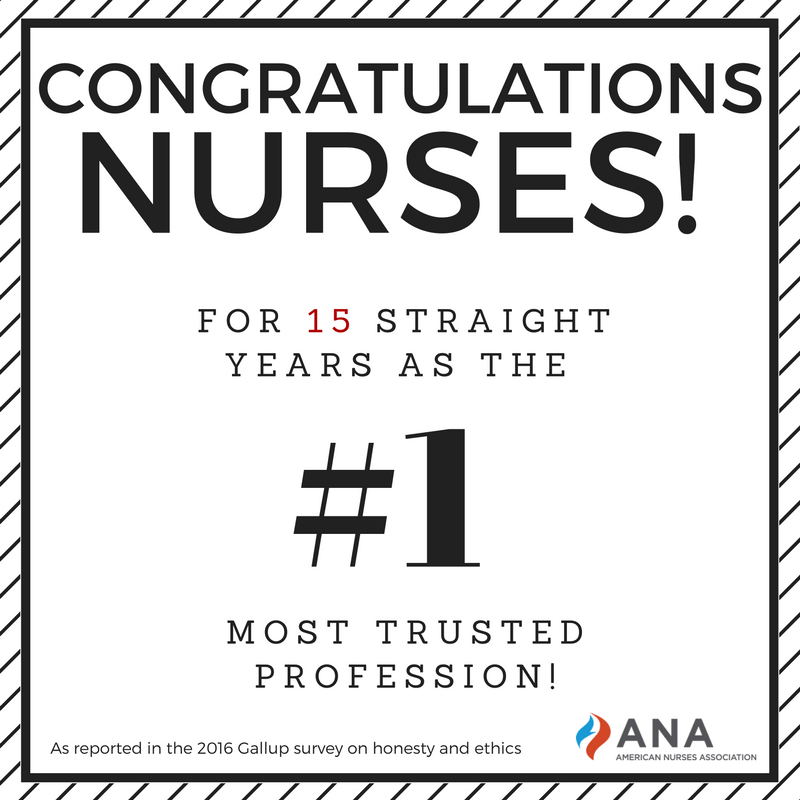
Nurses are the most trusted professionals in the United States, according to the 2017 edition of Gallup’s annual poll. The poll marks the 16th consecutive year nursing topped the list as the most honest and ethical profession.

For the 2017 poll, Gallup asked a random sample of 1,049 U.S. adults to rate honesty and ethical standards for 22 occupations. The respondents selected ratings of very high/high, very low/low or average.

Healthcare providers took three spots in the top five most trusted professions, with a high percentage of respondents rating their honesty and ethical standards as very high or high. They are listed below along with their rank:

  • Nurses (1) — 82 percent rated honesty and ethical standards very high or high
  • Medical doctors (4) — 65 percent
  • Pharmacists (5) — 62 percent

Since Gallup first included nurses in the survey in 1999, respondents have ranked the frontline providers as the most trusted profession in all but one year. In 2001, firefighters topped the list after Gallup included the profession in the poll in the wake of 9/11.

“Nurses provide much more than bedside care,” said Pamela Cipriano, PhD, RN, president of the American Nurses Association, in an emailed release. “We advocate for patients, deliver primary care, meet the complex needs of patients with chronic conditions, volunteer for disaster relief efforts, and are a trusted voice in boardrooms across the country.”


Podcast: Nurses to the Rescue!

Nurses to the Rescue!

Image result for Nurses to the Rescue!

They are the most-trusted profession in America (and with good reason). They are critical to patient outcomes (especially in primary care). Could the growing army of nurse practitioners be an answer to the doctor shortage? The data say yes but — big surprise — doctors’ associations say no.


Analysis: Nurse force to grow 36% by 2030, thanks to millennials

http://www.healthcaredive.com/news/analysis-nurse-force-to-grow-36-by-2030-thanks-to-millennials/506539/

Dive Brief:

  • Millennials are becoming registered nurses at nearly twice the rate of baby boomers, but that still won’t necessarily prevent a nursing shortage as boomers retire, a new analysis in Health Affairs concludes.
  • The number of younger RNs nearly doubled to 834,000 in 2015, after dropping to 440,000 in 2000 when Generation Xers were joining the workforce.
  • The number of millennials entering the space has leveled off recently, however, suggesting only modest growth over the next decade. Still, millennials will dominate the nurse workforce in the 2020s, the article says.

Dive Insight:

The average age of the nursing workforce in 2005 was 44, spurring widespread predictions of a nursing shortage as baby boomers retired from the field, according to the authors.

They attribute millennials’ embrace of nursing to several factors. The profession offers stable lifetime earnings and low unemployment as well as opportunities for advancement and relocation. And it can be parlayed in myriad ways across the healthcare industry.

“Considering the acceleration in retirement of the baby boomers and the stabilization of the entering cohort sizes among millennials, we expect the nurse workforce to grow 36%, to just over four million RNs, between 2015 and 2030, a rate of 1.3% annual per capita growth,” the authors write. “This is a rate of per capita growth similar to that observed from 1979 to 2000, but half the rate observed in the rapid-growth years of 2000-15.”

Whether that growth rate is enough to meet demand as baby boomer nurses retire is hard to gauge.

While nursing may be enjoying a surge in popularity, as professions go, retention is a growing problem. In a recent Medscape poll, about one in five nurses said they would not make the same career choice again. Nurses with more than 21 years in the profession were more likely to be dissatisfied than those who were new to the practice.

To retain nurses, hospitals need to provide opportunities for upward mobility and changing roles. They also need to address clinician burnout associated with increasing regulatory and administrative tasks. Allowing nurses to practice at the top of their licenses can also increase workplace satisfaction — not to mention helping address the problem of physician burnout.

How Florence Nightingale cleaned up ‘hell on earth’ hospitals and became an international hero

http://www.pbs.org/newshour/updates/florence-nightingale-cleaned-hell-earth-hospitals-became-international-hero/?utm_source=atlanticfacebook&utm_medium=social

British nurse Florence Nightingale (1820 - 1910) makes her rounds in the Barrack hospital at Scutari, during the Crimean War, 24th February 1855

In all of medical history, few names have been sung more brightly than Florence Nightingale, born on this day in 1820. Credited with founding the first modern, secular nursing school in 1860 (at St. Thomas’s Hospital in London, and currently part of King’s College, University of London), Florence’s birthday has been designated International Nursing Day.

Nicknamed “the Lady of the Lamp” by an intrepid journalist for the London Times, and subsequently immortalized by Henry Wadsworth Longfellow in his 1857 poem “Santa Filomena,” Florence Nightingale first came to prominence during the Crimean War.

Appalled by the primitive, filthy hospital facilities, Nightingale later wrote, “the British high command had succeeded in creating the nearest thing to hell on earth.”

In 1855, she organized and trained a group of nurses to help the soldiers injured during that conflict. Appalled by the primitive hospital facilities, the lack of beds, bandages, and bathing facilities, all wrapped into a decidedly filthy, vermin-ridden environment, Nightingale later wrote, “the British high command had succeeded in creating the nearest thing to hell on earth.” Initially, her nurses were not allowed to see the suffering soldiers and, instead, ordered to clean the hospital floors. As the casualties mounted and the physicians became overwhelmed, Nightingale’s nurses were finally enlisted to help.

READ MORE: Celebrating Rebecca Lee Crumpler, first African-American woman physician

Nightingale’s poetic moniker was the result of her late evening rounds visiting the wounded soldiers. When the war ended and she returned home to London, she was lauded as a national hero and showered with awards and medals including a jewel from Queen Victoria.
Nightingale’s 1859 book, “Notes on Nursing,” on the other hand, shed a far better light on the profession and soon became a standard textbook for training nurses around the globe.Ever busy with advancing the profession of nursing, Nightingale worked extraordinarily hard to counter the prevalent (and negative) view of nurses, such as that described by Charles Dickens in his 1842-1843 novel, “Martin Chuzzlewit.” One of the minor characters in this delightful tome is an incompetent, poorly trained and negligent nurse named Sarah Gamp. She is best recalled as an alcoholic, far more interested in her next glass of gin than the needs of her patients.

Florence was also consumed with advancing the causes of cleanliness in the hospital setting and beyond by using the newly developed mathematical methods of statistics to prove that such interventions made a difference.

Beginning with her war work, Nightingale noted that 10 times more soldiers died of the so-called filth diseases, such as cholera, dysentery, typhoid and typhus, than those who succumbed to bullets and cannon balls. She determined the cause to be related to the overcrowding of soldiers, paltry latrine and sewer facilities and, in an era when “poisonous miasmas” were still thought to the source of many infectious diseases, poor ventilation in the hospital wards. Indeed, her insistence on adequate ventilation led to a worldwide trend of building hospitals with large windows and cross-ventilation schemes, a design one can still see in the few 19th century hospital buildings that remain in various American and European cities.

READ MORE: How poet John Keats met his early end

Working with the pioneering British statistician William Farr and public health and urban poverty expert Edwin Chadwick, she compiled, analyzed and presented understandable and detailed information on the living conditions of England’s poorest citizens, as well as the living conditions, public health, and medical care of those living in India. Florence Nightingale pioneered in the graphical representation of the numbers she crunched. She was an early adopter of the “pie chart” and developed her own “rose diagram,” which is a circular histogram of data she called the “coxcomb” and used to describe seasonal changes in patient mortality, first in various military theaters and, subsequently, among Britain’s poor.

This work led to the passage of England’s Public Health Acts of 1874 and 1875, which required property owners to connect their sewage lines to main drain pipes, as a means of controlling the dumping of huge amounts of human waste onto city streets, and giving control of public health problems to local authorities who saw the unhealthy conditions first hand, rather than the previous system of granting those powers to centralized government officials in a faraway office. Both these reforms are credited with playing a vital role in extending the lifespan of British subjects (as well as citizens in other industrialized, western nations) by 20 years, between 1891 and the mid-1930s, when there were not yet the advantages of antibiotics, intravenous fluids or other modern medical conveniences.

If you want to know what is really going on with a patient, make sure you ask his or her nurse first.

A deeply religious woman, Florence was the advantaged child of a wealthy family. She managed to use those advantages, as well as surmount the disadvantages of being an ambitious, professional woman in Victorian England, to help the neediest and most vulnerable, both to the ravages of poverty and disease.

Today, on Florence Nightingale’s birthday and International Nurse’s Day (this year’s celebratory theme is “The Balance of Mind, Body and Spirit”), we celebrate her multitude of accomplishments and those of the legion of nurses who followed in her path and continue to make a huge difference in caring for the ill.

When reflecting on the life of this extraordinary woman, the doctor in me is forced to recall a lesson he learned the hard way as an intern: if you want to know what is really doing on with a patient, make sure you ask his or her nurse first.

Words of wisdom for new nurses

http://www.kevinmd.com/blog/2017/02/words-wisdom-new-nurses.html

Image result for Words of wisdom for new nurses

These are my words of wisdom. My rules. Maybe this will help you absorb the rhyme and rhythm of nursing.

1. Stay alert, take a 30-minute break, take yourself to the bathroom, decompress. 12 hours is a very long day.

2. Be kind and gentle to all, from the janitor to the CEO to the poverty stricken homeless person. Treat everyone as an equal. There is no elite; there is no VIP unless everyone is a VIP.

3. Always keep your cup half-empty. I always thought the nurse that thought she knew everything was the most dangerous nurse. Medicine, cures, procedures, diagnosis and treatments are always changing. So keep your mind open.

4. Stay far away from the “bully trap.” The lateral violence. It’s not worth it, and you can be a part of ruining a person’s self-worth. Forever. Stay far away. Stand up to the bully, fight them off. Report them. Protect your fellow nurse and nursing staff.

5. Know your facts about your patient before you call an MD, PA or NP. Write down your problems.

6. Do not ever apologize to an MD for calling him or her about a patient that you need new orders for or you need to report a new condition in the patient. That is their job to assist you. You are the protector, the teacher, the nurse of your patients.

7. Chose your battles wisely. Managers can be wonderful, but they also can be a slippery slope. Chose your friends wisely also. Deception sadly comes in sheep clothing.

8. The worst shift can be the most wonderful shift if you engage, empower and help your fellow team. It is beyond any retirement gold watch you’ll ever receive when you have a good crew to work with and to depend on.

9. Watch out for burnout. That is the wonders of being a nurse. To go from psychiatry, ER, maternity nursing to newborn ICU, trauma ICU or neuro ICU to peace corps or travel nurse, to getting your BSN, or masters degree or doctorate to become an NP or an anesthetist: The world of nursing is wide open.

My bottom line to you all:

  • Keep your chin up, decompress, take a vacation, follow your heart.
  • Be kind to each other.
  • Respect one another. The old nurse and the new nurse.
  • No question is ever dumb.
  • Questions are good and much safer than not questioning and therefore potentially making a grave mistake.
  • Empower each other.

We’re all in this together. This circle of life. From birth to dying with dignity.

Focus, love, and empower.